


Why Cloud Computing DevOps Matters for Modern Businesses
Cloud computing DevOps represents the powerful intersection where scalable, on-demand cloud infrastructure meets the collaborative, automated practices of DevOps methodology. Here’s what you need to know:
The Core Relationship:
- Cloud Computing provides the flexible, scalable infrastructure (servers, storage, networking) delivered over the internet
- DevOps is the cultural and technical practice that unifies development and operations teams to deliver software faster
- Together, they enable organizations to build, test, and deploy applications with unprecedented speed and reliability
Key Benefits:
- 81% performance increase for companies using both cloud and DevOps together
- Faster time-to-market through automated CI/CD pipelines
- Cost efficiency via pay-as-you-go models and dynamic scaling
- Improved collaboration by breaking down silos between teams
- Improved resilience with cloud redundancy and automated recovery
Today’s businesses face constant pressure to innovate quickly while managing complex IT systems and security threats. The combination of cloud infrastructure and DevOps practices addresses this challenge by removing barriers to rapid, reliable software delivery.
The cloud democratized access to enterprise-grade infrastructure—no more waiting weeks for physical servers or dealing with capacity constraints. DevOps emerged to bridge the gap between developers who want to ship features fast and operations teams who need stability and security. When you bring these two together, you get a framework that allows teams to deploy updates safely and frequently, scale resources instantly, and respond to market changes in days instead of months.
Why This Matters for Your Business:
Traditional IT approaches create bottlenecks. Manual processes slow down deployment. Siloed teams lead to miscommunication. Static infrastructure can’t handle traffic spikes. Cloud computing DevOps solves these problems by providing the tools, practices, and infrastructure to automate workflows, enable collaboration, and scale on demand.
I’m Reade Taylor, Founder and CEO of Cyber Command, and I’ve spent years helping businesses transform their technology operations through secure, scalable cloud infrastructure and modern DevOps practices. Throughout my career—from building enterprise security systems at IBM to founding Cyber Command—I’ve witnessed how cloud computing DevOps accelerates digital change while reducing operational headaches.
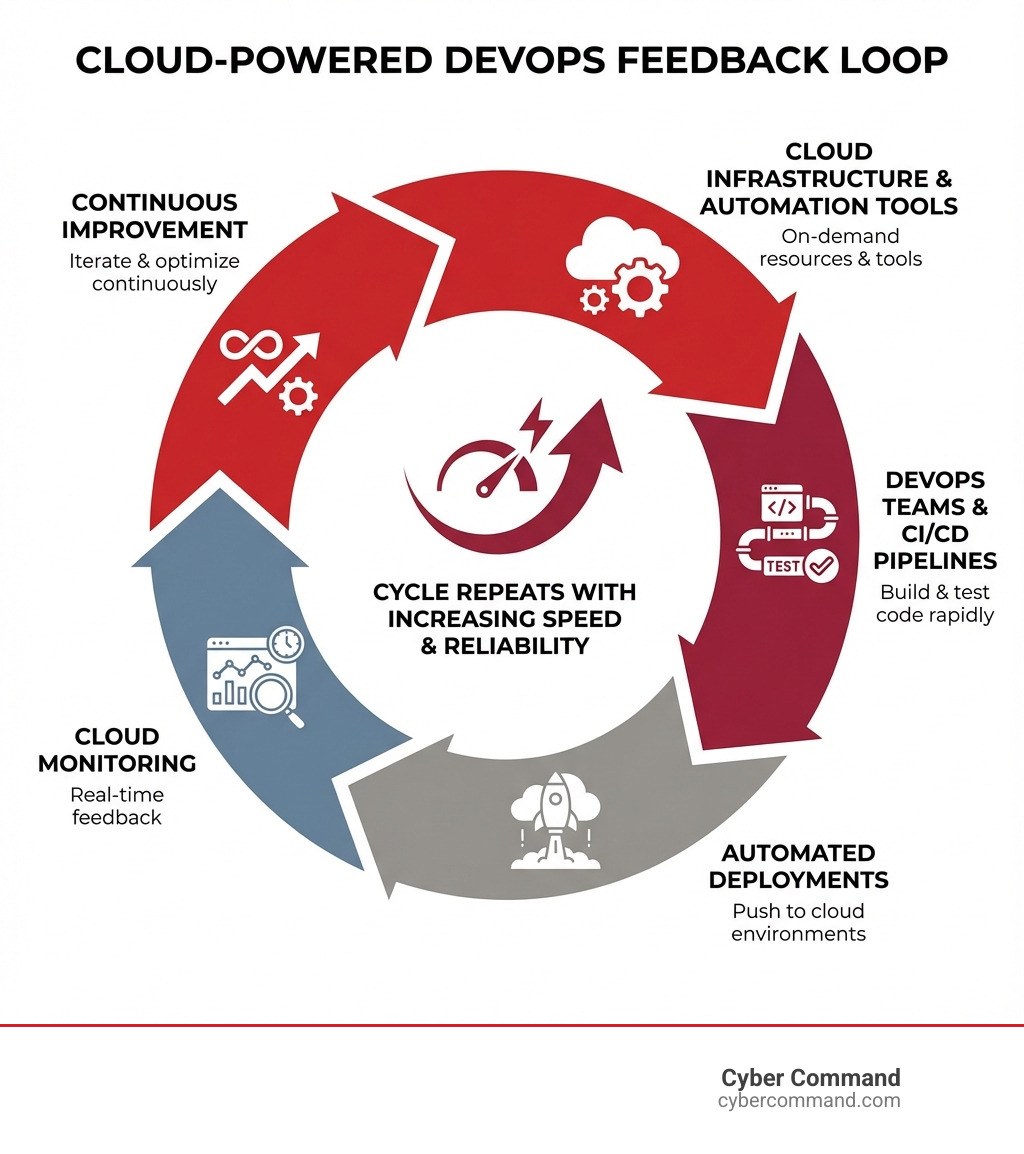

The Symbiotic Relationship: How Cloud Computing Enables DevOps
The partnership between cloud computing and DevOps is truly a match made in digital heaven. Cloud computing provides the powerful, flexible foundation, while DevOps offers the methodologies and culture to leverage that foundation to its fullest. This synergy is what allows organizations to achieve unparalleled agility, speed, and reliability in their software delivery.
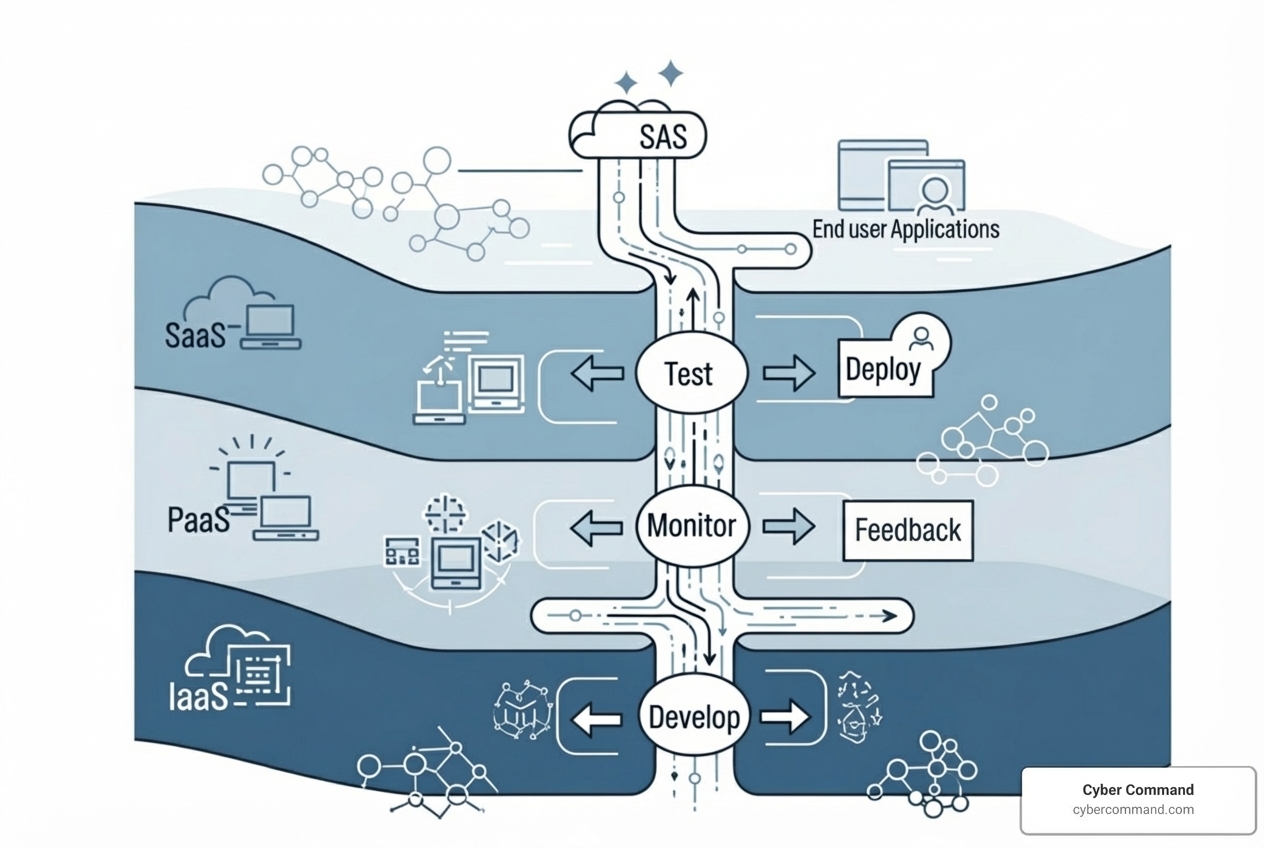

Cloud computing offers on-demand access to a vast array of IT resources, from virtual servers and storage (Infrastructure-as-a-Service, or IaaS) to complete development environments (Platform-as-a-Service, or PaaS) and ready-to-use applications (Software-as-a-Service, or SaaS). This fundamental capability fundamentally changes how we approach software development and operations. Instead of waiting for hardware procurement, we can instantly provision resources. Instead of managing complex infrastructure, we can leverage managed services. This elasticity, combined with a pay-as-you-go model, makes the cloud the perfect playground for cloud computing DevOps.
How the Cloud Acts as a Catalyst for DevOps Practices
The cloud doesn’t just host our applications; it actively enables and improves every aspect of DevOps.
- Infrastructure as Code (IaC): One of the most transformative aspects is the ability to define and manage infrastructure programmatically using code. Infrastructure as Code (IaC) allows us to treat our servers, networks, and databases like application code – versioning them, testing them, and deploying them automatically. Cloud providers offer robust APIs and services like AWS CloudFormation, Azure Resource Manager, and Google Cloud Deployment Manager that make IaC a reality. This ensures consistency, reduces human error, and speeds up environment provisioning.
- On-Demand Environments: Need a staging environment for a new feature? Spin it up in minutes. Need to test a patch on a replica of your production system? Clone it instantly. The cloud’s on-demand nature means we can create and tear down environments as needed, fostering rapid experimentation and reducing resource waste.
- CI/CD Pipeline Support: Cloud platforms are built to support continuous integration and continuous delivery (CI/CD) pipelines. They offer managed services for source control, build automation, artifact management, and deployment. This means we can automate the entire software release process, from code commit to production deployment, with high confidence and minimal manual intervention. Cloud Automation is a cornerstone of this efficiency.
- Global Availability: Cloud providers offer data centers across the globe, allowing us to deploy applications closer to our users, improving performance, and enabling disaster recovery strategies. This global reach, combined with cloud load balancing and content delivery networks (CDNs), is invaluable for modern applications.
Core DevOps Principles in a Cloud Environment
The core principles of DevOps—collaboration, automation, continuous delivery, and monitoring—are amplified and made more accessible in a cloud environment.
- Collaboration and Shared Responsibility: The cloud naturally fosters collaboration by providing a shared platform accessible to all teams. It encourages a culture where developers and operations teams work together, breaking down traditional silos. With cloud services, both teams have visibility and shared responsibility over the infrastructure and applications. For insights into how this differs from other approaches, check out Bridging the Gap: My Take on DevOps vs. Platform Engineering.
- Continuous Integration (CI): Developers frequently merge code changes into a central repository, followed by automated builds and tests. Cloud-based source control (like GitHub or AWS CodeCommit) and build services (like Azure Pipelines or Google Cloud Build) make this seamless, allowing us to catch integration issues early.
- Continuous Delivery (CD): Once integrated, code changes are automatically built, tested, and prepared for release to production. Cloud-based CI/CD tools automate the deployment process to various environments, ensuring that reliable software is always ready for release.
- Automation is King: From provisioning infrastructure with IaC to automating testing, deployment, and even scaling, the cloud provides the APIs and services necessary to automate virtually everything. This minimizes manual effort, reduces errors, and frees up valuable engineering time.
- Monitoring and Feedback: Cloud platforms offer comprehensive monitoring and logging services that provide real-time insights into application and infrastructure performance. This continuous feedback loop is vital for quickly identifying and resolving issues, optimizing performance, and making data-driven decisions.
The Business Impact: Key Benefits of a Cloud DevOps Approach
The fusion of cloud computing and DevOps isn’t just about technical elegance; it delivers tangible business benefits that drive competitive advantage.
- Faster Time-to-Market: By automating CI/CD pipelines and leveraging on-demand cloud resources, we can significantly reduce the time it takes to move an idea from conception to production. This agility allows us to respond rapidly to market changes and customer feedback, deploying new features or bug fixes frequently. Vodafone, for example, reported a 100x increase in software releases per month using Azure DevOps, leading to a 4x increase in developer productivity.
- Cost Efficiency: The cloud’s pay-as-you-go model, combined with dynamic scaling capabilities, means we only pay for the resources we consume. DevOps practices help optimize resource usage by automating environment provisioning and de-provisioning. This can lead to substantial cost savings, as we avoid over-provisioning and capital expenditure on hardware. For more on managing cloud expenses, see Benefits of Moving to the Cloud.
- Improved Collaboration: DevOps inherently promotes communication and collaboration between development and operations teams. Cloud platforms provide shared tools and environments that break down silos, fostering a unified approach to software delivery.
- Improved Resilience: Cloud environments offer built-in redundancy, backup, and disaster recovery capabilities. When combined with DevOps practices like automated testing, blue/green deployments, and immutable infrastructure, we can build highly resilient systems that minimize downtime and ensure business continuity. Organizations can explore solutions like Disaster Recovery as a Service (DRaaS) to improve their resilience further.
- Increased Innovation: With faster release cycles and reduced operational overhead, teams are free to experiment more, innovate faster, and focus on delivering value to customers. The statistics speak for themselves: companies using both DevOps and Cloud saw an impressive 81% increase in performance.
The Core of Modern Delivery: Key Stages and Best Practices in Cloud Computing DevOps
At the heart of successful cloud computing DevOps lies a well-defined lifecycle, continuously iterating and improving. This “infinity loop” integrates cloud services at every stage, ensuring efficiency, speed, and reliability.
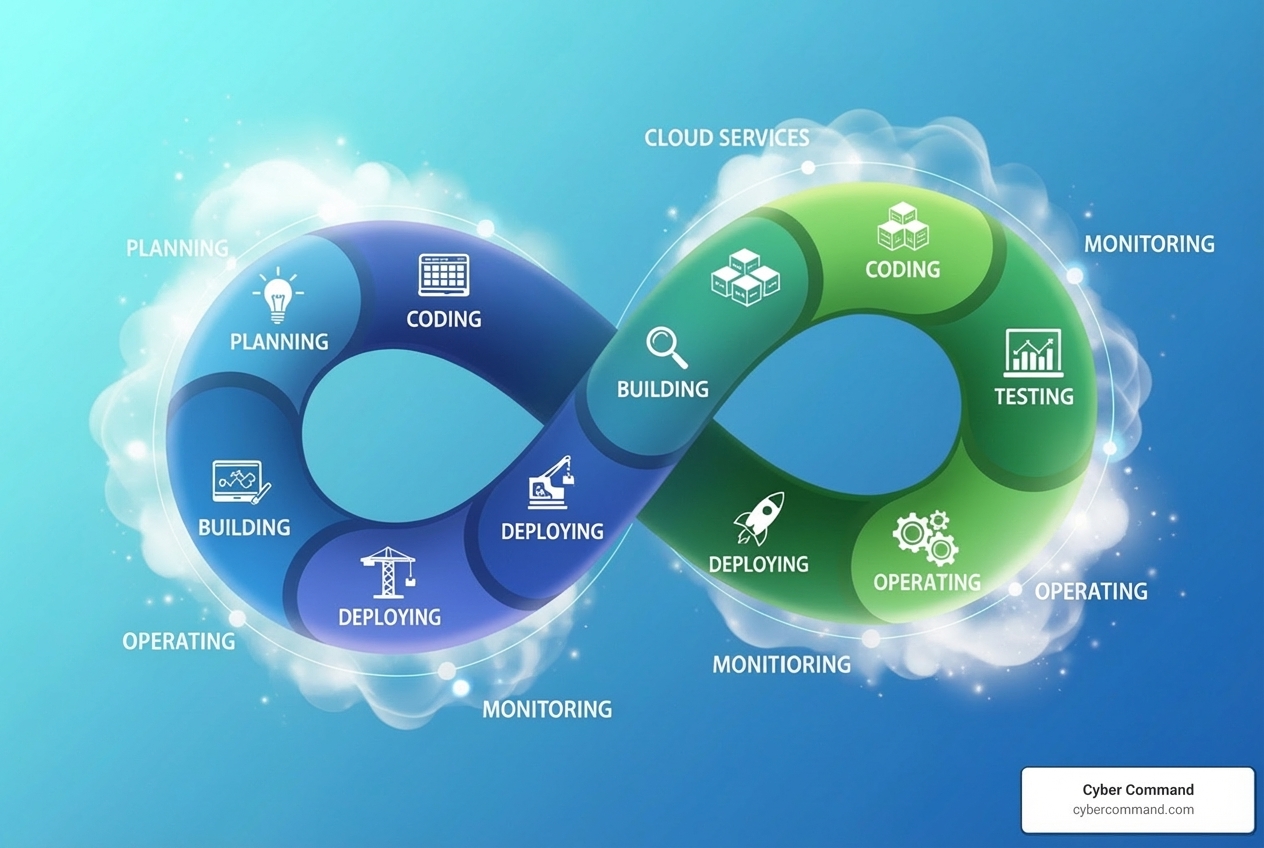
The cloud empowers us to implement robust CI/CD pipelines, automate repetitive tasks, and accept rapid iteration, all of which are crucial for modern software delivery.
The DevOps Lifecycle on the Cloud
Let’s walk through the key stages of the DevOps lifecycle and see how cloud platforms transform each one:
- Plan: This initial stage involves gathering requirements, defining features, and planning sprints. Cloud-based agile planning tools (like Azure Boards or Jira on AWS) provide collaborative platforms for teams, regardless of their physical location in Florida or Texas.
- Code: Developers write code and commit it to version control systems. Cloud providers offer managed Git repositories (like AWS CodeCommit, Azure Repos, Google Cloud Source Repositories) that integrate seamlessly with other services. Cloud IDEs (like AWS Cloud9) allow developers to code directly in the cloud.
- Build: Code is compiled, dependencies are resolved, and artifacts are created. Cloud build services (AWS CodeBuild, Azure Pipelines, Google Cloud Build) offer scalable, on-demand compute for rapid compilation and packaging, often supporting multiple languages and platforms.
- Test: Automated tests (unit, integration, end-to-end) are run to ensure code quality. Cloud platforms provide scalable environments for automated testing, allowing for parallel execution and faster feedback. Tools like BrowserStack integrate with CI/CD pipelines to offer automated cross-browser testing on a grid of 3500+ real devices and browsers, drastically cutting down testing time.
- Release: The validated code artifact is prepared for deployment. Cloud artifact repositories (AWS CodeArtifact, Azure Artifacts, Google Artifact Registry) securely store and manage package versions, making them readily available for deployment.
- Deploy: The application is deployed to various environments (staging, production). Cloud deployment services (AWS CodeDeploy, Azure Pipelines, Google Cloud Deploy) automate this process, supporting various deployment strategies like blue/green or canary releases to minimize risk.
- Operate: The application runs in the production environment. We leverage cloud services for compute (EC2, Azure VMs, Google Compute Engine), serverless functions (Lambda, Azure Functions, Cloud Functions), and container orchestration (EKS, AKS, GKE), all managed and provisioned via IaC.
- Monitor: Application and infrastructure performance are continuously monitored. Cloud-native monitoring and logging tools (Amazon CloudWatch, Azure Monitor, Google Cloud Monitoring) provide unified observability, enabling real-time alerts, performance tracking, and debugging. For securing these pipelines, consider Cloud-based CI/CD pipelines.
Best Practices for Successful Implementation
Adopting cloud computing DevOps isn’t just about tools; it’s about a strategic shift in how we approach software delivery. Here are some best practices we champion:
- Start Small, Iterate Fast: Don’t try to transform everything at once. Pick a small project, automate a single CI/CD pipeline, and learn from the experience. Continuous improvement is key.
- Automate Everything: Manual steps are prone to error and slow down delivery. Leverage the cloud’s automation capabilities for infrastructure provisioning, testing, deployment, and even recovery.
- Adopt Infrastructure as Code (IaC): Treat your infrastructure like code. Use tools like Terraform, CloudFormation, or ARM templates to define and manage your cloud resources. This ensures repeatability, consistency, and version control.
- Implement Robust Monitoring and Logging: Visibility is crucial. Use cloud-native tools to collect metrics, logs, and traces. Set up alerts to proactively identify issues and establish a continuous feedback loop. Check out how Proactive IT Management integrates this approach.
- Foster a Collaborative Culture: DevOps is fundamentally a cultural shift. Encourage open communication, shared responsibility, and cross-functional teamwork between development and operations teams.
- Design for the Cloud: Take advantage of cloud-native services. Don’t just lift-and-shift traditional applications. Re-architect where appropriate to leverage managed services, serverless, and containerization. Review your architecture against frameworks like the AWS Well-Architected Framework for optimal design.
Integrating Security: The Rise of DevSecOps
In a world of increasing cyber threats, security cannot be an afterthought. This brings us to DevSecOps, which integrates security practices throughout the entire cloud computing DevOps lifecycle, rather than treating it as a final gate.
- Shift-Left Security: The core idea is to “shift left,” meaning security considerations and testing happen as early as possible in the development process. This includes threat modeling during planning, secure coding practices, and automated security checks in the CI/CD pipeline.
- Automated Security Testing: Integrate tools for Static Application Security Testing (SAST), Dynamic Application Security Testing (DAST), and Software Composition Analysis (SCA) directly into your pipelines. These tools automatically scan code, running applications, and dependencies for vulnerabilities.
- Vulnerability Scanning: Regularly scan container images, cloud configurations, and deployed applications for known vulnerabilities. Cloud platforms offer services that facilitate this, like GitHub Advanced Security for Azure DevOps.
- Compliance as Code: Define compliance requirements as code and integrate automated checks into your pipelines. This ensures that your cloud infrastructure and applications continuously adhere to regulatory standards.
- Shared Responsibility Model: In the cloud, security is a shared responsibility. While cloud providers secure the underlying infrastructure (“security of the cloud”), we are responsible for securing our applications, data, and configurations (“security in the cloud”). Understanding this distinction is vital. We also offer comprehensive Cybersecurity services to help manage this shared responsibility effectively. Aligning with frameworks like the NIST Cybersecurity Framework can provide a structured approach to managing these risks.
Essential Tools for Cloud Computing DevOps on Major Platforms
Major cloud providers offer a rich ecosystem of services custom for cloud computing DevOps. Here’s a snapshot of some key offerings:
| Category | AWS (Amazon Web Services) | Azure (Microsoft Azure) | Google Cloud (Google Cloud Platform) | Open-Source & Cross-Platform Tools |
|---|---|---|---|---|
| Source Control | CodeCommit, GitHub | Azure Repos, GitHub | Cloud Source Repositories, GitHub | Git (GitHub, GitLab, Bitbucket) |
| CI/CD Orchestration | CodePipeline | Azure Pipelines | Cloud Build, Cloud Deploy | Jenkins, GitLab CI/CD, CircleCI |
| Build Services | CodeBuild | Azure Pipelines | Cloud Build | Jenkins, GitLab Runner, Docker Build |
| Artifact Management | CodeArtifact | Azure Artifacts | Artifact Registry | Nexus, Artifactory |
| Deployment | CodeDeploy, ECS/EKS, Lambda | Azure DevOps, Azure Kubernetes Service (AKS), Azure Functions | Cloud Deploy, Google Kubernetes Engine (GKE), Cloud Functions | Kubernetes, Helm, Ansible |
| Infrastructure as Code | CloudFormation, CDK, Terraform | Azure Resource Manager (ARM) Templates, Bicep, Terraform | Cloud Deployment Manager, Terraform | Terraform, Ansible, Pulumi |
| Monitoring & Logging | CloudWatch, X-Ray, Prometheus, Grafana, DevOps Guru | Azure Monitor, Application Insights, Log Analytics, Azure Sentinel | Cloud Monitoring, Cloud Logging, Cloud Trace, Cloud Operations Suite | Prometheus, Grafana, ELK Stack (Elasticsearch, Logstash, Kibana), OpenTelemetry |
| Container Orchestration | ECS (Fargate), EKS (Kubernetes) | AKS (Kubernetes), Azure Container Apps | GKE (Kubernetes) | Kubernetes, Docker Swarm |
| Security | IAM, Security Hub, GuardDuty, WAF, Secrets Manager, GitHub Advanced Security | Azure Security Center, Azure Key Vault, Azure Firewall, GitHub Advanced Security | Security Command Center, Secret Manager, Cloud Armor | HashiCorp Vault, Open Policy Agent (OPA), Aqua Security, Snyk |
Microsoft was ranked highest in both the current offering and strategy categories in the 2025 Forrester Wave™ DevOps Platforms report, highlighting the strength of its Azure DevOps and GitHub integrations.
Advanced Strategies and Future Frontiers
As the cloud and DevOps continue to evolve, so do the strategies we employ to maximize their potential. Embracing advanced approaches and keeping an eye on emerging trends is crucial for staying competitive, especially for businesses in dynamic regions like Central Florida and Texas.
Cloud-native architecture forms the backbone of these advanced strategies, coupled with the intelligence of AI and the agility of serverless computing.
Leveraging Cloud-Native Principles for a Competitive Edge
Cloud-native computing is an approach that uses cloud computing to “build and run scalable applications in modern, dynamic environments such as public, private, and hybrid clouds.” It’s about designing applications specifically for the cloud’s unique characteristics.
- Microservices: Instead of monolithic applications, cloud-native systems break down applications into small, independent services. Each microservice performs a single function, can be developed and deployed independently, and communicates via APIs. This improves agility and resilience.
- Containers (Docker, Kubernetes): Containers package applications and all their dependencies into isolated, portable units. Docker is a popular containerization platform, and Kubernetes is the leading orchestration system for managing and scaling these containers across clusters. This ensures consistent environments from development to production.
- Immutable Infrastructure: Instead of updating existing servers, immutable infrastructure means that every change results in a new server being provisioned with the updated configuration. This reduces configuration drift and improves reliability.
- Service Mesh: For complex microservices architectures, a service mesh (like Istio or Linkerd) provides a dedicated infrastructure layer for handling service-to-service communication, including traffic management, security, and observability.
- Platform Engineering: This emerging discipline focuses on building and maintaining internal developer platforms that streamline the software delivery process for development teams. By providing self-service tools and paved roads, platform engineering accelerates feature delivery and reduces cognitive load on developers, perfectly complementing cloud computing DevOps. Learn more about Platform Engineering and its benefits. For a deeper dive into what cloud-native means, you can refer to What is Cloud Native?.
Overcoming Common Challenges in Cloud Computing DevOps
While the benefits are immense, implementing cloud computing DevOps isn’t without its problems. We often help our clients in Orlando, Jacksonville, and Tampa Bay steer these complexities.
- Security Risks: The shared responsibility model can be confusing, and misconfigurations are common entry points for attackers. Robust security practices, automated security testing, and continuous monitoring are essential. For comprehensive guidance, consult Cloud Migration Security.
- Cost Management (FinOps): The pay-as-you-go model can quickly lead to “cost sprawl” if not managed effectively. Implementing FinOps (Financial Operations) practices—which involve culture, processes, and tools for financial accountability—is crucial to optimize cloud spending.
- Complexity in Multi-Cloud/Hybrid Environments: Many organizations operate across multiple cloud providers or combine cloud and on-premises infrastructure. Managing this heterogeneous environment requires careful planning, consistent tooling, and robust integration strategies.
- Skill Gaps and Training: The rapid evolution of cloud and DevOps technologies means there’s a constant need for skilled professionals. Investing in continuous training for existing staff and hiring talent with expertise in these areas is paramount.
- Vendor Lock-in: While cloud-native services offer powerful capabilities, relying too heavily on a single provider can lead to vendor lock-in. Adopting open standards, multi-cloud strategies, and portable technologies like containers can mitigate this risk.
The Future of DevOps: Emerging Trends
The landscape of cloud computing DevOps is constantly evolving, with exciting new trends shaping its future.
- AI-driven Operations (AIOps): Leveraging Artificial Intelligence and Machine Learning to automate IT operations, predict issues, and optimize performance. AIOps tools analyze vast amounts of operational data to identify patterns, detect anomalies, and even trigger automated remediation. This can significantly reduce human intervention and improve system reliability. For more on AI’s role in business, see How Is Artificial Intelligence Used in Business?.
- GitOps: This operational framework uses Git as the single source of truth for declarative infrastructure and applications. All changes—infrastructure, configuration, and application code—are managed through Git pull requests, enabling automated deployments and easy rollbacks.
- Serverless DevOps: With serverless computing (e.g., AWS Lambda, Azure Functions, Google Cloud Functions), developers focus solely on code, and the cloud provider manages the underlying infrastructure. Serverless DevOps streamlines deployment, scaling, and cost management, making it ideal for event-driven architectures.
- Edge Computing: As more data is generated at the “edge” (e.g., IoT devices, mobile devices), DevOps practices are extending to manage and deploy applications closer to the data source. This reduces latency and improves real-time processing.
- Platform Engineering: As mentioned before, Platform Engineering is gaining traction as organizations seek to productize their internal development tools and infrastructure, providing a streamlined, self-service experience for developers while enforcing best practices and governance.
Frequently Asked Questions about Cloud Computing and DevOps
What is the primary difference between Cloud and DevOps?
Cloud computing provides on-demand IT resources and infrastructure over the internet; DevOps is a cultural and technical methodology focused on unifying software development (Dev) and IT operations (Ops) to deliver applications faster and more reliably. The cloud provides the ideal platform to implement DevOps practices. Think of it this way: the cloud is the powerful engine, offering scalable compute, storage, and networking, while DevOps is the driving technique that ensures we get the most efficient, fastest, and safest journey out of that engine. One is a technology model, the other is a set of practices and a cultural philosophy.
How does Infrastructure as Code (IaC) work in a cloud DevOps context?
IaC allows teams to define and manage their cloud infrastructure using code (e.g., configuration files) rather than manual processes. This enables automated, repeatable, and consistent provisioning of environments, which is fundamental to achieving the speed and reliability goals of DevOps. Instead of manually clicking through a cloud console to set up servers, databases, and networks, we write scripts (using tools like Terraform, CloudFormation, or ARM templates) that describe the desired state of our infrastructure. This code is then version-controlled, reviewed, and deployed just like application code. This means every environment, from development to production, can be identical, reducing “it works on my machine” issues and speeding up deployments. More info about Cloud Infrastructure Automation services
Is coding a mandatory skill for a DevOps professional?
While DevOps is not purely about coding, a strong understanding of scripting and programming is essential. Professionals need to write code for infrastructure (IaC), create automation scripts for CI/CD pipelines, and understand the application code to facilitate better collaboration between development and operations teams. A DevOps professional doesn’t necessarily need to be a full-stack developer, but they must be proficient in scripting languages (like Python, Bash, or PowerShell) and have a good grasp of how to read, understand, and sometimes modify application code. This coding literacy is crucial for automating workflows, integrating tools, and troubleshooting issues across the development and operations spectrum.
Conclusion
The synergy between cloud computing and DevOps is undeniable. Cloud platforms provide the flexible, scalable, and on-demand infrastructure that acts as a powerful accelerator for DevOps practices. In turn, DevOps methodologies offer the cultural and technical framework to fully leverage the cloud’s capabilities, leading to faster innovation, increased efficiency, and unparalleled reliability in software delivery.
For businesses in Florida and Texas, embracing cloud computing DevOps isn’t just an option; it’s a strategic imperative to stay competitive in today’s digital landscape. We’ve seen how it improves collaboration, streamlines processes, and ultimately drives business value. As an experienced Managed Service Provider, Cyber Command helps businesses harness the power of cloud and DevOps, ensuring secure, efficient, and scalable operations.
The future of software delivery is undoubtedly cloud-native, automated, and intelligently managed. By integrating these powerful forces, we empower organizations to build robust, resilient, and innovative solutions that meet the demands of tomorrow. To further explore how these modern approaches can benefit your business, Explore our Platform Engineering services to build your path to success.