
January 12, 2026 #Co-Managed IT
Cloud security services: Master 4 Pillars, Secure 2025
Secure your future in the cloud. Explore comprehensive Cloud security services to protect data, prevent threats, and ensure business growth.
Why Cloud Security Services Matter More Than Ever
Cloud security services protect your business data, applications, and infrastructure from cyber threats when you use cloud platforms like AWS, Azure, or Google Cloud. These specialized services include:
- Identity and Access Management (IAM) – Controls who can access your cloud resources
- Data Encryption – Protects sensitive information at rest and in transit
- Threat Detection and Response – Monitors for attacks and responds automatically
- Compliance Management – Ensures adherence to regulations like GDPR, HIPAA, and PCI-DSS
- Cloud Security Posture Management (CSPM) – Identifies and fixes misconfigurations
- Continuous Monitoring – Tracks activity 24/7 to catch suspicious behavior
Moving your business to the cloud isn’t just about renting server space—it’s a security partnership that requires you to understand exactly who’s responsible for what. Most global organizations are migrating to the cloud, making cloud security synonymous with cybersecurity itself. Yet over 80% of cloud breaches stem from misconfigurations, not sophisticated hacks.
The challenge for business leaders is clear: cloud environments introduce new vulnerabilities that traditional security measures simply can’t address. Without the right protection, you’re exposed to data breaches, compliance violations, and operational disruptions that can cost millions in penalties and lost customer trust.
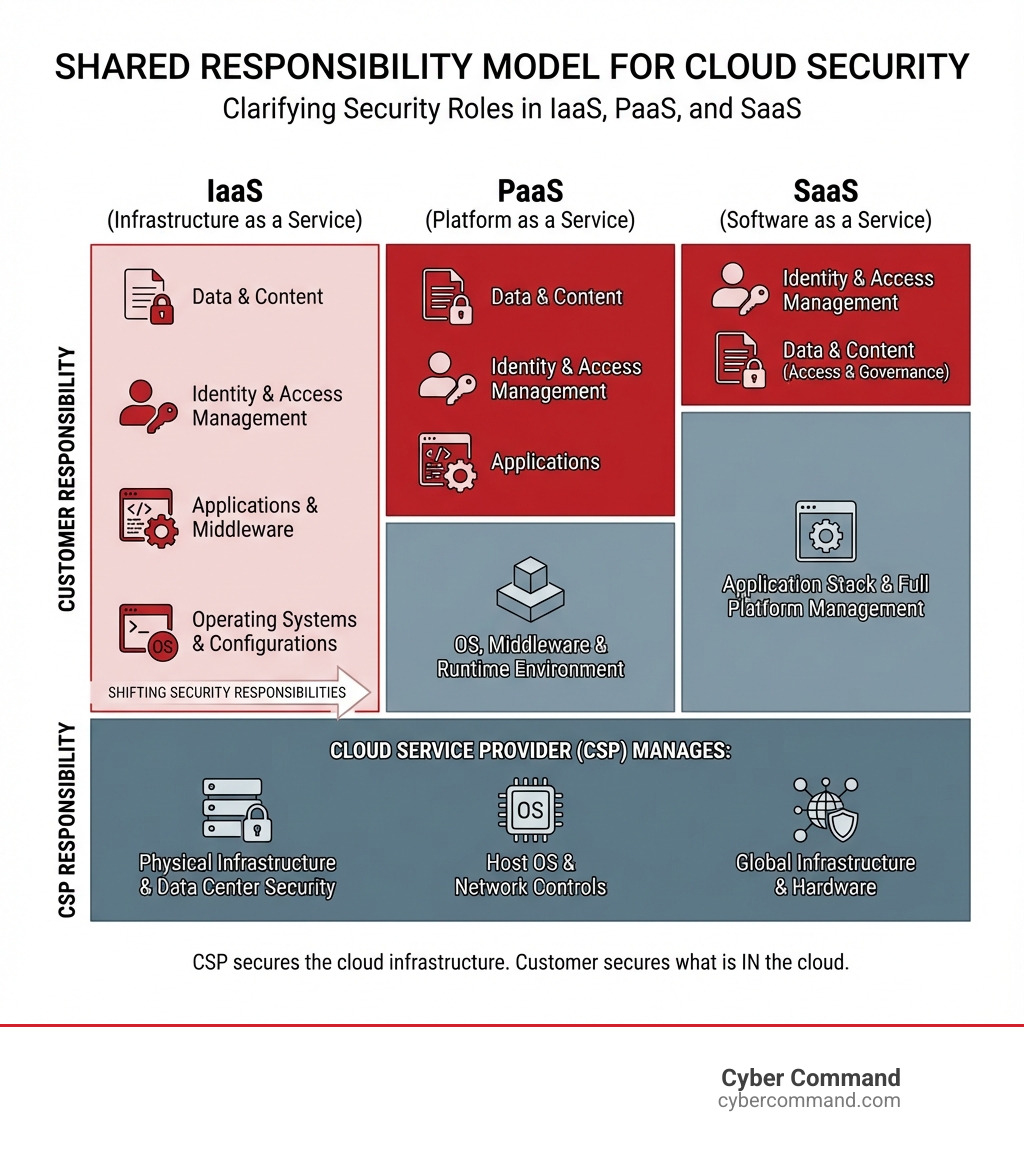
The good news? Cloud security doesn’t have to be overwhelming. When you understand the shared responsibility model—where your cloud provider secures the infrastructure while you secure your data and applications—you can build a robust defense. The right cloud security services work proactively to detect threats, automate responses, and keep your business running smoothly.
I’m Reade Taylor, Founder and CEO of Cyber Command, and I’ve spent my career helping businesses transform their approach to IT and Cloud security services, starting as an engineer with IBM Internet Security Systems. My mission is simple: make technology a competitive advantage, not a source of stress, by delivering reliable, security-focused cloud solutions that let you focus on growing your business.
This guide will walk you through everything you need to know about cloud security services—from understanding modern threats to choosing the right partner—so you can protect what matters most and operate with confidence in the cloud.
Understanding the Modern Cloud Threat Landscape
The journey to the cloud offers unparalleled agility and scalability, but it also introduces a new set of security challenges that demand our attention. Organizations today face a rapidly evolving threat landscape where traditional defenses are often insufficient.
Our primary cloud security challenges often stem from a few key areas. Firstly, many businesses struggle with a lack of visibility into their cloud environments, leading to unmanaged assets and potential vulnerabilities lurking in the shadows. Imagine trying to guard a house when you don’t know how many windows it has or if any are left open uped – that’s the visibility problem in a nutshell!
Secondly, misconfigurations are a common culprit. With the complexity of cloud settings, it’s all too easy to inadvertently expose sensitive data. In fact, misconfigurations are cited as the cause of over 80% of cloud breaches. It’s a stark reminder that even the most advanced technology can be undermined by human error.
Thirdly, maintaining compliance with varied regulatory standards across different jurisdictions (like GDPR, HIPAA, or PCI-DSS) complicates things significantly. What works for one region might not fly in another. Finally, the proliferation of multi-cloud or hybrid environments means we often need to implement consistent security controls across disparate platforms, adding layers of management complexity.
Cloud security threats are constantly evolving, often bypassing traditional perimeter checks and firewalls by exploiting hidden system vulnerabilities. This dynamic environment requires a security approach that is as agile and flexible as the cloud itself. Understanding this division of responsibility is crucial for maintaining a secure cloud posture, as outlined in A guide to the shared responsibility model.
Why Traditional Security Falls Short in the Cloud
Traditional security measures, often built around a defined network perimeter, struggle to cope with the dynamic, distributed nature of cloud environments. It’s like trying to protect a sprawling, ever-changing city with a single castle wall – it just doesn’t work anymore.
Cloud workloads are highly dynamic, spinning up and down in moments, often across multiple regions or providers. This elasticity makes it nearly impossible for static, on-premise firewalls to keep pace. Moreover, cloud services rely heavily on Application Programming Interfaces (APIs) for communication and integration. While powerful, these APIs introduce new potential vulnerabilities that traditional security tools weren’t designed to monitor or protect.
The distributed architecture of cloud environments means that data and applications are no longer confined to a single data center. This decentralization renders traditional perimeter defenses obsolete. Evolving attack vectors, such as ransomware, zero-days, and fileless attacks, are specifically designed to exploit these new cloud paradigms. And let’s not forget about insider threats, which remain a significant concern, often exploiting access privileges within the cloud.
The Rise of Perimeter-less Security
Given the shortcomings of traditional, perimeter-based security, the industry has acceptd the concept of “perimeter-less security.” This isn’t just a fancy buzzword; it’s a fundamental shift in how we approach protection. Instead of trying to secure a network boundary that no longer truly exists, we focus on securing every access point, every user, and every piece of data, regardless of its location.
This approach is heavily rooted in Zero Trust principles, which operate on the mantra “never trust, always verify.” Every user, device, and application attempting to access resources must be authenticated and authorized, even if they’re already inside the network. Identity, therefore, becomes the new perimeter. Our focus shifts from “where” something is to “who” or “what” it is.
Securing data, not just networks, is paramount. This involves robust encryption, strict access controls, and continuous monitoring of data wherever it resides. Techniques like micro-segmentation further improve this by dividing networks into small, isolated zones, limiting lateral movement for attackers even if they manage to breach one segment. This holistic approach ensures that security is woven into the very fabric of our cloud operations, offering a much stronger defense against modern threats.
Stuck on something like this right now?
Talk it through with a real US-based engineer, 24/7, no phone trees: (407) 587-0089.
Book a Free Strategy SessionThe Four Pillars of Comprehensive Cloud Security Services
To build a truly resilient and secure cloud environment, we rely on a strategic framework often described as the “Four Pillars of Cloud Security.” These pillars form the core components of any comprehensive cloud security strategy, ensuring that our defenses are robust, integrated, and proactive. They are: Identity and Access Management (IAM), Data Protection, Visibility and Compliance, and Threat Prevention. These pillars are not isolated; they work in concert, integrating seamlessly with modern DevSecOps practices by incorporating security measures across the entire software development lifecycle.

Pillar 1: Identity and Access Management (IAM)
At the heart of cloud security lies Identity and Access Management (IAM). This pillar ensures that only authorized individuals and services can access specific resources, preventing unauthorized entry and limiting the potential damage from a compromised account. It’s about carefully controlling who gets to open which digital doors.
Key to our IAM strategy is the principle of least privilege, meaning users and applications are granted only the minimum permissions necessary to perform their tasks. We also enforce multi-factor authentication (MFA) for all sensitive accounts and actions, adding an extra layer of verification beyond just a password. Role-based access control (RBAC) allows us to assign permissions based on job functions, simplifying management while maintaining strict control. For complex cloud environments, Cloud Infrastructure Entitlement Management (CIEM) solutions help us manage entitlements and tighten permissions, ensuring no one has more access than they need. Centralized identity solutions streamline user management and provide a single source of truth for access policies.
Pillar 2: Data Protection and Encryption
Data is the lifeblood of modern business, and protecting it in the cloud is non-negotiable. Our data protection pillar focuses on safeguarding information throughout its lifecycle, from creation to deletion.
Encryption plays a vital role in this. We ensure data is encrypted both at rest (when stored) and in transit (when moving between services) using advanced algorithms like AES-256 and TLS 1.3. Services like AWS Key Management Service (KMS) handle the complex management of encryption keys, so you don’t have to worry about them. Data Loss Prevention (DLP) tools are crucial for monitoring and blocking sensitive data from leaving our controlled environment, whether accidentally or maliciously. This also involves careful data classification, identifying and categorizing sensitive information such as:
- Personally Identifiable Information (PII)
- Protected Health Information (PHI)
- Intellectual Property (IP)
- Financial data
By categorizing data, we can apply appropriate security controls and ensure compliance with regulations like HIPAA and PCI-DSS.
Pillar 3: Visibility, Monitoring, and Compliance
You can’t protect what you can’t see! The Visibility, Monitoring, and Compliance pillar provides the insights we need to understand our cloud security posture and adhere to regulatory requirements. Cloud Security Posture Management (CSPM) solutions are essential here, helping us detect misconfigurations across popular services like GCP, AWS, and Azure. These solutions often support agentless deployment, providing immediate insights.
Continuous monitoring is our constant lookout, tracking activity 24/7 for anomalies and potential threats. Log analysis, often powered by advanced analytics tools like Google Chronicle, allows us to store and analyze petabytes of security telemetry, uncovering hidden patterns and suspicious behavior. Automated compliance checks ensure that our cloud configurations align with frameworks like GDPR, HIPAA, PCI-DSS, NIST, ISO 27001, and SOC 2. The NIST Cybersecurity Framework provides excellent guidance for structuring our overall security approach, while cloud providers’ compliance offerings help us meet specific regulatory mandates.
Pillar 4: Threat Prevention, Detection, and Response
The final pillar is our active defense against cyber threats. Threat Prevention, Detection, and Response focuses on stopping attacks before they happen, identifying them quickly if they do, and responding effectively to minimize damage.
Cloud Workload Protection Platforms (CWPP) are key, providing runtime protection for containerized workloads, servers, and virtual machines. These agents can mitigate various runtime threats, including ransomware, zero-days, and fileless attacks. AI-powered threat detection is a game-changer, leveraging machine learning to identify complex attack patterns that human analysts might miss. Generative AI acts as a cybersecurity analyst, providing contextual summaries of alerts and suggesting next steps, significantly reducing alert noise and speeding up incident response.
Automated incident response ensures that when a threat is detected, predefined actions are taken immediately to contain it. Vulnerability management, including agentless scanning, helps us continuously assess our cloud environments for weak points and prioritize critical vulnerabilities. Real-time alerts keep our security teams informed, allowing for rapid investigation and response to any suspicious activity.
Beyond Defense: The Strategic Benefits of Cloud Security
While protecting against threats is paramount, cloud security services offer far more than just a defensive shield. They are a strategic enabler, facilitating digital change and helping us turn potential risks into tangible opportunities.

Integrating security and risk considerations early in the digital change process can prevent costly surprises and fixes down the road. It ensures that as we innovate and grow, our foundation remains solid. Strong cloud security is not a bottleneck; it’s a launchpad for secure growth.
How Specialized Cloud Security Services Drive Business Growth
Specialized cloud security services directly contribute to business growth by protecting our most valuable assets and fostering an environment of trust.
Firstly, they are essential for protecting intellectual property (IP) and safeguarding brand reputation. IP is often stored and processed in the cloud. Robust security measures ensure that our proprietary information remains confidential and our brand’s image is not tarnished by a breach. This protects the very innovations that drive our competitive edge.
Secondly, secure cloud services enable innovation. When we have confidence in our security posture, we can experiment with new technologies, collaborate more effectively, and bring new products and services to market faster, without constantly worrying about underlying risks. This proactive integration of security helps us turn risks into opportunities, pioneering cutting-edge resources and fostering forward-leaning collaboration.
Finally, effective cloud security improves operational efficiency, including procurement and vendor management. By ensuring robust security practices across our supply chain and with our vendors, we reduce third-party risks, improve visibility into Nth-party relationships, and streamline our processes. This allows us to focus on our core business, knowing our digital assets are secure.
Ensuring Business Continuity and Disaster Recovery
In today’s interconnected world, business continuity and disaster recovery are not just good ideas—they’re essential. Cloud security services play a critical role in minimizing operational disruption from attacks or outages.
Automated data backups are a cornerstone of this, ensuring that our critical information is regularly saved and can be quickly restored. Resilient cloud architecture, designed with redundancy and fault tolerance, means that even if one component fails, our services remain operational. Rapid recovery protocols, often integrated into automated incident response plans, allow us to quickly detect, contain, and recover from cyber-attacks, natural disasters, or system failures.
By leveraging these capabilities, we can significantly improve our ability to withstand cyber-attacks and other unforeseen events. This focus on resilience ensures that we can maintain continuous operations and rapidly recover, protecting our revenue streams and customer trust.
Choosing the Right Cloud Security Partner
Selecting the right cloud security partner is a critical decision that can significantly impact your organization’s security posture and overall success. It’s not just about finding a vendor; it’s about finding a true extension of your team.
When evaluating providers, we look for a partnership approach, where the provider understands our unique business needs and acts as a trusted advisor. Scalability is also key; the chosen solution must be able to grow with our business, adapting to evolving demands without compromising security. For businesses operating across multiple time zones, 24/7 support is non-negotiable, ensuring that help is always available when we need it most. Finally, deep technical expertise, demonstrated by a proven track record and comprehensive knowledge of the latest cloud security threats and solutions, is paramount. This is where our U.S.-based, 24/7/365 support team excels, offering transparent, all-inclusive pricing as an extension of your business.
Key Features to Look for in Cloud Security Solutions
When diving into the nitty-gritty of various cloud security services, there are specific features that stand out as essential for a robust defense.
A unified management dashboard is a game-changer. It consolidates security operations into a single pane of glass, providing a holistic view of our security posture across our entire cloud estate. This eliminates data silos and simplifies management, especially in multi-cloud environments.
Agentless deployment options are a huge plus. They allow for rapid setup and minimize operational overheads, as we can protect our cloud workloads quickly without the hassle of installing and maintaining agents on every server. This is particularly beneficial for Cloud Security Posture Management (CSPM).
Strong integration capabilities via APIs are vital. Cloud security platforms should seamlessly connect with our existing IT and security tools, CI/CD pipelines, and other cloud services. This fosters collaboration between development, security, and operations teams, ensuring security is a shared responsibility.
Support for multi-cloud and hybrid environments is increasingly important. Our chosen solution must be able to protect assets across Azure, AWS, Google Cloud, and on-premise infrastructure, enforcing consistent security policies everywhere.
Finally, comprehensive reporting and analytics are crucial for understanding our security landscape, tracking compliance, and demonstrating ROI. This includes detailed reports on security incidents, vulnerability assessments, and compliance checks against frameworks like CIS and NIST.
Evaluating and Selecting a Provider for Cloud Security Services
The process of evaluating and selecting a provider for cloud security services requires a methodical approach to ensure we choose the best fit for our organization.
First, we begin by thoroughly assessing our unique needs. What are our most critical assets? What compliance regulations must we adhere to? What are our existing security gaps? This self-assessment forms the foundation of our search.
Next, we rigorously check for compliance expertise. Can the provider help us ensure adherence to regulations like GDPR, HIPAA, or PCI-DSS in the cloud? They should offer solutions custom to meet these regulatory requirements, often with over 2,000+ out-of-the-box checks for common compliance frameworks.
We also request case studies and testimonials to understand how they’ve helped similar businesses. This provides real-world insights into their capabilities and effectiveness.
Crucially, we need to understand their support model. Is it 24/7? Is it U.S.-based? What are the service level agreements (SLAs)? For us, 24/7/365 U.S.-based support is a cornerstone of our service, acting as an extension of our clients’ teams.
Finally, transparent pricing is essential. We avoid providers with hidden fees or complex billing structures, preferring clear, all-inclusive models that allow us to budget effectively. This commitment to transparency is a key differentiator for us and ensures that our clients, and across the United States, always know what to expect.
Frequently Asked Questions about Cloud Security
What are the biggest cloud security challenges for organizations today?
The biggest cloud security challenges organizations face today are multifaceted. Primarily, they struggle with a lack of visibility into their cloud environments, leading to unmanaged assets and potential vulnerabilities. Misconfiguration is another common and critical problem, wherein the complexity of cloud settings can easily expose sensitive data; notably, over 80% of cloud breaches are caused by misconfigurations. Additionally, maintaining compliance with varied regulatory standards across different jurisdictions (like GDPR, HIPAA, or PCI-DSS) complicates things. Finally, implementing consistent security controls on multiple cloud platforms, including multi-cloud or hybrid environments, presents significant operational complexity.
How does AI and automation improve cloud security?
AI and automation significantly improve cloud security by enabling real-time threat detection at scale, automating incident response to contain threats faster, identifying anomalous user behavior, and prioritizing vulnerabilities, which reduces manual effort and minimizes human error. AI-powered capabilities can ingest and analyze data on a planetary scale, applying threat intelligence and curated detections to uncover even the most novel threats. Generative AI, for instance, can act as a cybersecurity analyst, surfacing critical context, generating detections and playbooks, and dramatically reducing operational toil and alert noise, speeding up incident response. This allows security teams to focus on strategic initiatives rather than being bogged down by manual tasks.
What is the shared responsibility model in cloud security?
The shared responsibility model defines the division of security obligations between the cloud service provider (CSP) and the customer. The CSP (e.g., AWS, Azure, Google Cloud) is responsible for the security of the cloud, meaning they secure the underlying infrastructure, physical facilities, host operating systems, and network controls. The customer, on the other hand, is responsible for security in the cloud. This includes securing their data, applications, operating systems, network configurations, identity and access management, and ensuring compliance. While the CSP provides the secure foundation, we, as customers, must correctly configure and implement security measures within our cloud environments.
Conclusion: Secure Your Future in the Cloud
Navigating the complexities of the cloud doesn’t have to be a solo journey. By understanding the modern threat landscape, embracing perimeter-less security, and building our defenses upon the four pillars of IAM, Data Protection, Visibility, and Threat Prevention, we can transform our cloud environment from a potential risk into a strategic advantage.
At Cyber Command, we believe in proactive security that future-proofs your business. Our enterprise-grade IT, cybersecurity, and platform engineering services are designed to simplify complex cybersecurity management, providing you with the peace of mind to focus on innovation and growth. With 24/7/365 U.S.-based support and transparent, all-inclusive pricing, we act as an extension of your team, ensuring your cloud security is always robust, compliant, and ready for whatever the digital horizon brings.
Don’t let cloud security concerns keep you up at night. Take control of your digital future. Learn how co-managed IT can secure your cloud environment and empower your business to thrive securely in the cloud.
This article is for general informational purposes only and is not legal, compliance, insurance, or other professional advice. Threats, technologies, and regulations change quickly; confirm current requirements with your own advisors before acting. See our full disclaimer.