



Why Digital Process Automation Matters for Your Business
Digital process automation (DPA) is the practice of using technology—particularly low-code development tools—to streamline, automate, and orchestrate business operations across multiple systems and teams. Instead of relying on manual work, disconnected spreadsheets, and email chains, DPA creates automated workflows that move information and tasks through your organization efficiently and accurately.
What is Digital Process Automation?
- Definition: Using software to automate end-to-end business processes that typically require human interaction
- Key Technologies: Low-code platforms, APIs, cloud-based architecture, AI/ML
- Primary Goal: Transform manual, paper-based operations into efficient digital workflows
- Main Benefit: Reduces operational costs while improving speed, accuracy, and customer satisfaction
In today’s business environment, manual processes are no longer just inefficient—they’re broken. Organizations implementing DPA report improved efficiency, reduced costs, and higher customer satisfaction scores. Leading enterprises use DPA to become more customer-centric and responsive, rapidly automating operations without the delays and high costs of traditional IT development.
The shift from paper to electronic, from manual to automated, isn’t just about digitizing documents. It’s about fundamentally changing how work gets done. Whether you’re onboarding a new customer, processing an invoice, or managing employee requests, DPA eliminates bottlenecks, reduces errors, and frees your team to focus on strategic work rather than repetitive tasks.
I’m Reade Taylor, founder and CEO of Cyber Command, and I’ve spent my career helping businesses transform their technology from a liability into a competitive advantage. Throughout my work with digital process automation, I’ve seen how the right automation strategy can turn overwhelmed teams into efficient operations that scale effortlessly.
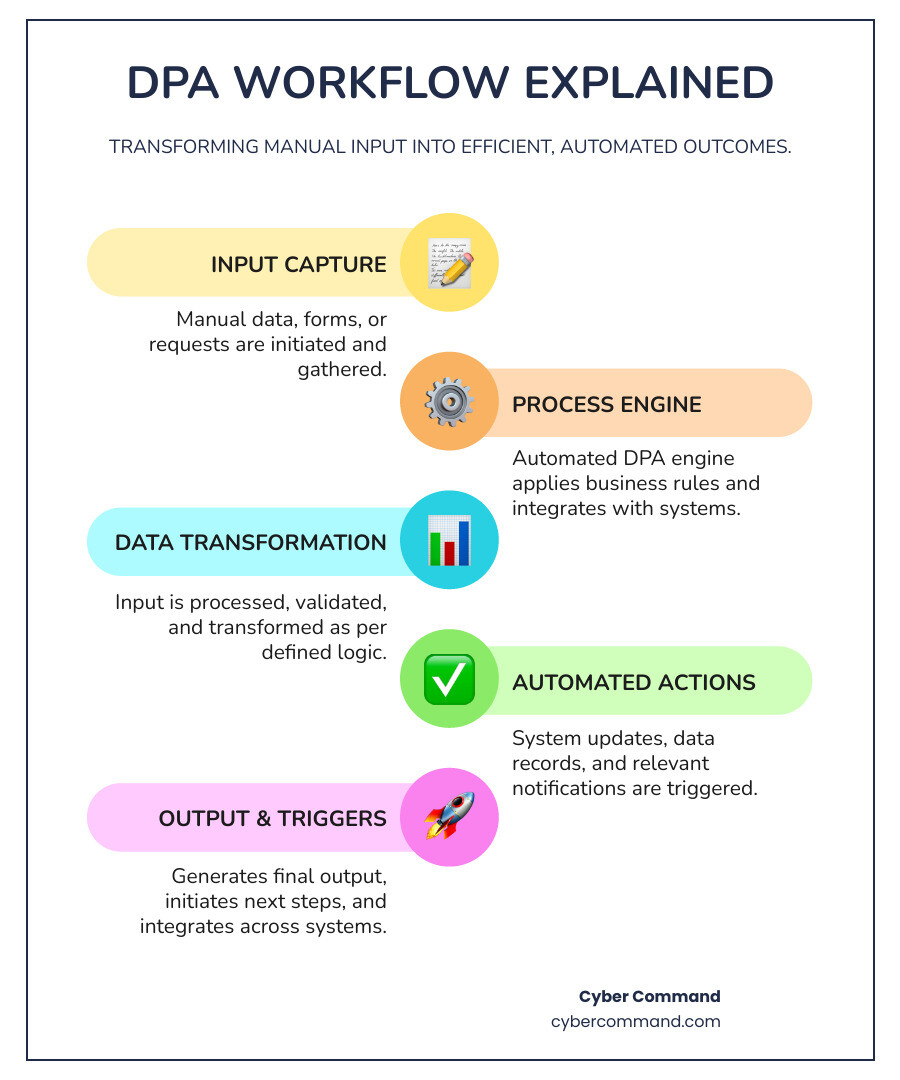

DPA vs. RPA vs. BPM: Understanding the Automation Landscape
Navigating business automation can sometimes feel like deciphering alphabet soup. Terms like DPA, RPA, and BPM are often used interchangeably, but they represent distinct approaches to streamlining operations. Understanding their differences is crucial for choosing the right tools for your business in Florida or Texas. As Forrester research suggests the industry is moving beyond traditional BPM terminology, it’s clear the landscape is evolving.


Let’s break down these essential concepts:
-
Business Process Management (BPM): Think of BPM as the grand architect of your business operations. It’s a comprehensive methodology focused on designing, executing, monitoring, and optimizing all processes within an organization. BPM aims for continuous improvement and strategic alignment. Historically, BPM often focused on back-office tasks to reduce costs and improve overall productivity. While still relevant, traditional BPM solutions sometimes faced criticism for being cumbersome and complex.
-
Robotic Process Automation (RPA): If BPM is the architect, RPA is the diligent, tireless worker bee. RPA involves software robots (bots) that mimic human actions to automate repetitive, rule-based tasks. These bots interact with existing applications and systems just like a human would—clicking, typing, and extracting data from user interfaces. RPA is excellent for automating specific, high-volume tasks, like data entry or generating reports, without requiring deep system integration. However, RPA typically works at the task level and is less suited for orchestrating complex, end-to-end workflows.
-
Digital Process Automation (DPA): This is where the evolution truly shines. Digital process automation is often seen as the modern evolution of BPM, with a sharper focus on technology-driven automation and end-to-end digital change. DPA goes beyond individual tasks or departmental processes. It orchestrates complex, interdepartmental workflows, often involving human interaction, multiple systems, and dynamic decision-making. DPA platforms leverage low-code development tools, APIs, and cloud architecture to create comprehensive workflow applications, enabling rapid development and agility.
Here’s a quick comparison:
| Feature | Business Process Management (BPM) | Robotic Process Automation (RPA) | Digital Process Automation (DPA) |
|---|---|---|---|
| Scope | Holistic, strategic management of all business processes | Task-specific, repetitive actions | End-to-end, complex workflows across departments and systems |
| Approach | Design, analyze, optimize processes | Mimics human interaction with user interfaces | Creates new digital applications and orchestrates integrated workflows |
| Technology | Workflow engines, process modeling tools | Software robots, screen scraping | Low-code/no-code platforms, APIs, cloud-based architecture, AI/ML |
| Integration | Can be complex, often requires custom development | Minimal, works on top of existing UIs | API-driven, seamless integration with disparate systems |
| Complexity | Handles high complexity, strategic | Best for simple, rule-based tasks | Handles high complexity, dynamic decisions, human-in-the-loop |
| Primary Goal | Process optimization, cost reduction, governance | Efficiency, speed, accuracy for repetitive tasks | Digital change, customer experience, innovation, agility |
While RPA automates specific tasks, and BPM provides the overarching framework, digital process automation is the engine that truly drives digital change by enabling fluid, integrated, and intelligent workflows across your entire organization. It’s about empowering business users and IT to collaborate and build solutions that meet evolving customer demands and market needs.
The Strategic Value of Digital Process Automation
In today’s business environment, staying competitive means constantly seeking ways to improve efficiency, reduce costs, and improve customer satisfaction. This is precisely where digital process automation steps in, offering immense strategic value for businesses in Orlando, Dallas, and beyond.
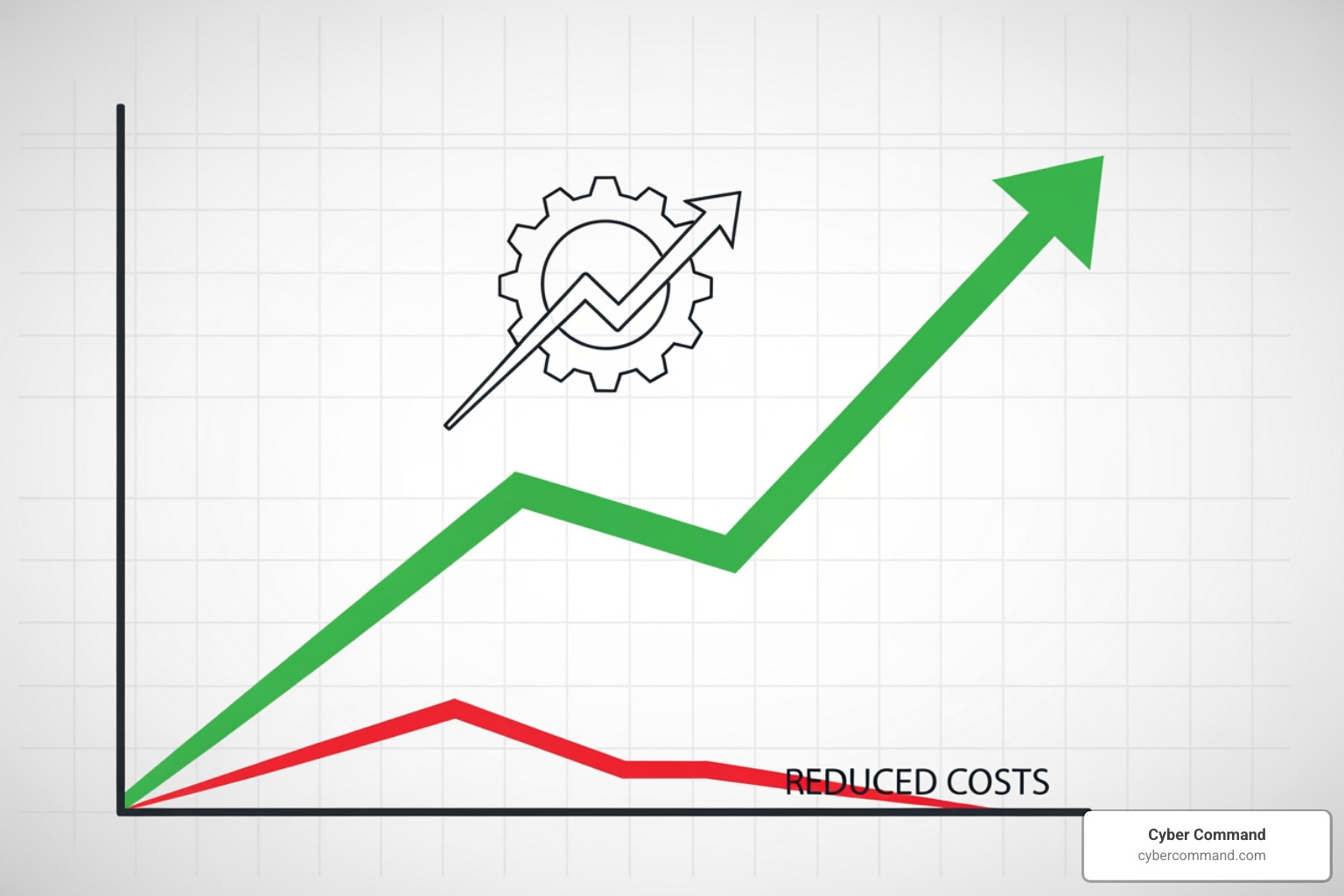
DPA isn’t just a technological upgrade; it’s a strategic imperative that fuels business growth, provides a significant competitive advantage, and enables truly data-driven decisions. By optimizing processes end-to-end, DPA helps organizations break down data silos and foster a culture of innovation. It also provides crucial agility, especially when dealing with legacy systems, allowing us to improve them without costly overhauls. This approach is vital for supporting initiatives like Nonprofit Digital Transformation, where resources are often stretched thin.
Key Benefits of Implementing DPA
When we talk about the benefits of digital process automation, we’re not just talking about minor tweaks. We’re discussing fundamental shifts that can redefine how your business operates:
- Increased Operational Efficiency and Employee Productivity: By automating repetitive, mundane tasks, DPA frees up your team members for higher-value, more strategic work. Imagine your customer service reps focusing on complex issues and building customer relationships instead of manual data entry. Salesforce reports that 99% of service professionals say automation saves them time, which makes perfect sense when you consider the sheer volume of manual tasks in many organizations.
- Reduced Operational Costs: Less manual work means fewer errors, less rework, and optimized resource allocation. This directly translates to significant cost savings. While improving customer experience is often the primary goal, cost reductions are a very welcome side effect.
- Improved Accuracy and Fewer Errors: Humans make mistakes; robots don’t (at least not in the same way!). Automating data entry and other rule-based processes drastically reduces human error, which is especially critical for regulated industries or those dealing with sensitive financial information.
- Better Customer Experience: When customers expect instant gratification, DPA allows us to deliver faster, more accurate, and seamless interactions. Whether it’s rapid customer onboarding (reduced from weeks to minutes in some cases!) or quick responses to service requests, DPA ensures a frictionless customer journey. This leads to higher satisfaction and loyalty.
- Employee Empowerment: When employees are liberated from soul-crushing, repetitive tasks, their morale improves, and they can engage in more creative and innovative work. This not only makes for a happier workforce but also open ups new potential for problem-solving and growth.
- Scalability: As your business grows, DPA solutions can scale with you, handling increased volumes of transactions and processes without needing a proportional increase in headcount or manual effort. This makes it easier for companies to expand into new markets or launch new products.
- Better Compliance and Governance: DPA platforms often include built-in audit trails, real-time monitoring, and adherence to predefined business rules, making it easier to ensure compliance with regulations and maintain robust governance across all processes.
Business Processes Primed for Automation
Almost any process that is repetitive, rule-based, involves multiple steps or systems, or requires human intervention at various stages can be a candidate for digital process automation. Here are some prime examples:
- Customer Onboarding: From initial inquiry to account setup and welcome communications, DPA can streamline the entire journey, ensuring consistency, accuracy, and compliance. This is a critical first impression for your customers.
- Invoice Processing: Automating the receipt, validation, approval, and payment of invoices can significantly reduce processing times and errors, freeing up your finance team.
- Employee Onboarding: Beyond just HR, this involves IT provisioning, access management, training assignments, and more. A digitalized onboarding process ensures new hires are productive from day one.
- IT Service Requests: Password resets, software installations, access requests – DPA can automate the ticketing, approval, and fulfillment of many common IT tasks, reducing the burden on your IT team.
- Procurement: Automating purchase requisitions, approvals, vendor management, and order tracking can lead to cost savings and better supply chain management.
- Loan and Credit Approvals: For financial institutions, DPA can automate document collection, credit checks, risk assessment, and approval workflows, drastically speeding up a process where “speed is everything.”
- Real Estate Workflows: From property management tasks to client communications and document handling, Automation for Real Estate can revolutionize efficiency.
How DPA Drives Digital Change and Growth
Digital process automation is more than just making existing processes faster; it’s about fundamentally changing how businesses operate. It’s a true pivot from manual to automated that can change entire processes and organizations.
- End-to-End Process Optimization: DPA focuses on optimizing entire workflows, not just isolated tasks. This holistic view ensures that bottlenecks are eliminated across departments, leading to seamless operations.
- Breaking Down Data Silos: By integrating disparate systems and applications, DPA ensures that data flows freely across your organization. This provides a single source of truth, better insights, and more informed decision-making.
- Fostering Innovation: When employees are freed from mundane tasks, they have more time and mental energy to dedicate to creative problem-solving, strategic initiatives, and developing new ideas that drive the business forward.
- Agility for Legacy Systems: A challenge for established businesses is modernizing without ripping and replacing expensive legacy systems. DPA platforms can “wrap” these systems with a process-centric application layer, adding agility and new functionality without a complete overhaul.
- Enabling New Business Models: The flexibility and speed offered by DPA allow organizations to experiment with new products, services, and customer engagement strategies, rapidly scaling successful ventures or quickly pivoting away from those that don’t gain traction. This responsiveness is key to thriving in a dynamic market.
A Practical Guide to Implementing DPA
Implementing digital process automation isn’t a “set it and forget it” endeavor. It requires careful planning, strategic execution, and continuous optimization. At Cyber Command, we understand that a successful DPA journey is about more than just software; it’s about changing your operational DNA.
Essential Features of a DPA Platform
When evaluating DPA platforms, we look for key features that ensure flexibility, scalability, and ease of use:
- Low-Code/No-Code Development: This is a game-changer. Low-code platforms allow business users and citizen developers to build and customize applications and workflows with minimal coding, significantly accelerating development cycles and reducing reliance on IT resources.
- Visual Workflow Designer: An intuitive drag-and-drop interface makes it easy to map out processes, define logic, and configure automation rules, even for non-technical users.
- Integration Capabilities (APIs): Robust API integration is crucial for connecting your DPA platform with existing enterprise systems (ERPs, CRMs, HRIS, etc.), ensuring seamless data flow and process orchestration across your entire tech stack.
- Business Rules Engine: This feature allows us to define and manage complex business logic that governs automated decisions, ensuring consistency and compliance.
- Analytics and Reporting: Real-time dashboards and reporting tools provide visibility into process performance, allowing us to identify bottlenecks, measure KPIs, and make data-driven improvements.
- Security and Compliance: Given the sensitive nature of business data, a DPA platform must offer robust security features like role-based access control, encryption, audit logs, and compliance with relevant industry regulations.
- Case Management: For processes that require human judgment or exceptions, integrated case management capabilities ensure that these tasks are routed appropriately, tracked, and resolved efficiently.
6 Steps to a Successful DPA Implementation
A well-structured approach is vital for maximizing the ROI of your digital process automation initiatives. We recommend the following steps:
- Process Audit & Identification: Before automating, we need to understand what we’re automating. This involves a comprehensive audit of existing processes to identify inefficiencies, manual bottlenecks, and areas that offer the most significant potential for improvement and business impact. Prioritize processes that are high-volume, repetitive, critical for compliance, or directly impact customer satisfaction.
- Set Clear Goals & KPIs: What does success look like? Define specific, measurable, achievable, relevant, and time-bound (SMART) goals for each automation initiative. Establish key performance indicators (KPIs) to track progress, such as reduced processing time, decreased error rates, or improved customer satisfaction scores.
- Select the Right Tools: This is where expertise matters. Based on your identified processes and goals, choose a DPA platform that aligns with your specific needs, existing IT infrastructure, and future scalability requirements. Consider factors like low-code capabilities, integration options, and vendor support.
- Develop & Test (Pilot): Start small! Begin with a pilot project on a mature, impactful process to learn the platform, refine your approach, and demonstrate quick wins. Thoroughly test and validate automations in a controlled environment to catch any bugs or unforeseen issues before wider deployment.
- Deploy & Scale: Once the pilot is successful and refined, roll out the DPA solution to the relevant departments or across the organization. This step requires careful planning to minimize disruption and ensure a smooth transition.
- Train, Monitor & Optimize: Digital process automation isn’t a one-time project. Train and support employees on new technologies, workflows, and tasks. Use analytics and AI to continuously monitor process performance, identify new areas for improvement, and optimize your automated workflows. Provide support:Train and support employees on new technologies, guidelines, workflows, tasks, and other changes resulting from automation. is crucial for adoption.
Overcoming Common DPA Challenges
Even with the best intentions, implementing DPA can encounter roadblocks. We’ve seen these challenges and have strategies to help you steer them:
- Budget Constraints: Automation is an investment, and demonstrating ROI can be challenging upfront. Solution: Focus on pilot projects that show quick, measurable returns. Highlight how DPA leads to reduced operational costs and increased revenue, making the business case undeniable.
- Lack of Skilled Resources: Finding and retaining talent with automation expertise can be tough. Solution: Leverage low-code/no-code DPA platforms that empower existing business users to build solutions, reducing reliance on specialized developers. Partner with experts like Cyber Command for managed services and support.
- Integration with Legacy Systems: Many businesses in Plano, TX, and across the US rely on older, complex systems. Solution: Choose DPA platforms with robust API integration capabilities that can “wrap” legacy systems, allowing them to participate in automated workflows without costly replacements. Our Cloud Automation Tools can help bridge these gaps.
- Employee Resistance to Change: People naturally resist new ways of working. Solution: Engage employees early in the process. Communicate the benefits (e.g., freeing them from mundane tasks) and provide comprehensive training and support. Emphasize that DPA augments human capabilities, rather than replaces them.
- Security Concerns: Automating processes, especially those involving sensitive data, raises security questions. Solution: Prioritize DPA platforms with enterprise-grade security features, including strong encryption, access controls, and audit trails. Ensure your implementation adheres to best practices for data protection and compliance.
The Future of Automation: AI, Hyperautomation, and Emerging Trends
The world of digital process automation is constantly evolving, with exciting advancements on the horizon. We’re moving beyond simple automation to a future where processes are not just automated but intelligent, adaptive, and self-optimizing.
The Role of AI and Machine Learning in Digital Process Automation
Artificial Intelligence (AI) and Machine Learning (ML) are rapidly changing DPA, elevating it to what’s often called Intelligent Process Automation (IPA). These technologies bring cognitive capabilities to automated workflows:
- Intelligent Process Automation (IPA): This combines DPA with AI/ML to handle unstructured data, make predictive decisions, and continuously learn from process outcomes. It’s about making automation “smarter.”
- Predictive Decision-Making: AI algorithms can analyze historical data to predict outcomes and make real-time decisions within a workflow, such as automatically approving a loan based on specific criteria or flagging a transaction for review.
- Pattern Recognition: ML can identify patterns and anomalies in data that humans might miss, enhancing fraud detection, quality control, and threat intelligence.
- Natural Language Processing (NLP): NLP allows DPA systems to understand and process human language from emails, customer feedback, and documents, enabling automation of tasks that previously required human interpretation.
- Chatbots and Virtual Assistants: AI-powered chatbots can handle routine customer inquiries, deflect simple service cases, and provide instant support, freeing human agents for more complex interactions. We’ve seen chatbots deflect up to 60% of internal service cases in some instances.
- Advanced Data Analysis: AI can quickly process vast amounts of data, identifying trends, generating insights, and creating automated reports, leading to more informed strategic decisions.
Emerging Trends and the Future of DPA Software
The future of digital process automation is dynamic and promising. We anticipate several key trends shaping its evolution:
- Hyperautomation: This isn’t just about automating tasks; it’s about orchestrating multiple technologies (RPA, DPA, AI, ML, IoT) to automate as many business processes as possible, creating intelligent, adaptable workflows that continuously optimize themselves. It’s about moving from disconnected tools to a harmonious symphony of automated analysis and response.
- Cloud-Native DPA Solutions: The shift to cloud-based platforms will continue, offering increased scalability, faster deployment, improved collaboration, and improved security features for automated workflows. This provides the agility businesses need to adapt quickly.
- Increased User-Friendliness: Low-code/no-code platforms will become even more sophisticated and accessible, democratizing automation and empowering a broader range of business users to create and manage their own workflows.
- Autonomous Workflows: Driven by advancements in AI, DPA systems will increasingly be able to make decisions and execute actions with minimal human oversight, leading to more self-optimizing and self-healing processes.
- Support for Multi-Cloud Environments: As businesses adopt diverse cloud strategies, DPA solutions will evolve to seamlessly integrate and orchestrate processes across various cloud providers and decentralized operations.
- Integration with IoT and Blockchain: DPA software will increasingly integrate with Internet of Things (IoT) devices for real-time data input and with blockchain for secure, transparent, and immutable transaction processing, creating more intelligent and responsive processes. These are just some of the 7 Technology Shifts we’re seeing.
Frequently Asked Questions about Digital Process Automation
What is the main difference between DPA and RPA?
The main difference lies in their scope and approach. Digital process automation (DPA) focuses on automating and orchestrating entire, end-to-end business processes, often involving human interaction, multiple systems, and dynamic decision-making via APIs and low-code applications. In contrast, Robotic Process Automation (RPA) automates specific, repetitive, rule-based tasks by mimicking human actions on a user interface. Think of DPA as redesigning and automating the entire workflow, while RPA automates individual steps within an existing (and potentially still manual) workflow.
What is a simple example of a process suitable for DPA?
A great example is employee onboarding. Digital process automation can automate the entire workflow from sending the offer letter and collecting digital signatures, to provisioning IT equipment, creating user accounts across different systems (like HR, email, and internal tools), and scheduling orientation sessions. This ensures a smooth, consistent, and efficient experience for every new hire, reducing manual effort for HR and IT teams.
How does DPA improve the customer experience?
DPA significantly improves the customer experience by creating faster, more accurate, and seamless interactions across all touchpoints. For instance, DPA can reduce the time it takes to process loan approvals from days to hours, provide real-time status updates on orders or service requests, and streamline customer service interactions by quickly routing inquiries and providing agents with comprehensive customer data. This reduction in wait times, elimination of errors, and personalized service leads to higher customer satisfaction and loyalty.
Conclusion: Start Your Automation Journey
As we’ve explored, digital process automation is more than a buzzword; it’s a strategic imperative for businesses looking to thrive in today’s digital economy. From enhancing efficiency and reducing costs to improving customer experiences and fostering innovation, DPA open ups immense value across your organization. It’s about making your business smarter, more agile, and ultimately, more competitive.
The journey to an automated future begins with understanding your current processes and identifying where DPA can make the most impact. Whether you’re in Winter Springs, Jacksonville, or Tampa Bay, our team at Cyber Command is ready to help you steer this change. We offer proactive, 24/7/365 U.S.-based support and transparent, all-inclusive pricing, acting as an extension of your business to ensure your DPA initiatives are successful.
Don’t let manual bottlenecks hold you back. Let us help you open up true operational excellence. Start your digital transformation with our managed IT services today.