



Why Cloud Migration Fails Without Proper Assessment
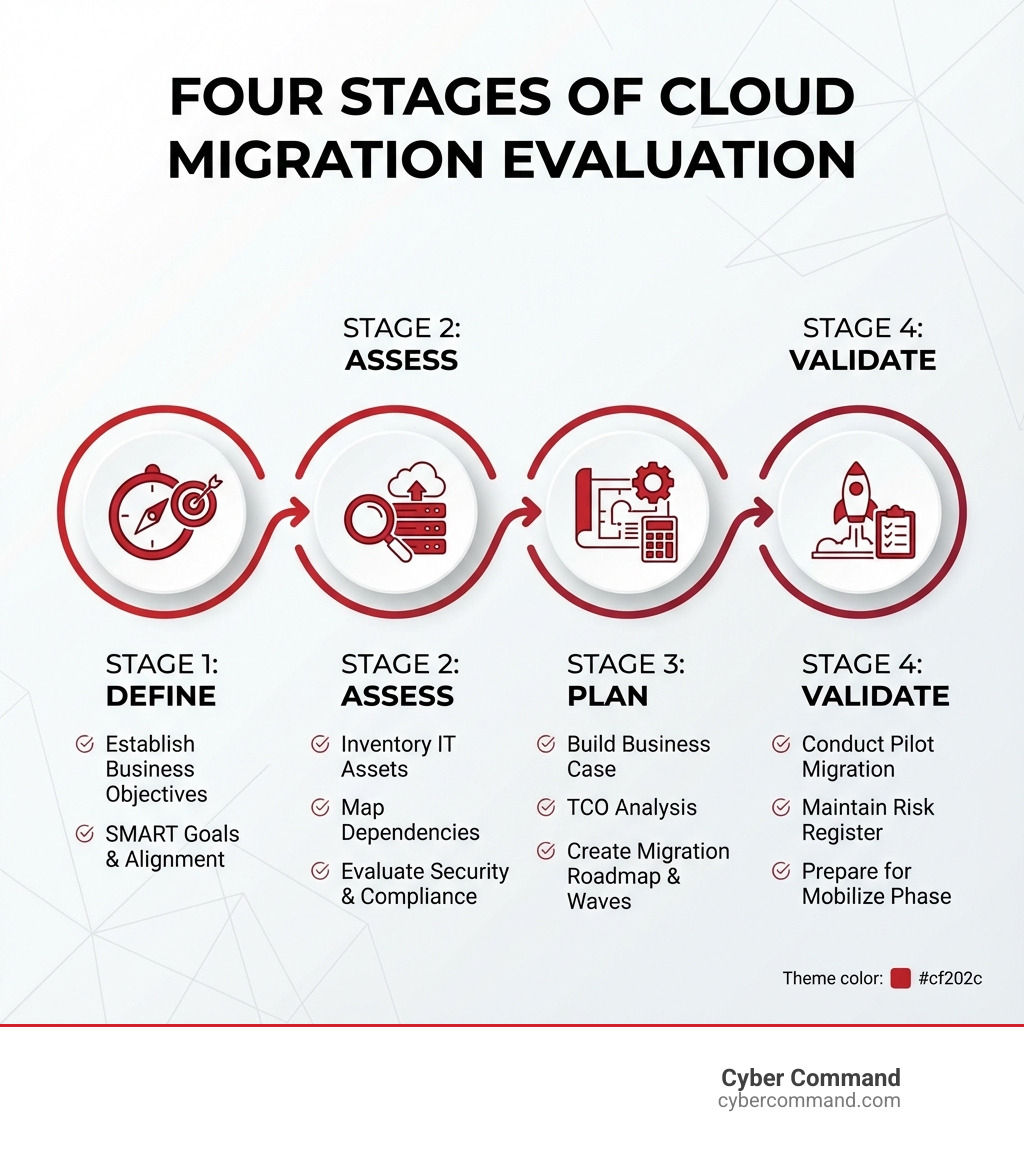
The evaluation phase of cloud migration is your critical first step to moving workloads to the cloud successfully—without blown budgets, missed deadlines, or security gaps. This phase involves four key activities:
- Define your business objectives and align stakeholders on clear goals
- Assess your current IT environment, including all applications, dependencies, and infrastructure
- Plan your migration strategy by categorizing workloads and creating a detailed roadmap
- Validate your approach through pilot migrations and risk assessment
The stakes are high. According to industry research, roughly one-third of all cloud migration initiatives are complete failures. Even among “successful” migrations, 25% fail to meet deadlines or expectations. More striking: 83% of data migration projects either fail or exceed their budgets and schedules.
Why do so many migrations fail? Most organizations skip or rush through the evaluation phase. They lack visibility into their application dependencies, underestimate costs, or fail to align technical plans with business goals. The result? Unexpected downtime, security vulnerabilities, and budget overruns that can cripple a business.
The evaluation phase changes this trajectory. It gives you full visibility into every component, dependency, and requirement before you move anything. You can anticipate issues, minimize risks, and make informed decisions backed by data—not guesswork.
This assessment isn’t just a technical exercise. It’s a strategic business initiative that determines whether your cloud investment delivers the promised benefits: reduced costs, improved agility, better security, and faster innovation. Without it, you’re essentially migrating blind.
I’m Reade Taylor, Founder and CEO of Cyber Command. Over the years helping businesses steer complex infrastructure changes, I’ve seen how a thorough evaluation phase of cloud migration separates successful projects from costly disasters—and I’m here to show you exactly how to get it right.

Step 1: Define Your Strategic Business Objectives
Before we even think about servers or software, the first and most crucial step in the evaluation phase of cloud migration is to clearly define why we’re undertaking this journey. What are our primary goals and objectives? Without a clear destination, any path will do – and that’s a recipe for disaster.
Our motivations for moving to the cloud can vary, but common drivers include:
- Cost Optimization: This is often a top priority. According to Flexera’s 2024 State of the Cloud Report, 82% of enterprises cite cost optimization as a top priority. We want to reduce operational expenses, shift from capital expenditures to operational ones, and avoid the hefty costs of maintaining on-premises infrastructure in our Florida and Texas data centers.
- Improved Agility and Scalability: We need the ability to quickly scale resources up or down to meet fluctuating demand without significant upfront investment. This is essential for innovation and responding to market changes. 62% of enterprises prioritize improved performance and scalability.
- Improved Security and Compliance: While often a concern, moving to the cloud can actually improve our security posture, leveraging the advanced capabilities of cloud providers. It also helps us meet evolving regulatory requirements.
- Accelerated Digital Change: The cloud provides a platform for modernizing applications, adopting new technologies like AI/ML, and fostering a culture of innovation across our organization.
- Increased Operational Resilience: Cloud environments often offer superior disaster recovery and business continuity capabilities compared to traditional on-premises setups.
These goals shouldn’t just be vague aspirations. They must be specific, measurable, and aligned with our overall business strategy.
Aligning Stakeholders and Setting SMART Goals
The evaluation phase of cloud migration isn’t just an IT project; it’s a fundamental business change. Therefore, securing executive buy-in and aligning stakeholders across the organization is paramount. From finance and operations to marketing and sales, everyone needs to understand the vision, benefits, and potential impacts of the migration.
We facilitate workshops and discussions to ensure all interdepartmental objectives are incorporated into the cloud strategy. For instance, our IT department might prioritize improved security, while our finance team focuses on cost reduction. Marketing and sales might need tools for improved customer engagement or scalable infrastructure for digital campaigns. By bringing these perspectives together, we build a unified vision.
To make our goals actionable, we use the SMART goal framework: Specific, Measurable, Achievable, Relevant, and Time-bound. For example, instead of a vague goal like “reduce costs,” a SMART goal would be “reduce infrastructure costs by 25% within 12 months of completing the cloud migration.”
We also establish Key Performance Indicators (KPIs) to measure the success of our migration. These might include:
- Total Cost of Ownership (TCO): Before and after migration, providing a clear financial comparison.
- Application Performance Metrics: Such as response times, throughput, and latency.
- Uptime and Availability Percentages: Ensuring our services remain robust.
- Time to Deploy New Resources: Reflecting increased agility.
- Security Incident Response Times: Demonstrating an improved security posture.
Visualizing these goals helps solidify understanding and commitment across teams.
Step 2: Conduct a Comprehensive Portfolio Assessment
With our strategic objectives firmly in place, the next critical step in the evaluation phase of cloud migration is to thoroughly understand our current IT landscape. This involves a deep dive into every application, server, database, and network component that we might consider for migration. Think of it as creating a meticulous inventory of our entire digital estate, from our Orlando data center to our facilities in Plano, Texas.
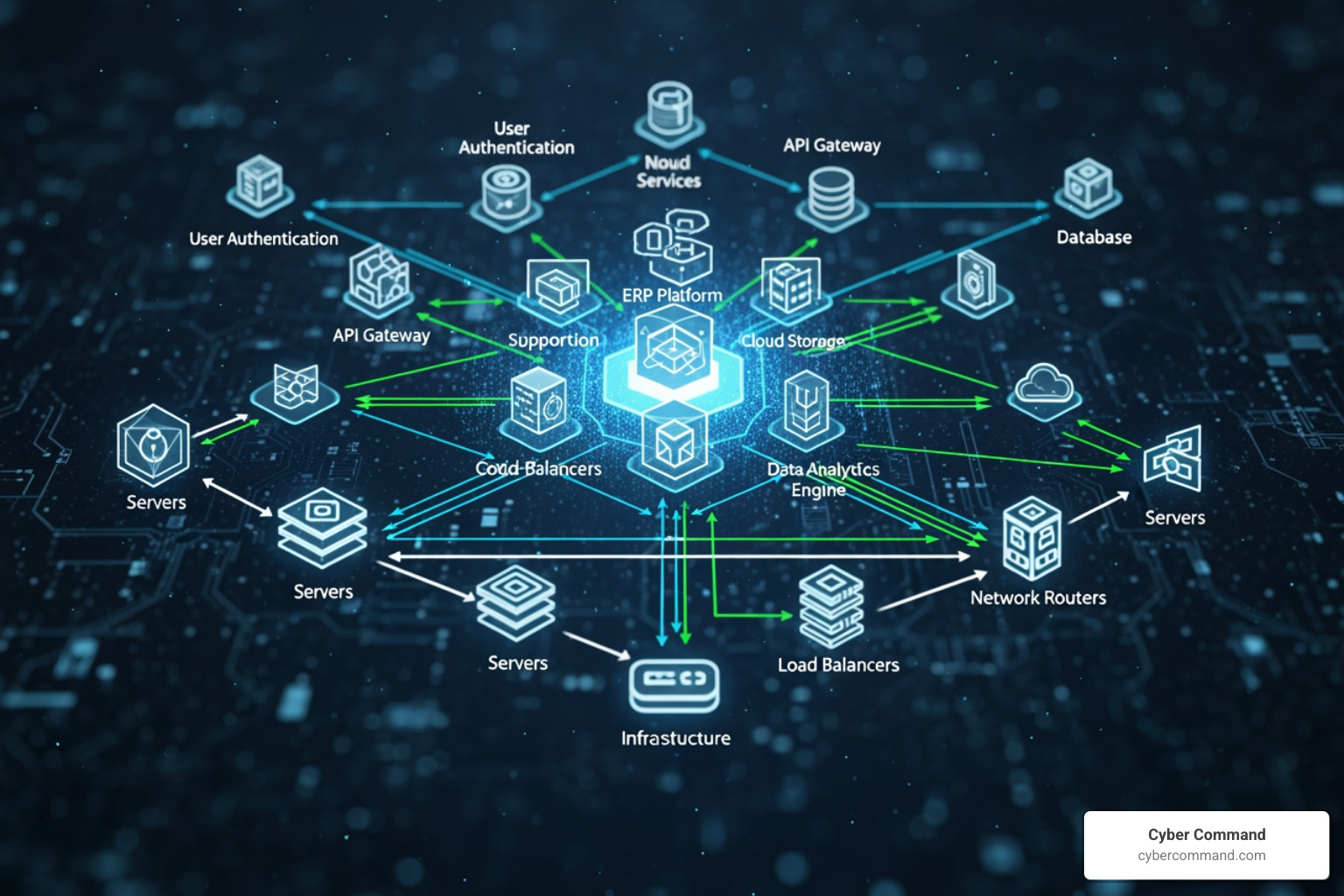

This comprehensive portfolio assessment is where we truly get to grips with the technical feasibility and interdependencies of our systems. It’s a data-driven exercise designed to answer fundamental questions: What do we have? How does it work? What does it depend on? And how critical is it to our business?
The output of this assessment will inform our migration strategies, often categorized by the “6 Rs of Cloud Migration”:
- Rehost (Lift-and-Shift): Moving applications as-is to the cloud.
- Replatform (Lift-Tinker-and-Shift): Making minor cloud-specific optimizations without changing core architecture.
- Repurchase: Moving to a SaaS product.
- Refactor/Rearchitect: Reimagining and rebuilding applications to be cloud-native.
- Retain: Keeping certain applications on-premises due to specific constraints.
- Retire: Decommissioning applications that are no longer needed.
The Core Activities of the evaluation phase of cloud migration
Our comprehensive assessment involves several core activities:
- IT Asset Inventory: This is more than just a list of hardware. We use tools like automatic discovery to gain full visibility into our complex IT environments. These tools help us obtain a complete inventory of assets, capturing detailed information about hardware, software, configurations, and dependencies. This includes servers, virtual machines, storage, network devices, and all installed software.
- Infrastructure Findy: We collect granular data on server utilization (CPU, memory, disk I/O), network throughput, and storage capacity. This baseline performance data is crucial for right-sizing resources in the cloud and optimizing costs.
- Application and Database Inventory: We catalog all applications, their versions, operating systems, and associated databases. For databases, this includes engine types, versions, and hosting models.
- Dependency Mapping: This is arguably the most complex but vital part. Applications rarely operate in isolation. We map all internal and external dependencies—application-to-application, application-to-database, application-to-network, and even integrations with third-party services. Automated tools, complemented by interviews with workload owners, help us uncover these intricate relationships that might otherwise be overlooked. This understanding prevents integration failures and supports accurate migration sequencing.
Here’s a list of key data points we collect for each application:
- Application Name & Business Owner: Who uses it, and how critical is it?
- Technical Stack: Operating System, programming languages, frameworks, middleware.
- Resource Utilization: CPU, RAM, disk I/O, network bandwidth (peak and average).
- Storage Requirements: Data size, type, and growth rate.
- Database Details: Type, version, size, dependencies.
- Network Connectivity: Inbound/outbound rules, ports, protocols.
- Dependencies: Upstream and downstream applications, services, and data sources.
- Security & Compliance: Specific requirements (e.g., encryption, access controls).
- Licensing Information: For operating systems, databases, and third-party software.
- Operational Requirements: SLAs, RPOs, RTOs.
- Environmental Classification: Production, test, development.
Evaluating Security, Compliance, and Governance
Security and compliance are non-negotiable, especially for our clients in regulated industries across Florida and Texas. During the evaluation phase of cloud migration, we conduct a detailed assessment of our data security needs and compliance mandates. This includes a thorough review of our current security posture against the offerings of potential cloud providers.
Considerations include:
- Data Sovereignty: Where must our data physically reside? This influences our choice of cloud provider data center locations.
- Regulatory Compliance: We ensure our chosen cloud solution can meet specific regulations like GDPR, HIPAA, PCI DSS, or others relevant to our clients. We leverage resources like CSA resources for guidance on cloud security best practices.
- Industry Standards: Compliance with standards like ISO 27001 is evaluated.
- Security Controls: We review existing controls (access management, encryption, network security) and determine how they will be adapted or improved in the cloud.
- Governance Policies: How will we manage cloud resources, access, and costs once migrated? This includes establishing clear policies for resource provisioning, auditing, and monitoring.
We also use compliance scanning tools and security posture assessment platforms to identify any gaps or potential vulnerabilities early in the process.
Choosing the Right Cloud Model and Provider
One size does not fit all in the cloud. During the evaluation phase of cloud migration, we carefully assess whether a public, private, or hybrid cloud model best suits our needs. As of 2024, approximately 73% of enterprises deploy in the hybrid cloud, leveraging the best of both worlds for flexibility and workload optimization.
We consider a multi-cloud strategy if specific workloads benefit from different providers (e.g., specialized databases on one provider, AI/ML services on another). When comparing providers, we look at several factors:
- Geographical Presence: Does the provider have data center locations in regions relevant to our operations and data residency requirements (e.g., in the US, near our Florida and Texas clients)?
- Cost Structure: We compare pricing models, taking into account pay-as-you-go options, reserved instances, spot pricing, and Bring Your Own (BYO) licensing.
- Service Offerings: Does the provider have the specific services we need, particularly for specialized workloads like Oracle databases or Microsoft SQL Server?
- Integration Capabilities: How well do their services integrate with our existing tools and processes?
- Support and SLAs: What level of support is offered, and what are the guaranteed Service Level Agreements?
It’s important to recognize that not all workloads are created equally. Each may be best suited to a different cloud provider, especially if they contain specialized use cases. Our goal is to find the best fit for each part of our portfolio.
Step 3: Build the Business Case and Migration Roadmap
Having defined our objectives and thoroughly assessed our current environment, the next crucial step in the evaluation phase of cloud migration is to build a compelling business case and a detailed migration roadmap. This is where we translate our findings into a concrete plan that justifies the investment and guides our journey.

This stage brings together all the data we’ve collected to project financial viability, prioritize workloads, and outline the phased approach to migration. It’s about quantifying the benefits and costs, and charting a clear course forward.
Quantifying the Business Case: TCO and ROI
The business case for migration centers on demonstrating a clear financial advantage and return on investment (ROI). We perform a detailed cost analysis that includes:
- Current IT Costs: A comprehensive breakdown of our existing on-premises expenses, including hardware, software licenses, maintenance, power, cooling, data center rent (if applicable), and staffing.
- Migration Costs: Estimates for data transfer, refactoring efforts, new software licenses, and training for our teams.
- Projected Cloud Operational Costs: Based on our right-sizing efforts from the assessment, this includes estimated pay-as-you-go charges, reserved instance costs, and managed service fees.
- Hidden Costs: We proactively identify potential hidden costs such as data egress fees (moving data out of the cloud), unexpected downtime during migration, and consulting fees.
By comparing our current TCO with the projected cloud TCO, we can calculate the ROI. A compelling business case often shows significant savings over a 3-5 year period. For instance, an IDC whitepaper indicates that IT operational staff productivity can increase by 62% after migration to AWS, with staff managing around 400 servers on AWS compared to 150 on-premises. This isn’t just about direct infrastructure cost reduction; it’s about operational efficiency too.
Here’s a simplified table comparing on-premises vs. cloud TCO components:
| Component | On-Premises | Cloud (IaaS/PaaS) |
|---|---|---|
| Infrastructure | Servers, storage, networking (CapEx) | Virtual machines, managed services (OpEx) |
| Software | Licenses (perpetual) | Subscriptions, BYO licensing, usage-based |
| Facilities | Data center rent, power, cooling | Included in service fees |
| Maintenance | Hardware/software support, patching | Managed by provider, shared responsibility |
| Staffing | IT operations, sysadmins, network engineers | Cloud architects, DevOps engineers (fewer for infra) |
| Scalability | Manual procurement, long lead times | On-demand, automated, elastic |
| Disaster Recovery | Dedicated infrastructure, complex setup | Built-in services, automated failover |
| Security | In-house team, hardware/software | Shared responsibility, advanced tools |
Creating the Migration Blueprint and Roadmap
With the financial justification in hand, we assemble a detailed migration blueprint. This involves outlining a phased approach, avoiding a disruptive “big bang” migration. Instead, we group applications into “migration waves” based on dependencies, business criticality, and technical readiness.
Our blueprint includes:
- Timelines and Milestones: A realistic schedule for each phase and wave.
- Roles and Responsibilities: Clearly defining who does what, from our internal teams to our trusted partners.
- Communication Plan: Ensuring transparent updates to all stakeholders throughout the process.
- Cloud risk management strategies: Identifying potential risks (technical, operational, organizational) and defining mitigation plans. We establish a risk register for all workloads.
- Defining the Landing Zone: This is our secure, scalable, and well-governed cloud environment. We design it to accommodate future growth and changing requirements, implementing infrastructure-as-code (IaC) practices for easy replication and modification of environments. The landing zone provides the foundational capabilities for our cloud operations.
Laying the Foundation for the Mobilize Phase
The evaluation phase of cloud migration is foundational. Its key outputs directly inform and prepare us for the subsequent Mobilize and Migrate phases. The deliverables expected from this phase are:
- Comprehensive Assessment Report: Detailing our current IT environment, including application inventory, dependency maps, and technical readiness.
- Detailed Business Case Document: Quantifying TCO, ROI, and strategic benefits.
- Prioritized Application Portfolio: Identifying which applications to migrate, modernize, or retire, and in what order.
- High-Level Migration Roadmap: Outlining the phased approach, migration waves, and key milestones.
- Security and Compliance Gap Analysis: Highlighting areas needing attention in the cloud.
- Documented Business Objectives and KPIs: Serving as our guiding stars throughout the journey.
- Skills Gap Analysis: Identifying areas where our team needs training or upskilling to manage cloud technologies.
These outputs allow us to effectively lay the foundation for the Mobilize phase. This next phase will involve filling any gaps identified in our readiness assessment, mobilizing our organization, setting up workstreams, building the cloud landing zone, and preparing our teams for change. We often reference frameworks like the AWS Cloud Adoption Framework (AWS CAF) to ensure a holistic view across business, people, governance, platform, security, and operations.
Overcoming Common Challenges in the Evaluation Phase of Cloud Migration
The evaluation phase of cloud migration is designed to identify and mitigate potential pitfalls, but it’s not without its own challenges. Knowing what to look for and how to address it proactively can make all the difference.
Some common challenges we encounter include:
- Inaccurate Inventory: Relying on outdated or incomplete CMDBs can lead to missed assets or incorrect assumptions about configurations.
- Undocumented Dependencies: The “spaghetti monster” of interconnected systems can hide critical links, causing unexpected outages if not properly mapped.
- Scope Creep: Without clear objectives and a well-defined scope, the project can expand indefinitely, leading to budget overruns and missed deadlines.
- Lack of Skills: Our internal teams might lack the expertise in cloud assessment tools or methodologies.
- Resistance to Change: Stakeholders or team members may be hesitant about the migration, fearing job changes or new complexities.
We overcome these by:
- Embracing Automation: Using specialized findy tools to get real-time, accurate data.
- Engaging Workload Owners: Their institutional knowledge is invaluable for validating automated findings and uncovering undocumented dependencies.
- Clear Governance: Establishing strict change control processes and regularly reviewing the scope against objectives.
- Training and Upskilling: Investing in our team’s cloud skills early on.
- Transparent Communication: Highlighting the benefits and addressing concerns openly to build confidence and buy-in.
Why the evaluation phase of cloud migration is non-negotiable
We’ve seen the statistics: roughly one-third of all cloud migration initiatives are a complete failure. This isn’t because the cloud is inherently flawed; it’s often due to a rushed or inadequate evaluation phase of cloud migration.
This phase is non-negotiable because it is our proactive shield against failure. It allows us to:
- Mitigate Risk: By identifying potential issues (technical, security, compliance) early, we can develop strategies to avoid or minimize their impact.
- Prevent Overspending: A thorough assessment helps us accurately predict resource needs, avoid unnecessary spending on over-provisioned cloud resources, and identify cost-saving opportunities.
- Ensure Security and Compliance: We can design our cloud environment from the ground up with security and regulatory adherence built-in, rather than bolted on later.
- Gain Stakeholder Confidence: A well-researched and data-backed plan builds trust among executives and teams, fostering a smoother transition.
- Build a Solid Foundation: Without this blueprint, subsequent phases become chaotic, expensive, and prone to error. It’s like trying to build a skyscraper without architectural plans – it simply won’t stand.
Tools and Frameworks for a Data-Driven Assessment
To ensure our evaluation phase of cloud migration is as robust and data-driven as possible, we leverage a suite of powerful tools and established frameworks:
- Findy and Analysis Tools: Solutions like Device42 or Azure Migrate offer automatic discovery capabilities to provide visibility into complex IT environments, capturing detailed information about hardware, software, and dependencies.
- Application Portfolio Management (APM) Tools: Platforms like LeanIX streamline cloud migration assessment by linking application data to business capabilities, helping us decide which applications to migrate, modernize, or retire.
- Cost Assessment Tools: Cloud provider-specific tools (like AWS Migration Evaluator) and third-party solutions help us perform TCO analysis, compare pricing models, and estimate cloud spend.
- Performance and Dependency Mapping Tools: These tools provide granular data on application performance and help visualize complex interdependencies, crucial for planning migration waves.
- Cloud Adoption Frameworks: We often apply frameworks like the AWS Cloud Adoption Framework (AWS CAF) or Microsoft’s Cloud Adoption Framework for Azure. These provide a structured approach across six key perspectives: business, people, governance, platform, security, and operations, ensuring a holistic assessment.
- Specific Cloud Migration Tools: For Azure migrations, Azure Migrate is a comprehensive service that helps with findy, assessment, and migration of on-premises servers, databases, and applications.
By using these tools and frameworks, we transform guesswork into precise data, enabling us to make informed decisions that lead to successful cloud changes for our clients in Florida and Texas.
Frequently Asked Questions about the Cloud Migration Evaluation Phase
What are the key deliverables from the evaluation phase?
The primary outputs include a comprehensive inventory of IT assets, a detailed business case with TCO/ROI analysis, a prioritized application portfolio, a high-level migration roadmap with defined waves, a security and compliance gap analysis, and a documented set of business objectives and KPIs. These deliverables act as the blueprint for the entire migration journey.
How long should the evaluation phase take?
The duration varies based on the size and complexity of the IT environment. For a small to medium-sized business with a relatively straightforward IT footprint, it can take 4-8 weeks. For large enterprises with hundreds or thousands of applications and complex interdependencies, it can last several months, sometimes 3-6 months. The key is to be thorough rather than fast; rushing this phase is a common reason for migration failures.
What are the “6 Rs of Cloud Migration”?
The 6 Rs are a common framework for categorizing migration strategies for applications, helping to determine the best approach for each workload:
- Rehost (Lift-and-Shift): Moving applications as-is to the cloud without modifications. This is often the fastest initial migration strategy.
- Replatform (Lift-Tinker-and-Shift): Making minor cloud-specific optimizations to applications to take advantage of cloud features, without significantly changing the core architecture.
- Repurchase: Moving to a SaaS product, effectively replacing an existing application with a cloud-native, off-the-shelf solution.
- Refactor/Rearchitect: Reimagining and rebuilding applications to be cloud-native, leveraging microservices, containers, or serverless functions for maximum cloud benefits.
- Retain: Keeping certain applications on-premises due to specific constraints like regulatory compliance, legacy hardware dependencies, or cost.
- Retire: Decommissioning applications that are no longer needed, reducing complexity and saving resources.
Conclusion: Your First Step to a Successful Cloud Change
The journey to the cloud is a strategic imperative for businesses aiming to modernize, innovate, and remain competitive. However, as we’ve seen, this journey is fraught with potential pitfalls, and a significant number of cloud migrations fall short of expectations or fail entirely.
The evaluation phase of cloud migration is your blueprint for success. It’s the critical first step that transforms a hopeful endeavor into a carefully planned and executed change. By diligently defining your objectives, comprehensively assessing your current environment, and building a robust business case and roadmap, you lay an unshakeable foundation for what comes next.
At Cyber Command, we understand the complexities involved. We’ve guided numerous businesses across Florida and Texas through their cloud changes, turning potential chaos into calm, structured progress. Our expertise ensures that your evaluation phase of cloud migration is thorough, data-driven, and perfectly aligned with your business goals. By completing a thorough evaluation, you move from hoping for a successful migration to planning for one.
Don’t leave your cloud future to chance. Let us help you chart a clear, confident course. Learn more about our Cloud Migration services and find how we can be an extension of your business, ensuring your cloud journey is a resounding success.