


You're probably dealing with a familiar kind of pressure right now. A quarter closes fast, a client wants a change live before Monday, and the team is still patching a cloud setup that only seems to work when one specific person is online. In a lot of Orlando firms, that's the moment DevOps stops sounding like a buzzword and starts looking like a way to keep releases moving without turning every deployment into an emergency.
For devops services Orlando buyers, the core question isn't whether automation sounds useful. It's whether your business can get a repeatable operating model that ties code, infrastructure, and security together without adding more management overhead. That's where local service packaging matters, especially for SMBs that need predictable pricing, clear responsibility, and accountability that doesn't disappear after the project ends.
Table of Contents
- Introduction to DevOps Services in Orlando
- Understanding DevOps and Platform Engineering for Orlando Businesses
- Benefits of DevOps Services for Central Florida Businesses
- DevOps Engagement Models in Orlando
- Integrating Security and Compliance with DevOps
- Industry Use Cases and Orlando Case Studies
- Pricing Structures and SLAs for DevOps Services
- How to Choose the Right DevOps Services Partner in Orlando
Introduction to DevOps Services in Orlando
A local professional services firm can feel stable right up until the week every client needs something at once. One partner wants a new portal update, another needs a report fix, and the cloud environment is still held together by scripts that only one administrator fully trusts. In that setup, deployments slow down, outages get handled reactively, and the business starts treating infrastructure change like a risk event instead of a routine process.
That's the gap DevOps services fill when they're packaged well. They connect application delivery, infrastructure control, and monitoring into a workflow that can be repeated, audited, and improved instead of improvised. For Orlando companies, that matters because the market is already showing sustained demand for DevOps expertise, with salary benchmarks pointing to strong competition for engineers who can handle cloud automation and platform operations in a real business setting, not just a lab environment. Built In's Orlando DevOps salary data shows $126,717 average salary, $6,234 in average additional cash compensation, and $132,951 total compensation, while Robert Half's Orlando guide lists $119,180 and Indeed's Orlando-area data shows $121,481 per year based on 84 salaries posted over the prior 36 months.
Practical rule: if your deployment process depends on one person remembering every step, you don't have a DevOps process yet, you have tribal knowledge.
That's why local buyers should look past vague promises about speed. The better question is how a provider packages governance, security, and reporting so your team can approve changes with confidence. Orlando businesses that buy well get more than faster releases, they get a calmer operating rhythm, clearer ownership, and fewer surprises when growth, compliance, or customer demand pushes the system harder.
Understanding DevOps and Platform Engineering for Orlando Businesses
A local business can have fast developers and still ship slowly if every release depends on manual steps, tribal knowledge, and a few overworked people remembering the order of operations. DevOps fixes that by treating software delivery like a controlled assembly line. Code moves through a repeatable path, infrastructure is built the same way each time, and checks happen before changes reach production, not after a customer finds the problem.
That shift matters because Orlando companies do not benefit from speed alone, they benefit from order. When change is packaged with clear rules, the business can approve releases with less second-guessing, and the team can keep working even when one person is unavailable. Operational governance is part of the service, not an afterthought.
What platform engineering really adds
Platform engineering is the shared layer that makes DevOps practical across multiple teams. Instead of each group inventing its own deployment steps, environments, and access rules, the platform team builds standard components, shared guardrails, and self-service options. Developers still move quickly, but they do so inside a structure that reduces drift, prevents misconfiguration, and keeps the release path consistent.
A good platform feels boring on purpose. That calm setup is what lets the business ship changes without re-learning the same lessons every week.
For Orlando businesses, the talent issue makes that structure even more important. The local market is competitive for people who can handle cloud, automation, and operations together, so building the capability entirely in-house can be difficult to sustain. Built In's Orlando salary benchmarks show that this work sits in a premium skill band, which is one reason many SMBs are better served by a managed model with clear scope and accountability.

A practical buyer should look for three mechanics in any proposal. Infrastructure as Code keeps environments reproducible, environment parity keeps testing and production aligned, and deployment observability shows who changed what, when it changed, and what happened next. AWS infrastructure reference for environment setup helps illustrate why that structure matters, because a well-defined foundation reduces the chance that one team's shortcut becomes everyone else's problem.
Orlando leaders should also ask how the service is packaged. Predictable pricing, named responsibilities, and reporting tied to release activity matter as much as the technical work itself. A provider that can describe clear operating rules, measurable outcomes, and reliability consulting programs is usually thinking about the business side of delivery, not just the tooling.
Useful test: if a vendor cannot explain how one release moves from build to production without manual guesswork, the service is not mature enough yet.
Benefits of DevOps Services for Central Florida Businesses
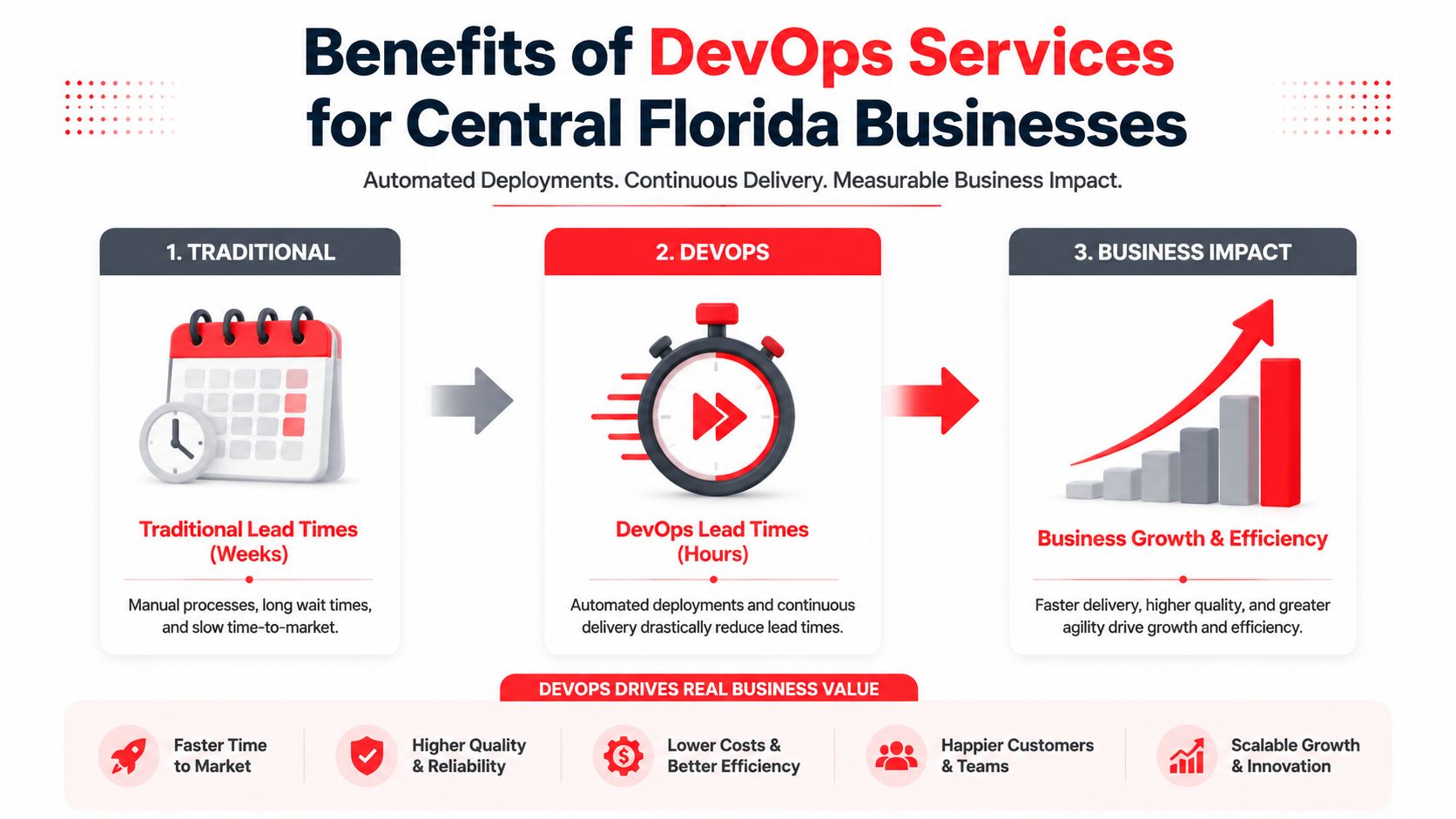
The strongest benefit is not speed by itself, it's predictability. When deployment steps are automated and environments are standardized, leaders can plan around release windows instead of bracing for random disruption. That matters for Central Florida firms that need to serve clients, maintain uptime, and keep internal teams from burning time on repetitive fixes.
Another benefit is operational consistency across expanding teams and locations. A cloud environment configured once and deployed the same way each time is easier to scale, easier to roll back, and easier to troubleshoot. That reduces the kind of drift that happens when one office uses a slightly different process, one contractor keeps their own notes, and the system slowly becomes harder to support than anyone expected.
Why managed delivery changes the business case
Orlando buyers should also pay attention to how DevOps is being sold. A local provider describes DevOps as architecture plus just-in-time and managed services around cloud applications and integrations, with an emphasis on scalability, uptime, and repeatability. That packaging fits SMBs better than one-off project work because the value doesn't stop when the initial build ends.
That broader market direction is easy to see in the global DevOps outlook. Mordor Intelligence projects the market will rise from $16.13 billion in 2025 to $19.57 billion in 2026, then expand to $51.43 billion by 2031 at a 21.33% CAGR over 2026 to 2031. The same source also cites a projection from $10.4 billion in 2023 to $25.5 billion in 2028 at 19.7% CAGR. For Orlando buyers, that growth matters because it explains why local providers keep bundling DevOps with managed cloud, security, and compliance. If you want a deeper reliability framework to compare against, reliability consulting programs can help you think about operational discipline alongside delivery speed.
DevOps Engagement Models in Orlando
Orlando SMBs often run into trouble when they assume DevOps has to be packaged the same way for every business. A small company with limited IT staff needs a different operating model than a team that already manages cloud systems and just needs disciplined release support. The right fit depends on internal skill, compliance pressure, and how much management overhead the business can realistically carry.
A good way to judge the model is to ask who owns the work after the first deployment. If that answer is fuzzy, the engagement will probably stay fuzzy too.
Fully managed, co-managed, and project-based
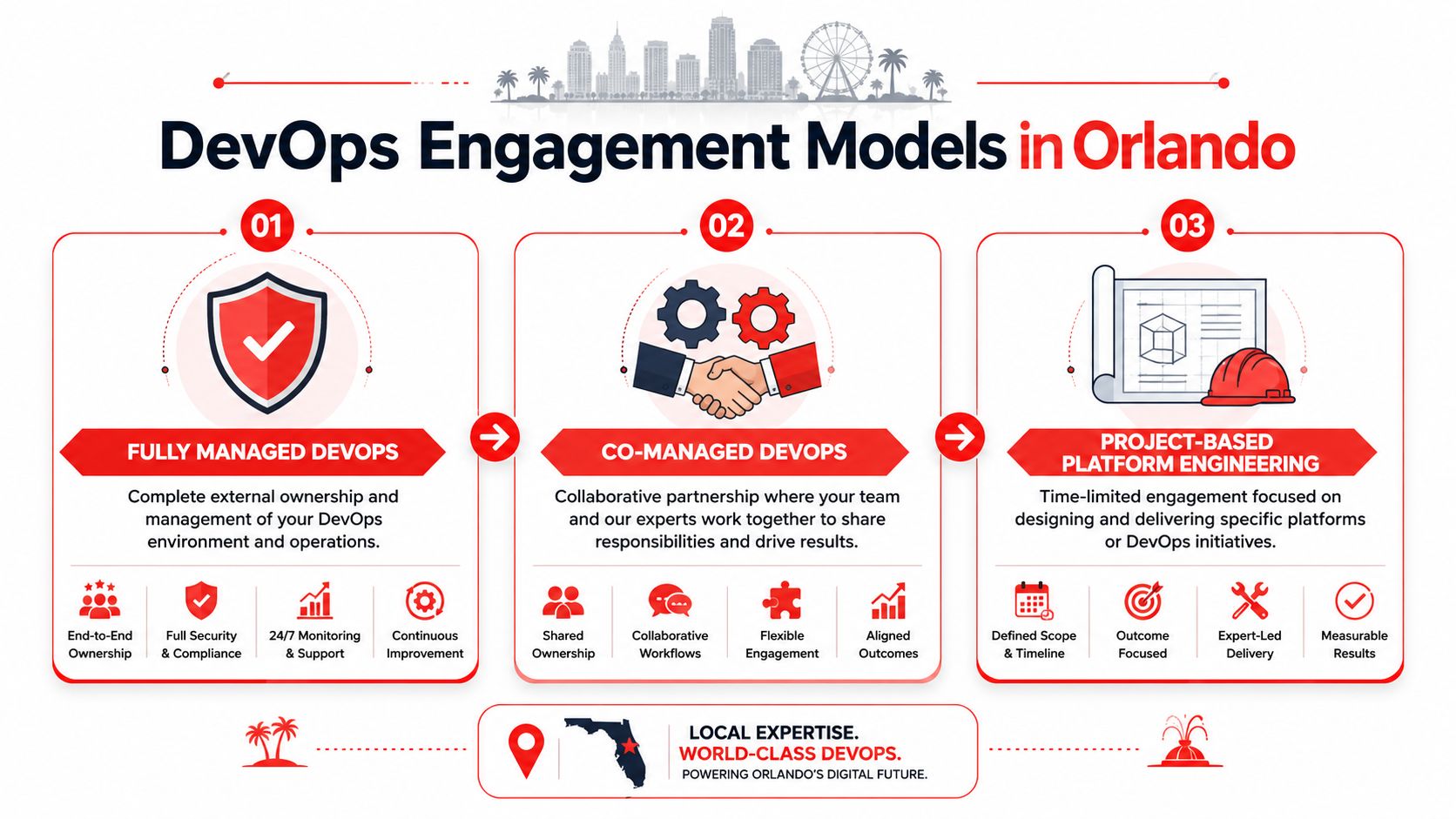
Fully managed DevOps works for organizations that want one accountable team to own the delivery path, monitoring, and operational follow-through. This model fits when the internal team is small, the environment changes often, or the business cannot keep improvising around deployment risk. It is the closest option to handing off the operational burden while still keeping clear visibility into results.
Co-managed DevOps gives the business a shared operating model. Internal IT keeps strategic control, while the external partner handles the platform engineering work that is difficult to staff or difficult to keep consistent. That approach usually fits a company that already has technical depth, but needs a more disciplined build-and-release system and clearer division of responsibilities.
Project-based platform engineering is narrower and suits a defined need, such as building a standardized release pipeline or cleaning up environment drift before a larger migration. It works best when the company wants a scoped outcome instead of a long-term managed relationship.
| Model | Scope | Typical Pricing | SLA Highlights |
|---|---|---|---|
| Fully Managed | End-to-end delivery, monitoring, and governance | All-inclusive monthly service structure | Response targets, uptime commitments, and shared accountability |
| Co-Managed | Shared responsibility between internal IT and external engineers | Retainer or blended support structure | Defined ownership by function, with escalation paths |
| Project-Based | Fixed-scope platform or automation work | Project pricing | Deliverable-based timing and acceptance criteria |
Choosing the right fit
A provider's paperwork should make ownership easy to trace. Who changes infrastructure, who approves releases, and who handles incidents should all be written down in plain language. The labels matter less than the operating rules, because a service without clear handoffs usually slides back into ad hoc support.
That is where packaging matters for Orlando buyers. Some providers structure DevOps as an all-inclusive operating service, with governance, delivery, and support bundled together so the business can budget with less guesswork. Others deliver only the build phase, which can leave the client responsible for the messy part after launch. The difference is like getting a car with a maintenance plan versus buying the car and hoping someone else remembers the oil changes.
A proposal should also show where accountability lives for Infrastructure as Code, observability, and release approvals. If those pieces are missing, the team may be able to deploy faster, but it will not have a reliable way to prove what changed, when it changed, or who signed off. That is the operational discipline Orlando SMBs need when they want predictable pricing and measurable responsibility.
The market signal in Orlando is that DevOps is increasingly delivered as managed cloud and integration engineering, not as one-off project work. The packaging matters because buyers need to ask how the service is governed, not only what it automates. Cyber Command, LLC is one example of a local partner that offers managed and co-managed IT alongside DevOps and platform engineering, and the same question applies to any provider, ask how responsibility is assigned before asking how fast they can deploy.
Integrating Security and Compliance with DevOps
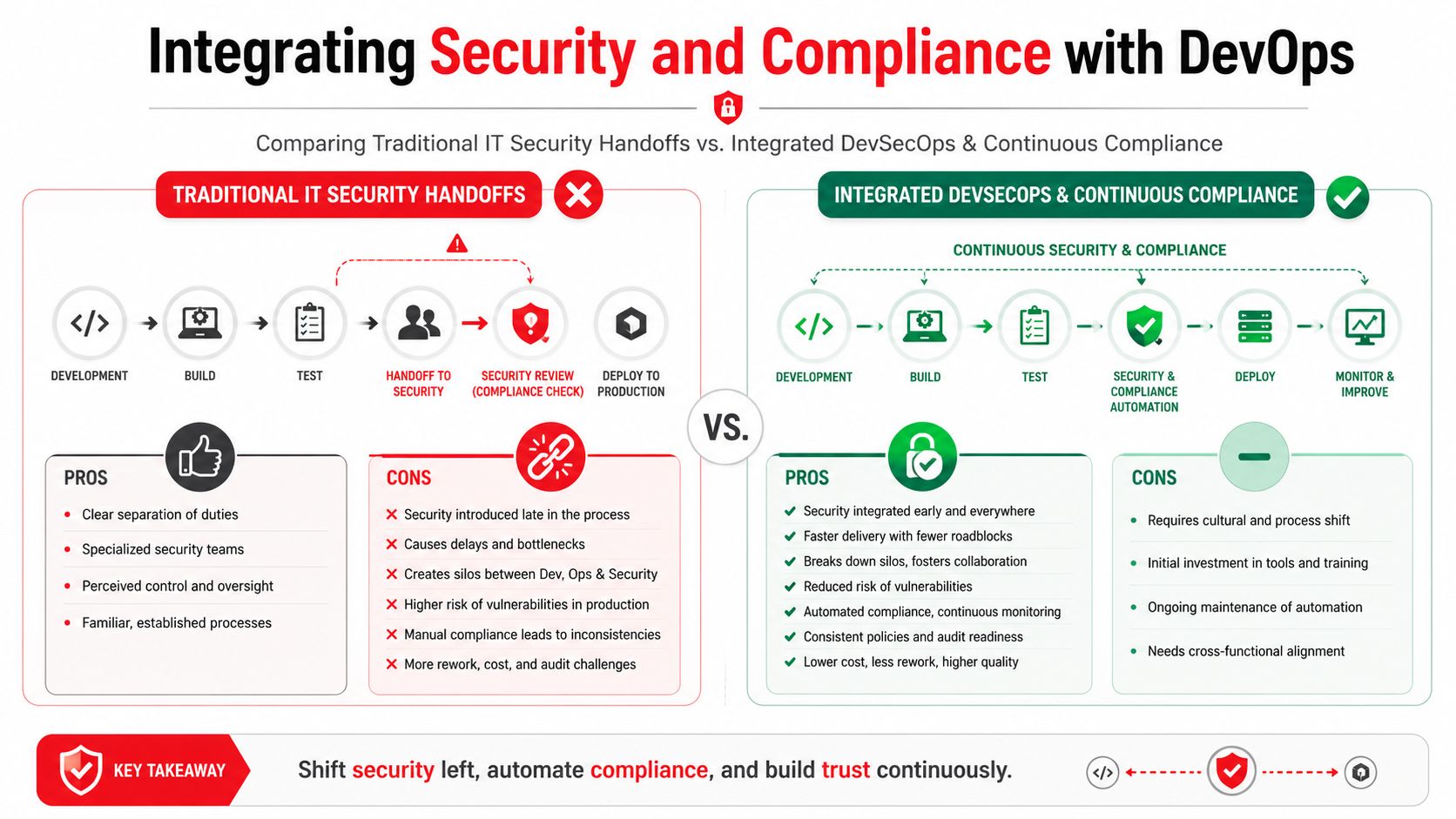
A fast release can still create a business problem if it weakens access control, auditability, or recovery. In regulated environments, DevOps works best when security is built into the release path from the start, so Orlando firms in professional services, healthcare, and finance do not have to choose between speed and control.
Why the control stack has to move together
A solid service treats identity and access controls, immutable backups, and 24/7 monitoring as parts of the same control stack. If one layer is weak, the others lose value quickly. A stolen credential, for example, can make a backup less useful if the restore path is not clean and the alerting layer is not watching for unusual activity.
Continuous compliance matters for the same reason. The pipeline should verify the person or service account making a change, preserve tamper-resistant restore points, and alert the security team when something looks off. Cyber Command's platform engineering design describes a zero-trust approach that combines identity management, MFA, immutable backups, and continuous SOC oversight to reduce blast radius and improve recoverability.
Security checkpoint: if a proposal talks about deployment automation but skips access control, restore testing, and monitoring handoff, it is not ready for a regulated business.
What regulated buyers should verify
For medical practices, the HIPAA Security Rule requires administrative, physical, and technical safeguards, including risk analysis and risk management. That means a vendor should be able to explain how access is granted, how changes are logged, and how incidents are handled when something goes wrong. The same logic helps professional services firms and financial firms, even when the specific compliance framework differs.
The right questions are practical. Can this partner reduce risk, prove compliance, and still ship changes quickly? Can the service show who approved the change, what was protected, and how recovery is checked after an incident? If those answers are unclear, the offer is too thin for a regulated environment.
Industry Use Cases and Orlando Case Studies
A legal practice in Orlando often runs into the same operational problem, too many small changes moving through too many hands. A document portal gets updated, a permissions fix is needed, and someone still has to track the sequence manually so the release does not break client access. Once the team moves to a controlled pipeline, the release process becomes repeatable instead of fragile, which helps attorneys and staff trust the system without having to learn infrastructure details they do not want to own.
A medical spa faces a different kind of pressure. Staff need systems that stay available during busy booking periods and patient communication windows, and a manual fallback process can create bottlenecks right when clients expect steady service. When infrastructure, backup planning, and monitoring are standardized, the business spends less time reacting to interruptions and more time keeping appointments and customer flow stable.
The central Florida pattern
An industrial services company usually deals with the widest operational spread. Field sites do not behave like a single office, and a patchwork setup across multiple locations makes support uneven. Standardized infrastructure gives the business one way to deploy, one way to restore, and one way to document change, which makes support much easier across sites.
These examples also point to a regional buying pattern. Central Florida has a large base of employer establishments, and that concentration is one reason Orlando-focused content should speak to neighboring cities too, since many buyers operate across county lines even when their main office sits in Orlando.
The best lesson from local adoption is simple. Businesses do not need DevOps because it sounds modern, they need it because scattered environments and undocumented processes make growth expensive.
For Orlando SMBs, the operational lesson is broader than technology alone. The service needs to arrive packaged with clear ownership, defined access, backup checks, and reporting that shows what changed and who is accountable. That is what turns DevOps from a vague promise into a service model with predictable all-inclusive pricing and measurable accountability.
Pricing Structures and SLAs for DevOps Services
Pricing should match the way the service is delivered. A flat monthly model works best when the provider owns ongoing operations and reporting. A project price works better when the business wants a defined build, cleanup, or migration outcome. Co-managed retainers sit in the middle, where both sides keep responsibility and the scope stays shared.
The point of an SLA is not to create legal clutter. It's to make accountability visible. Good agreements define response times, escalation paths, uptime targets, and how exceptions are handled, so the client doesn't have to chase answers during an incident.
| Model | Scope | Typical Pricing | SLA Highlights |
|---|---|---|---|
| All-Inclusive Managed | Continuous DevOps, cloud support, and monitoring | Predictable recurring service fee | Clear response windows, shared reporting, and operational ownership |
| Co-Managed Retainer | Shared engineering and support responsibilities | Monthly retainer tied to scope | Escalation rules and divided responsibilities |
| Fixed-Scope Project | Platform setup or automation work | One-time project fee | Milestones, acceptance criteria, and handoff terms |
For buyers, the hidden cost is usually not the line item, it's the gap between what the contract promises and what the team receives. Ask who writes the deployment scripts, who watches the alerts, and who fixes drift after launch. If those answers stay vague, the pricing may look clean while the operating burden stays messy.
How to Choose the Right DevOps Services Partner in Orlando
A good starting point is simple, ask how the partner handles a real production problem on a busy weekday. Orlando business leaders need a provider that can explain who answers first, how escalation works, and how fast leadership can see what happened without sorting through technical noise. Local presence matters because it usually means faster coordination, but the stronger signal is whether the provider can show clear ownership from the first alert to the final fix.
Governance should come next. A DevOps partner is like a traffic controller for your release process, it keeps changes moving without letting every lane operate on guesswork. Ask how change control works, who approves releases, and how exceptions are documented when plans shift. If the answer is vague, the service may look modern while the day-to-day operation stays unclear.


Compliance support and operational discipline should be easy to explain in plain language. If your business handles regulated data, the partner should walk through identity controls, backup practices, monitoring, and audit evidence without turning the conversation into jargon. Release accountability matters too, because a provider that sets up the tooling but cannot explain who owns each deployment leaves your team with unclear responsibility after launch.
Keep the evaluation focused on outcomes, not buzzwords. Predictable pricing, measurable accountability, and a service model that fits your internal capacity are the pieces that matter most for Orlando SMBs that want DevOps without surprise costs. If you want a local partner to show how those pieces fit together, use the Orlando office contact path and ask for a discovery call centered on your release process, your compliance needs, and the reporting your leadership team expects.
If you're ready to make DevOps more predictable for your Orlando business, contact Cyber Command, LLC and ask for a discovery conversation about managed or co-managed DevOps, cloud delivery, and security-aware platform engineering.