


A lot of Orlando business owners are dealing with the same problem right now. The company is growing, staff are working across offices or from home, clients expect fast responses, and the technology stack was never really designed for that level of pressure. What started as a few laptops, a file server, and a basic backup subscription has turned into a patchwork of systems nobody fully trusts.
That usually shows up on an ordinary workday. A law office in Winter Park can't open case files fast enough before a client call. A medical practice near Lake Nona loses access to a line-of-business application and front-desk staff start reverting to manual workarounds. An accounting firm in Downtown Orlando discovers that a “backup completed” alert didn't mean the restore would work. None of those problems feel strategic in the moment, but all of them are business problems first.
IT Infrastructure Management in Orlando FL matters because this region isn't operating like a small market anymore. Local firms in healthcare, legal, finance, architecture, engineering, and other professional services are expected to deliver enterprise-grade availability and security without carrying enterprise-size internal IT teams. That gap is where proactive infrastructure management becomes the difference between stable growth and recurring disruption.
Table of Contents
- Is Your Technology Supporting or Slowing Your Orlando Business
- What Is IT Infrastructure Management
- Why Proactive Management Is Critical for Orlando SMBs
- Cybersecurity and Compliance in Central Florida
- What to Expect from a Top-Tier Orlando IT Partner
- The Orlando Business Owner's Vendor Selection Checklist
- Frequently Asked Questions from Local Businesses
Is Your Technology Supporting or Slowing Your Orlando Business
On paper, many Central Florida companies think their IT is “fine.” Systems are up most days, people can log in, and the office internet works. But the true measure isn't whether technology exists. It's whether staff can do their jobs quickly, safely, and without interruption.
A common pattern looks like this. The business adds new employees, opens another location, adopts cloud software, and keeps layering tools onto an old foundation. Soon the network drags, permissions are inconsistent, remote staff have a worse experience than office staff, and every change creates side effects somewhere else. The owner starts hearing about technology only when something is broken.
That doesn't stay confined to IT. Delays affect billing. File access issues slow client work. Weak processes around patching and account management create security exposure. A slow system at a medical office or legal practice doesn't just frustrate staff. It affects service delivery and trust.
Businesses usually don't have an “IT problem.” They have an operations problem caused by unmanaged infrastructure.
The market is moving away from reactive support for a reason. The global IT infrastructure management market is projected to reach approximately USD 63.5 billion by 2034, growing at about 9.6% CAGR, which signals a broad shift toward proactive, tool-driven management rather than break-fix support, according to IT infrastructure management market analysis.
What slowing systems usually mean
- Recurring tickets point to design issues: If the same printer, Wi-Fi, login, or file-sync problem keeps returning, the issue is usually poor standardization, not bad luck.
- Emergency work hides technical debt: Constant “quick fixes” often mean nobody has cleaned up permissions, hardware lifecycle planning, backup validation, or network segmentation.
- Costs become unpredictable: Owners stop budgeting for strategy and start paying for interruptions.
When technology is supporting the business, people stop thinking about it. They log in, work, collaborate, and go home. That's the standard Orlando companies should expect.
What Is IT Infrastructure Management
Most owners hear the phrase and think it means “keeping computers running.” That's too narrow. IT infrastructure management is the discipline of designing, maintaining, securing, and improving the systems your business depends on every day.
A better analogy is city infrastructure. Roads, water, electricity, traffic controls, and emergency services all have to work together. If one part fails, the whole city feels it. Your company runs the same way. Devices, servers, storage, applications, cloud services, security controls, and user access all depend on each other.

The business definition that matters
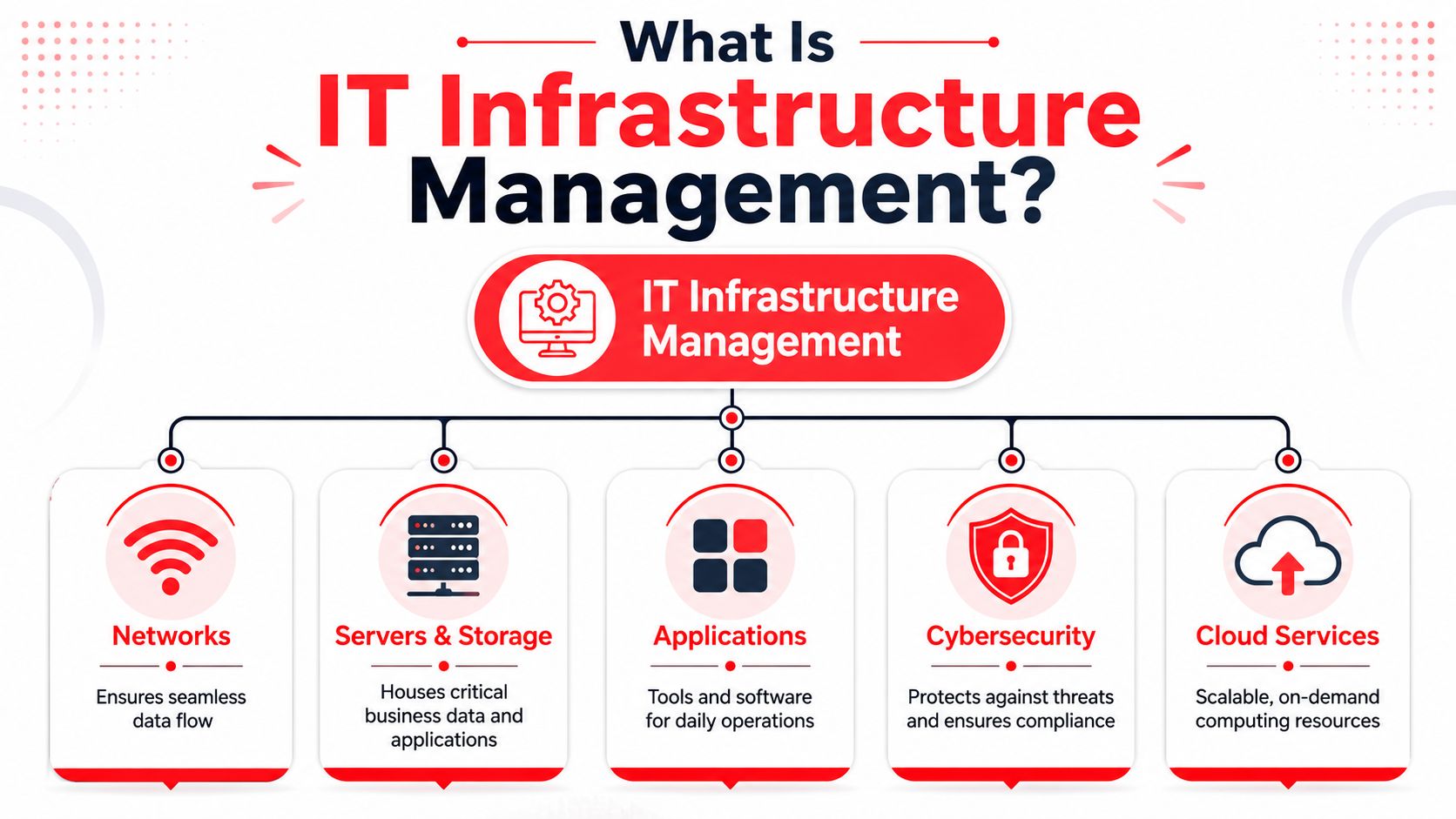
For a business owner, IT infrastructure management means making sure five things happen consistently:
- Systems stay available.
- Staff can work without friction.
- Security controls are enforced.
- Changes are made in a controlled way.
- Costs are visible enough to plan.
That includes routine work most employees never see, like patching servers, reviewing failed backups, replacing aging hardware, documenting the network, validating account permissions, and checking performance trends before users complain.
If you're comparing this idea with broader service operations, it's useful to understand how support and infrastructure work fit together inside IT service management definitions and practices. Infrastructure management is one of the practical layers that turns service promises into actual uptime.
The five components that need active management
Networks
Your network is more than internet access. It controls how staff, phones, printers, cloud apps, guest devices, and branch offices connect. In Orlando firms with multiple suites, clinics, or remote workers, weak network design often shows up as random slowness that “comes and goes.”
Servers and storage
Some firms still run local servers for line-of-business systems, file storage, or compliance reasons. Others mix local infrastructure with cloud platforms. Either way, storage capacity, redundancy, backup integrity, and recovery planning need active oversight.
Applications
Business software fails when dependencies around it fail. Login issues, outdated integrations, poor update control, and inconsistent workstation setups can make a good application look unreliable.
Cybersecurity
Security isn't separate from infrastructure. User identity, endpoint protection, patching, access control, log visibility, and segmentation all live inside the infrastructure stack.
Cloud services
Cloud adoption helps, but it doesn't eliminate management. It changes the job. Someone still has to govern access, monitor spend, align backups, and decide what belongs in cloud environments versus local systems.
A well-managed environment isn't one with the most tools. It's one where these moving parts are documented, monitored, and aligned with how the company operates.
Why Proactive Management Is Critical for Orlando SMBs
Many small and mid-sized businesses still treat IT support like maintenance on an air conditioner. If something breaks, call someone. That approach doesn't hold up once the company depends on cloud apps, remote access, compliance controls, and always-on client service.
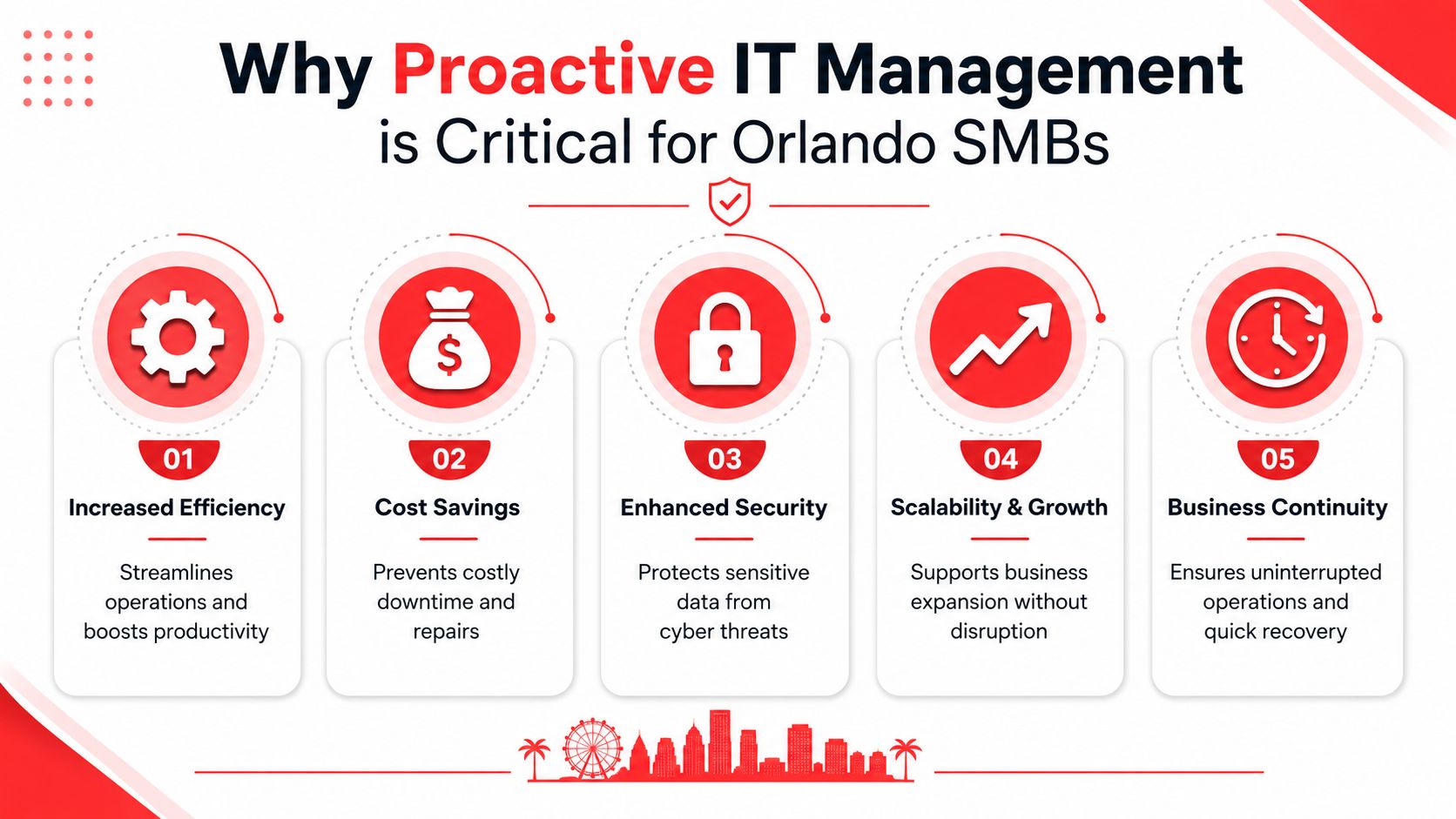
Orlando firms are especially exposed because growth adds complexity faster than most internal teams can standardize it. New locations, remote staff, industry-specific software, and tighter client expectations all increase the cost of downtime. A reactive provider might restore service eventually. A proactive one works to prevent the outage, shorten the blast radius, and recover cleanly when something still goes wrong.
Reactive support breaks at the worst time
Break-fix support usually looks cheaper until you account for what it interrupts. The outage doesn't happen during a quiet hour. It hits during billing, intake, a client deadline, or a compliance-sensitive workflow.
The deeper issue is that reactive support doesn't build maturity. It doesn't standardize devices, enforce patch windows, clean up old permissions, or test recovery paths. It waits for failure to reveal what should have been managed in advance.
Practical rule: If your provider mostly talks about ticket response, not prevention, they're supporting incidents instead of managing infrastructure.
Resilience is now an operating requirement
Recovery expectations are getting tighter. A 2023 survey found that 68% of organizations demand sub-two-hour recovery-time objectives for critical workloads, and cloud-based DRaaS reduced mean time to recovery by 40 to 60%, according to research on infrastructure recovery challenges and solutions. For Orlando architecture, legal, accounting, and consulting firms, that changes what “backup” should mean.
Backup alone isn't enough. Businesses need restore testing, application dependency mapping, and a clear order of operations during an outage. The questions that matter are operational:
- Which systems must come back first: Billing, phones, document management, scheduling, or clinical systems?
- Who approves failover decisions: Not every outage should trigger the same recovery action.
- Can staff work from another location: If the office is unavailable, remote access and identity controls have to hold up.
A proactive model also helps businesses scale with less friction. When onboarding, permissions, workstation standards, cloud access, and documentation are consistent, adding staff or another office becomes a process instead of a scramble.
That consistency is what turns IT from a recurring distraction into an operating asset.
Cybersecurity and Compliance in Central Florida
Healthcare, legal, financial, and other professional services firms in Central Florida face a harder reality than general office environments. They hold sensitive records, depend on constant access to systems, and often don't have much tolerance for service interruption. That combination makes infrastructure decisions inseparable from cybersecurity.
In practice, many of the biggest risks are ordinary failures. Old accounts never get disabled. A remote employee uses an unmanaged device. A shared folder has broad access nobody reviews. A clinic separates guest Wi-Fi from internal traffic poorly, or not at all. Attackers don't need dramatic weaknesses if basic controls are loose.

Why regulated firms in Orlando carry more risk
Florida's breach profile makes the issue concrete. Health-care-related data breaches accounted for roughly 42% of all reported breaches in the state, with smaller practices often cited for inadequate network segmentation and missing endpoint protection, according to Flexential's overview of IT infrastructure management and Florida breach risks.
That matters for privately owned medical practices, dental groups, veterinary clinics, accounting firms, and law offices across Orlando, Winter Park, Kissimmee, and surrounding Central Florida cities. These businesses often have high-value data but limited internal security depth.
A compliance-driven infrastructure baseline usually includes:
- Identity controls first: Privileged accounts need multi-factor authentication, and remote access should never rely on weak shared credentials.
- Segmentation by function: Clinical, finance, HR, operations, and guest traffic shouldn't all live in the same flat environment.
- Logging and review: Security events need centralized visibility so suspicious activity isn't discovered days later by accident.
- Routine patch discipline: Critical systems need a defined cadence, not “when we have time.”
For firms that want a practical baseline, Cyber Command's guide to cybersecurity best practices for small businesses is a useful starting point for turning policy into day-to-day controls.
What secure infrastructure looks like in practice
Compliance language can make this feel abstract. It isn't. A secure environment is visible in how the business works every day.
A law office should be able to add or remove user access through a documented process. A medical spa should know where patient-related data is stored, who can access it, and how it's protected in transit and at rest. An engineering firm with hybrid staff should enforce device standards before that staff connects to project files from home or a job site.
Security improves when access, devices, and data flows are standardized. Most breaches take advantage of inconsistency.
What doesn't work is bolting security onto unstable infrastructure. If patching is inconsistent, backups are unverified, and user permissions are poorly documented, the environment stays fragile no matter how many alerts get generated. In Central Florida's regulated sectors, resilience and compliance come from disciplined infrastructure management first.
What to Expect from a Top-Tier Orlando IT Partner
At 8:15 on a Monday, the phones are down, the internet is unstable, and your team cannot reach the files they need. In a healthcare office, that delays patient scheduling. In a law firm, it can interrupt filing deadlines and client communication. In a professional services firm, it stalls billable work. A strong IT partner is judged in moments like that, but its primary value shows up earlier, in the planning and standards that keep those disruptions from happening in the first place.
A serious Orlando IT partner takes ownership of operations, not just tickets. The job is to reduce downtime, control risk, and help you make sound technology decisions before failures turn into lost revenue or compliance trouble.
That starts with a clear service model. You should know what is monitored, how incidents are escalated, who owns vendor coordination, and what gets reviewed each month. If those answers stay vague during sales conversations, they will stay vague after you sign.
The service model should be operational, not reactive
A capable provider should be able to explain the work that happens between support calls. For Orlando businesses with multiple offices, hybrid staff, or regulated data, that ongoing work matters more than the help desk script.
Look for evidence of execution in areas like these:
- Infrastructure monitoring: Servers, firewalls, switches, endpoints, backups, and line-of-business systems should be watched with clear alerting and response procedures.
- Patch management: Updates need a defined schedule, testing standards, exception handling, and reporting that leadership can review.
- Documentation: Network diagrams, asset records, admin access, vendor contacts, and recovery steps should be current and usable during an outage.
- Lifecycle planning: Aging firewalls, unsupported servers, and overloaded wireless networks should be identified before they become emergency projects.
- Local field support: Some issues require hands-on work. Office moves, failed hardware, wiring problems, and internet circuit cutovers usually do.
That local piece matters in Central Florida. A provider serving medical clinics in Lake Nona, legal offices downtown, or multi-site firms across Winter Park and Kissimmee needs a plan for on-site response, not just remote access tools.
Strategy should show up in regular business reviews
Support keeps the lights on. Strategy keeps you from overspending on the wrong systems or carrying avoidable risk.
A top-tier partner should bring structure to quarterly reviews. That includes asset aging, warranty status, backup results, unresolved risks, cloud spend, compliance gaps, and upcoming business changes such as a new office, acquisition, or staffing increase. For healthcare and legal firms in Orlando, those conversations should also account for retention requirements, access controls, and audit readiness.
Co-managed arrangements need the same clarity. If you already have an internal IT manager or office administrator handling day-to-day issues, the outside partner should fill the gaps cleanly. That may mean after-hours coverage, security monitoring, project delivery, Microsoft 365 administration, or better documentation. Overlap creates confusion. Defined ownership reduces it.
If you want a practical framework for evaluating that fit, this guide on how to choose a managed service provider is a useful starting point.
Good providers also address connectivity as business risk
Many Orlando owners think of internet service as a utility decision. It is an uptime decision.
A provider worth hiring should review circuit redundancy, firewall failover, office Wi-Fi coverage, and ISP escalation paths, especially for firms that depend on cloud systems, VoIP, imaging, or remote access. Before signing a long-term contract, it helps to compare top business internet options against your location, application needs, and tolerance for downtime.
One Orlando example is Cyber Command, LLC. The relevant point is not branding. It is whether the provider offers managed and co-managed support, clear reporting, live help desk coverage, and security operations that match the needs of regulated and service-based businesses in this market.
A top-tier partner makes the environment more predictable every quarter. Fewer surprises. Better documentation. Faster recovery. Lower exposure. If your systems still feel improvised six months into the relationship, you are paying for support without getting management.
The Orlando Business Owner's Vendor Selection Checklist
A vendor decision usually looks fine until the first real incident. The internet drops during a Monday intake rush at a Winter Park law office. A dental practice in Kissimmee loses access to imaging. A medical group near downtown Orlando gets hit with a phishing event and no one can say, in plain terms, who owns containment, recovery, and patient-facing communication. Vendor selection should prevent that kind of confusion before the contract is signed.
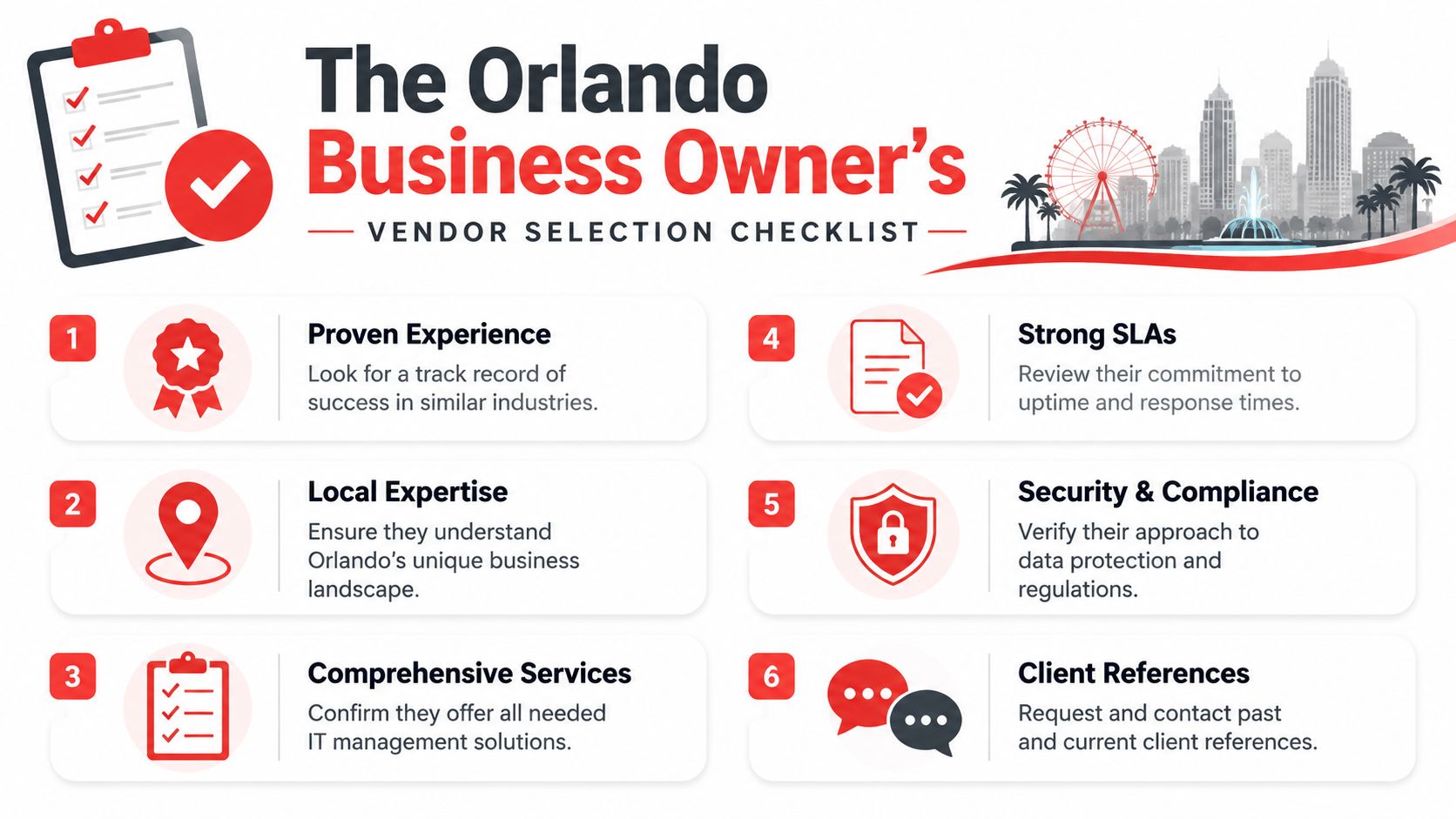
The right provider fits your operating model, your compliance exposure, and the way your staff operates. In Orlando, that matters more than polished sales language. Healthcare groups need tighter control over access, backups, and auditability. Law firms care about document security, retention, and reliable remote access for attorneys. Professional services firms often need stable cloud performance across multiple offices, home users, and field staff.
Questions that expose weak providers fast
Ask direct questions and listen for specific process details, not broad promises.
- Industry fit: What experience do they have with your applications, retention rules, access approvals, and regulatory obligations?
- Local response: If a firewall fails, a circuit goes down, or an office relocation needs cutover planning, who handles it and what is the response path?
- Standardization: How do they manage workstation builds, identity controls, patching, backup checks, onboarding, offboarding, and site-to-site consistency?
- Reporting: What do monthly or quarterly reports include? You should see risk status, unresolved issues, asset age, and upcoming decisions that affect budget or uptime.
- Connectivity review: Internet service affects phones, cloud apps, imaging, and remote work. If connectivity is part of the project, it helps to compare top business internet options alongside your IT evaluation.
A second screen helps. This practical guide on how to choose a managed service provider is useful if you want a sharper evaluation process.
How to judge cost control without getting vague answers
Cloud, on-premises, and hybrid environments each have advantages. Cloud can reduce hardware burden and speed up deployment. On-premises can make sense for legacy applications, specialized equipment, or stricter control requirements. Hybrid is common in Orlando firms that need to balance line-of-business software, compliance, and multiple office locations.
The problem is not the platform choice. The problem is unclear ownership and poor financial discipline. A capable provider should explain where your monthly spend goes, which costs are fixed, which ones can rise with headcount or usage, and what projects are likely over the next 12 to 24 months. If they cannot explain that in plain language, budget surprises are likely.
| Checklist area | What a strong answer sounds like |
|---|---|
| Scope clarity | “Here is what is covered in the monthly agreement, what is excluded, and how project work is approved.” |
| Security ownership | “Here are the controls we manage, the alerts we review, and the incidents we escalate.” |
| Compliance support | “Here is how technical controls map to your healthcare, legal, or professional services requirements.” |
| Cost planning | “Here is your recurring monthly spend, plus hardware lifecycle, licensing, and project items to budget for.” |
| Multi-site support | “Here is how we keep policies, access, and support consistent across each Central Florida location.” |
A good vendor makes risk easier to see and costs easier to forecast. That is the standard.
Frequently Asked Questions from Local Businesses
Business owners across Orlando, Winter Springs, Kissimmee, and nearby cities tend to ask practical questions, not theoretical ones. They want to know how this works for their office, their staff, and their industry. That's the right focus.
Orlando IT Management FAQ
| Question | Answer |
|---|---|
| Does a small healthcare or dental office really need formal infrastructure management? | Yes. Smaller regulated offices often have less margin for error because a few weak controls can affect patient data, scheduling, billing, and daily operations all at once. |
| What about law firms and accounting firms that already use cloud software? | Cloud applications reduce some infrastructure burden, but they don't remove responsibility for identity, endpoints, backups, permissions, connectivity, and secure remote access. |
| How is co-managed IT different from fully managed IT? | Co-managed IT supports an internal employee or small internal team. The outside partner usually handles areas like after-hours coverage, cybersecurity operations, patching, vendor coordination, or larger infrastructure projects. |
| Can one provider standardize multiple offices in Central Florida? | Yes, if they document the environment, align network and endpoint standards, and apply the same onboarding, security, and support processes across each location. |
| Does local data center growth matter to my business? | It can. Orlando's stronger regional infrastructure footprint supports better options for resilient hosting, colocation strategy, and hybrid designs for companies that need lower-latency regional services or tighter control. |
| What industries benefit most from this in Central Florida? | Healthcare, legal, accounting, architecture, engineering, financial services, veterinary practices, and other professional services often see the fastest value because downtime and weak security affect both operations and trust. |
| Is hybrid work part of infrastructure management now? | Absolutely. Secure access, device control, user identity, and support for staff working from home, clinics, branch offices, or job sites all belong inside the infrastructure plan. |
| How do I know whether my current setup is the problem? | Look for recurring tickets, inconsistent user experiences, unclear ownership, weak documentation, surprise costs, and uncertainty about recovery if a critical system fails. |
One final point matters for Central Florida specifically. Generic MSP messaging often treats every market the same. That's a mistake. Orlando businesses operate across healthcare, tourism-adjacent professional services, community organizations, multi-office service firms, and hybrid teams spread across the region. The strongest infrastructure plans reflect that local mix instead of forcing every company into the same template.
If your business is tired of recurring outages, unclear IT costs, or security gaps that keep getting deferred, Cyber Command, LLC is worth contacting for a direct review of your current environment. A practical conversation should cover your uptime risks, compliance pressure, support model, and whether your infrastructure is built for where the company is going next, not just where it was two years ago.