


For professional service firms, generic IT support is a gamble you just can't afford. When you're a lawyer, accountant, or medical professional, your IT isn't just about keeping the lights on—it's the very foundation of client trust, regulatory compliance, and data security. That’s where specialized IT support for professional services comes in, offering a level of industry-specific expertise that a generalist provider simply can't touch.
Why Generic IT Fails Professional Services
Think of it like this: you wouldn't hire a general contractor to design the blueprints for a new, HIPAA-compliant hospital wing. Sure, both can build, but only a specialized architect understands the complex web of requirements for medical infrastructure. The same logic applies to your firm's technology.
Generic IT support treats your sensitive client files, financial records, and patient data just like any other business's data. In a high-stakes environment, that's a massive, and unnecessary, risk. For firms in Central Florida hubs like Orlando, Tampa, and Winter Park, where reputation is everything, a single data breach doesn't just mean downtime. It can shatter client relationships and trigger severe legal and financial penalties.
The Specialization Gap
The real issue is a fundamental gap in understanding. A generic provider's main job is to keep things running and solve problems as they pop up. A specialist, on the other hand, is laser-focused on risk, compliance, and turning technology into a strategic advantage. It's the critical difference between reactive fixes and proactive protection.
This disconnect becomes painfully obvious when you look at specific needs:
- Cybersecurity: A one-size-fits-all firewall won't cut it. Professional firms need targeted defenses against sophisticated phishing schemes aiming to access client trust accounts or ransomware that could lock up years of critical legal files.
- Compliance: Do you handle data governed by HIPAA, FINRA, or other strict regulations? A generalist IT provider may not have the deep knowledge to configure and manage your systems to meet these standards, leaving your firm wide open to audits and fines.
- Workflow Integration: Your specialized software—for legal case management, accounting, or electronic health records—is the lifeblood of your firm. A generalist who's never seen it before will struggle to troubleshoot it, leading to frustrating delays and lost productivity.
A standard IT provider sees a server. A specialized partner sees a fortress that needs to protect client trust accounts and comply with FINRA regulations. This table breaks down the core differences.
General IT vs. Specialized Professional Services IT Support
| Feature | Standard IT Support | Specialized IT for Professional Services |
|---|---|---|
| Primary Goal | Maximize uptime, fix general issues. | Minimize risk, ensure compliance, optimize workflows. |
| Security Focus | Basic network security (firewalls, antivirus). | Advanced, layered security targeting industry-specific threats. |
| Compliance | General awareness, but not an area of expertise. | Deep expertise in HIPAA, FINRA, etc., with compliance-driven configurations. |
| Software Support | Best-effort support for common business software. | Expert-level support for industry-specific applications (e.g., case management, EMRs). |
| Approach | Reactive ("break-fix"). | Proactive and strategic. |
In short, one keeps the computers on, while the other protects your entire practice.
The Growing Need for Experts
The market for IT professional services is exploding. Projections show it will surge by USD 781.5 billion from 2026 to 2030, powered by a staggering 11.4% CAGR. North America is leading the charge, responsible for 39% of that growth as firms scramble to modernize.
But there's a catch: a severe talent shortage is causing project delays that average 15%. This hits smaller professional service firms the hardest, as they can't compete with larger corporations for the few available experts.
For a law firm in Tampa or an accounting practice in Lake Mary, this talent gap means that leaning on a specialized outsourced IT partner isn't just an option—it's a strategic move for survival and security. If you go with a generalist, you're going to get generalist results.
Ultimately, choosing IT support for professional services is about aligning your technology with the core of your business: protecting sensitive information and maintaining impeccable client trust. To see what a true IT partnership should look like, you can explore our guide on what IT support should actually do for your business. This isn't just an IT decision; it's a business decision that protects your reputation and secures your future.
The Pillars of a Modern IT Strategy for Your Firm
A modern IT strategy for a professional services firm isn’t just about having fast computers or an internet connection that works. It’s a framework built on several distinct pillars that have to work together to protect your firm, keep you operational, and help you grow. If you neglect one, it’s like building a house with an incomplete foundation—sooner or later, you're going to see cracks.
For firms in Orlando, Kissimmee, or anywhere in Central Florida, getting these pillars right is non-negotiable. You’re not just protecting your own business; you're safeguarding sensitive client data and your professional reputation. Think of these as the essential blueprints for a secure and resilient practice.
Managed IT Services: The Core Framework
The first and most foundational pillar is comprehensive Managed IT Services. This is so much more than having a number to call when a printer jams. It’s like having an entire expert IT department—from strategic C-level planning down to daily support—but for a fraction of what it would cost to hire an in-house team.
A true managed services partner pulls your firm out of the old reactive "break-fix" cycle and into a proactive management model. They monitor your systems around the clock to catch problems before they cause downtime. When every minute is a billable hour, that proactive approach is everything.
The right kind of IT support sits at the very top of the technology hierarchy, purpose-built for the demands of professional firms.
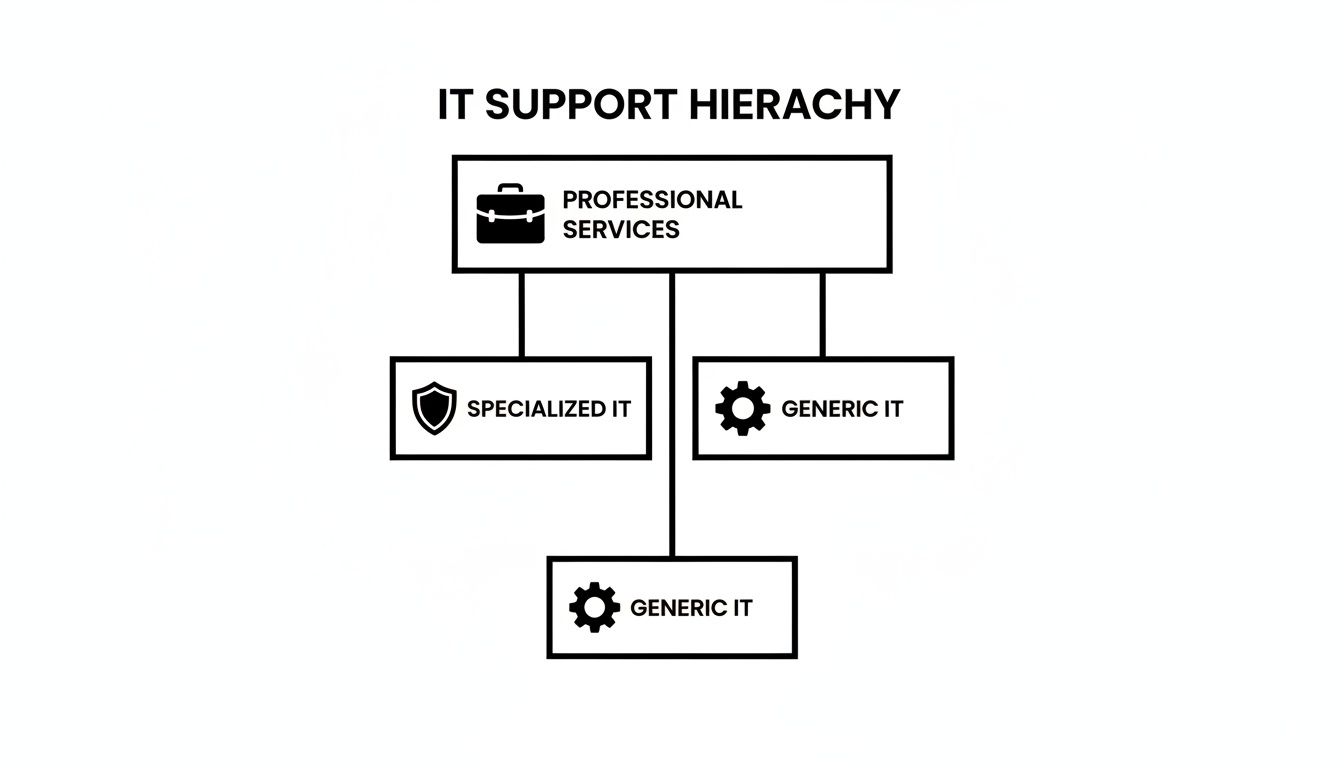

As you can see, generic IT provides the base, but it’s the specialized layer that truly understands and supports the unique, high-stakes environment of professional services.
Advanced Cybersecurity and the SOC
Next up is a cybersecurity posture that’s both tough and intelligent, anchored by a Security Operations Center (SOC). Think of a standard firewall as the lock on your office door. A SOC is the 24/7 digital security team actively patrolling your virtual perimeter, investigating every shadow, and responding instantly to any sign of trouble.
A SOC provides real, active defense:
- Active Threat Hunting: Instead of waiting for an alarm to go off, they’re proactively searching your network for hidden intruders that evade standard defenses.
- Incident Response: When a breach is detected, a dedicated team is already on deck to contain and neutralize the threat, minimizing the damage.
- Continuous Monitoring: They use sophisticated tools to watch for anything out of the ordinary—from strange login attempts to unusual data movements—that could signal an attack.
For any firm handling confidential client information, this level of active defense has become an absolute necessity.
Compliance Management and Audits
For law firms, financial advisors, and medical practices, compliance isn’t just a good idea—it’s a prerequisite for staying in business. Navigating the technical maze of regulations like HIPAA and FINRA is a full-time job. A specialized IT partner demystifies this process, implementing and documenting the controls needed to make sure your firm is always audit-ready.
This means your technology isn't just working; it's meticulously configured to meet specific legal standards, protecting you from crippling fines and the kind of reputational harm you can't just fix.
The increasing complexity of hybrid cloud environments and relentless cybersecurity threats are pushing more firms to seek out experts. The global market for IT Managed Services is projected to hit USD 437.26 billion by 2026, a growth driven largely by a talent shortage that keeps firms from handling these demands internally. You can dig deeper into the managed services market trends to see the full scope of this shift.
U.S.-Based 24/7/365 Helpdesk
Finally, the whole strategy rests on fast, expert support. When a critical application crashes ten minutes before a client meeting or you can’t access a case file, you need immediate help from someone who gets the urgency.
A U.S.-based, 24/7/365 helpdesk ensures your team gets effective support without fighting through time zone delays or communication barriers. Because for a professional services firm, downtime is never just downtime—it’s lost revenue and eroding client trust.
Cybersecurity Threats Facing Florida Firms in 2026

For professional services firms in Central Florida, cybersecurity isn't some abstract IT problem. It's a direct threat to your business. The dangers facing a law firm in Orlando, a financial advisor in Tampa, or an accounting practice in Lake Mary are specific, sophisticated, and carry devastating consequences. This isn't about generic fear-mongering—it’s about understanding the real scenarios that threaten your reputation, your clients, and your bottom line.

Think about it. A ransomware attack encrypts every single case file just one week before a major court date. Or a cleverly disguised phishing email tricks a partner into giving up their login credentials, handing attackers the keys to sensitive M&A data. These aren't far-fetched hypotheticals; they are the daily realities that keep business owners up at night.
The financial and reputational stakes are sky-high. A single breach can trigger staggering regulatory fines, a mass exodus of clients, and years spent trying to rebuild the trust you lost. For professional firms, where confidentiality is the bedrock of your business, that kind of damage can be permanent.
The Anatomy of a Modern Attack
Today’s cyber threats have evolved far beyond the simple viruses of the past. Attackers are now running sophisticated, targeted campaigns designed to exploit the specific vulnerabilities of professional services. They know you handle valuable information, and they know you're often willing to pay to get it back.
Here are the primary threats that Central Florida firms are up against in 2026:
- Ransomware-as-a-Service (RaaS): Cybercriminal groups now sell ransomware tools on the dark web, making it easy for even low-skilled attackers to target your firm. They encrypt all your critical files—client records, financial statements, case documents—and demand a hefty ransom, with downtime lasting days or weeks.
- Business Email Compromise (BEC): This is a highly targeted scam where a criminal impersonates a senior partner or a trusted vendor. They might send a completely legitimate-looking email to your accounting department asking for an urgent wire transfer to a fraudulent account.
- Credential Theft & Data Exfiltration: Attackers use incredibly convincing fake login pages and phishing emails to steal usernames and passwords. Once they’re in, they don't just encrypt data—they steal it, threatening to leak sensitive client information online if you don't pay.
These attacks often start with a single, innocent mistake. In fact, a recent report found that human error was a factor in 74% of all breaches. This statistic alone underscores the need for a security strategy that goes far beyond just technology. To see what these tactics look like in the wild, you can learn about the most common cyber attacks on small businesses and how to spot them.
Reactive Break-Fix vs. Proactive Defense
How your firm approaches these threats is what separates survival from disaster. The old "break-fix" model of IT—where you only call for help after something breaks—is dangerously obsolete in today’s environment.
Waiting for an attack to happen before you act is like waiting for your office to be engulfed in flames before you think about installing smoke detectors. By the time you notice the problem, the damage is done. This reactive posture leaves your firm completely exposed and just waiting for the next attack, which is always right around the corner.
A proactive security strategy assumes you are a constant target. It focuses on building multiple layers of defense designed to prevent, detect, and respond to threats before they can cause harm. This is the core philosophy of a true managed security partner.
A proactive approach, driven by proper IT support for professional services, flips the script. It includes several critical components working in concert:
- Active Threat Hunting: Security experts aren't just sitting around waiting for an alarm. They are actively searching your network for signs of sophisticated intruders who may have slipped past automated defenses.
- Continuous Compliance Monitoring: Your systems are constantly measured against regulatory standards like HIPAA or FINRA, ensuring you are always audit-ready and shielded from compliance-related penalties.
- Robust Employee Security Training: Your team is your first and most important line of defense. Ongoing training transforms employees from a potential liability into a human firewall, teaching them how to recognize and report suspicious activity before it's too late.
By adopting a proactive stance, you move from a position of vulnerability to one of strength and resilience. Instead of just waiting for the next crisis, you build an organization capable of withstanding the persistent and ever-evolving threats of the modern world.
How AI Is Becoming Your IT Co-Pilot

The future of IT support for professional services is already unfolding, and it’s powered by Artificial Intelligence. But this isn't about robots taking over the helpdesk. It’s much smarter than that.
Think of AI as an incredibly sharp co-pilot. It handles the routine flight checks and scans the horizon for trouble, freeing up the human IT pilot to focus on getting your firm to its destination. This partnership allows your IT provider to stop just reacting to problems and start aligning your technology directly with your business goals.
AI Doesn't Replace Expertise—It Amplifies It
The real power of AI is how it enhances human skills. For a busy law firm in Orlando or an accounting practice in Winter Springs, this means faster solutions and smarter security. AI-driven tools work tirelessly in the background, handling tasks at a scale no human team could ever manage alone.
This creates a far more resilient and efficient operation for your firm:
- Predictive Maintenance: AI algorithms analyze performance data from servers and workstations to spot hardware failures before they cause a crisis. This is the difference between replacing a failing hard drive during scheduled maintenance and scrambling to recover data after a crash.
- Automated Security: AI constantly hunts for security vulnerabilities and can automatically deploy critical software patches across your entire network. It closes security gaps much faster than humanly possible, shrinking your firm’s exposure to threats.
- Intelligent Helpdesks: AI-powered helpdesk systems instantly resolve common issues like password resets or simple software questions. This frees up human technicians to dig into complex problems that demand real critical thinking.
As AI becomes a core part of business operations, tools like automated Invoice Data Extraction Software show its power in action. They demonstrate how AI can take on tedious, repetitive work, freeing your team to focus on high-value client activities.
Shifting from Reactive Fixes to a Proactive Partnership
By offloading the day-to-day monitoring and maintenance to AI, your IT partner finally has the bandwidth to focus on what truly matters—your business strategy. The conversation shifts from, "What's broken today?" to "How can we use technology to help you grow?"
AI is fundamentally changing IT support. Generative AI adoption skyrocketed from 33% in 2023 to 71% in 2024. High-performing firms now treat AI as an operational partner, which can slash unproductive task time by 23%.
But this partnership relies on human oversight. While 88% of leaders trust AI to handle operations, a crucial 89% still verify its output, proving the need for an expert hand at the controls. This is why you need an experienced IT provider to integrate these tools effectively. You can dig into how these trends are shaping the future in this professional services outlook.
This "human-in-the-loop" approach is the new standard. The AI co-pilot handles the system checks, but the human pilot is still making the critical decisions and navigating your firm toward its goals. This collaboration ensures your technology doesn't just run—it drives your business forward.
Choosing the Right IT Partner in Central Florida
Picking the right IT partner for your professional services firm feels like a huge decision—and it is. This choice ripples through everything you do, from day-to-day operations and data security to client trust and staying on the right side of compliance.
For firms in Central Florida hubs like Orlando, Tampa, or Lake Mary, this isn't just about finding a vendor who can fix a broken computer. It's about finding a local partner who gets your industry's specific pressures and can offer real, strategic guidance. You need a team that thinks beyond just reacting to problems and helps you plan for the future.
Fully Managed vs. Co-Managed IT
The first step is deciding what level of help you actually need. It really boils down to two main approaches, and the right one depends entirely on your firm’s current setup and what you want to achieve.
- Fully Managed IT: This is the all-in-one, "we handle everything" solution. You're essentially outsourcing your entire IT department to a team of experts. It’s the perfect fit for firms without an internal IT person, covering everything from the 24/7 helpdesk to cybersecurity strategy for one predictable monthly fee.
- Co-Managed IT: This is more of a partnership model. The IT provider works hand-in-hand with your existing IT staff, filling in the gaps. This is ideal if you have an IT person on payroll but need to beef up your security, give your team access to a 24/7 helpdesk, or simply free up your internal staff to focus on bigger projects.
For most professional services firms, the peace of mind that comes with a fully managed plan is hard to beat. To make the right call, you need to know what a top-tier managed IT support provider in Orlando should be offering. That way, you’re comparing apples to apples.
The Value of a Local Presence
While a ton of IT work can be done remotely, don't underestimate the value of having a partner right here in the Orlando area. When a critical server finally gives up the ghost or a network outage cuts you off completely, remote support can't always save the day. You need someone who can get there—fast.
A local provider means you get a rapid on-site response when it matters most. That proximity builds a much stronger, more accountable relationship than you'll ever get from a faceless national call center.
Knowing your IT team can be in your office quickly isn't just a nice perk; it's a real, tangible benefit that directly impacts your uptime and your ability to keep working. It’s invaluable peace of mind.
Your IT Partner Evaluation Checklist
Finding the right partner means you have to dig deeper than a slick sales pitch. A true partner will have clear, confident answers to these questions.
Use this checklist to cut through the noise and systematically evaluate potential providers. It will help you see if they truly have what it takes to meet the high standards of a professional services firm.
Your IT Partner Evaluation Checklist
| Evaluation Criterion | Questions to Ask | Ideal Answer / What to Look For |
|---|---|---|
| Industry Expertise | "Can you describe your experience with other firms like mine?" "How do you handle our specific compliance needs, like HIPAA or FINRA?" | They should confidently name other firms in your industry and walk you through their specific processes for managing compliance—not just give a vague, generic answer. |
| Transparency & Reporting | "Can I see a redacted example of a client's quarterly business review (QBR)?" | The answer should be a firm "Yes." The report should show clear metrics on system health, security posture, support ticket trends, and strategic advice. A simple list of tasks completed isn't enough. |
| Service Guarantees | "What are your guaranteed response and resolution times in the Service Level Agreement (SLA)?" | Look for specific, contractually obligated timeframes. Vague promises like "we'll get to it as soon as we can" are a major red flag. |
| Cybersecurity Posture | "Tell me about your Security Operations Center (SOC). Is it 24/7? What kind of proactive threat hunting do you do?" | The answer must include a 24/7/365 SOC, active threat hunting, and a clear incident response plan. "We use firewalls and antivirus" is a totally insufficient answer in 2026. |
| Pricing Model | "Is your pricing all-inclusive, or will we see extra charges for projects, on-site visits, or after-hours support?" | The best partners offer a predictable, flat-rate price. This aligns their goals with yours—they only profit when your systems are running smoothly, with zero problems. |
By asking these direct questions, you shift the power dynamic in your favor. It forces providers to prove their value and helps you separate the true strategic partners from the vendors just looking to make a sale.
For ambitious professional services firms, it's time to stop thinking about technology as just another bill to pay. Top-tier IT support for professional services isn't a cost center to be slashed—it's a direct investment in your firm's reputation, resilience, and future growth. Making that mental shift is the final, most important step in securing your firm's success.
Throughout this guide, we've laid out the case. You’ve seen how generic, one-size-fits-all IT support leaves firms that handle sensitive client data dangerously exposed. In today’s high-stakes environment, specialized cybersecurity isn't a luxury; it's the very foundation of client trust and regulatory survival. The need for industry-aware support isn't just a preference, it's an absolute necessity.
The Local Advantage for Central Florida Firms
If your practice is in Orlando, Winter Park, or anywhere in Central Florida, the benefits of partnering with a local provider are immediate and tangible. A local team understands the specific market pressures you face because they're part of your community. They aren't just a disembodied voice on a phone line; they're the people who can show up when a remote fix just won't cut it.
That local presence translates directly into:
- Faster resolution when critical hardware or network failures bring your operations to a halt.
- Stronger relationships built on face-to-face strategic planning and a shared understanding of the local business climate.
- Greater accountability from a partner who is genuinely invested in your success right here in our community.
As you evaluate potential IT partners, it helps to know what’s going on behind the curtain. Understanding the tools they use to deliver their services gives you a clearer picture of their capabilities. For instance, you could review an all-in-one platform like Atera, which bundles remote monitoring, management, and support ticketing. Seeing how these systems work gives you insight into how a prospective partner can offer efficient, streamlined support.
Choosing the right IT partner changes the game completely. It transforms technology from a source of endless frustration into a powerful engine for growth. It elevates your firm from constantly putting out fires to proactively managing a strategic asset that fuels your success.
Your Call to Action
The last step is to take a hard, honest look at where you stand. Is your technology a source of constant headaches and unpredictable costs, or is it giving you a competitive edge? Are you truly confident your client data is protected against the sophisticated threats specifically targeting law firms, accounting practices, and medical clinics?
If there’s even a shadow of a doubt, it’s time to make a change. Don’t wait for a data breach or a catastrophic system failure to force your hand. A dedicated, specialized partner can assess your current environment, pinpoint vulnerabilities, and build a technology roadmap that actually aligns with your firm’s goals. Take the first step today to protect your practice and secure your future.
Frequently Asked Questions
When you're exploring IT support for your professional services firm, a lot of questions come up. We hear these all the time from practices across Central Florida, so here are some straightforward answers from our experience.
My Firm Is Small. Do I Really Need Managed IT Services?
That’s a fair question, and the short answer is yes—now more than ever. It's a common misconception that cybercriminals only go after the big fish. In reality, they often see smaller firms in places like Orlando and Tampa as easier targets, banking on the assumption you have less robust security.
For a small practice, a single data breach can be a business-ending event. Managed IT services give you access to enterprise-grade security and support for a predictable monthly fee, which is far more affordable than hiring a full-time expert or cleaning up the mess after a cyberattack. It’s about leveling the playing field and giving your firm the same rock-solid technology and security your larger competitors rely on.
What Is the Difference Between Managed and Co-Managed IT?
The main distinction comes down to how much you want to hand over to your IT partner. It’s all about creating the right fit for your team.
- Managed IT is the full-service, hands-off approach. Your provider essentially becomes your outsourced IT department, handling everything from big-picture strategy down to the daily helpdesk tickets. This is the perfect model if you don't have an internal IT person on staff.
- Co-Managed IT is a partnership model. Here, the provider works alongside your existing IT team, filling in gaps and adding horsepower. For instance, they might take over 24/7 security monitoring or manage the helpdesk, freeing your internal staff to focus on higher-value projects.
There's no one-size-fits-all answer. The right choice depends entirely on the resources you have in-house and where you want your firm to go.
How Does Flat-Rate IT Support Pricing Work?
Flat-rate, or all-inclusive, pricing is exactly what it sounds like: you pay one fixed, predictable monthly fee for a comprehensive bundle of IT services. This typically includes everything from unlimited helpdesk support and proactive network management to cybersecurity, data backups, and strategic guidance.
This model is incredibly effective because it makes your IT budget completely predictable. More importantly, it aligns our goals with yours. Your IT partner is incentivized to prevent problems from ever happening because it's in their best interest to keep your systems running smoothly—not to bill you more when things break.
Why Is a U.S.-Based Helpdesk Important for My Orlando Practice?
Having a U.S.-based helpdesk is non-negotiable for most professional services firms, and for good reason. First, you get immediate help from people who work in your time zone and understand the local business environment. No frustrating language barriers or overnight ticket delays.
More critically, it’s a matter of security and compliance. When your team is handling sensitive client data, you need assurance that everyone supporting your systems operates under U.S. data privacy laws. When a critical issue pops up, you need to know you're getting fast, effective, and trustworthy support from people who are accountable to the same standards you are.
Ready to turn your IT from a source of frustration into a strategic asset? The team at Cyber Command, LLC delivers proactive, compliance-driven IT support and cybersecurity built for the unique pressures of professional services firms in Central Florida. Let's create a technology plan that secures your clients' trust, protects your reputation, and fuels your growth.
Learn more about our approach at https://cybercommand.com.