



Why Agile DevOps Practices Matter for Your Business
Agile DevOps practices combine two powerful methodologies to help organizations deliver software faster, more reliably, and with higher quality. If you’re looking to understand what these practices are and why they matter, here’s what you need to know:
Core Agile DevOps Practices:
- Continuous Integration & Delivery (CI/CD) – Automated pipelines for building, testing, and deploying code
- Infrastructure as Code (IaC) – Managing infrastructure through version-controlled code
- Automated Testing – Quality gates built into every stage of development
- Cross-functional Collaboration – Breaking down silos between development and operations teams
- Continuous Monitoring – Real-time visibility into application and infrastructure performance
- Iterative Development – Short development cycles (sprints) with frequent releases
Key Benefits:
- 30% faster software delivery
- 22-50% fewer defects in code
- 2x customer satisfaction improvement
- 3x faster deployments with 2x faster incident resolution
In today’s fast-moving business environment, getting software released to users is often a painful, risky, and time-consuming process. Traditional approaches where development teams “throw code over the wall” to operations create bottlenecks, quality issues, and frustration. Meanwhile, your competitors who’ve adopted modern practices are shipping updates daily or even hourly, responding to customer needs faster, and spending less time fighting fires.
The research is clear: organizations implementing DevOps automation achieve a 312% ROI and $1.8 million NPV in just three years, with payback in under six months. High-performing companies deploy 30 times more frequently than lower performers while maintaining better quality and stability.
But here’s the reality that many businesses face: you’re dealing with outdated systems, your IT team is constantly in reactive mode, and every change feels risky. You need software that works, systems that stay up, and technology that actually helps your business grow instead of holding it back.
I’m Reade Taylor, Founder and CEO of Cyber Command. Over my career building enterprise-grade infrastructure and security systems, I’ve seen how implementing Agile DevOps practices transforms chaotic, stressful technology operations into predictable, efficient systems that drive business value. This guide will show you exactly how these practices work together and how they can help your organization achieve peak performance.
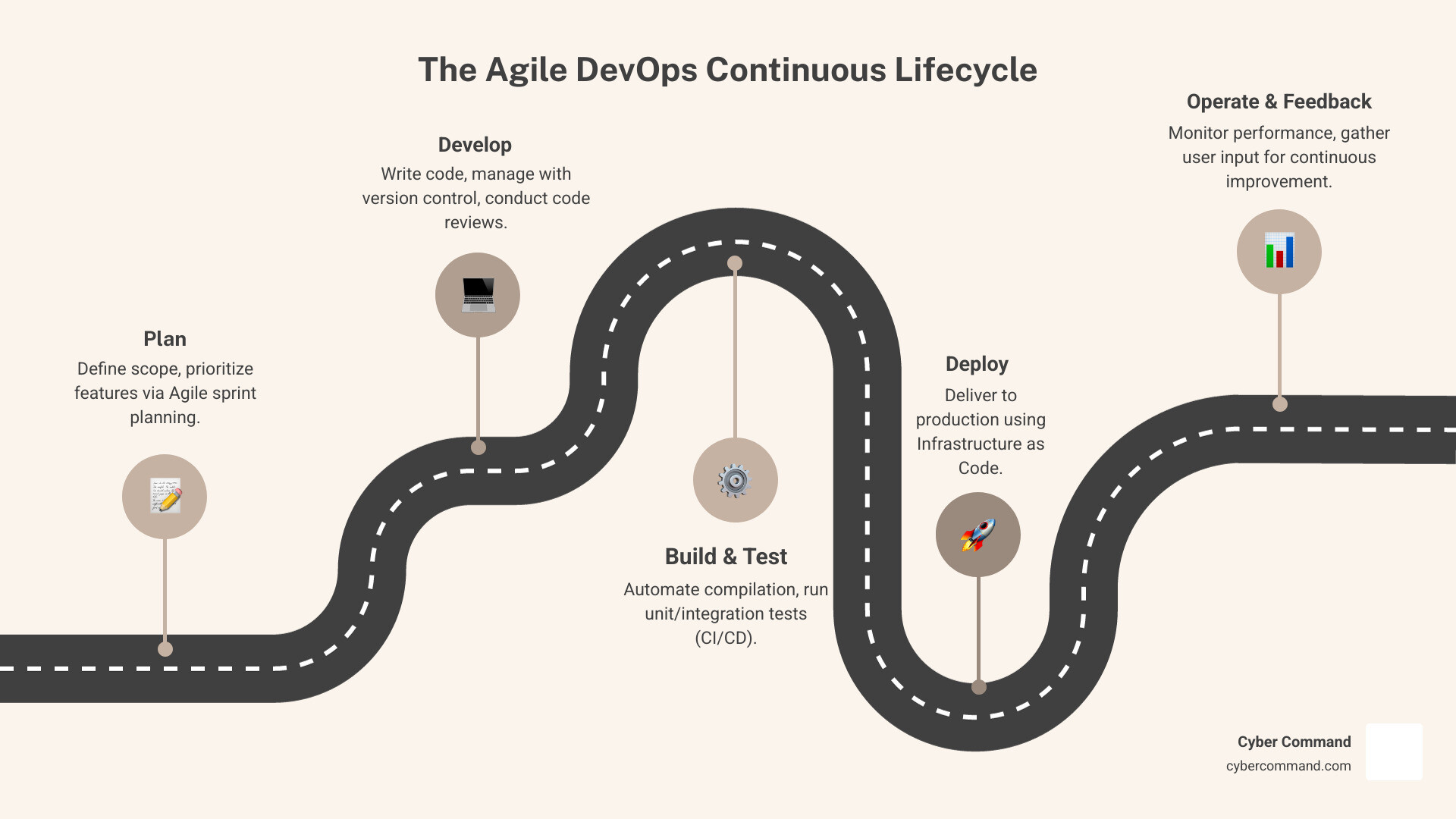

Agile DevOps practices terms to learn:
Foundations: Understanding Agile and DevOps
For years, software development felt like a game of telephone. Development teams would carefully craft their code, then “throw it over the wall” to operations teams, hoping it would run smoothly. This traditional, siloed approach often led to communication gaps, slow deployments, and a frustrating cycle of blame when things went wrong. Imagine a relay race where each runner blames the next for dropping the baton! This is the fundamental problem that modern methodologies sought to solve.


What are the Core Principles of Agile?
Agile methodologies emerged in the early 2000s as a response to the rigid, linear “Waterfall” models that often stifled innovation and made adapting to change a nightmare. The Agile Manifesto, introduced in 2001, laid out a set of values that revolutionized how we approach software development. At its heart, Agile emphasizes:
- Individuals and interactions over processes and tools: We value the people doing the work and how they communicate more than rigid rules or specific software.
- Working software over comprehensive documentation: The ultimate goal is a functional product, not endless paperwork.
- Customer collaboration over contract negotiation: We involve customers throughout the development process to ensure we’re building what they truly need.
- Responding to change over following a plan: In our dynamic world, being able to adapt quickly is more valuable than sticking to a predetermined, outdated plan.
These values drive an iterative approach to development, breaking down large projects into smaller, manageable “sprints” or “iterations.” Frameworks like Scrum and Kanban offer practical ways to implement Agile, focusing on short development cycles, continuous feedback, and rapid adjustments. This means we’re constantly planning, developing, testing, and getting feedback, ensuring we deliver value incrementally and adapt as needs evolve. To dive deeper into these foundational principles, you can read the full Agile Manifesto.
What is DevOps and What Problem Does it Solve?
While Agile focused on how we develop software, DevOps, a term coined by Patrick Debois in 2009, emerged to address how we deliver and operate it. DevOps is a portmanteau of “development” and “operations,” reflecting its core mission: to bridge the historically disconnected worlds of software development and IT operations.
The problem DevOps aims to solve is simple: the “wall” between Dev and Ops teams that leads to slow deployments, quality issues, and a lack of shared responsibility. Before DevOps, developers would build features, and operations would deploy and maintain them, often with minimal communication. This created silos, inefficiency, and a lot of finger-pointing when things went wrong.
DevOps tackles this by fostering a culture of collaboration, shared responsibility, and automation across the entire software delivery lifecycle. It’s about bringing people, processes, and tools together to create a continuous flow of software delivery. The CALMS framework often summarizes its core principles:
- Culture: Breaking down silos and fostering collaboration, trust, and shared goals.
- Automation: Automating repetitive tasks across the pipeline, from testing to deployment.
- Lean: Eliminating waste and focusing on delivering value efficiently.
- Measurement: Tracking metrics to understand performance and identify areas for improvement.
- Sharing: Encouraging knowledge sharing and feedback loops across teams.
By embracing these principles, we can move beyond manual, error-prone processes to achieve continuous integration (CI), continuous delivery (CD), and continuous monitoring, ensuring our software is not only built well but also delivered reliably and efficiently.
| Aspect | Agile | DevOps |
|---|---|---|
| Focus | Software development lifecycle | Entire software delivery lifecycle |
| Scope | Development teams, product delivery | Development, Operations, QA, Security |
| Primary Goal | Rapid, iterative value delivery, customer feedback | Faster, more reliable, automated delivery |
| Key Principle | Individuals & interactions, working software | Collaboration, Automation, Continuous flow |
| Problem Solved | Inflexibility, slow feedback in development | Silos, manual processes, slow deployments |
The Synergy: How Agile and DevOps Create a Powerful Alliance
Agile and DevOps are not competing methodologies; they are, in fact, best friends, offering a powerful synergy that transforms software delivery. Agile provides the “what” and the “why” – the iterative approach to understanding customer needs and delivering value in small increments. DevOps provides the “how” – the practices and tools to ensure those small, valuable increments are delivered quickly, reliably, and continuously into production.
When we integrate Agile and DevOps, we create a seamless, continuous feedback loop. Agile teams rapidly validate ideas with end-users, then DevOps practices ensure these validated ideas move safely and quickly through build, test, and deployment pipelines. This continuous flow extends Agile’s focus on rapid feedback and continuous improvement beyond development, right into operations and back again. It’s about achieving both speed and stability – a crucial balance in today’s competitive landscape.


Key Benefits of Integrating Agile and DevOps
The integration of Agile DevOps practices yields profound benefits for organizations, impacting everything from delivery speed to customer satisfaction. We’ve seen these benefits in our work across Florida and Texas:
- Faster Time to Market: Agile’s iterative approach combined with DevOps’ automation means features get to users quicker. Studies by Accenture show that businesses that leverage DevOps practices experience 30% faster software delivery.
- Improved Software Quality: Continuous testing and feedback loops catch bugs early. Organizations implementing DevOps achieve 22% fewer defects in their code, with some reports indicating up to 50% fewer defects.
- Improved Collaboration: Breaking down the traditional Dev/Ops wall fosters shared understanding and responsibility. This leads to more cohesive teams and smoother workflows.
- Greater Flexibility and Adaptability: The ability to respond to market changes and customer feedback rapidly becomes a core strength. Agile’s responsiveness is amplified by DevOps’ efficient delivery mechanisms.
- Continuous Feedback Loops: From user acceptance testing in Agile sprints to production monitoring in DevOps, feedback is constant, allowing for rapid adjustments and improvements.
- Increased Customer Satisfaction: Faster delivery of high-quality, relevant features directly translates to happier customers. Companies with strong DevOps practices boast twice as much customer satisfaction as those without.
These benefits aren’t just theoretical; they translate into tangible business advantages, helping organizations in places like Orlando, Jacksonville, and Plano stay competitive.
How Integration Impacts Collaboration, Quality, and Speed
When Agile and DevOps truly integrate, we see a transformative impact across three critical areas:
- Collaboration: The integration fosters cross-functional teams where developers, operations engineers, and even security and QA professionals work together from conception to operation. This shared ownership and responsibility eliminate friction and “finger-pointing,” leading to a more harmonious and productive environment. Daily communication and collective problem-solving become the norm, rather than the exception.
- Quality: Automated testing, a cornerstone of DevOps, is deeply embedded into Agile’s iterative cycles. Bugs are detected and fixed much earlier in the development process, reducing the cost and effort of rework. Frequent, smaller deployments, enabled by DevOps, mean that any issues that do arise are smaller in scope and easier to isolate and resolve. This contrasts sharply with traditional methods where large, infrequent deployments often led to a backlog of critical bugs. We’ve seen that organizations with strong DevOps practices experience three times faster deployments and two times faster mean time to resolution (MTTR) for incidents.
- Speed: Agile’s focus on delivering small, incremental changes is boostd by DevOps’ continuous delivery capabilities. Repetitive tasks like testing and deployment are automated, freeing valuable developer time and reducing human error. This allows for frequent, smaller deployments, accelerating feedback loops and enabling earlier bug detection. High-performing agile teams using DevOps practices deploy code 30 times more frequently than lower performers, and organizations with strong DevOps practices see a 23% increase in developer productivity. This translates into a competitive edge, allowing businesses to adapt faster to market demands.
Implementing Agile DevOps Practices for Peak Performance
Adopting Agile DevOps practices isn’t just about ticking boxes; it’s a journey that requires significant cultural shift, process refinement, and thoughtful toolchain integration. It’s about creating an environment where innovation thrives and delivery becomes a smooth, continuous flow.
The Critical Role of Automation
Automation is the backbone of successful Agile DevOps integration. It’s what bridges the gap between Agile’s rapid iterations and DevOps’ continuous delivery. By automating repetitive, manual tasks, we achieve several key benefits:
- Reduced Human Error: Manual processes are inherently prone to mistakes. Automation ensures consistency and accuracy, especially in critical areas like deployment and testing.
- Increased Speed and Efficiency: Tasks that once took hours or days can be completed in minutes. This frees up valuable developer and operations time, allowing our teams to focus on innovation and solving complex problems, rather than mundane, repetitive chores. Gartner predicts that by 2025, low-code/no-code automation tools will be used by 70% of new application development projects, highlighting the growing importance of automation.
- Faster Feedback: Automated testing provides immediate feedback on code changes, allowing issues to be identified and resolved early.
- Scalability: Automation allows us to scale our operations without proportionally increasing manual effort.
Key areas where automation plays a critical role in Agile DevOps practices include:
- CI/CD Pipelines: These automated pipelines build, test, and deploy code changes continuously. Every code commit triggers a series of automated steps, ensuring that only validated code reaches production.
- Infrastructure as Code (IaC): Instead of manually configuring servers and networks, we define our infrastructure using code. This makes environments reproducible, version-controlled, and easily scalable.
- Automated Testing: From unit tests and integration tests to performance and security tests, automation ensures comprehensive quality checks at every stage.
- Monitoring and Logging: Automated tools collect and analyze data from our applications and infrastructure, providing real-time insights into performance and potential issues.
To learn more about how we leverage automation, explore our Cloud Automation tools and strategies.
Key Tool Categories for Agile DevOps:
- Version Control Systems: Git, GitLab, GitHub, Bitbucket (for managing code and configuration).
- CI/CD Platforms: Jenkins, GitLab CI/CD, CircleCI, AWS CodePipeline (for automating build, test, and deploy).
- Configuration Management: Ansible, Puppet, Chef (for automating infrastructure and application configuration).
- Infrastructure Provisioning: Terraform, AWS CloudFormation (for defining and provisioning infrastructure as code).
- Monitoring & Observability: Prometheus, Grafana, Splunk, Elastic Stack (for collecting and visualizing metrics, logs, and traces).
Practical Strategies for Successful Agile DevOps Practices
Implementing Agile DevOps practices effectively requires a structured approach that combines technological adoption with process refinement. Here are some strategies we champion:
- Foster a Culture of Collaboration: This is paramount. We encourage cross-functional teams, regular meetings, and joint planning sessions between development and operations. The goal is to build empathy and shared understanding.
- Implement Continuous Integration and Continuous Delivery (CI/CD): Establish robust CI/CD pipelines that automate the entire software delivery process from code commit to production deployment. This ensures frequent, reliable releases.
- Accept Infrastructure as Code (IaC): Manage your infrastructure (servers, networks, databases) through code. This makes environment provisioning consistent, repeatable, and version-controlled, minimizing “configuration drift.”
- Prioritize Continuous Monitoring: Implement comprehensive monitoring and logging across your applications and infrastructure. This provides real-time visibility, allowing for proactive issue detection and faster resolution.
- Encourage Continuous Learning: The technology landscape is always evolving. We foster a culture of continuous learning through retrospectives, experimentation, and investing in training for our teams.
- Align Metrics with Business Goals: Ensure that the metrics we track (like deployment frequency, lead time, and MTTR) are directly tied to overall business objectives, demonstrating the value of our efforts.
For a deeper dive into securing your automated pipelines, check out our Best Practices for Secure DevOps in Your CI/CD Pipeline.
Cultural Shifts Required for Sustainable Agile DevOps Practices
While tools and processes are vital, the true differentiator in Agile DevOps practices is culture. It requires a fundamental shift in mindset, moving away from traditional, siloed thinking towards a collaborative, transparent, and learning-oriented environment.
- Breaking Down Silos: The most significant shift is the eradication of the “us vs. them” mentality between development and operations. We promote shared accountability and the “you build it, you run it” philosophy, where teams take full ownership of their products from inception to operation.
- Fostering Psychological Safety: Teams must feel safe to experiment, fail fast, and learn from mistakes without fear of blame. This encourages innovation and continuous improvement. Leader sponsorship is crucial here, modeling desired behaviors and fostering open dialogue.
- Embracing Failure as a Learning Opportunity: Instead of punishing failures, we view them as opportunities for growth. Post-incident reviews focus on systemic improvements rather than individual culpability.
- Promoting Shared Accountability: Everyone on the team is responsible for the success of the product, from code quality to operational stability. This is reinforced through shared goals and metrics.
- Leadership Buy-in: Cultural change starts at the top. Leaders must champion Agile DevOps practices, communicate a clear vision, allocate resources, and actively participate in the change process.
This cultural evolution is challenging but incredibly rewarding, leading to more engaged teams and ultimately, better software delivery.
Overcoming Problems: Common Challenges and Solutions
The journey to integrate Agile DevOps practices isn’t without its bumps. We’ve seen organizations in Tampa Bay and Central Florida grapple with common problems, but with proactive planning and effective change management, these can be successfully steerd.
Navigating Resistance to Change and Team Silos
Resistance to change is natural. People are comfortable with existing routines, and asking them to adopt new ways of working can be met with skepticism. Similarly, deeply entrenched team silos can be incredibly difficult to dismantle.
- Challenge: “Why fix what isn’t broken?” mentality, fear of new responsibilities, and existing organizational structures that reinforce silos.
- Solution:
- Clear Communication: Articulate the “why” behind the change. Explain the benefits for individuals, teams, and the organization. We emphasize how these practices improve daily work and reduce frustration.
- Executive Sponsorship: Strong leadership support is crucial. When leaders champion Agile DevOps practices, they signal its importance and remove barriers.
- Cross-Functional Team Creation: Start forming teams with members from both development and operations. Encourage them to work on shared goals, fostering empathy and mutual understanding.
- Shared Goals and Metrics: When both Dev and Ops are measured on the same outcomes (e.g., system uptime, deployment frequency), their incentives align.
- Start Small with Pilot Projects: Don’t try to change everything at once. Identify a small, manageable project where Agile DevOps can demonstrate quick wins. This builds momentum and showcases success.
Managing Tooling Complexity and Balancing Speed with Quality
The vast array of DevOps tools available can be overwhelming, leading to “tooling fatigue.” Furthermore, there’s often a perceived trade-off between delivering software quickly and ensuring its quality.
- Challenge: Too many tools, incompatible systems, steep learning curves, and the pressure to deliver fast at the expense of stability.
- Solution:
- Standardize the Toolchain: While flexibility is good, having a core set of standardized tools for CI/CD, monitoring, and IaC reduces complexity and simplifies training.
- Create an Internal Developer Platform (IDP): An IDP provides a curated, self-service environment for developers, abstracting away underlying infrastructure complexity. This streamlines workflows and ensures consistency. To learn more about this, explore our insights on Internal Developer Platforms.
- Embed Quality Gates: Integrate automated testing (unit, integration, performance, security) directly into your CI/CD pipelines. Code should not proceed to deployment if it fails these automated checks.
- Automated Security Scanning: Incorporate tools for static and dynamic application security testing (SAST/DAST) and vulnerability scanning into your pipelines. For advanced security, consider practices like Containment-as-Code (automating threat response logic) and Detection-as-Code (treating threat detection rules as version-controlled code).
- Policy-as-Code: Define security and operational policies as code that can be automatically enforced across your infrastructure and applications. This ensures compliance without slowing down delivery.
By combining careful tool selection with robust automation and quality checks, we can achieve both speed and quality, delivering reliable software at a rapid pace.
Measuring Success and The Future of Agile DevOps
Implementing Agile DevOps practices is a continuous journey of improvement. To ensure we’re moving in the right direction, we need to measure our progress and look ahead to future innovations.
How to Measure the Success of Your Integration
“If you can’t measure it, you can’t improve it.” This adage holds especially true for Agile DevOps practices. We need clear, quantifiable metrics to understand our performance and identify areas for optimization. The DevOps Research and Assessment (DORA) metrics are an excellent starting point:
- Deployment Frequency: How often an organization successfully releases to production. High frequency indicates efficiency and responsiveness.
- Lead Time for Changes: The time it takes for a code change to go from commit to production. Shorter lead times mean faster delivery.
- Mean Time to Resolution (MTTR): The average time it takes to restore service after an incident. Lower MTTR indicates better operational resilience.
- Change Failure Rate: The percentage of changes to production that result in degraded service or require rollback. A low failure rate signifies high quality and stability.
These DORA metrics provide a holistic view of software delivery performance. We also consider frameworks like SPACE metrics (Satisfaction and Well-being, Performance, Activity, Communication and Collaboration, Efficiency and Flow) to get a broader understanding of team health and effectiveness. By aligning these metrics with our overall business goals, we can ensure our Agile DevOps practices are driving tangible value. For more detailed information on these critical metrics, you can visit the DevOps Research and Assessment (DORA) website.
The Future Outlook for Agile and DevOps
The landscape of software development is constantly evolving, and the synergy of Agile and DevOps will continue to adapt and grow. We anticipate several exciting trends shaping the future:
- AI in DevOps: Artificial intelligence is ready to revolutionize many aspects of DevOps. We expect to see AI-powered test generation, where AI analyzes code changes to create and update test suites automatically. AI will also play a role in self-healing pipelines, detecting and remediating failures in real-time, and in auto-scaled observability tools that adjust resources to maintain performance visibility.
- Low-Code/No-Code Automation: The rise of low-code/no-code platforms will further democratize automation, allowing more team members to contribute to workflow optimization without deep coding expertise.
- DevSecOps: Integrating security practices earlier and throughout the entire development lifecycle (shift-left security) will become standard. This means security is not an afterthought but an intrinsic part of Agile iterations and DevOps pipelines.
- Increased Focus on Developer Experience (DevEx): As development environments become more complex, organizations will prioritize making developers’ lives easier and more productive. This includes providing better tools, clearer documentation, and streamlined workflows.
- Platform Engineering: We’ll see a continued emphasis on Platform Engineering, which provides internal developer platforms and managed services to streamline the developer experience and accelerate delivery. This allows developers to focus on building features, while the platform team handles the underlying infrastructure and tooling. If you’re looking to scale your teams effectively, our Platform Engineering managed services can provide invaluable support.
While technology will continue to advance, the cultural aspects of collaboration, continuous learning, and shared responsibility will remain the true differentiators in the successful adoption of Agile DevOps practices.
Conclusion
The integration of Agile DevOps practices is more than just a trend; it’s a strategic imperative for any organization aiming to thrive in today’s digital economy. Agile provides the iterative framework for understanding and delivering value, while DevOps offers the engineering practices and cultural glue to ensure that value is delivered continuously, reliably, and at scale. It’s a powerful blend that transforms software development from a bottleneck into a competitive advantage.
At Cyber Command, we understand that this journey requires expertise, a commitment to cultural change, and the right strategic partners. We’ve seen how these practices empower teams, accelerate innovation, and ultimately lead to happier customers and more resilient businesses across Florida and Texas. It’s a continuous journey, but one that yields profound rewards.
To optimize your software delivery lifecycle with expert guidance, explore our Platform Engineering services.