


It's 8:10 on a Tuesday in Central Florida. A small accounting firm opens for business, staff log in, clients start emailing tax documents, and nothing looks wrong. Weeks later, someone discovers a mailbox rule forwarding sensitive messages outside the company, a workstation that stealthily accessed an unfamiliar destination, and cloud sign-ins that don't match normal office activity. By then, the problem isn't just technical. Billable time has already been lost, client trust is at risk, and leadership has to ask a painful question: how long was someone inside the environment without being noticed?
That's the gap proactive security is meant to close.
For many organizations in Orlando, Winter Springs, and nearby Central Florida communities, security still depends too heavily on tools that wait for an alert. That works for obvious threats. It doesn't work nearly as well for quiet misuse of credentials, suspicious cloud behavior, or attacker activity that looks almost normal. Professional service firms, medical practices, and finance-related businesses feel this pressure more than most because privacy, compliance, and reputation are tightly connected.
Threat hunting services in Florida exist for this exact problem. Instead of assuming “no alert” means “no threat,” analysts work from the assumption that something may already be wrong and actively search for evidence. In a managed model, that work happens through a live, U.S.-based security operations center, around the clock, so a small internal team doesn't have to build and staff the capability alone.
Table of Contents
- Introduction to Proactive Threat Hunting
- Understanding Threat Hunting and Managed Hunting Services
- How 24/7 SOC-Driven Threat Hunting Works
- Business Benefits and Compliance for Florida SMBs
- Buyer's Checklist for Selecting Threat Hunting Services Florida
- How to Choose Local Central Florida Vendors
- Typical Engagement Scopes and Outcomes
- Conclusion and Next Steps
Introduction to Proactive Threat Hunting
A reactive security program waits for smoke. A proactive one checks the walls for heat before the fire spreads.
That difference matters in Central Florida businesses where a single compromised account can affect payroll records, patient information, legal files, design documents, or customer financial data. An architecture firm may lose access to project files during a client deadline. A dental practice may face privacy concerns tied to appointment systems and stored records. A law office may discover someone accessed sensitive correspondence long before anyone noticed. In each case, the visible incident is only the final symptom.
Threat hunting starts earlier. Analysts look for hidden signs of compromise that ordinary monitoring may miss. They don't depend only on a blinking warning light. They review behavior across endpoints, log sources, identities, and cloud activity to see whether the pieces form a suspicious pattern.
Practical rule: If your team only investigates what automatically triggers an alert, you're only seeing the threats your current rules already know how to describe.
That's why threat hunting services in Florida have become more relevant for small and mid-sized organizations, not just large enterprises. Attackers don't sort targets by company size alone. They look for weak monitoring, under-resourced teams, and businesses where a disruption creates urgency and advantage.
The pressure is especially sharp for professional services and regulated organizations in Orlando and Winter Springs. These firms often handle sensitive data but don't have the staffing depth to run a mature security program all day, all night, and through weekends and holidays. A managed model closes that gap by giving them continuous investigation and response support without forcing them to build every process internally.
Understanding Threat Hunting and Managed Hunting Services
The field is expanding quickly. The threat hunting market outlook from MarketsandMarkets says the global threat hunting market was valued at USD 3.0 billion in 2023 and is projected to reach USD 6.9 billion by 2029, a 14.9% CAGR, with North America driving much of the demand. That growth makes sense. More businesses have learned that tools alone don't explain suspicious behavior.

What threat hunting actually means
Threat hunting is easiest to understand with a detective analogy.
A basic alerting system is like a burglar alarm. It rings when a known trigger occurs. Threat hunting is what detectives do after asking, “What if the intruder never tripped the alarm?” They form a theory, gather evidence, and test whether the evidence supports the theory.
In practice, that means analysts work from the assumed-breach premise. They search across EDR, SIEM, and cloud logs using testable hypotheses grounded in MITRE ATT&CK techniques. Instead of waiting for obvious malware, they might investigate whether credentials were misused, whether someone moved between systems in an unusual sequence, or whether a cloud login pattern suggests unauthorized access.
A simple example helps:
- A normal alert-driven team sees only what a rule catches.
- A threat hunter asks whether a trusted account behaved in an untrusted way.
- The hunt pulls together endpoint events, authentication logs, and cloud actions.
- The result may uncover quiet activity that never produced a high-confidence alert.
If you want a plain-language primer on malware and common device risks before going deeper into hunting, this guide on device security threats explained is a useful companion read.
Where managed hunting services fit
Managed hunting services add the people, process, and continuous coverage many SMBs don't have in-house.
That matters because threat hunting isn't a one-time scan. It's an operating discipline. Someone has to define hunt hypotheses, review telemetry, validate findings, escalate serious issues, tune detections, and document what happened in language leadership can act on. A small internal IT team already handling users, vendors, devices, and cloud administration usually can't do all of that well at the same time.
For Central Florida SMBs, managed services also solve a budgeting problem. Existing market options often leave small businesses unsure whether hunting is sold as a premium project, an hourly add-on, or part of a broader managed package. That uncertainty makes vendor selection harder than it should be.
The clearest distinction looks like this:
| Model | What it does | Main limitation |
|---|---|---|
| Basic alerting | Watches for known triggers | Misses quiet attacker behavior |
| DIY hunting | Internal team investigates proactively | Hard to sustain consistently |
| Managed hunting | Dedicated SOC team hunts, validates, escalates, and refines detections | Requires careful vendor selection |
Good threat hunting isn't just “more alerts.” It's disciplined investigation that turns hidden activity into repeatable protection.
How 24/7 SOC-Driven Threat Hunting Works
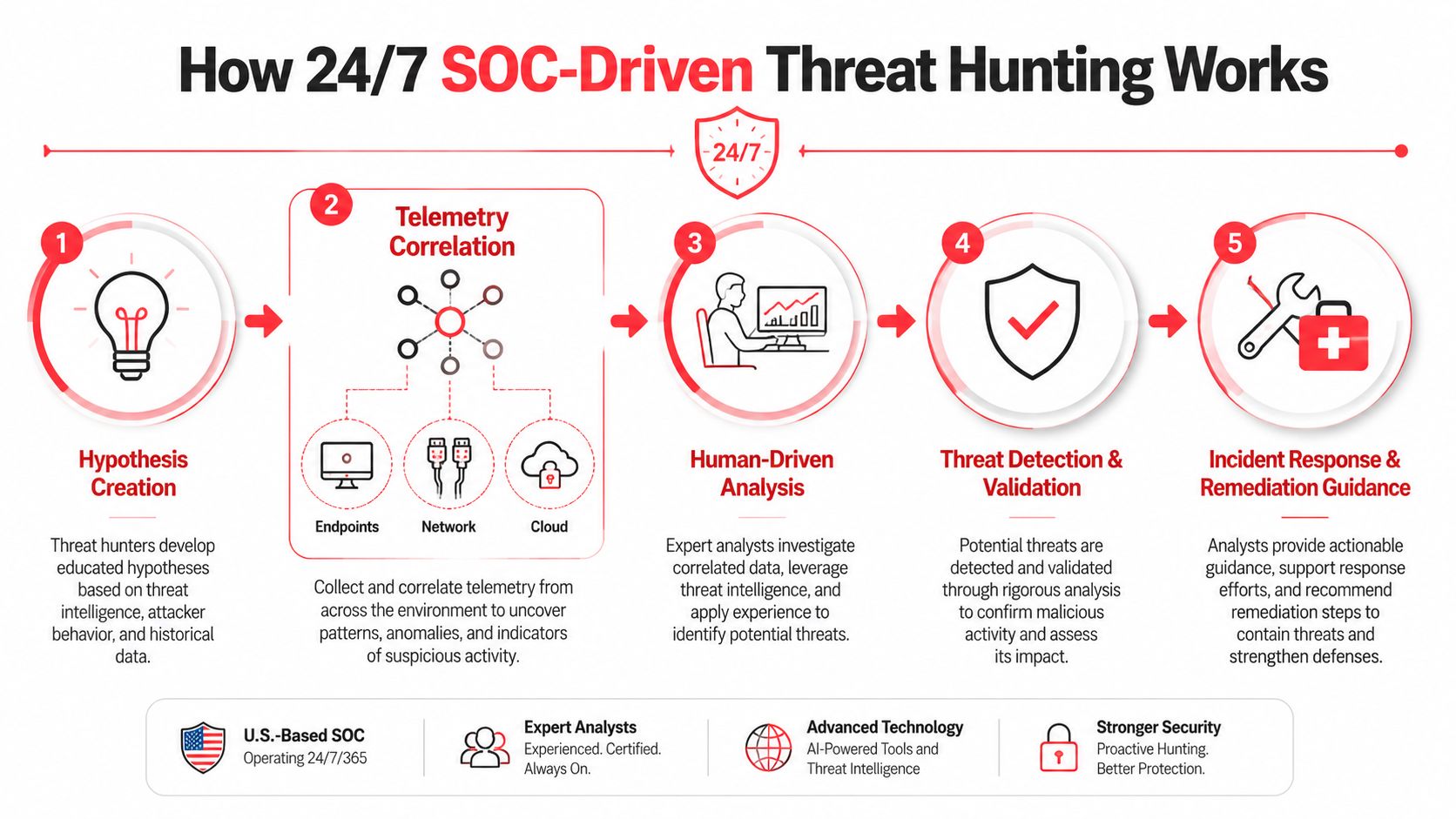
A live SOC works like an always-on investigation desk. It doesn't just collect signals. It connects them, tests them, and decides whether they represent routine noise or a real threat.
The operating cycle inside a live SOC
Effective threat hunting relies on structured work, not guesswork. In Florida environments, that usually means the team hunts across endpoint telemetry, network activity, and cloud logs, then maps suspicious behavior to attacker techniques.
Here's the cycle in plain language:
- Start with a hypothesis. The team asks a focused question, such as whether stolen credentials were used for cloud access or whether a user endpoint shows signs of persistence.
- Correlate telemetry. Analysts compare endpoint events, identity signals, network records, and cloud logs to see whether the same story appears from multiple angles.
- Triage by humans. A person reviews the context. That's where false assumptions get caught and stealthy patterns get recognized.
- Validate the threat. If the activity is malicious or strongly suspicious, the team confirms scope and urgency.
- Escalate and guide response. The issue moves to containment and remediation, with instructions the client can act on.
- Refine detection rules. What the team learned becomes a persistent detection so the same pattern is easier to catch next time.
Frameworks help. MITRE ATT&CK gives the hunt team a shared map of attacker behavior. Instead of searching randomly, they investigate technique patterns in a repeatable way.
High-performance managed hunting services can reach 99% MITRE ATT&CK coverage, with 2-minute alert-to-triage and 15-minute escalation for critical incidents, according to this managed threat hunting benchmark summary. Those numbers matter because speed only helps when it's paired with disciplined analysis.
A visual reminder of continuous support can help clarify what around-the-clock coverage looks like in practice. See this live SOC support visual.

Why the human layer matters
Automation is good at volume. It's weaker at context.
A machine may see a login, a process execution, and a file access event as separate records. A hunter may see a pattern: unusual sign-in timing, followed by suspicious endpoint behavior, followed by cloud actions inconsistent with the user's role. That pattern recognition is where much of the value lives.
Readers often get confused here because “24/7 monitoring” and “24/7 threat hunting” sound similar. They aren't the same thing.
- Monitoring asks, “Did anything trigger?”
- Hunting asks, “What are we missing?”
- Response asks, “What do we do now?”
The strongest programs treat those as connected motions, not separate services thrown together on a contract.
For Orlando and Winter Springs businesses, that connection matters during weekends, after-hours access, and holiday periods when attackers often expect slower response. Continuous hunting shortens the time between suspicious activity and meaningful analyst action, and it helps leadership move from uncertainty to a documented response path.
Business Benefits and Compliance for Florida SMBs
A Winter Park accounting firm can lose half a day to uncertainty after one suspicious mailbox rule appears. A small medical office in Orlando can face the same problem after an employee signs in from an unusual location and no one can quickly explain whether it was benign, stolen credentials, or the start of a larger issue.
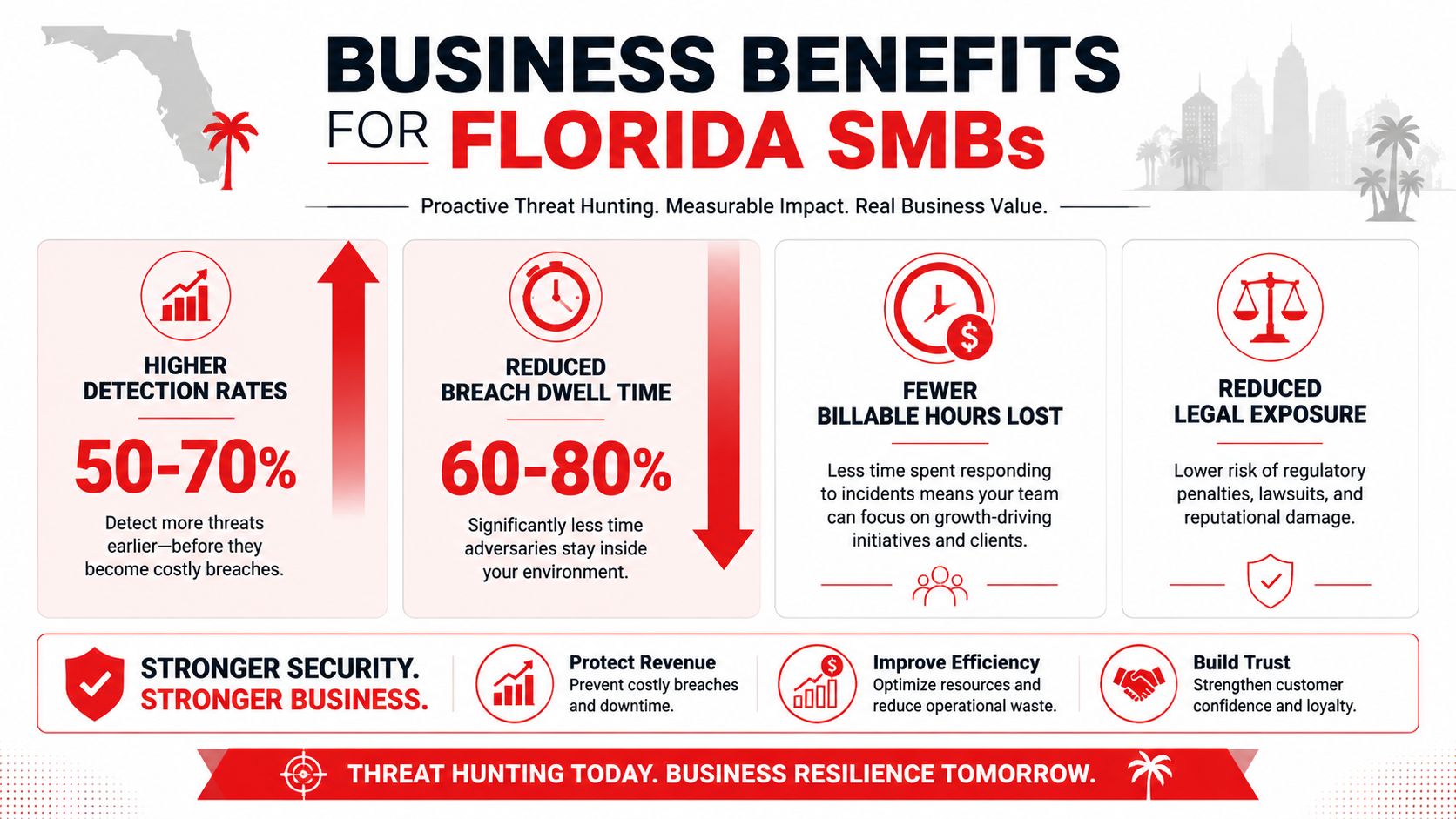
That is why threat hunting earns budget approval. It reduces uncertainty before uncertainty turns into downtime, client concern, and expensive cleanup.
What the business case looks like
For Florida SMBs, especially law firms, CPA practices, healthcare groups, insurance agencies, and other professional service providers, the first business loss is often interruption. Staff stop serving clients. Leadership starts asking for timelines. Someone has to determine whether the issue stayed on one device or spread into email, cloud storage, or shared client records.
Threat hunting helps by shortening the fact-finding stage.
A good analogy is smoke investigation in a building. Basic monitoring tells you a detector went off. Hunting checks the hallway, nearby rooms, and the air vents to find out whether the smoke came from burnt toast, faulty wiring, or a fire spreading behind the wall. That difference matters because Florida SMBs rarely have spare internal security staff who can pause billable work and run that investigation well.
Cost predictability matters too. Many Central Florida businesses are not only buying security coverage. They are buying budget stability. Flat-rate managed hunting packages are easier to approve than open-ended hourly investigations because leadership knows what is included each month, what triggers escalation, and what will not become a surprise line item after a stressful event. A small but useful buying signal for cloud-centered environments is whether the provider can show current cloud security alignment, such as this cloud security partnership indicator.

That pricing clarity fills a real local gap. Smaller organizations in Orlando, Winter Springs, Sanford, Kissimmee, and surrounding areas often need enterprise-style investigation support without enterprise-style billing uncertainty.
Why compliance teams care
Compliance leaders usually look at threat hunting through a different lens. They care about evidence, timelines, and whether the organization can show reasonable review steps after something suspicious appears.
For Central Florida SMBs, that often connects to a few practical requirements:
- HIPAA-related expectations for healthcare practices and medical service providers. If patient data may have been exposed, the organization needs clear logs, investigation notes, and a defensible timeline of what was reviewed.
- GLBA-related security expectations for financial firms and firms handling sensitive financial data. It helps to show that unusual access, account misuse, and suspicious data movement were examined rather than ignored.
- Florida breach review and notification decisions. Counsel and leadership need facts. Hunting improves the quality of those facts by pulling together endpoint, identity, email, and cloud activity into one investigation record.
- Client contract requirements. Many professional service firms in Central Florida now face security questionnaires that ask about active monitoring, incident review, and documented response processes.
Readers sometimes confuse compliance with prevention. They are connected, but they are not the same.
Compliance asks, "Can you show what happened and what controls you followed?"
Threat hunting helps answer, "What did we investigate, what did we find, and how quickly did we contain it?"
That distinction matters during audits, insurance reviews, and post-incident legal discussions.
A managed hunting program supports those conversations by providing:
- Documented investigations that go beyond a verbal assurance that nothing appeared wrong
- Cross-system context so email, identity, endpoint, and cloud activity can be reviewed as one timeline
- Repeatable reporting that helps leaders spot recurring weaknesses instead of treating each event as isolated
- Clear escalation paths so the right internal contact, counsel, or compliance lead is pulled in at the right time
Threat hunting does not replace legal advice, privacy review, or a formal compliance program. It makes those functions more effective because the organization has better records, clearer timelines, and stronger support for the decisions it makes.
Buyer's Checklist for Selecting Threat Hunting Services Florida
Many SMBs get stuck at the buying stage. Proposals sound similar, but the service behind them can be very different. That's especially true when vendors use the phrase “threat hunting” to describe anything from a one-time scan to a full managed SOC engagement.
A common market gap is pricing clarity. Existing content often excludes flat-fee managed hunting packages for small businesses, leaving Florida SMBs unaware that 24/7 proactive hunting can be included in all-inclusive managed IT contracts, as noted in this Florida SMB pricing gap discussion.

What to look for before you sign
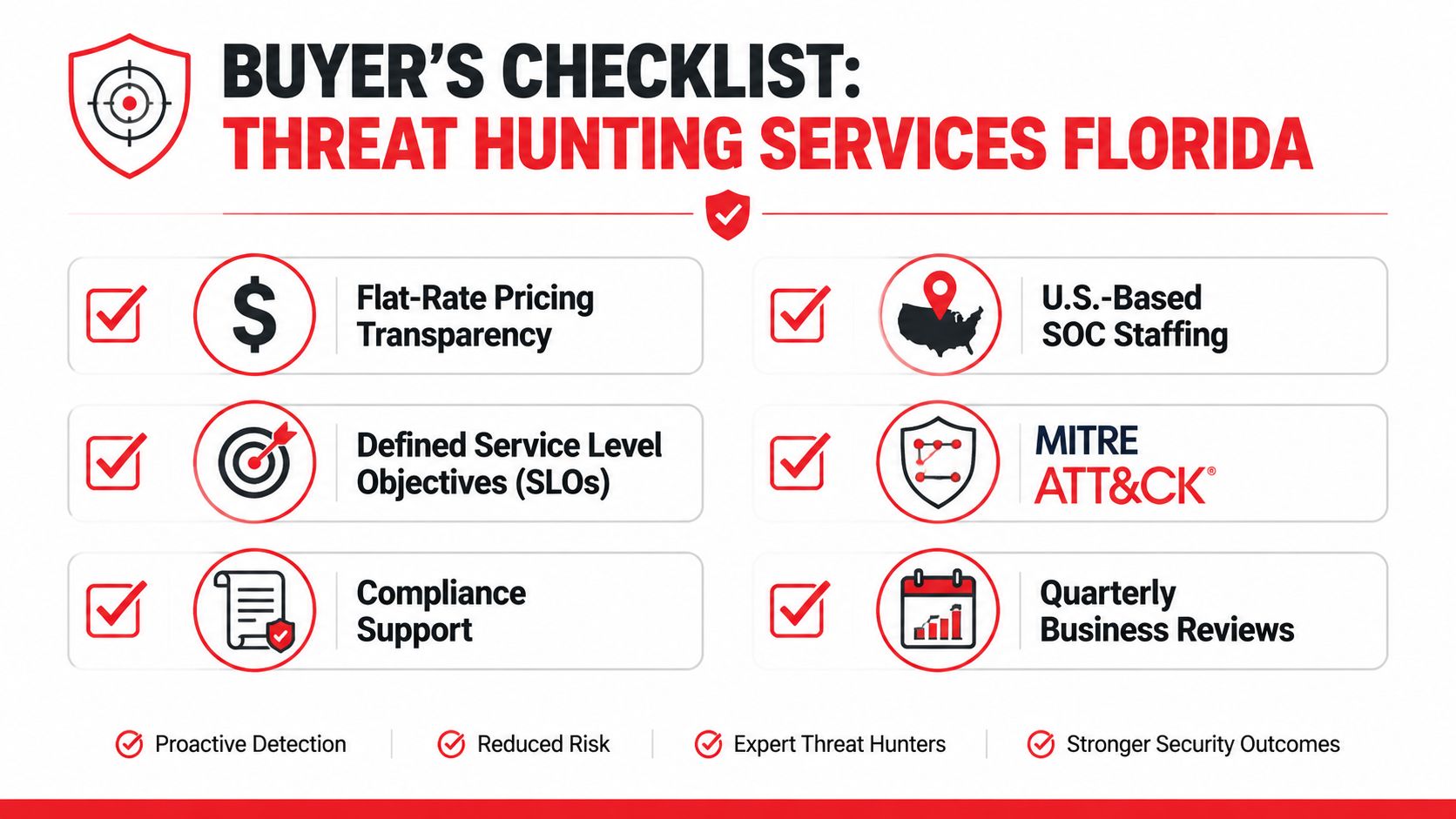
Use this checklist when reviewing threat hunting services in Florida.
Flat-rate pricing transparency
If pricing changes every time the provider investigates something unusual, budgeting becomes harder and leadership may hesitate during real incidents.U.S.-based SOC staffing
Ask who is reviewing alerts, who validates threats, and who contacts your team when something serious happens.Defined service level objectives
“Fast response” isn't enough. You want written expectations for triage, escalation, and communication.MITRE ATT&CK coverage
A mature provider should explain how hunts map to attacker techniques, not just promise broad protection.Compliance support
This matters for medical practices, accounting firms, legal offices, and other organizations that need strong reporting and incident records.Quarterly business reviews
Threat hunting shouldn't disappear into a ticket queue. Leadership should see trends, lessons learned, and unresolved risks.
Questions that reveal weak proposals
Some warning signs show up only when you ask direct questions.
| Ask this | Strong answer sounds like | Weak answer sounds like |
|---|---|---|
| How do you define threat hunting? | Proactive, hypothesis-driven investigation | “We monitor alerts” |
| Is pricing predictable? | Clear package scope and inclusions | “It depends how much work we find” |
| Who escalates incidents? | Named role and documented process | Vague after-hours language |
| What reporting do we get? | Regular summaries and executive-ready findings | Raw alert exports |
If a vendor can't explain what happens between “something looks odd” and “here's what to do next,” you're not buying a hunting program. You're buying ambiguity.
How to Choose Local Central Florida Vendors
Local fit matters more than many buyers realize. A generic provider can offer remote coverage, but a provider with Central Florida context usually understands the day-to-day realities of the businesses here. That includes lean internal teams, mixed cloud and on-premises environments, compliance-heavy workflows, and leadership teams that want predictable service instead of technical chaos.
What local fit actually looks like
A strong local vendor should understand how different industries in Orlando, Winter Springs, and surrounding communities operate.
A medical practice needs a provider that can speak clearly about privacy, access monitoring, and operational continuity. A law firm needs someone who respects urgency, confidentiality, and document-heavy workflows. An engineering or architecture firm may care more about project continuity, file access, and protecting intellectual property. The hunting service should reflect those differences in reporting and escalation.
Look for practical signs of maturity:
- Regional understanding. The provider should know the pressure points Central Florida SMBs face.
- Clear reporting portals. Leadership shouldn't need a technical translator to understand what happened.
- Auditor coordination. Compliance support is stronger when the provider can work with outside reviewers and internal stakeholders.
- On-site readiness when needed. Some incidents still benefit from physical presence and direct coordination.
A local reputation signal can also help during evaluation, such as this Orlando cybersecurity recognition visual.
How to separate a real hunting partner from a generic provider
One overlooked factor is how the vendor connects to Florida's broader cyber response environment. The Florida Department of Law Enforcement operates a dedicated Cyber Intelligence Unit under its Office of Statewide Intelligence, monitoring and responding to cyber threats targeting Florida businesses, according to the FDLE Office of Statewide Intelligence overview. A provider doesn't need to make dramatic promises about law enforcement coordination, but they should understand when and how collaboration may matter.
The best local partners usually stand out in quieter ways:
- They explain findings in business language.
- They don't hide behind hourly billing uncertainty.
- They can tell you how they support regulated industries in Florida.
- They show how response, reporting, and improvement fit together.
That's the difference between a hunting partner and a company that resells a monitoring stack.
Typical Engagement Scopes and Outcomes
Threat hunting packages don't all look the same. Most Florida SMBs will fit one of three practical engagement profiles.
Three common engagement profiles
Basic monitoring-first hunt often fits very small firms that need better visibility but aren't ready for deep program maturity. Think of a local professional office with a small internal admin team. The provider reviews telemetry, investigates suspicious patterns, and reports findings, but the client may still handle some remediation steps internally. The outcome is improved awareness and a clearer picture of risk.
Mid-tier managed hunting usually fits growing medical practices, accounting firms, and legal offices that need continuous support and documented reporting. In this model, the service includes active investigation, escalation guidance, recurring reviews, and stronger alignment with compliance needs. This is often where flat-rate packaging becomes most valuable because leadership can forecast security spend more confidently.
Enterprise-style continuous hunting fits organizations with multiple locations, higher regulatory pressure, or more complex environments. The provider runs a more mature workflow across endpoint, cloud, and network telemetry, with tighter response coordination and regular strategic review. The goal isn't only finding threats. It's improving resilience over time.
Here's a simple way to compare them:
| Engagement profile | Typical fit | Common outcome |
|---|---|---|
| Basic monitoring-first | Smaller firms with limited internal IT depth | Better visibility and earlier issue identification |
| Mid-tier managed hunting | Regulated SMBs and professional services | Stronger reporting, steadier response, better budget predictability |
| Enterprise-style continuous | Multi-site or higher-risk organizations | Broader coverage and tighter operational discipline |
The right choice depends less on size alone and more on data sensitivity, client expectations, compliance pressure, and how much uncertainty the business can tolerate.
Conclusion and Next Steps
Threat hunting services in Florida help businesses move from passive monitoring to active defense. For Central Florida SMBs, that shift matters because quiet threats can affect client trust, uptime, compliance, and day-to-day operations long before an obvious alert appears. The strongest programs combine continuous SOC coverage, clear escalation paths, transparent pricing, and reporting that leaders can use.
Use the checklist above, ask direct questions, and look closely at whether the provider understands Orlando, Winter Springs, and the compliance reality of your industry. The right next step is simple: get a current-state assessment, define your hunting priorities, and request a flat-rate proposal you can evaluate without guesswork.
If your organization wants a local, practical starting point, Cyber Command, LLC works with businesses in Orlando and Winter Springs on 24/7 SOC coverage, managed IT, compliance-focused cybersecurity, and predictable flat-rate support. A consultation can help you assess current gaps, prioritize threat hunting needs, and turn security from a reactive scramble into a continuous operating discipline.