
Why Go Custom? The Strategic Advantage of Tailored AI Software


Why Custom AI Development Creates a Lasting Competitive Advantage
Custom AI development is the process of building custom artificial intelligence solutions designed specifically for your unique business challenges, workflows, and proprietary data—rather than using generic, off-the-shelf tools.
Quick Answer for Business Leaders:
- Custom AI = Built on your data, solves your problems, creates competitive advantages competitors can’t easily replicate
- Off-the-Shelf AI = Generic solutions for broad markets, limited flexibility, vendor-controlled updates
- When to Go Custom: Your data is a strategic asset, existing tools underperform for your niche, or you need full control over behavior and compliance
- Key Benefits: Higher accuracy (60-93% improvements documented), intellectual property ownership, continuous improvement from your feedback loops
Most business leaders see AI as either a buzzword or a magic bullet. The reality sits somewhere in between.
The challenge isn’t whether AI can help your business. Companies across industries are already using AI to automate workflows, personalize customer experiences, and uncover insights buried in their data. The real question is: should you buy a generic solution, or build something custom?
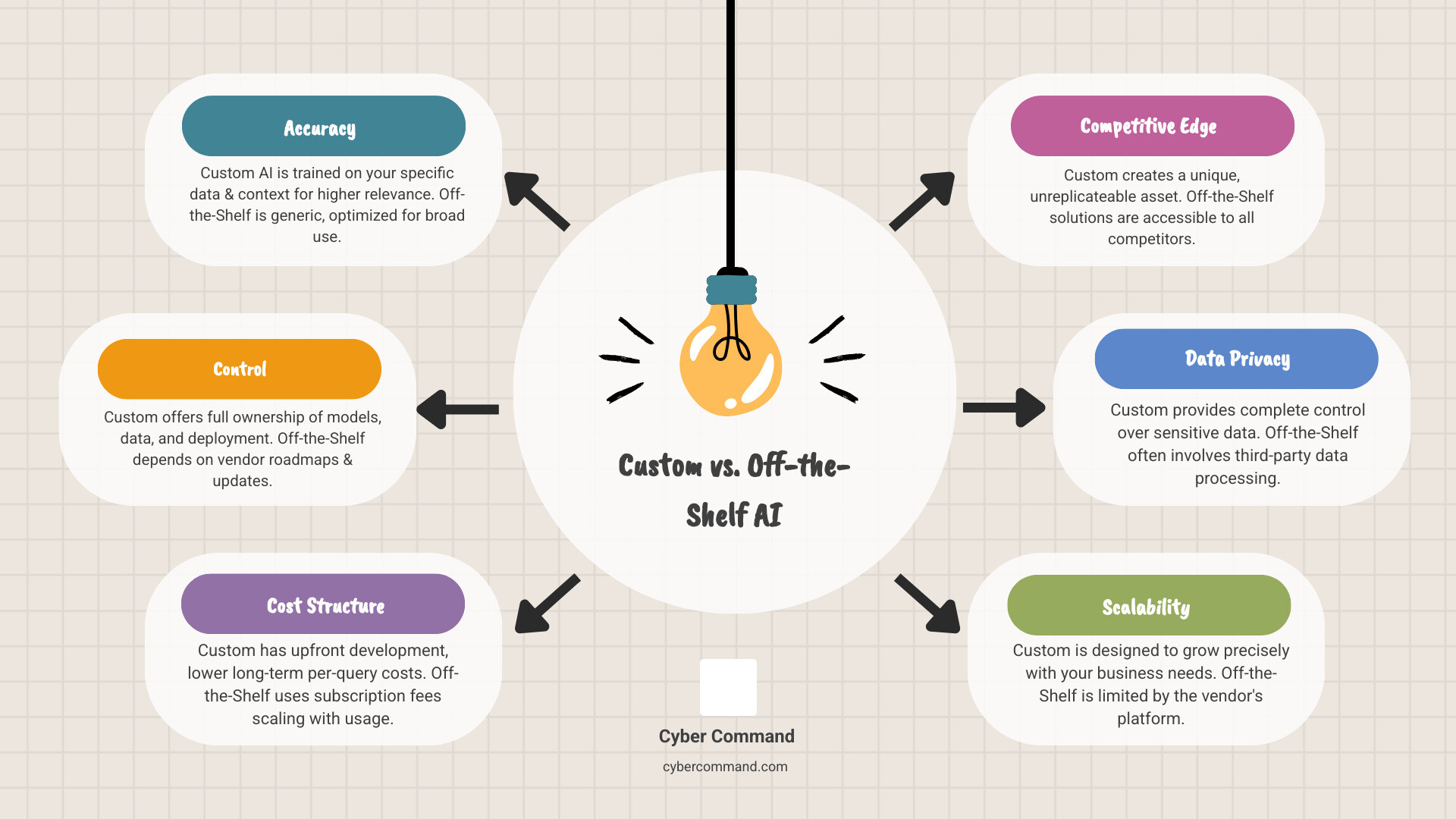
Off-the-shelf AI tools promise quick wins. But they’re designed for everyone—which means they’re optimized for no one. They can’t adapt to your specific industry terminology, your unique customer behavior patterns, or your proprietary processes. They lock you into someone else’s roadmap, someone else’s pricing model, and someone else’s security standards.
Custom AI development flips this equation. When you build AI on your own data, you create a competitive asset that reflects your business’s unique knowledge and experience. Your competitors can’t simply buy the same tool and catch up.
Consider the evidence: Keeper Tax improved their AI model’s accuracy from 85% to 93% by adding just 500 new training examples each week. Sana Labs saw a 60% improvement in output quality by customizing GPT-3 with their data. These aren’t incremental gains—they’re transformative advantages that compound over time.
But custom AI isn’t always the right answer. It requires clear strategic thinking about your data, your competitive position, and your operational readiness. Building something custom demands investment—not just in technology, but in data preparation, ongoing maintenance, and organizational change management.
I’m Reade Taylor, Founder and CEO of Cyber Command, and I’ve spent my career helping businesses transform their relationship with technology—from my early days as an engineer with IBM Internet Security Systems to building Cyber Command’s comprehensive approach to secure, high-availability IT environments. Custom AI development represents the next evolution in how technology can become a true competitive advantage rather than just another operational cost.
The Strategic Divide: When to Choose Custom AI
In the rapidly evolving landscape of artificial intelligence, businesses often face a pivotal decision: adopt a ready-made solution or start on custom AI development. While off-the-shelf tools offer convenience, they rarely provide the precise fit required for truly transformative results. This is where the strategic benefits of custom AI shine, offering higher accuracy and invaluable intellectual property (IP) ownership.
We believe that custom AI is the ideal choice when ready-made solutions fall short. This occurs when existing tools demonstrate limited performance for your critical tasks, or when your business operates within a niche that off-the-shelf options simply don’t address. For example, a marine logistics company might need a custom AI to optimize ship fuel consumption based on specific variables like weather, route, cargo weight, and engine type—a scenario where no generic solution exists.
Custom AI allows us to build solutions that directly address your unique operational challenges, rather than forcing your processes to conform to a generic tool. This custom approach ensures the AI is deeply integrated into your workflows and truly understands your data.
To better understand how AI can reshape your operations, explore our guide on How is Artificial Intelligence Used in Business.
Here are some common business areas where custom AI development delivers unparalleled value:
- Conversational AI (Chatbots, Agents): Creating intelligent virtual assistants that understand your customers’ nuances, speak your brand’s language, and automate customer service or internal support tasks with precision. A custom chatbot provides 24/7 instant support and personalized service, improving customer satisfaction and engagement, which can lead to new lead generation and sales opportunities.
- Predictive Analytics (Demand Forecasting, Fraud Detection): Developing models that forecast demand with greater accuracy based on your historical sales data, or identifying fraudulent activities by recognizing patterns unique to your transactions. This can translate into millions in additional revenue from even a 10% improvement in sales effectiveness.
- Computer Vision (Quality Inspection, Asset Tracking): Building AI that performs visual quality checks on your production lines, identifies specific assets in complex environments, or monitors internal safety requirements—all custom to your specific products and conditions.
- Intelligent Automation (Document Processing, Workflow Optimization): Automating the extraction, classification, and organization of information from inconsistently formatted documents, processing invoices, or managing inventory, freeing up human resources for more strategic tasks.
Opening up Your Competitive Edge
One of the most compelling reasons to invest in custom AI development is the ability to build a unique asset that competitors cannot easily replicate. When we build custom AI models on your proprietary data, we’re not just creating software; we’re crafting intellectual property that is intrinsically tied to your business’s competitive advantage. This differentiation is crucial in today’s crowded markets.
Consider the real-world impact:
- Sana, a learning platform, customized GPT-3 with their specific data and saw a remarkable 60% improvement in question and content generation accuracy, leading to fundamentally more personalized and effective learning experiences for their users.
- Keeper Tax, by continuously fine-tuning their GPT-3 model with just 500 new training examples each week, managed to increase accuracy from 85% to 93%. This iterative improvement, fueled by their unique data, gives them a distinct edge.
- Another company, focused on summarizing customer feedback, improved accuracy from 66% to 90% by using a customized version of GPT-3. These are not just numbers; they represent tangible, intuitive information that helps customers make informed product decisions.
These examples illustrate that custom AI isn’t just about solving a problem; it’s about embedding intelligence that learns and grows with your business, offering a long-term return on investment and unparalleled scalability. It’s about ensuring that your AI systems are not only effective today but also continuously improve, adapting to evolving market dynamics and customer needs.
Is Your Business Ready for Custom AI?
Deciding when to pursue custom AI development is a strategic undertaking. It’s not a decision to be made lightly, but rather after a thorough assessment of your business’s unique circumstances and objectives.
We often advise businesses to consider custom AI when their data is a strategic asset. If your data contains unique insights, proprietary information, or reflects specific operational nuances that are vital to your competitive position, then building AI around this data is paramount. This ensures that the AI truly understands and leverages your most valuable resource.
Another critical factor is avoiding vendor lock-in. Relying solely on off-the-shelf solutions can leave your business at the mercy of a single vendor’s roadmap, pricing, and security policies. We believe in empowering our clients with full control over their technology. Custom AI provides this autonomy, ensuring that you own your models, your data, and your future innovation. This flexibility is particularly important in industries with strict regulations or rapidly changing market demands.
Furthermore, a critical need for customization and control is a strong indicator for custom AI. If existing tools lack the flexibility to manage complex interactions, integrate with your specific systems, or adapt to unique customer behaviors, then a custom solution is likely the answer. As a study highlighted, a custom version of GPT-3 outperformed prompt design across three important measures: results were easier to understand (a 24% improvement), more accurate (a 17% improvement), and better overall (a 33% improvement).
Before diving in, it’s wise to evaluate your organization’s preparedness. Our AI Readiness Checklist can help you assess your current capabilities and identify potential gaps. Many businesses, especially in Florida and Texas, struggle with a lack of skilled talent and in-house expertise, making it difficult to properly integrate and manage AI models at scale. This is where partnering with experienced AI development firms like us can bridge the gap, bringing the necessary skills to your project.
Finally, consider the potential impact. When an application has a significant impact on revenue or efficiency, developing a custom solution can deliver far better results than a generic tool. Even a 10% improvement in sales effectiveness could translate into millions in additional revenue. This tangible return on investment makes the case for custom AI compelling.
The Blueprint for Custom AI Development
Starting on custom AI development is akin to constructing a bespoke building; it requires a meticulous blueprint and a structured methodology to ensure a solid foundation and a successful outcome. At Cyber Command, we accept an agile approach, emphasizing iterative cycles and continuous feedback to deliver solutions that evolve with your business needs.

At the heart of any successful Large Language Model (LLM) project, which often forms the core of many custom AI solutions, are three essential pillars:
- Clearly Defined Product Goals: What does success look like? What specific problem are we solving, and how will we measure its impact? Without precise objectives, an AI project can quickly lose direction.
- High-Quality, Relevant Data: Data is the lifeblood of AI. The quality, quantity, and diversity of your domain-specific data are paramount. This includes internal documents, databases, and user logs.
- An Appropriate Baseline Model: Choosing the right starting point, whether it’s a foundational model like Gemini or Gemma, or a more specialized open-source model, sets the stage for effective customization.
Our development methodology is designed to transform your vision into a production-ready AI product, ensuring that every step, from concept to deployment, is carefully managed and aligned with your strategic goals.
A Practical Roadmap for Your Project
Our practical roadmap for custom AI development guides you through a structured process, ensuring clarity, collaboration, and continuous progress:
- Findy Stage: This initial phase is all about understanding. We work closely with you to define your business objectives, identify your existing data assets, and establish clear success metrics and Key Performance Indicators (KPIs). It’s about studying your reality, challenges, and opportunities.
- Solution Blueprint: Once we have a deep understanding of your needs, we craft a detailed solution blueprint. This includes mapping out the technical architecture, estimating timelines, and outlining the budget. This plan ensures everyone is aligned before significant development begins.
- Prototype Sprint: We believe in validating ideas quickly. During this phase, we develop a working proof of concept (PoC) or a minimum viable product (MVP). This allows us to test the technical approach, gather early feedback, and make necessary adjustments, minimizing risk before full-scale development.
- Production Deployment: With a validated prototype, we move to hardening, securing, and integrating the AI solution into your existing production environment. This involves robust testing, ensuring seamless integration with your current systems, and implementing necessary security measures.
- Continuous Optimization: AI is not a “set it and forget it” technology. Post-deployment, we establish processes for ongoing monitoring of performance, retraining models with new data, and rolling out new features. This ensures your custom AI solution remains accurate, relevant, and continues to deliver value over time.
The Crucial Role of Data in Custom AI Development
Data isn’t just important in custom AI development; it’s foundational. As we often say, “Garbage in, garbage out.” The performance and accuracy of your custom AI models depend heavily on the quality, quantity, and diversity of the data used for training.
Our approach to data in custom AI projects involves several best practices:
- Data Preparation: Before any model training begins, data must be carefully collected, cleaned, and preprocessed. This often involves changing raw data into a usable format, handling missing values, and normalizing data to ensure consistency.
- Data Quality and Quantity: A well-curated and representative dataset is essential for achieving reliable results. We work with our clients to identify and leverage their most valuable data, ensuring it is both comprehensive and clean.
- Data Governance: Establishing clear data governance policies from the outset is critical. This ensures data privacy, security, and compliance with regulations relevant to your business, such as those impacting our clients in Florida and Texas.
- PII Redaction and Bias Mitigation: For sensitive applications, we implement strategies for Personally Identifiable Information (PII) redaction to protect privacy. Equally important is bias mitigation, ensuring that the training data does not perpetuate or amplify existing biases, leading to fair and ethical AI outcomes.
By focusing on these aspects, we ensure that your custom AI solution is built on a strong, reliable data foundation, leading to superior performance and trustworthy results.
Key Customization Techniques Explained
When we talk about making an AI model “yours,” we’re referring to a suite of sophisticated techniques in custom AI development that allow us to tailor generic models to your specific needs. The two dominant approaches today are fine-tuning and Retrieval-Augmented Generation (RAG).
Here’s a quick comparison of these powerful techniques:
| Feature | Fine-Tuning | Retrieval-Augmented Generation (RAG) |
|---|---|---|
| Concept | Adapting a pre-trained model with new data | Augmenting an LLM’s knowledge with external data sources |
| Cost | Higher compute/memory for training, lower inference | Lower training cost, higher inference for retrieval |
| Data Freshness | Requires re-training for updates | Real-time access to latest information |
| Hallucination | Reduces hallucinations by specializing | Grounds responses in external sources to reduce them |
| Control | Changes model behavior directly | Controls information source, not model behavior |
| Use Case | Tone, style, domain-specific language, specific tasks | Factual accuracy, up-to-date info, citing sources |
- Fine-Tuning: This involves taking a pre-trained model (like GPT-3, which you can learn more about in details on fine-tuning from OpenAI) and further training it on your specific dataset. This process, especially with Parameter-Efficient Fine-Tuning (PEFT) techniques like LoRA/QLoRA, dramatically reduces the computational cost compared to training a model from scratch. Fine-tuning allows the model to adapt to your unique vocabulary, tone, and specific tasks, leading to higher accuracy and more relevant outputs. For example, by fine-tuning GPT-3, companies have seen correct outputs increase from 83% to 95%.
- Retrieval-Augmented Generation (RAG): Instead of retraining the model, RAG allows the LLM to access and integrate information from external knowledge bases or documents in real-time. The model retrieves relevant information from your proprietary data (e.g., product manuals, internal reports) and uses it to formulate its response. This is excellent for ensuring factual accuracy, providing up-to-date information, and grounding responses in your specific context without the need for constant model retraining.
- Building Models from Scratch: For highly specialized needs or when no suitable baseline model exists, we can undertake the complex task of building an AI model entirely from the ground up. This offers ultimate control but requires significant resources.
- Hybrid Approaches: Many production systems leverage a mix of fine-tuning for conversational fluency and RAG for factual accuracy, often orchestrated by AI agents. This allows us to combine the best of both worlds, creating robust and highly specialized solutions.
From Lab to Live: Production, Deployment, and Maintenance
Bringing a custom AI development project to fruition involves more than just building the model; it requires a robust strategy for deployment, ongoing management, and continuous improvement. This entire lifecycle, from development to operations, is encapsulated in what we call MLOps (Machine Learning Operations).
MLOps is crucial for ensuring the long-term reliability and effectiveness of your AI systems. It involves establishing continuous delivery pipelines, implementing automated testing, carefully managing model versioning, and deploying sophisticated monitoring dashboards. This comprehensive approach minimizes downtime, accelerates iterations, and ultimately ensures the sustained value of your AI investment.
Critical Production and Security Considerations
When we move from prototyping to production, several critical factors come into play that dictate the success and longevity of your custom AI development solution:
- Speed (Latency): For real-time applications, the speed at which your AI model processes requests and generates responses is paramount. We optimize models through techniques like quantization, batching, and caching to ensure predictable and low latency.
- Cost (Per-Query): While custom AI might have an upfront investment, we strive for lower per-query costs at scale. Efficient model design and deployment strategies contribute significantly to cost-effectiveness in the long run.
- Fidelity (Accuracy, Hallucination Rate): The accuracy of the AI’s outputs and its tendency to “hallucinate” (generate factually incorrect but plausible-sounding information) are vital. We implement rigorous testing, validation, and continuous monitoring to maintain high fidelity and minimize errors.
- Security and Compliance: This is non-negotiable. Custom AI development for businesses, especially those dealing with sensitive data, must adhere to stringent security protocols and compliance regulations. This includes robust access controls, encryption for data at rest and in transit, audit trails, and Data Loss Prevention (DLP) gates. The recent NX Breach incident, where threat actors used AI tools to exfiltrate sensitive data, underscores the critical need for proactive security measures. We integrate security from the ground up, ensuring your AI solutions are protected against evolving threats. For a deeper dive into this, read our article on Understanding the Role of AI and ML in Threat Detection.
- Data Privacy: Protecting your proprietary and customer data is our top priority. We design solutions with privacy by design, ensuring that sensitive information is handled securely and in compliance with all relevant data protection laws.
Choosing the Right Deployment Pattern
The deployment pattern for your custom AI development solution depends heavily on your specific needs, infrastructure, and security requirements. We work with you to select the most appropriate approach:
- Hosted Endpoints (Cloud APIs): This is often the quickest way to get a custom AI model into production. We deploy your model to a cloud provider’s managed service (like Google Cloud’s Vertex AI), which handles the infrastructure, scaling, and maintenance. This is ideal for speed-to-market and where data sensitivity allows for cloud hosting.
- Hybrid Solutions: For businesses that need a balance of cloud flexibility and on-premise control, hybrid deployments are an excellent option. This might involve processing sensitive data on-premise while leveraging cloud resources for less sensitive tasks or burst capacity.
- On-Premise or Private Cloud Deployment: For highly regulated industries or those with extremely sensitive data, deploying the custom AI solution entirely within your own data centers or private cloud environment offers maximum control and security. This ensures that your data never leaves your controlled infrastructure.
The decision for deployment is influenced by factors such as regulatory requirements, the sensitivity of your data, and your desired level of control over the infrastructure. We help you steer these choices to ensure your custom AI solution is deployed effectively and securely.
Frequently Asked Questions about Custom AI Development
Why choose a custom AI solution over an off-the-shelf tool?
Off-the-shelf AI tools, while convenient, are designed for generic needs and often fall short when faced with your business’s unique challenges. They may not address specific business needs, leading to performance gaps or requiring significant, costly configurations. Custom AI development, conversely, is built on your proprietary data, creating a unique competitive advantage that competitors can’t replicate. It offers higher accuracy for your specific context, provides full control over the application and data, and evolves with your business, ultimately leading to a superior long-term return on investment.
Can we train an AI model with our own company data?
Yes, using your own data is the core principle of custom AI development. Machine learning thrives on data, making your proprietary information essential. Our process involves an initial audit and conceptualization, followed by setting up robust data collection and change processes that comply with all privacy and security standards. Your data, which might include CRM records, support tickets, or internal documents, is then used to train models specifically adapted to your business context, terminology, and customer behavior. This approach ensures the AI system truly understands your sector, clients, and challenges, offering superior performance, and crucially, you retain full ownership of your data and models.
How long does it take to develop a custom AI solution?
The timeline for custom AI development varies considerably depending on the project’s complexity, the availability and quality of your data, and the extent of required integrations. A simple prototype or proof-of-concept might be developed in as little as 1 to 3 months. More complex, production-ready solutions with multiple integrations and advanced functionalities could take anywhere from 6 to 18 months. We use an agile development approach, which allows us to deliver tangible results through successive, iterative stages. This means you can start benefiting from AI contributions and see value long before the entire project is completed, with continuous updates and feedback loops throughout the process.
Conclusion
The journey into custom AI development is a strategic investment in your business’s future. It’s about moving beyond generic solutions to accept custom intelligence that truly understands and responds to your unique operational landscape.
As we’ve explored, the strategic advantages are clear: from higher accuracy and the creation of unique, unreplicable assets to gaining full control over your data and intellectual property. Custom AI development empowers your business to innovate faster, optimize processes with precision, and deliver unparalleled customer experiences. It’s about building a durable competitive asset that learns and grows with you, changing data into decisive action.
At Cyber Command, we understand that navigating the complexities of AI requires expert guidance. With our enterprise-grade IT, cybersecurity, and platform engineering services, we act as an extension of your business, providing proactive, 24/7/365 U.S.-based support. We’re here to help you design, develop, and deploy custom AI solutions that are not just cutting-edge, but also secure, scalable, and perfectly aligned with your strategic vision.
Ready to open up the full potential of custom AI for your organization in Florida or Texas? Let us help you chart a course to innovation and sustainable growth.