
Becoming an IT Business Partner: Expectations and How to Excel


More Than Just IT Support
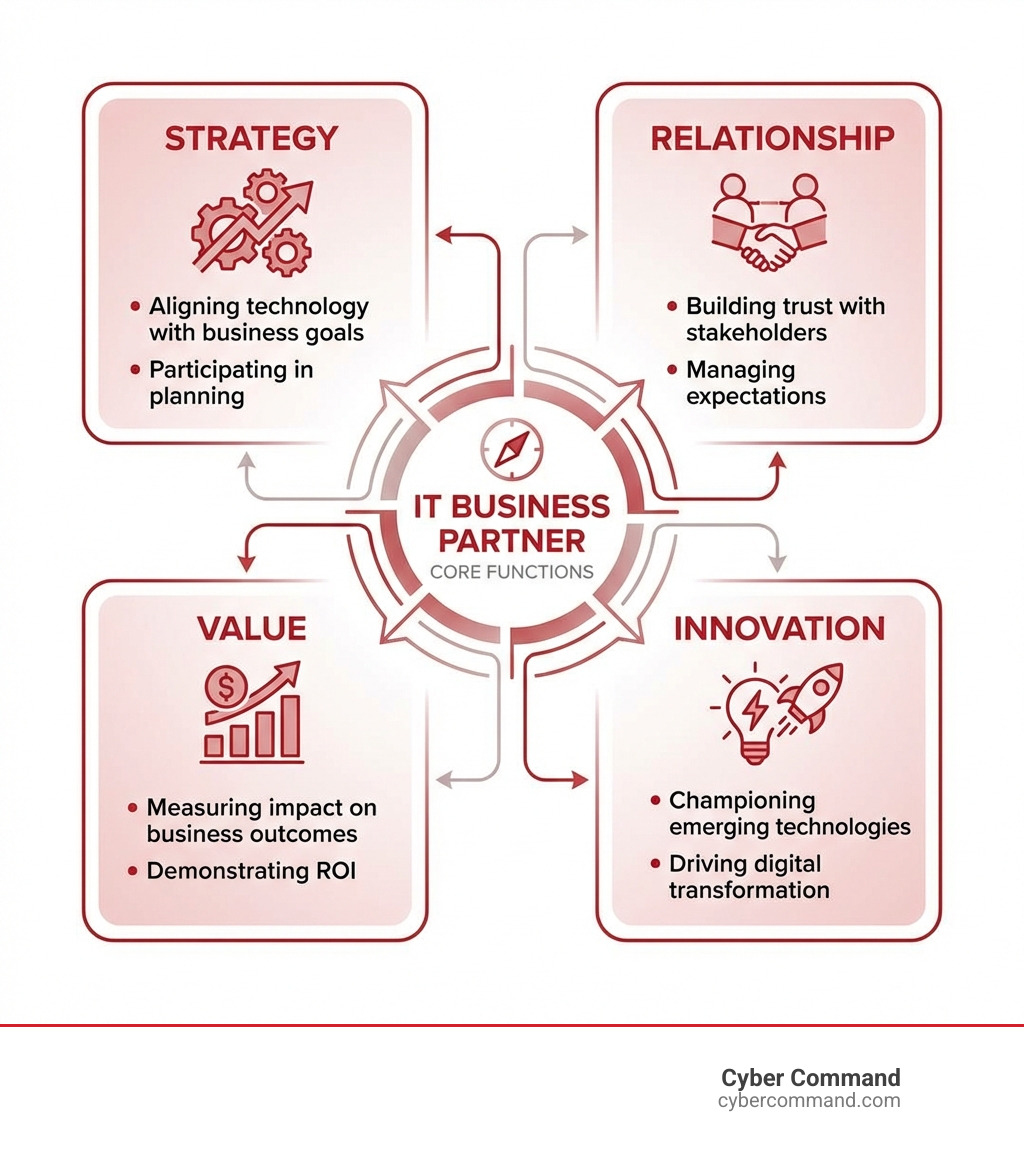
An IT business partner is a strategic role that bridges the gap between business units and technology teams. Unlike traditional IT support, they translate business needs into technology solutions, participate in strategic planning, drive digital change, and measure value. They are trusted advisors who align IT investments with organizational goals to drive measurable business outcomes.
Key characteristics of an effective IT business partner:
- Strategic focus – Participates in business planning and roadmap development, not just tactical execution
- Relationship builder – Cultivates trust with stakeholders across all business functions
- Translator – Converts business language into technical requirements and vice versa
- Value driver – Measures and communicates IT’s impact on revenue, efficiency, and customer outcomes
- Change enabler – Facilitates digital change and champions innovation
The world of business technology has fundamentally shifted. While seven in 10 organizations report their IT departments have a primary role in corporate technology decision-making, a gap remains. 51% of business executives rate IT as one of the top sources they turn to when making strategic technology decisions, yet many IT departments still operate as cost centers rather than strategic partners.
The IT business partner role has evolved from reactive service centers to proactive solution anticipators. These professionals don’t just fix problems—they prevent them. They don’t just implement systems—they ensure those systems drive business value. And they don’t just speak tech—they speak business.
This change represents an identity shift for IT professionals. As business leaders become more tech-savvy and employees adopt solutions on their own (leading to “shadow IT”), the need for IT professionals who can collaborate and add strategic value has never been greater.
I’m Reade Taylor, and during my time as an engineer with IBM Internet Security Systems and now as CEO of Cyber Command, I’ve witnessed the evolution of the IT business partner role firsthand—from technical support function to strategic growth driver. I’ve helped businesses transform their relationship with technology by acting as a true IT business partner focused on business outcomes.
Handy IT business partner terms:
The Modern IT Business Partner vs. Traditional IT Roles
The landscape of information technology within organizations is constantly shifting. What was once a purely technical support function has blossomed into a critical strategic capability. This evolution has given rise to the IT business partner role, a position fundamentally different from traditional IT support or management. While all IT professionals contribute to an organization’s success, the IT business partner operates at a unique intersection, driving value and fostering collaboration in ways that traditional roles often cannot.
What is an IT business partner?
At its core, an IT business partner is a strategic link between the IT department and various business functions, often called a Business Relationship Manager (BRM). The primary objective is not just to deliver technology, but to ensure that technology drives positive business results. We act as the “glue” holding the technical and operational sides of a business together by proactively anticipating technology needs, managing IT solution delivery, and meeting with stakeholders to understand their goals. This allows us to translate complex business needs into clear, actionable technology requirements.
Our role is about more than just fulfilling requests; it’s about demand shaping. We build strategic relationships to stimulate and shape demand for IT services. We establish value management as a core capability, ensuring every IT initiative is tied to measurable business value and that services are custom to partner needs. We champion a culture of shared ownership and constant evolution, fostering an environment of trust, creativity, and innovation. The IT business partner is not merely a “go-between,” which can reduce accountability. Instead, we are deeply embedded, understanding both technical intricacies and business implications to ensure solutions are strategically aligned and value-driven.
Key Differences from IT Support and Management
The distinction between an IT business partner and traditional IT support or management roles is crucial for understanding its unique value proposition. Let’s break down these differences:
| Metric | IT Business Partner | Traditional IT Manager |
|---|---|---|
| Primary Focus | Strategic alignment, business outcomes, value creation, relationship building | Operational efficiency, project delivery, system uptime, technical problem-solving |
| Key Goal | Drive business growth and innovation through technology, become a trusted advisor | Ensure IT systems run smoothly, deliver projects on time and budget, manage resources |
| Communication Style | Translates business needs to IT and IT capabilities to business; consultative, collaborative | Technical communication; directive, problem-focused |
| Success Measurement | ROI of IT investments, strategic impact, stakeholder satisfaction, business KPIs | Project completion rates, system availability, incident resolution times, budget adherence |
Focus on ‘Why’ vs. ‘How’: A traditional IT manager focuses on the “how”—how to implement a system or fix a bug. An IT business partner, however, focuses on the “why”—why is this technology needed? What business problem does it solve? This shift from tactical execution to strategic purpose is fundamental.
Long-Term Strategy vs. Daily Operations: While IT managers are crucial for daily operational excellence, the IT business partner is deeply involved in long-term strategic planning. We participate in budgetary planning, develop product roadmaps, and oversee proofs of concept to fuel innovation, keeping our gaze on the horizon.
Partnership vs. Service Provider: Traditional IT often functions as a service provider. The IT business partner lifts this to a true partnership, working collaboratively with leaders to co-create solutions rather than just taking orders. We foster a culture of learning and growth across departments.
Influence vs. Authority: An IT manager has authority over their team, while an IT business partner often influences without direct authority. We achieve goals through strong communication, negotiation, and relationship-building, acting as a champion of change. As one expert puts it, IT pros need to become the right blend of tech guru and business consultant. This is precisely where we shine, bridging communication gaps and translating complex technical concepts into understandable business terms.
The goal is to transform IT support from a back-end function to a strategic powerhouse. We don’t just solve IT problems; we protect clients while navigating threats and compliance. We make delivering cybersecurity simple, profitable, and scalable, acting as an extension of your team. This proactive, collaborative approach defines the modern IT business partner.
The Essential Skillset for Success
To excel as an IT business partner, one needs a dynamic blend of technical expertise, business understanding, and exceptional interpersonal abilities. It’s not enough to be a tech guru; you must also be a business consultant, strategic advisor, and master communicator. This unique combination allows us to effectively steer the complex intersection of technology and business, driving innovation and delivering tangible value.

Blending Technical Prowess with Business Acumen
While the IT business partner role emphasizes strategic alignment, a solid technical foundation remains indispensable. We need to speak the language of IT, understand system nuances, and grasp the complexities of technology solutions. Many successful IT business partners have practical experience as programmers, analysts, or project managers.
However, technical skill alone is insufficient. The true differentiator is blending this knowledge with deep business acumen. This involves:
- Understanding Business Processes: A comprehensive grasp of the organization’s core operations, workflows, and departmental functions.
- Financial Literacy: Understanding budgets, return on investment (ROI), and cost-benefit analysis is critical to articulate the financial impact of IT investments and manage tech debt.
- Industry Expertise and Market Awareness: Staying abreast of industry trends and competitor activities helps identify opportunities and recommend technologies that provide a competitive edge.
- Speaking the Language of Business: We must translate complex technical jargon into clear business language, focusing on value and strategic impact rather than just features and functions.
This blend ensures technology decisions are deeply integrated into the strategic fabric of the business, avoiding the siloed thinking that creates problems.
Developing Critical Communication and Leadership Skills
An IT business partner cannot succeed without exceptional communication and leadership skills. These soft skills open up the role’s full potential:
- Relationship Building: Our success hinges on building and nurturing trusted business relationships across all functions, fostering a culture of collaboration and mutual respect.
- Stakeholder Management: We interact with diverse stakeholders, from front-line employees to C-suite executives, requiring custom communication and effective expectation management.
- Negotiation and Conflict Resolution: We must be skilled at conflict negotiation to achieve alignment on budgets, priorities, or technical solutions.
- Influencing Without Authority: We often drive change without direct authority, requiring diplomacy and the ability to articulate compelling arguments that resonate with business leaders.
- Change Management: We must be adept at guiding organizations through technological transitions, minimizing disruption, and ensuring successful adoption of new tools.
- Data Storytelling: We need to tell a story with data, changing the impact IT business partners have on their business and making the invisible impact of IT visible and compelling.
These skills are developed through continuous learning and practice. For ambitious IT professionals, this career path offers immense potential for growth and strategic impact, with many advancing into senior roles like Chief Information Officer (CIO).
How IT Business Partners Drive Strategic Value
The true measure of an IT business partner lies in our ability to drive strategic value for the organization. We move beyond merely supporting operations to actively shaping the business’s future through technology. This involves a deep understanding of business objectives, a keen eye for technological opportunities, and the ability to steer complex organizational dynamics to deliver impactful solutions.

Translating Business Needs into Technology Solutions
One of our most critical functions is to act as the bridge between abstract business needs and concrete technology solutions. This translation process involves:
- Strategic Requirements Gathering: We don’t just ask “what do you need?” but “what business problem are you trying to solve?” This uncovers the true underlying needs.
- Solution Assessment and Design: We assess potential technology solutions for feasibility, scalability, cost-effectiveness, and alignment with the overall IT architecture and business strategy.
- Aligning Tech with Strategic Objectives: Every technology initiative must tie back to a clear business goal, whether it’s enhancing customer experience, improving efficiency, or enabling new revenue streams.
- Managing Solution Delivery: We oversee the entire lifecycle of IT solution delivery, from conception to implementation and adoption, ensuring solutions meet requirements and are delivered on time and within budget.
- User Experience (UX) Focus: We prioritize user experience in technology solutions to ensure they are intuitive, accessible, and aligned with user needs, which improves adoption and business impact.
When business and IT are not properly aligned, it can lead to a significant “it’s not my problem” IT problem. We work to break down these silos, fostering a collaborative environment where business and IT co-lead initiatives to ensure IT decisions are translated into joint business objectives with clear ROI.
Overcoming Common Challenges
The path of an IT business partner is not without its problems. We frequently encounter challenges that require diplomacy, strategic thinking, and persistence:
- Shadow IT: The use of IT systems without organizational approval. We collaborate with business counterparts to understand their needs and offer solutions that are both effective and compliant.
- Cultural Resistance: Introducing new technologies can meet resistance. We act as champions of change, building trust and demonstrating the value of new initiatives through clear communication.
- Budget Constraints: We must be adept at prioritizing, making a strong business case for investments, and demonstrating the ROI of IT projects.
- Misaligned Priorities: Different business units may have conflicting priorities. We facilitate discussions to define shared goals and align IT efforts with overarching strategic objectives.
- Proving Value: We overcome this by documenting and measuring the impact of our work on business objectives like revenue growth or cost savings. As 51% of business executives rate IT as a top source for strategic technology decisions, the opportunity to prove this value is significant.
By proactively addressing these challenges, we ensure that IT functions as a strategic asset, driving growth and competitive advantage rather than being perceived as a cost center.
The Future of the Role and How to Prepare
The world of technology is not static, and neither is the role of the IT business partner. As businesses continue their digital change journeys, our role is ready for even greater strategic importance. We anticipate future technological developments and understand how emerging technologies can be integrated into business strategies for efficiency, customer experience, and innovation.
Championing Emerging Technologies and Sustainability
The future IT business partner will be at the forefront of integrating cutting-edge technologies while championing responsible and sustainable practices.
- Artificial Intelligence (AI): We will need to understand how AI can be leveraged for data analysis, automation, and predictive insights to improve customer experiences and business operations.
- Internet of Things (IoT): From smart factories to connected healthcare, we will be instrumental in identifying IoT applications, managing data streams, and ensuring the security of connected systems.
- Blockchain: Understanding blockchain’s potential in supply chain management, data security, and verifiable transactions will be key to implementing secure and transparent business processes.
Beyond technology, future IT business partners will champion sustainable practices:
- Promoting Energy-Efficient Technologies: We will advocate for and implement IT solutions that minimize energy consumption, from cloud infrastructure to end-user devices.
- Reducing Electronic Waste: We will help develop strategies for responsible disposal and recycling of electronic equipment.
- Aligning IT with Corporate Sustainability Goals: We will ensure IT practices align with the organization’s broader environmental, social, and governance (ESG) objectives.
This expanded focus means the IT business partner role will increasingly accept more defined leadership positions, expanding strategic influence and driving digital change.
How to Foster a Strong IT Business Partnership
Building a robust IT business partnership is a continuous journey requiring commitment from both IT and business stakeholders. Here are key ways to foster such a partnership:
- Choose a partner who grasps your business: The partner must thoroughly understand your business ethos, challenges, and ambitions.
- Prioritize clear communication: Establish regular check-ins and maintain an open channel for feedback, avoiding tech jargon.
- Set shared goals and expectations: Collaboratively establish clear, achievable objectives for IT initiatives.
- Encourage collaboration: Promote a culture of teamwork and idea-sharing to break down silos and co-create solutions.
- Uphold transparency: Be candid about business requirements, apprehensions, and budgets, and expect the same in return.
- Ensure proper training and resources: Equip staff with the necessary training to collaborate efficiently and adopt new technologies.
- Regularly evaluate and adapt the partnership: Assess the partnership’s effectiveness and be prepared to adapt strategies as your business evolves.
- Recognize and respect each other’s expertise: Mutual respect for the unique expertise of both business and IT fosters a stronger relationship.
- Think long-term: View the partnership as a long-term strategic alliance, planning ahead for emerging technologies and future adaptations.
By implementing these practices, organizations can transform their IT function from a cost center into a powerful engine for innovation and growth.
Conclusion: Achieve True Partnership for Business Growth
The journey to becoming an effective IT business partner is one of continuous evolution, demanding a unique blend of technical expertise, business acumen, and exceptional interpersonal skills. We’ve seen how this role transcends traditional IT support, acting as a strategic liaison that translates business needs into powerful technology solutions, drives digital change, and champions innovation. The future of the IT business partner is bright, with increasing influence in areas like emerging technologies and sustainability, cementing its place as indispensable to modern business success.
Strategic alignment is no longer a luxury; it’s a necessity. For organizations to thrive in today’s , technology-driven world, IT must be integrated at every strategic level, from the boardroom to daily operations. The IT business partner is the key to open uping this potential, ensuring that every technological investment contributes directly to the organization’s growth, efficiency, and competitive advantage. Our ability to build trust, communicate effectively, and demonstrate tangible value is what transforms IT from a perceived cost center into a powerful growth driver.
For organizations seeking the benefits of a strategic IT business partnership without the overhead of an in-house role, providers like Cyber Command act as an extension of your team. With our proactive, 24/7/365 U.S.-based support and transparent, all-inclusive pricing, we embody the qualities of an ideal IT business partner for businesses across Winter Springs, Orlando, Jacksonville, Tampa Bay, Central Florida, Florida, Plano, and Texas. We are committed to understanding your business, anticipating your needs, and delivering IT solutions that drive your strategic objectives.
We empower you to focus on your core business, knowing that your technology strategy is in expert hands. Learn how our managed IT services can become your strategic advantage.