
March 19, 2026
Incident Management ITIL Definition: A Guide for Florida SMBs
Understand the incident management ITIL definition and protect your Florida business. A practical guide for restoring services and boosting cybersecurity.
Imagine your business is a busy Orlando highway during peak season. Suddenly, a server crashes or a phishing attack succeeds. It’s a multi-car pileup blocking every lane, bringing business to a dead stop. ITIL incident management is the official process that acts as your emergency response team, focused on one thing: clearing the wreckage and getting traffic flowing again as fast as humanly possible.
What Is ITIL Incident Management for Your Business?
Think of ITIL Incident Management as the dedicated paramedics and fire crew for your company’s technology. Its single, laser-focused goal is to restore normal service operations immediately after an unexpected interruption. This isn’t about conducting a lengthy investigation into what caused the crash—that comes later. It’s about minimizing the immediate damage caused by downtime.
For any business in Central Florida, from Tampa to Orlando, this process is absolutely critical. Whether you’re a medical practice in Lake Mary unable to access patient records or a financial firm in Lakeland facing a system failure, every minute of disruption costs you money and erodes the trust you’ve built with your clients.
The Core Goal: Restoration Over Perfection
The primary objective is pure speed. The process prioritizes getting your systems back online, even if it means using a temporary workaround. For instance, if a primary server fails, the incident management team’s first move isn’t to start diagnosing the faulty hardware. It’s to switch operations over to a backup server. This action restores service right away, even though the original server still needs repair.
The core principle of incident management is to minimize business impact and restore services swiftly. The focus is on immediate resolution, not long-term problem-solving, which is handled by a separate process.
This get-it-done approach prevents a minor hiccup from spiraling into a full-blown business catastrophe. Without a structured response, teams can waste precious time in chaotic, uncoordinated efforts, leading to longer outages and significant financial losses, especially when cyber security concerns are involved.
Defining What Constitutes an Incident
In the world of ITIL, an incident is any unplanned event that disrupts an IT service or reduces its quality. This could be anything from a single user being unable to print a document to a company-wide email outage. The severity of the incident is what dictates the urgency of the response.
A solid incident management process has a few key components:
- Rapid Identification: Spotting the issue the moment it happens, often through automated monitoring tools that act like smoke detectors for your IT and cyber security.
- Structured Logging: Creating a formal record or “ticket” for the incident to track its entire lifecycle from detection to resolution.
- Efficient Resolution: Applying the fastest possible fix or workaround to get the service running again.
- Clear Communication: Keeping everyone in the loop—from the affected users to the executive team—about the status of the incident.
A fundamental part of defining incident management for your business involves understanding the targets set by Service Level Agreements (SLAs). These agreements formally document the expected response and resolution times, providing a clear benchmark for performance. For businesses especially concerned with cybersecurity, this structured approach is vital. It ensures every security alert is handled with consistent urgency, turning a potential disaster into a managed event before it can spread and cause widespread damage.
Stuck on something like this right now?
Talk it through with a real US-based engineer, 24/7, no phone trees: (407) 587-0089.
Book a Free Strategy SessionThe Incident Management Lifecycle Explained
Thinking about incident management ITIL definition is one thing, but seeing it in action is another. It’s best to view the entire process as a predictable lifecycle—a step-by-step playbook that your response team uses to turn chaos into a controlled, efficient recovery.
This isn’t just theory. Each stage has a specific job, all designed to get your business back to normal operations as quickly as possible.
The high-level goal is simple: get out of the “Response” phase and back to “Normal” as fast as you can.
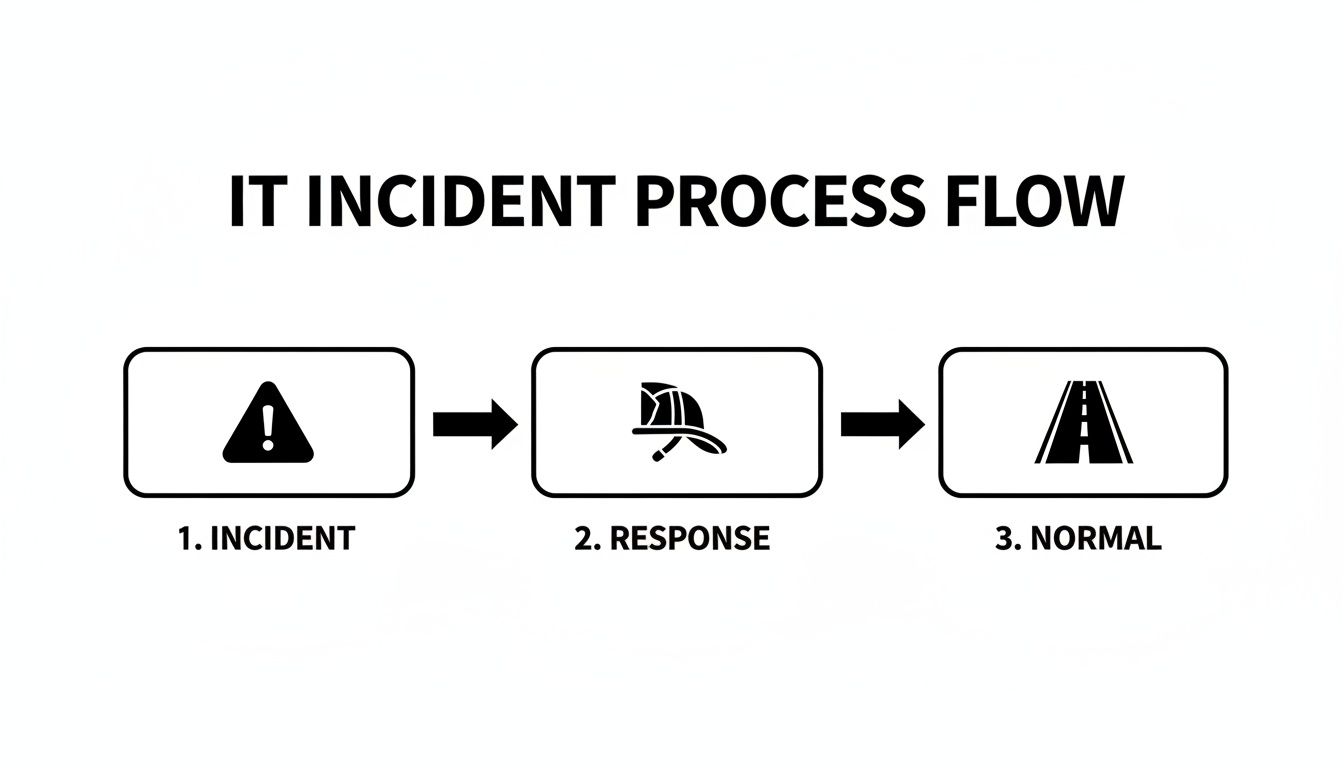
The entire process is built on that core principle. The longer you’re stuck in the response phase, the more damage is done. Now, let’s break down the play-by-play.
Stage 1: Identification and Logging
It all starts with Identification. This is the moment something goes wrong. An automated monitoring tool might fire off an alert, or a user might report a problem. This is where strong cybersecurity defenses are invaluable; a good system can spot a potential breach long before a user ever notices a thing.
Right after identification comes Logging. A formal record, or “ticket,” is created in your IT service management system. Think of this ticket as the incident’s official file—a central hub for every update, note, and action taken. It creates a clear timeline and ensures nothing gets lost in the shuffle.
Stage 2: Categorization and Prioritization
With a ticket created, the incident moves into Categorization and Prioritization. First, the IT team categorizes the incident based on what’s affected, like a “network issue,” “software bug,” or “cybersecurity alert.” This step makes sure the ticket lands on the desk of the right specialist from the get-go.
Next comes prioritization. Here, the team sizes up the incident’s business impact and urgency. Is this a minor inconvenience for one user (a fender-bender) or a critical system failure bringing the whole company to a halt (a multi-car pileup)? Cybersecurity threats like ransomware or data breaches always jump to the front of the line.
A common mistake for businesses is treating every issue with the same level of urgency. Effective prioritization ensures that the most critical problems—those that directly threaten revenue or security—are addressed first, allocating resources where they are most needed.
For example, a construction firm in Kissimmee discovers its team can’t access critical project files on a shared server. This is immediately logged as a high-priority incident. Why? Because it stops billable work for multiple employees, putting project deadlines and revenue at risk.
Stage 3: Diagnosis and Escalation
Once prioritized, the initial Diagnosis begins. Your helpdesk or first-line support team jumps in, performing a preliminary investigation to understand the symptoms. Their goal is to find a quick fix using known solutions and get the user back to work fast.
If they can’t solve it, Escalation happens. The incident gets passed up the chain to a more specialized team with deeper technical skills, like network engineers or cybersecurity analysts. For that Kissimmee construction firm, if the helpdesk can’t resolve the server access issue, they escalate it to the infrastructure team that manages the servers. You can learn more about formalizing these procedures by crafting your incident response plan for max efficiency.
Stage 4: Resolution and Closure
The specialized team now focuses on Resolution. Their primary mission is to restore service as fast as possible, even if it means using a temporary workaround.
In our construction firm example, the infrastructure team might restore access from a recent backup while they investigate the root cause of the main server failure. This gets the engineers working again immediately. The full fix can come later; getting operational is the priority.
Finally, once service is restored and the user confirms everything is working, the incident moves to Closure. The support team documents the final resolution steps in the ticket and officially closes it out. This last step is vital, as it builds a knowledge base that helps everyone resolve similar incidents much faster in the future.
Incident, Problem, and Change Management Explained
If you’ve ever wondered why your IT team seems to be fighting the same fires over and over, you’re not alone. Many business leaders in Central Florida ask us why simply “fixing things” doesn’t lead to a more stable IT environment. The answer is that not all IT fixes are created equal.
The official ITIL definition for incident management is all about getting things working again, fast. But for long-term stability, you need two other key processes working in the background: Problem Management and Change Management.
Let’s use a local analogy to make this crystal clear. Imagine a multi-car pile-up on I-4 during Orlando’s rush hour.
-
Incident Management is the paramedic crew arriving on the scene. Their only job is to treat the injured (the broken system), stabilize them, and clear the road as quickly as possible to get traffic flowing again. They aren’t investigating why the crash happened; they’re just dealing with the immediate crisis.
-
Problem Management is the traffic homicide investigator who shows up after the mess is cleared. They’re the ones looking at the skid marks, interviewing witnesses, and checking traffic light logs to find the root cause. Was it a blind spot? A faulty traffic signal? A poorly designed on-ramp?
-
Change Management is the city planning committee that gets the investigator’s report. They’re the ones who approve, schedule, and oversee the project to fix that faulty traffic light. They ensure the fix is done in a controlled way that minimizes disruption and actually prevents future accidents.
In a professional services firm, an incident might be a server crashing. The goal is to get it back online immediately. The problem investigation might reveal the server is ten years old and constantly overheating. The change would be the carefully planned project to replace it. Each process is distinct, but they all depend on each other.
Distinguishing the Three Disciplines
While these three processes work hand-in-hand, they operate on completely different timelines with fundamentally different goals. Incident management is always reactive—it’s about speed. In contrast, Problem and Change Management are more deliberate; one is investigative, and the other is preventative.
Cybersecurity is a perfect example of this in action. An incident is detecting a malware infection on a laptop. The immediate goal is to isolate that machine and stop the threat from spreading. Problem management then digs in to figure out how the malware got past your defenses in the first place. Finally, change management would oversee the implementation of new security controls to make sure it can’t happen again.
Relying only on incident management is like having an emergency room with no doctors trying to figure out what’s making people sick. You’ll get really good at patching people up, but you’ll never stop them from getting sick in the first place.
Understanding how these three disciplines fit together is the first step toward building a truly resilient IT operation. The table below breaks down their primary functions.
Discipline
Primary Goal
Focus
Nature
Incident Management
Restore normal service as quickly as possible.
Immediate resolution and workarounds.
Reactive
Problem Management
Find and eliminate the root cause of incidents.
Investigation, diagnosis, and prevention of recurrence.
Proactive & Reactive
Change Management
Control the lifecycle of all changes to minimize disruption.
Planning, risk assessment, and controlled implementation.
Proactive
For financial and professional services firms where uptime and data integrity are everything, this separation isn’t just a “nice-to-have”—it’s non-negotiable.
This approach ensures that while part of your team is fighting today’s fire (Incident Management), another part of your strategy is fireproofing the building for tomorrow (Problem and Change Management). It’s this layered, mature strategy that separates a chaotic IT environment from a stable, predictable one.
Why Proactive Incident Management Is a Competitive Edge
If your IT strategy is built around waiting for things to break, you’re playing a losing game. For high-stakes industries here in Central Florida—like law, finance, and healthcare—that reactive approach isn’t just inefficient; it’s a direct threat to your bottom line and your cybersecurity posture.
Moving beyond the basic incident management ITIL definition to a proactive strategy isn’t just an IT upgrade. It’s a powerful competitive advantage.
Being proactive means you stop firefighting. Instead, you use smart tools to find and fix problems before they can disrupt your operations. This is the fundamental shift that separates businesses that thrive from those constantly bogged down by tech headaches and security scares.

Ultimately, this approach delivers real business results. We’re talking about higher system uptime, stronger security, and deeper trust from clients who depend on you to be reliable.
The Real Cost of a Reactive Approach
For a busy law firm in Tampa, reactive IT means lost billable hours every single time a critical application crashes. For a Sanford medical practice, it means patient data is at risk and appointments get delayed. The true cost isn’t just the repair bill; it’s the lost productivity, damage to your reputation, and potential regulatory fines from a data breach.
Here’s the scary part: most companies aren’t nearly as proactive as they think they are. There’s often a huge gap between their perceived readiness and their actual ability to prevent incidents, leaving them dangerously exposed.
According to Atlassian’s 2023 State of Incident Management Report, only 56.4% of organizations were truly ‘proactive.’ This isn’t just a buzzword; proactivity was defined by using monitoring tools, having automated alerts, running incident response drills, and leveraging AI for trend analysis. For firms in professional services or healthcare with limited in-house IT, this statistic highlights a massive risk. Without these proactive tools, downtime can spiral, costing an average of $5,600 per minute. You can explore more data from the Atlassian State of Incident Management FY23 report.
This data reveals a massive opportunity. By adopting a proactive stance, your business can sidestep the common pitfalls that hold your competitors back, turning IT resilience into a true market differentiator.
The Pillars of a Proactive Strategy
Shifting to a proactive model means building a system designed to see and solve problems before they happen. This strategy is built on several key pillars that work together to create a stable, secure, and predictable technology environment.
A truly proactive strategy includes:
-
Advanced Monitoring and Alerting: This is your digital smoke detector. Instead of waiting for a user to report a problem, sophisticated tools watch over your network, servers, and applications 24/7. They spot unusual activity—like a server’s temperature rising or suspicious network traffic indicating a cyber threat—and automatically create an alert before it becomes a full-blown incident.
-
Automated Response and Remediation: Once an alert is triggered, automation can take immediate action. Think of it as a digital first responder. This could involve automatically restarting a failed service, blocking a malicious IP address, or escalating the issue to a specific engineer. This machine-speed response slashes resolution times from hours to minutes.
-
AI-Driven Trend Analysis: This is where things get really smart. Modern systems analyze patterns in your IT data to predict future failures. By identifying recurring minor issues that might seem unrelated, AI can flag an underlying problem that needs a permanent fix before it ever causes a major outage. This is a core component of how you can benefit from proactive IT management.
For any Central Florida business, this proactive posture is your best defense against the constant threat of cyber attacks. Active threat hunting and continuous monitoring mean security incidents are stopped in their tracks, protecting your sensitive client and patient data. This commitment to security and uptime gives your clients peace of mind and reinforces your reputation as a reliable, trustworthy partner.
How a Managed IT Partner Operationalizes ITIL for You
Knowing the incident management ITIL definition is a great starting point, but turning that textbook framework into a living, breathing, 24/7/365 operational model is a whole different ball game. For most small and mid-sized businesses in Central Florida, this is where a managed IT partner steps in to turn abstract theory into real-world protection.
Instead of facing the enormous cost and complexity of building an in-house incident response team from the ground up, you get an entire U.S.-based Security Operations Center (SOC) and helpdesk on day one. This team becomes your always-on crew, running the entire ITIL process for you.

This partnership lets you and your team finally stop putting out IT fires. You can shift your energy from technology failures back to your core business goals, knowing a professional team is standing guard around the clock.
Your 24/7/365 Incident Response Engine
For business owners in cities like Orlando and Kissimmee, a local partner like Cyber Command acts as a true extension of your own team. It all starts with proactive monitoring, where advanced tools keep a constant watch over your network, servers, and endpoints. The second an issue pops up, the ITIL lifecycle springs into action.
An alert is triggered, an incident is logged in the system, and our helpdesk team immediately starts digging in. This structured, rapid response means we’re identifying and working on problems in minutes, not hours. For your business, that translates to real, measurable results:
- Instant Detection & Logging: Our SOC uses sophisticated tools to spot anomalies, whether it’s a failing server or suspicious network traffic that could signal a cyber attack. An incident ticket gets created automatically, ensuring every event is tracked from start to finish.
- Rapid Local Response: Being right here in Central Florida means we can provide swift on-site support for critical hardware failures when a remote fix just won’t cut it.
- Swift Resolution: Our U.S.-based helpdesk is your first line of defense, resolving the vast majority of issues on the very first call. If an issue needs a specialist, it’s seamlessly escalated to a senior engineer.
This isn’t just reactive support; it’s a fully operationalized system built for resilience.
The greatest value of a managed IT partner is the offloading of mental and operational overhead. Business leaders no longer have to worry about who will answer the phone at 3 AM or whether their team has the skills to handle a sophisticated cyber threat. It’s handled.
Enhancing Cybersecurity Through Active Threat Hunting
A critical part of putting incident management into practice is a relentless focus on cybersecurity. In today’s world, waiting around for a security incident to announce itself is a recipe for disaster. Our SOC goes beyond basic monitoring by performing active threat hunting.
This means our security analysts are constantly digging through your network, searching for signs of advanced threats that might slip past automated defenses. This proactive stance is non-negotiable for organizations in professional services, finance, and healthcare that are trusted with sensitive client or patient data.
By folding threat hunting into the ITIL framework, we make sure potential security incidents are found and shut down before they become a full-blown breach. This active defense is a core part of the peace of mind that comes with a predictable, all-inclusive IT management plan. Curious about the platforms that power this? You can learn more about how we implement ServiceNow for IT service management.
The Power of A Mature Platform and Process
Top-tier managed IT partners use powerful platforms like ServiceNow to execute ITIL processes with precision; for those wanting a deeper dive, resources like the ServiceNow Certified System Administrator Study Guide are a great place to start. These powerful systems provide the backbone for logging, prioritizing, and managing incidents at scale.
When you partner with an expert, you get the full benefit of these enterprise-grade tools and mature processes without the massive upfront investment. It turns a complex framework into a simple outcome: your technology just works.
Ultimately, operationalizing ITIL is about creating a system of accountability and results. Through transparent reporting and regular business reviews, you can see exactly how your IT environment is performing. You get clear metrics on response times, resolution rates, and incidents prevented—giving you measurable proof of a resilient, secure, and well-managed technology infrastructure.
Of all the ITIL concepts we talk about, incident management is where the rubber really meets the road for most businesses. But I get it—the principles can feel a little abstract when you’re just trying to keep your Orlando business running.
You know the goal is a more stable IT environment, but you have practical questions. How do we even start? How do we know if it’s working? And is all this “proactive” stuff really going to save money?
This is where we move from theory to reality. Let’s tackle the real-world questions we hear most often from local business owners.
What Is the First Step My Orlando Business Should Take to Implement ITIL?
The single most important first step is visibility. You can’t manage what you can’t see. For most small and mid-sized businesses, this journey starts with a thorough audit of your entire technology environment, usually with an IT partner.
Think of this initial assessment as a detailed physical for your company’s tech. It helps identify your most critical systems, map out single points of failure, and shine a light on hidden security gaps. It’s the foundational map you need before you can even think about plotting a new course.
From there, the next move is to set up a formal process for logging and tracking every single IT issue. This can be as simple as a basic ticketing system or the platform your managed service provider uses. The goal is to get away from the chaotic, ad-hoc “call the IT guy” method and into a structured, documented process. This simple shift lays the groundwork for faster responses and much smarter decision-making down the road.
How Do I Measure the Success of My Incident Management Process?
Success isn’t just a feeling; it’s something you measure with a few Key Performance Indicators (KPIs) that track speed, efficiency, and improvement over time. While there are dozens of metrics out there, a business owner should really only focus on the handful that directly tie back to business impact.
The most important KPIs for a business leader to watch are:
- Mean Time to Acknowledge (MTTA): How quickly does your team jump on an alert once it’s raised? A low MTTA means your team is alert and engaged, which is critical for stopping small issues from becoming big disasters.
- Mean Time to Resolution (MTTR): This is the big one. It tracks the average time from when an incident is reported to when it’s completely fixed and service is restored. This metric directly correlates to minimizing the business pain of downtime.
- Number of Incidents: Simply tracking the total volume of incidents over time tells a story. A successful process, especially when paired with good problem management, should lead to a gradual decrease in the overall number of incidents.
- Percentage of Repeat Incidents: Seeing the same problem pop up over and over is a huge red flag. It’s a classic sign that you’re only treating symptoms, not the root cause. A good strategy will show a steady decline here.
A strong IT partner won’t hide these numbers. They’ll provide you with transparent reports and hold Quarterly Business Reviews (QBRs) to walk you through what these metrics mean. This gives you measurable proof that your IT is becoming more resilient and that your partnership is delivering real value.
Is a Proactive Incident Plan Really Less Expensive for a Small Medical Practice or Law Firm?
Absolutely. The old reactive, “break-fix” model seems cheaper on the surface, but it’s loaded with hidden costs and massive risks. For a law firm, an unexpected server failure can easily cost thousands in lost billable hours, and that’s before you even get the emergency repair bill.
For a Florida medical practice or law firm, the stakes are even higher. A data breach from an unmanaged security incident can trigger devastating regulatory fines, client lawsuits, and reputational damage that’s nearly impossible to repair. The cost of just one serious incident can easily dwarf years of proactive IT investment.
A proactive plan with a managed partner works on a predictable, flat-rate model. This investment is designed to prevent the vast majority of incidents from ever happening in the first place, thanks to 24/7 monitoring and active threat hunting. It transforms your IT spending from a volatile, unpredictable risk into a stable, strategic investment in uptime, security, and peace of mind.
By partnering with an expert, you shift your entire focus from reacting to disasters to preventing them. For businesses in Orlando and throughout Central Florida that depend on uptime and data security, this isn’t just another expense—it’s a fundamental requirement for operating in the modern world and a powerful competitive edge.
Are you ready to move beyond reactive IT firefighting and build a more resilient, secure business? Cyber Command, LLC provides the proactive partnership and 24/7 support Central Florida businesses need to thrive. Let us show you how a true ITIL-based approach can transform your technology from a liability into your greatest asset by visiting /.
This article is for general informational purposes only and is not legal, compliance, insurance, or other professional advice. Threats, technologies, and regulations change quickly; confirm current requirements with your own advisors before acting. See our full disclaimer.