


60% of small businesses in the U.S. say cybersecurity threats are their top concern, ahead of supply chain disruption and pandemic risk, according to the MetLife & U.S. Chamber of Commerce Small Business Index. That number matters because it shifts cybersecurity out of the “IT issue” bucket and into business continuity, client trust, and operational survival.
In Central Florida, that shift is overdue. Orlando firms are growing across legal, medical, financial, engineering, and service industries. Many operate across multiple offices, depend on cloud systems, and move sensitive data every day. A generic security package built for a national average business usually misses the actual pressures local companies face, especially in places like Lake Mary, Winter Springs, Winter Park, Kissimmee, and Downtown Orlando.
Good Orlando cybersecurity services aren't about buying the biggest stack. They're about protecting uptime, keeping regulated data under control, and making sure one bad click doesn't turn into a week of downtime, a failed audit, or a client confidence problem.
Table of Contents
- Why Orlando Businesses Cannot Ignore Cybersecurity in 2026
- Top Cyber Threats Facing Central Florida Businesses
- What Orlando Cybersecurity Services Actually Include
- Co-Managed vs Fully-Managed Support Models
- How to Choose the Right Orlando Cybersecurity Partner
- Real-World Cybersecurity Outcomes for Local Businesses
- Your Orlando Cybersecurity Questions Answered
Why Orlando Businesses Cannot Ignore Cybersecurity in 2026
The FBI's Internet Crime Complaint Center continues to log heavy losses from business email compromise, ransomware, and related cybercrime across the U.S. That matters in Orlando because the local impact usually shows up first as downtime, delayed billing, missed deadlines, and compliance exposure, not as a technical headline.
For Central Florida companies, cybersecurity has become an operating requirement. A Winter Park law firm needs reliable access to case files and email. A medical practice in Kissimmee needs scheduling, records, and communications available throughout the day. A Lake Mary financial or accounting office needs to protect client data while meeting reporting deadlines and regulatory expectations. If those systems fail, revenue and trust both take a hit.
The pressure is higher here because many Orlando businesses have grown faster than their security controls. They added cloud apps, remote access, new offices, outsourced vendors, and mobile devices, but kept the same approval habits, backup routines, and account permissions they used when the company was much smaller.
That gap creates risk.
Local growth creates local exposure
In Central Florida, I see the same pattern across legal, medical, and financial services firms. Leadership invests in tools that help the business move faster, then treats security as a separate project to handle later. The result is usually predictable. Shared admin accounts, weak MFA coverage, flat networks, inconsistent backups, and no clear owner for incident response.
Those weaknesses are expensive in regulated industries. A legal office has confidentiality obligations. A healthcare group has patient privacy and availability concerns. A financial firm has to protect sensitive records, control access, and show that security procedures are more than a policy sitting in a folder.
Brand risk belongs in the same conversation. Fake domains, spoofed email, and lookalike web addresses are common starting points for fraud and credential theft. If your company has not taken steps to protect your brand from typosquatting, you are leaving a preventable opening for attackers.
Practical rule: If payroll, client communication, scheduling, billing, or records access depends on connected systems, cybersecurity already affects uptime.
What works and what fails
Effective security is usually plain and disciplined. Protected identities. Limited admin rights. Tested backups. Documented recovery steps. Endpoint monitoring. Staff training tied to the actual scams your employees see. Regular reviews of vendors and remote access.
What fails is easy to spot. Companies buy advanced monitoring while basic account security is still weak. They assume cyber insurance replaces preparation. They depend on one internal IT person without confirming who watches alerts after hours, who approves privileged access, or how fast systems can be restored after an incident.
For Orlando businesses in 2026, the question is not whether cybersecurity deserves budget. The question is whether the business can afford the downtime, compliance problems, and client fallout that follow weak controls.
Top Cyber Threats Facing Central Florida Businesses
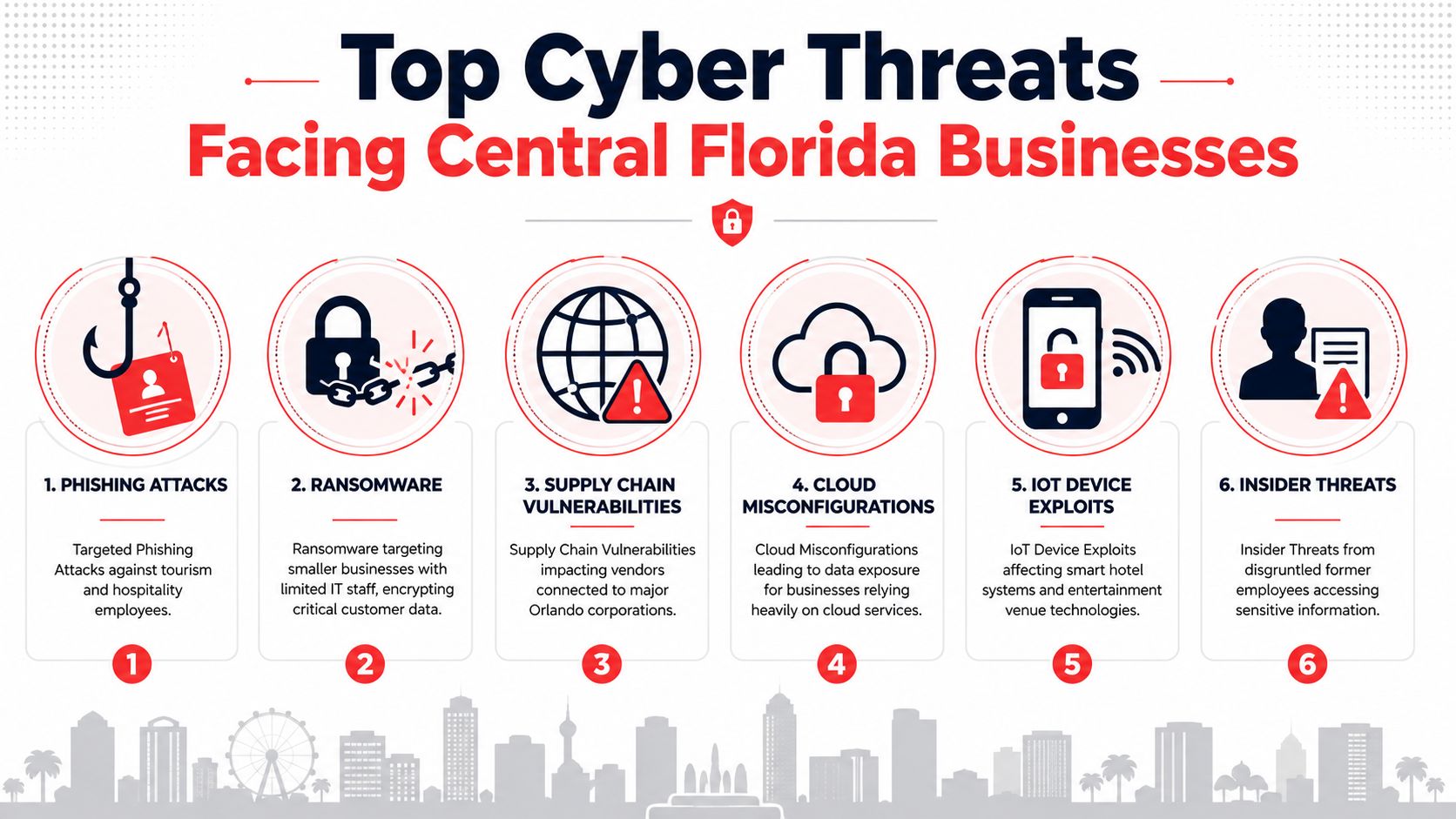
Florida small businesses face five primary threats: ransomware, phishing and social engineering, data breaches, insider threats, and compliance failures, and the same guidance stresses the need for offline backups, endpoint detection and response, and regular compliance assessments for frameworks such as HIPAA, PCI-DSS, and NIST, as outlined in this Florida small business cybersecurity guidance.
That list lines up with what Central Florida companies deal with. The threat names may sound generic, but the business impact isn't.

Where the pressure shows up locally
A Winter Park law firm handles confidential client files, contract drafts, and litigation records. A breach there isn't just an IT cleanup. It can become a client trust issue and a records access problem at the worst possible time.
A Kissimmee medical practice has a different exposure. Clinical workflows, scheduling, billing, and patient communication all rely on systems being available. If ransomware hits that environment, the operational disruption lands immediately.
A Lake Mary accounting or financial services office faces another pattern. Staff move sensitive documents, client tax data, and payment-related information through email, portals, and shared storage. Attackers know those users are accustomed to links, attachments, and approval requests. That makes phishing more effective when the controls are weak or inconsistent.
The threats that deserve immediate attention
Here's how these risks usually show up on the ground:
- Ransomware: This is the fastest route from “minor security issue” to full business interruption. If backups are poorly designed or never tested, recovery becomes slow, expensive, and chaotic.
- Phishing and social engineering: Most Orlando businesses don't get breached through movie-style hacking. They get tricked. Fake invoices, login prompts, voicemail notices, and document-share alerts still work because they target normal behavior.
- Data breaches: These often follow weak identity controls, exposed cloud data, or poor access hygiene. Professional firms and healthcare groups are especially exposed because they hold regulated or confidential information.
- Insider threats: Not every insider incident is malicious, but former employees with lingering access, shared passwords, and unmonitored file exports create avoidable risk.
- Compliance failures: This category gets ignored until a renewal, client questionnaire, or audit reveals that required controls were never formalized.
There's also a related brand risk many firms overlook. Attackers don't always need to breach your network if they can register lookalike domains and impersonate your business. If your company relies on email trust, invoices, or appointment confirmations, it's smart to protect your brand from typosquatting as part of the wider security conversation.
A useful test is simple. Ask which single event would disrupt your firm fastest: loss of email, loss of files, loss of internet, or loss of access to your core application. Your most likely threats usually map to that answer.
For Central Florida industries, this is why industry-specific guidance matters. Legal, medical, and financial businesses don't have identical risk. They need Orlando cybersecurity services that understand both the threat pattern and the compliance pressure attached to it.
What Orlando Cybersecurity Services Actually Include
A cybersecurity proposal should answer three questions fast: what gets protected, who is watching it, and what happens when something goes wrong. If those answers are buried under acronyms, the service is probably being sold better than it is being run.
For Orlando businesses, the right scope usually starts with a multi-layered architecture. That means perimeter controls such as managed firewalls and intrusion prevention, internal segmentation that limits lateral movement, endpoint controls on laptops and servers, centralized log review, and a documented response process. Legal, medical, and financial firms often need one more layer. They need those controls mapped to client requirements, insurance questionnaires, and regulatory obligations that affect renewals and contracts.

The core layers that matter
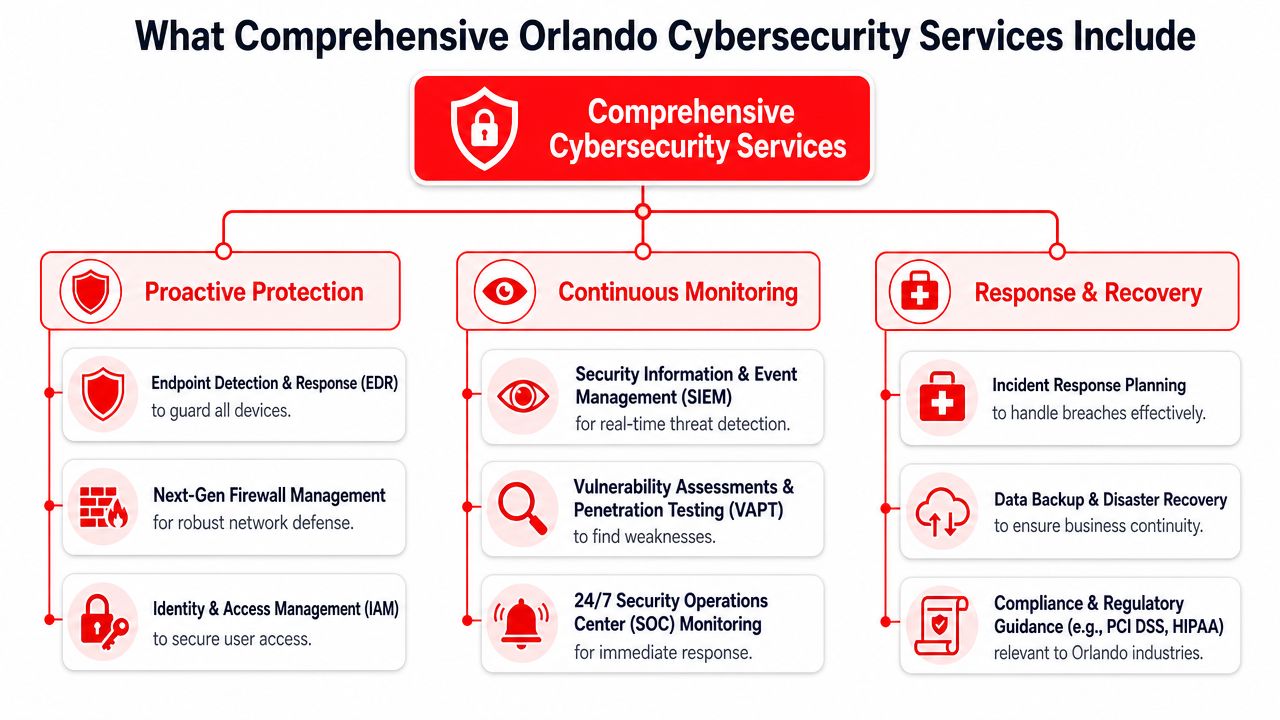
The first layer is protection. This covers endpoint security, patch management, email and web filtering, firewall administration, access controls, and multi-factor authentication. The business outcome is simple. Fewer preventable incidents and less downtime from basic failures that should have been stopped earlier.
The second layer is monitoring and investigation. Logs from endpoints, servers, cloud systems, and network devices are collected and reviewed so suspicious behavior can be validated instead of ignored. Alert fatigue is a real problem, so a provider needs a triage process that filters noise and escalates events that can affect operations, data, or compliance.
The third layer is response and recovery. This includes account containment, host isolation, evidence preservation, communication steps, backup validation, and recovery sequencing based on business priority. If your firm cannot explain who makes the call on a Friday night ransomware event, you do not have an operational service yet.
What business owners should expect in practice
A solid provider should explain services in plain language and tie each one to an outcome your leadership team cares about.
- Managed monitoring: Security staff review activity, investigate alerts, and escalate confirmed issues. Tools without review create a false sense of coverage.
- Incident response: The provider should define containment steps, decision paths, communication roles, and recovery actions before an event occurs.
- Endpoint protection: User devices, servers, and mobile systems need active controls because Orlando teams work from offices, homes, client sites, and healthcare facilities.
- Identity and access management: Account security includes MFA, privilege control, access reviews, and disciplined onboarding and offboarding. This matters a lot for law firms, clinics, and finance teams handling confidential records.
- Backup and recovery readiness: Backups must be protected from tampering, tested for recovery, and aligned to the systems your business cannot operate without.
For many Central Florida companies, compliance support is part of the service, not an add-on. A medical practice may need security controls aligned with HIPAA workflows. A law firm may need documented access governance for client data. A financial services firm may need stronger evidence collection for audits, cyber insurance, and vendor due diligence. Good providers build that documentation into day-to-day operations instead of scrambling when an auditor or client sends a questionnaire.
One trade-off deserves attention. Some businesses buy advanced monitoring before they have disciplined patching, MFA enforcement, and backup testing in place. That order usually creates cost without enough risk reduction. Firms with an internal IT lead often get better results from a co-managed IT services model in Orlando where internal staff keep control of daily operations and the security partner owns specialized coverage, escalation, and compliance support.
Good security service reduces operational risk and decision delay. If a provider cannot explain what happens at 2 a.m. during an incident, the service is not ready for a real event.
For businesses that want a local provider with integrated managed IT and security operations, one example is Cyber Command, LLC, which offers managed security capabilities as part of broader IT and cybersecurity support. The important question is whether the service covers protection, monitoring, response, recovery, and compliance in a way your team can practically use.
Co-Managed vs Fully-Managed Support Models
Choosing between co-managed and fully-managed support is less about company pride and more about operating reality. The right model depends on whether you already have internal IT capability, how regulated your environment is, and how much accountability you want a provider to own day to day.
One point is often missed in local sales conversations. Orlando SMBs usually need to prioritize foundational controls such as MFA, patching, and backups before paying for expensive SOC monitoring, and some guidance notes that 60–75% of cyber incidents are prevented by basic hygiene alone in the SMB context, as explained in this small business IT support analysis.
When co-managed support fits
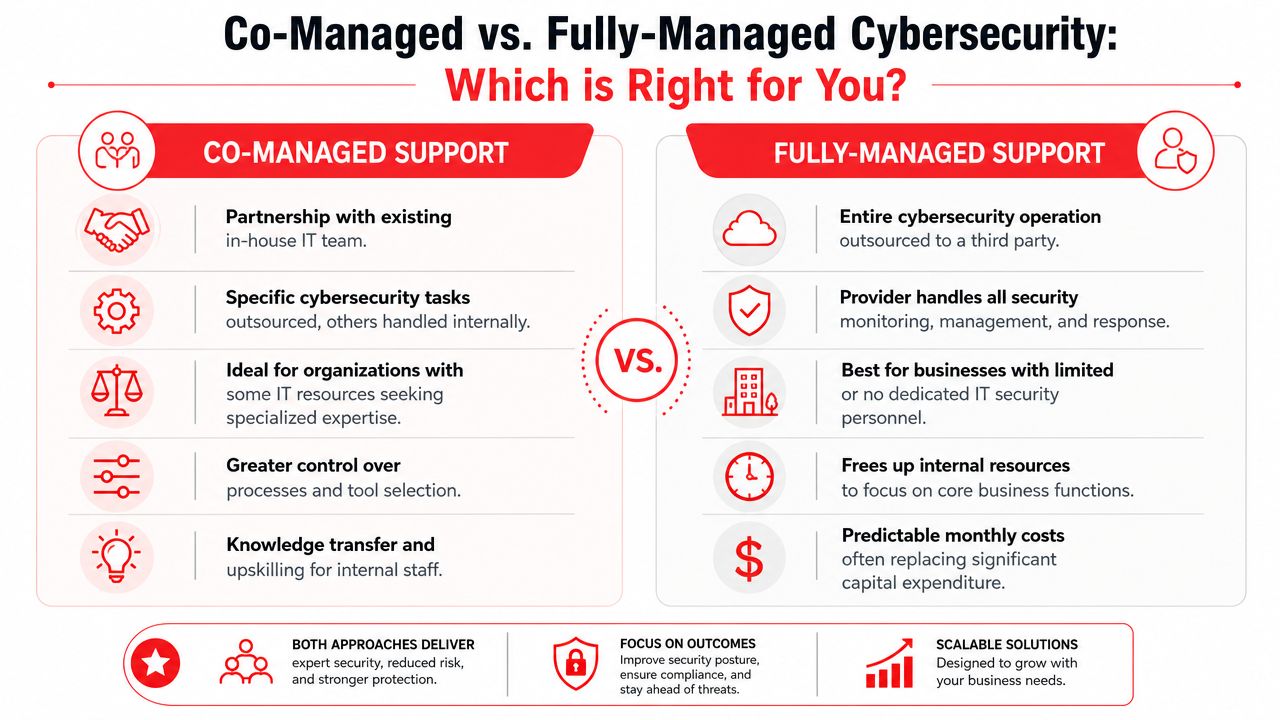
Co-managed support works best when you already have an internal IT person or small team that understands your environment but needs depth, coverage, or help with specialized security functions.
That model usually fits businesses like these:
| Business profile | Why co-managed works |
|---|---|
| A growing professional services firm with an internal IT generalist | Internal staff handle daily user support while the outside partner adds security operations, strategy, and escalation coverage |
| A multi-location company standardizing systems | The internal team keeps local knowledge, and the outside partner helps unify tools, process, and reporting |
| A regulated business with IT staff but limited security expertise | Internal personnel stay involved while outside specialists address compliance, monitoring, and recovery readiness |
A co-managed arrangement can also improve team maturity. The internal staff gains process discipline, documentation support, and access to broader expertise. For businesses exploring that route, this overview of co-managed IT services in Orlando gives a useful example of how the model is structured.
When fully-managed support makes more sense
Fully-managed support is the better fit when there's no real internal security bench, or when leadership wants one accountable partner handling the environment instead of a patchwork of freelancers and vendors.
Fully-managed usually makes sense when:
- There's no dedicated IT staff: A law firm, medical office, or accounting practice often needs one team to own support, security, vendor coordination, and recovery planning.
- Leadership wants clarity: One provider, one escalation path, one reporting structure. That's easier to govern than multiple handoffs.
- The environment is already inconsistent: If devices, user permissions, backup procedures, and documentation are all uneven, full ownership helps clean it up faster.
The wrong model is the one that leaves critical tasks in the gap between “our internal team thought the provider handled it” and “the provider assumed your team owned it.”
The biggest trade-off is control versus responsibility. Co-managed gives you more internal control but requires internal time and discipline. Fully-managed reduces management burden, but only if the provider is transparent about scope, response, and accountability.
How to Choose the Right Orlando Cybersecurity Partner
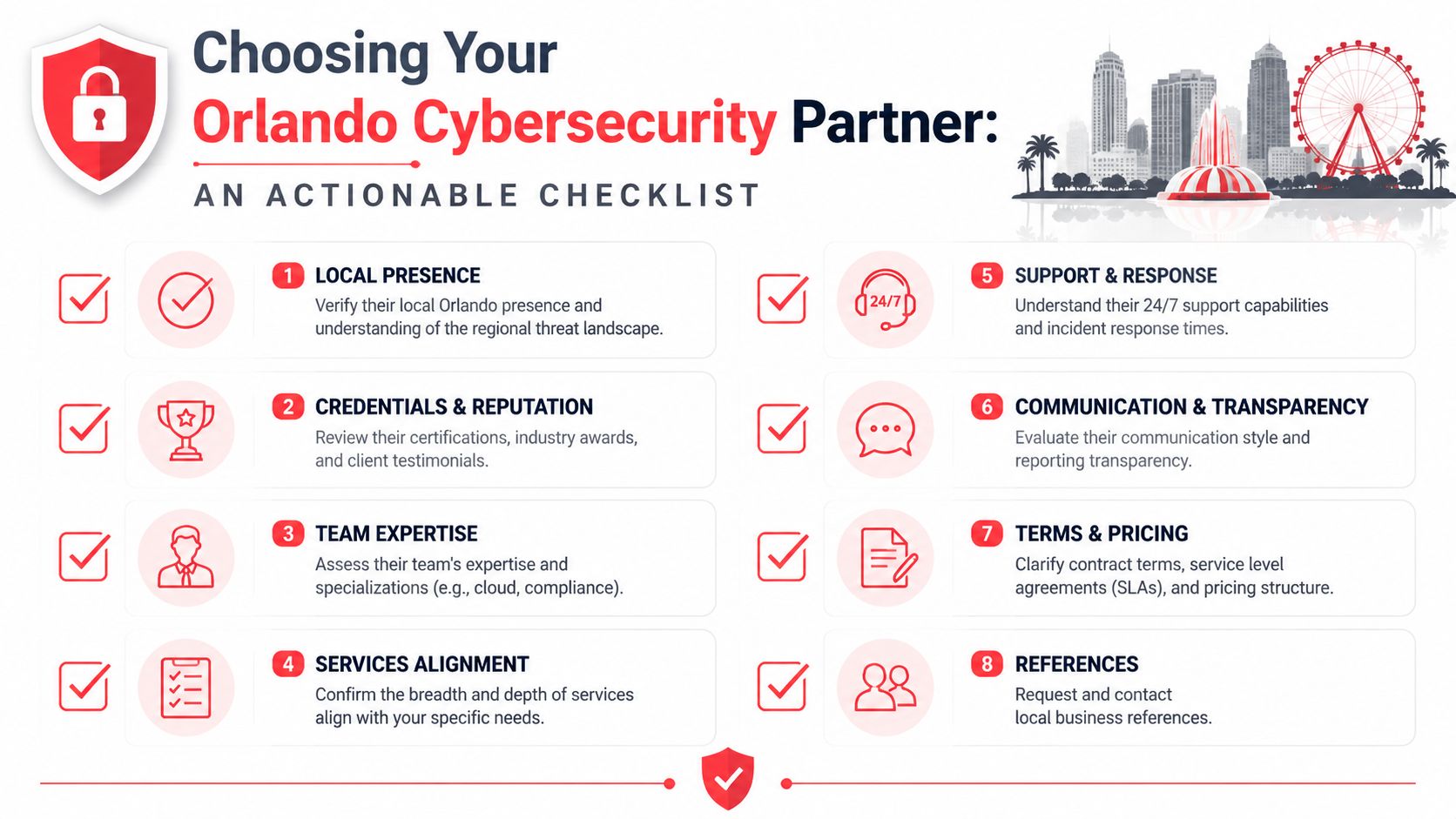
Most firms don't fail vendor selection because they asked too many questions. They fail because they asked the wrong ones. A polished proposal can hide weak response processes, vague accountability, and a service scope that looks strong on paper but doesn't match the way your business runs.
The provider you choose should understand basic control expectations for small businesses. The FCC says businesses should require password changes every three months, use MFA, enable encrypted and hidden Wi-Fi by disabling SSID broadcast, and restrict administrative privileges to trusted IT staff, according to the FCC cybersecurity guidance for small businesses. If a provider treats those fundamentals casually, that's a warning sign.
Questions that reveal real capability
Start with operating questions, not marketing claims.
- Who answers after hours: Ask whether real people handle urgent incidents and where that support sits operationally.
- What's included in response: Confirm whether the provider only alerts you, or also investigates, contains, and helps recover.
- How do they handle network security: A provider should be able to discuss segmentation, firewall governance, and access control clearly. A local example of service scope is this Orlando network security company page.
- How do they support compliance: Legal, medical, and financial firms need more than antivirus and backups. They need documentation, control alignment, and repeatable processes.
- What reporting do you receive: You want useful reporting that shows risk, actions taken, unresolved issues, and business impact.
A strong local partner should also understand the business rhythm of Central Florida industries. Medical offices need minimal disruption during patient hours. Law firms need records access certainty. Financial businesses need disciplined identity control and audit readiness. Architecture and engineering firms often highly value drawing access, project continuity, and vendor coordination.
Red flags that show up early
Some warning signs are easy to spot once you know where to look:
- Everything starts with advanced tooling: If the proposal skips basics and jumps straight to premium monitoring, the foundation may be weak.
- No clear line on admin rights: Uncontrolled privilege is still one of the fastest ways to turn a small incident into a larger one.
- Vague onboarding: If the provider can't explain how they assess devices, users, networks, backups, and vendors at the start, expect surprises later.
- No business language: If every explanation stays technical, they may struggle to support owners, practice managers, and operations leaders.
Ask one direct question: “If we suspect an account compromise at 8:30 a.m., what happens in the first hour?” The quality of the answer tells you more than a long service list.
The right partner doesn't just sell Orlando cybersecurity services. They connect security work to uptime, client trust, insurance expectations, and the practicalities of how your business operates.
Real-World Cybersecurity Outcomes for Local Businesses
The most useful way to judge cybersecurity isn't by how many acronyms a provider uses. It's by what changes in daily operations after the work is in place.
Professional services
A Downtown Orlando law office often starts from a familiar place. Staff use shared files heavily, attorneys work remotely, and no one is completely sure who still has access to what. Security projects in that environment usually produce two immediate outcomes: tighter control over confidential data and fewer disruptions during urgent client work.
An accounting firm in Lake Mary has a different pressure point. Tax season and reporting deadlines leave no room for instability. When the environment is standardized, backups are tested, user access is governed, and suspicious activity gets reviewed quickly, the biggest gain is confidence that the team can keep operating when the workload spikes.
The best security outcome is often quiet. The team stops improvising around recurring problems because the environment becomes predictable.
Healthcare and multi-location operations
A private practice or medical spa group in Central Florida usually cares about consistency across locations. One office may have decent controls while another has weak Wi-Fi security, informal onboarding, or poor device management. Once those locations are brought under one security standard, leadership gets cleaner oversight and fewer compliance gaps.
Backup and recovery planning becomes especially important in these environments. A provider that builds and manages a clear recovery process can reduce operational chaos when something breaks or a system has to be restored. This example of data backup and recovery in Orlando shows the kind of service area businesses should evaluate closely.
Another overlooked outcome is staff behavior. When employees know how to report suspicious emails, handle sensitive data, and escalate issues quickly, the business gets faster containment and less confusion. The improvement isn't flashy, but it protects schedules, reputation, and revenue.
For local businesses, that's the core point of cybersecurity. Better uptime. Fewer surprises. Cleaner compliance posture. More trust from clients and patients. That's what good Orlando cybersecurity services should deliver.
Your Orlando Cybersecurity Questions Answered
Are we too small to need cybersecurity services
No. If you use email, cloud apps, shared files, online banking, payment systems, or Wi-Fi, you have exposure. Smaller teams often need outside help sooner because they have less internal capacity to monitor, document, and recover.
Should we buy advanced monitoring first
Usually no. Start with fundamentals. Lock down identities, patch systems, protect endpoints, review admin rights, and make sure backups are usable. More advanced monitoring makes sense after the basics are under control, or sooner if you're in a high-risk regulated environment.
What should every employee be trained on
Every employee should receive yearly cybersecurity training that covers phishing recognition, unique passwords, safe handling of sensitive data, and immediate reporting of suspicious activity, based on the University of Rhode Island SMB cybersecurity guidance.
What should we do first if we suspect a breach
Isolate the affected system or account, preserve what happened, and contact your security partner immediately. Don't let staff troubleshoot ad hoc. Fast containment matters more than guesswork.
If your business in Orlando, Winter Springs, Lake Mary, or the broader Central Florida market needs a practical cybersecurity partner, Cyber Command, LLC is one option to evaluate. The firm provides managed and co-managed IT, 24/7/365 U.S.-based support, cybersecurity operations, compliance support, and recovery planning for organizations that need tighter security without losing sight of uptime, budget control, and day-to-day business operations.