


You're probably staring at the same problem a lot of Central Florida owners face. The phones ring, the helpdesk tickets keep piling up, and every “quick fix” turns into another interruption for your team, another surprise invoice, or another late-night worry about whether the network will hold up tomorrow.
That's the point where an Orlando IT strategy session stops being a nice-to-have and becomes a business decision. If your operation depends on uptime, guest-facing systems, compliance, or fast issue resolution across multiple locations, you need a plan that stabilizes first and modernizes second. Orlando's market intensity backs that up, with metro hotel occupancy at 72.8% for the week ending May 24, 2025, up 8.6% year over year, while average daily rate reached $202.61 and room-night demand was 10.8% higher than the prior year, according to Visitorlando's meeting destination update. That kind of activity doesn't reward reactive IT.
Table of Contents
- Why Your Business Needs an IT Strategy Session
- What Happens During an Orlando IT Strategy Session
- Deliverables You Will Receive After the Session
- Why Local Orlando Expertise Matters for IT Strategy
- Who Should Attend and How to Prepare
- Understanding Pricing Models and Engagement Options
- Next Steps to Book Your Strategy Session
Why Your Business Needs an IT Strategy Session
A contractor I worked with in Central Florida had the same story I hear all the time. Their team was busy, sales were growing, and every month something new broke, an aging laptop, a slow VPN, a backup job that didn't run, a user locked out right before a client meeting. They didn't need more “support.” They needed someone to step back, map the mess, and separate the actual risks from the daily noise.


That's the difference between tactical IT and strategic IT. Tactical support fixes the ticket in front of you, strategic planning decides which tickets should stop happening in the first place. If you're in professional services, healthcare, or industrial work, the trigger is usually the same, your business has outgrown the habits that used to be “good enough.”
For owners comparing internet stability, uptime, and field performance, a practical starting point is reading the best business internet providers 2025 resource so you can separate marketing claims from actual business fit. But internet alone doesn't solve the larger issue. A strategy session is where you connect connectivity, cybersecurity, backup, device management, and support into one operating model.
Practical rule: If you can't explain how downtime, security exposure, and vendor sprawl affect revenue, you're not ready to buy another tool, you're ready for a strategy session.
That's why the right session is a turning point. It forces a clean conversation about what matters most, what can wait, and what has to change before the next growth spurt turns into the next crisis.
What Happens During an Orlando IT Strategy Session
The best sessions are structured, not salesy. They start with business goals, because technology choices only make sense when you know what the company is trying to protect, improve, or scale. If leadership wants cleaner compliance, fewer outages, tighter control over user access, or smoother multi-site operations, that has to be on the table first.
Discovery comes before recommendations
A solid agenda usually starts with a plain-language interview. Who depends on which systems, where the pain points hit, and what the business can't afford to lose. The conversation then moves into current-state review, which means looking at endpoints, network structure, backups, identity controls, and support workflows as a connected system rather than separate silos.
That's also when the technical questions get blunt. What fails first when the office gets busy. Who owns patching. How fast do alerts turn into human response. Which systems are still being tolerated because nobody has had time to replace them. Those are the questions that expose hidden risk.
What the room should feel like
This should feel like a working meeting, not a pitch meeting. Decision-makers explain the business direction, operational staff explain where work gets stuck, and technical staff explain what's already in place. Everyone leaves with the same picture of reality, which matters more than polished slides.
The city's own technology organization is a good example of this kind of separation of duties. Orlando lists a Chief Information Officer plus deputy CIO roles for Technology Services and Technology Operations, which shows how clearly owned functions reduce confusion around service delivery and resilience, according to the city's Information Technology department page. That's the same logic a private business should use in its strategy session.
A good facilitator doesn't try to impress the room. They surface the weak points fast enough to change the roadmap.
If confidentiality is a concern, raise it early. Serious sessions should treat sensitive information like vendor contracts, incident history, and security posture as working material, not public theater.
Deliverables You Will Receive After the Session
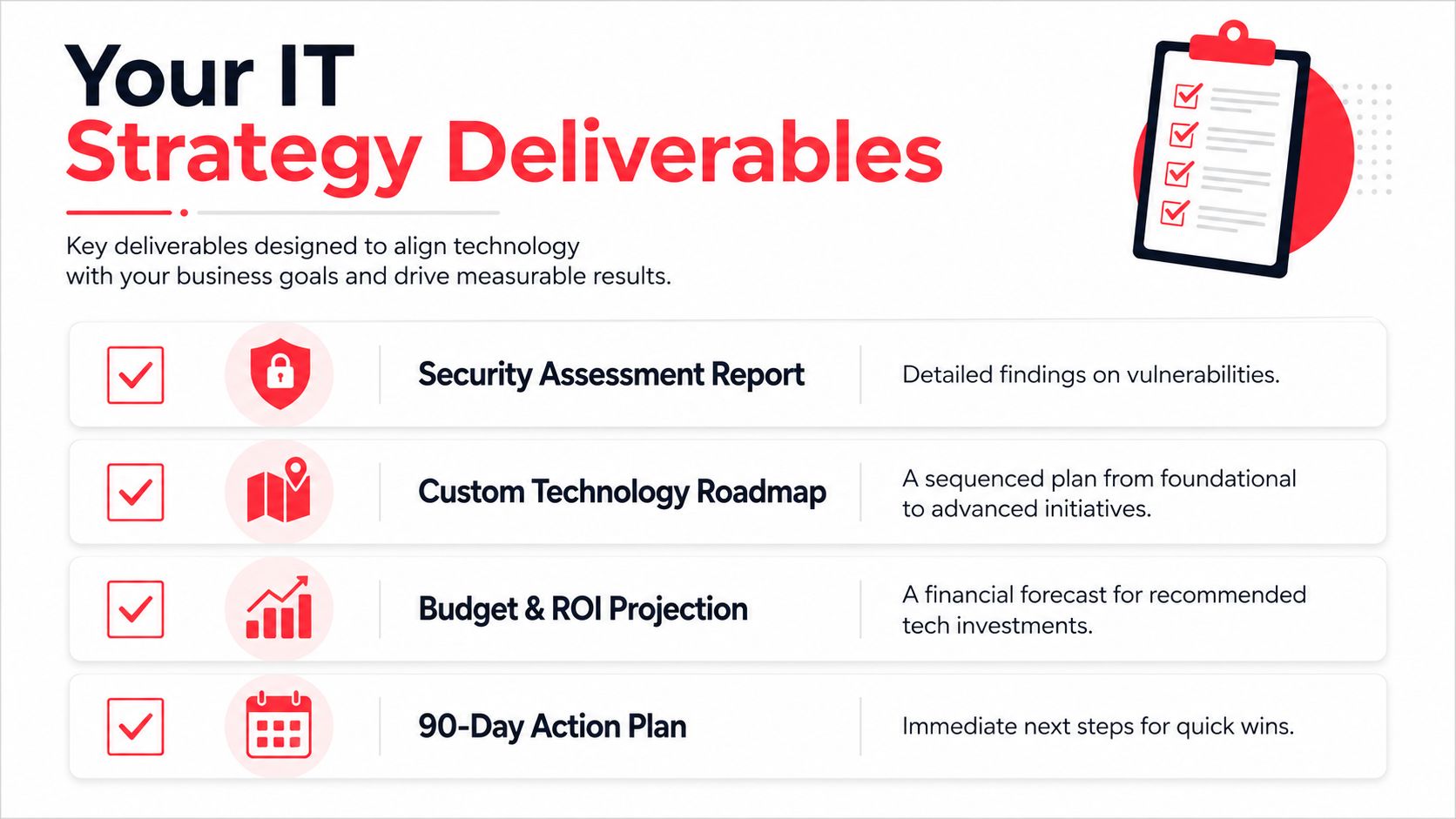
A strategy session is only valuable if it produces something leadership can use. The output should read like an operating plan, not a vague proposal. If it doesn't help you sequence work, budget intelligently, and brief other decision-makers, it's too thin.
The deliverables that actually matter
The first deliverable should be a custom technology roadmap that starts with foundational hygiene and moves toward modernization in the right order. That means the initial steps are usually identity, backups, patching, monitoring, and endpoint baselines, because those reduce avoidable incidents before you add more complexity. Anything that jumps straight to advanced tooling without that base is putting paint on a cracked wall.
You should also receive a security assessment report that flags vulnerabilities, compliance gaps, and operational weak spots in plain language. Leadership can stop guessing about risk and start prioritizing it. A useful sample of how that kind of report should be framed is available in this sample IT risk assessment report.
A strong package also includes a network diagram, a prioritized action plan, and a budget view that helps leadership choose what gets done now versus later. If you're building the case for a board, owner group, or finance review, those documents matter because they tie operational risk to spending decisions. A roadmap without a budget is just a wish list.
What good looks like in practice
Here's the standard I use:
- Security Assessment Report: Shows what's exposed, what's weak, and what needs immediate attention.
- Custom Technology Roadmap: Sequences the work from stabilization to modernization.
- Budget and ROI Projection: Gives leaders a planning range instead of surprise spending.
- 90-Day Action Plan: Turns the roadmap into near-term execution.
If your provider also manages implementation, the deliverables should keep evolving after the meeting. Cyber Command, LLC is one option in this space, offering managed IT, cybersecurity, and roadmap-driven support that can turn strategy findings into implementation work over time. The point isn't the document itself. The point is whether it helps your team make better decisions for months, not just the next week.
Why Local Orlando Expertise Matters for IT Strategy
Local presence is not a vanity feature. It changes the quality of the advice. A team that works in Orlando and surrounding Central Florida communities understands the practical difference between a single-site office, a multi-location operation, and a business that depends on face-to-face service, field work, or guest-facing systems.
Local context changes the roadmap
Orlando's role as a major business and meetings market makes weak IT planning expensive. If staff, clients, and vendors are constantly touching the same systems, uptime has to be steady and escalation has to be fast. A local advisor sees those pressure points early and sets priorities around them instead of treating every office like a generic template.
The sequence matters. Stabilize the environment first, then modernize it. That means fixing support gaps, access problems, backup weaknesses, and network bottlenecks before anyone starts talking about bigger upgrades. If you need help sorting that order out, a focused best IT support in Orlando review can show what strong local support should look like before strategy turns into spend.
Gartner's 2025 symposium coverage pointed to projected worldwide IT spending growth of 9.8% in 2026, reaching $6.08 trillion and crossing the $6 trillion mark for the first time, according to the National CIO Review coverage of Gartner's symposium themes. That makes the point plainly. Technology planning is a core business function, and Orlando firms need partners who treat it that way.
Orlando-specific thinking beats generic advice
A local team is more likely to understand how regional business patterns affect timing and risk. In practice, that means knowing when to schedule work, how to prepare for field disruptions, and how to support offices spread across different Central Florida areas without creating extra downtime. It also means knowing when an on-site assessment is the right call, especially if a remote review would miss cabling problems, switch placement issues, or workflow friction that users deal with every day.
Local strategy work also has to respect how Orlando businesses operate. Hotels, healthcare groups, professional services firms, and distributed offices do not all need the same rollout order, even if they use similar technology. A good advisor starts with the systems that keep the business running, then lines up modernization behind that. Cyber Command, LLC fits that approach by grounding planning in the realities of support, security, and what the team can execute next.
Orlando's own five-year Breakthrough Orlando technology strategy reinforces that this city is treating innovation, talent, and ecosystem growth as connected priorities, not isolated projects, according to Innovate Orlando's published overview. That is the right signal for business owners. A sound strategy session should follow the same pattern, practical, coordinated, and built around the order your business can absorb.
Who Should Attend and How to Prepare
Don't send only the person who knows the passwords. That's a waste of everyone's time. The right session includes the people who make decisions, live with the pain, and understand the budget.
Bring the right seats to the table
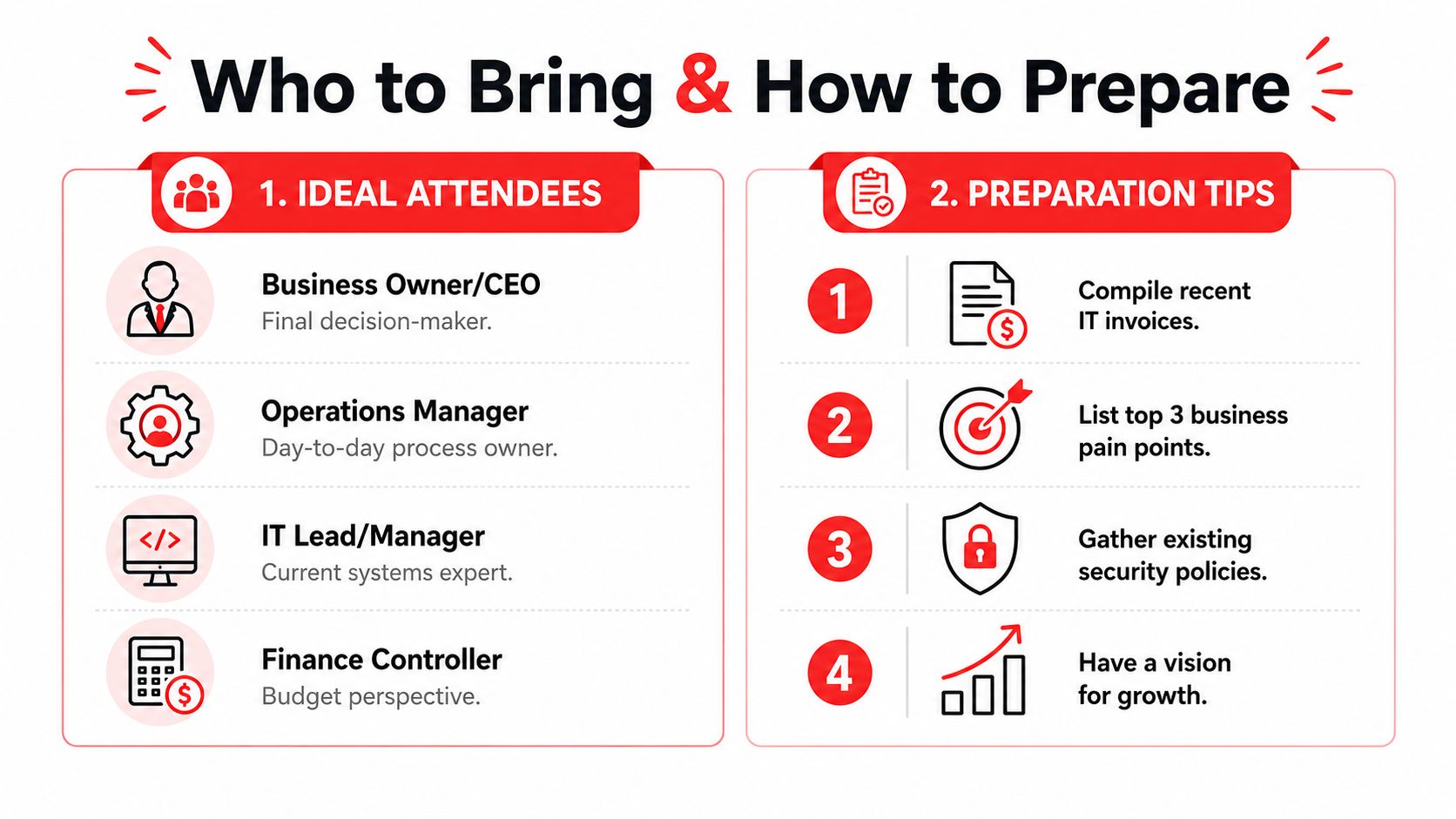
Start with the business owner or CEO, because someone has to approve the tradeoffs. Add the operations manager, because they know where work slows down. Include the IT lead or manager, because they understand the current stack and the hidden exceptions. If finance is involved, bring a finance controller or equivalent so budget discussions don't get fuzzy.
If a key decision-maker can't attend, get their priorities in writing before the meeting. Otherwise the room ends up talking past the actual decision process. That's how strategy sessions drift into delay.
Prep like the meeting matters
Use this checklist:
- Compile recent IT invoices. This shows what you're already paying for and where spend is scattered.
- List your top three business pain points. If everything is urgent, nothing is.
- Gather current security policies. Even weak policies are useful because they show the baseline.
- Bring a clear growth vision. New sites, new staff, and new services all change the roadmap.
Preparation rule: The best sessions don't start with “What should we do?” They start with, “Here's what's breaking, here's what we need, and here's what we can fund.”
For businesses in digital equity or public-facing service work, this prep should also include access concerns, language barriers, and usability issues for underserved users, because Florida's Digital Equity Plan prioritizes those groups as strategic workstreams, according to the Florida Digital Equity Plan draft. If your customers struggle to reach you online, that's an IT strategy issue too.
Understanding Pricing Models and Engagement Options
Buyers often ask the wrong question first. They ask, “How much does a strategy session cost?” The better question is, “What kind of engagement do I need to avoid paying twice?” A short advisory session, an ongoing retainer, and a fully managed relationship solve different problems.
Compare the engagement models before you commit
| Engagement Type | Typical Scope | Best For | Pricing Structure |
|---|---|---|---|
| One-time strategy session | Assessment, roadmap, and priorities | Leaders who need direction before spending | Fixed-fee or packaged engagement |
| Advisory retainer | Ongoing planning, reviews, and guidance | Teams that want periodic strategy input | Recurring monthly or quarterly fee |
| Managed IT package | Support, monitoring, security, and planning | SMBs that want one accountable partner | Predictable all-inclusive pricing |
The right model depends on complexity, not just headcount. Multi-site operations, compliance pressure, and a messy vendor stack usually justify a deeper relationship because the planning work doesn't stop after one meeting. If your environment is simple, a one-time session may be enough to create order.
Watch for pricing traps
The biggest trap is the cheap start that turns expensive later. Hourly consulting can look light on paper, then balloon when every discovery item becomes a separate project. Project-based fees can be fine, but they're only useful if the scope is tight and the roadmap is stable.
A predictable model makes budgeting easier because it reduces surprise work and forces clearer accountability. Cyber Command, LLC publishes a no-surprise pricing approach that aligns with that idea, and their Orlando IT pricing overview is a useful reference if you want to compare engagement styles without getting buried in hidden add-ons. The key question is whether the provider treats strategy as a one-off document or as part of ongoing operational control.
Next Steps to Book Your Strategy Session
If your business keeps reacting instead of planning, book the session now. Don't wait for the next outage, the next audit issue, or the next frustrated manager to prove the point for you. The right next step is simple, a direct conversation about goals, current pain, and what has to happen first.
A strong process usually moves like this. First, you contact the provider and describe the business situation in plain terms. Then you share a few basic details about locations, support needs, and current issues. After that, the meeting gets scheduled, the right people get invited, and the session starts with discovery instead of guesswork.
The value shows up quickly when the roadmap is honest. In the first 90 days of execution, the common early wins are cleaner access control, fewer support surprises, and better visibility into what's running. That doesn't require a full transformation. It requires sequence, discipline, and ownership.
If you're unsure whether now is the right time, use one test. If leadership can't clearly answer what systems are most critical, where the risks are, and what the next technology purchase should be, you're ready for strategy. If you already have those answers, you're probably ready to execute.
Cyber Command, LLC helps Central Florida businesses turn scattered IT decisions into a practical roadmap, with managed IT, cybersecurity, and support built around uptime and accountability. If you need an Orlando IT strategy session that focuses on stabilizing first and modernizing second, visit Cyber Command, LLC and start the conversation with a team that works this way every day.