
Beyond the Buzzwords: A Guide to Effective Process Improvement Services


Why Process Improvement Services Are Essential for Growing Businesses
Process improvement services help organizations identify, analyze, and optimize their workflows to reduce costs, eliminate inefficiencies, and drive sustainable growth. These services typically involve process mapping, root cause analysis, change management, technology integration, and continuous monitoring.
If your business struggles with lengthy timelines or systems that break down during growth, you’re not alone. Leading consulting firms have delivered over $90 billion in sustainable cost savings through structured process improvement. Yet many businesses still operate reactively, patching problems as they arise rather than building systematic solutions.
Processes are the mechanism by which your business delivers value. When they are visible, accessible, and repeatable, they create transparency and accountability. When they’re not, you end up with bottlenecks, compliance issues, and teams working around broken systems.
For growing businesses, the stakes are high. Market fluctuations and evolving customer expectations create constant pressure to adapt. A structured approach using proven methodologies like Lean Six Sigma or Business Process Management builds a foundation for both operational efficiency and long-term profit.
I’m Reade Taylor, Founder and CEO of Cyber Command. I’ve spent my career helping businesses transform technology into a competitive advantage through strategic process improvement services. My background as an engineer taught me that the best solutions combine technical expertise with clear communication and genuine partnership—exactly what effective process improvement requires.
What is Process Improvement and Why Does It Matter?
Process improvement is about systematically enhancing how work gets done. It’s a subdiscipline within business process management (BPM) that provides a structured approach to optimizing organizational workflows. Think of it as giving your business a comprehensive health check-up to get everything running smoothly.
Why does this matter? Because good processes empower teams to effectively serve partners. Without them, even dedicated employees get bogged down by inefficiency. Refining processes yields significant benefits:
- Cost Reduction: Eliminating waste and optimizing resource allocation cuts operational expenses.
- Increased Profitability: Efficient processes lead to higher output and a healthier bottom line.
- Improved Data Accuracy: Top performers can achieve up to 7x higher reporting efficiency and 5x greater data accuracy through master data management (MDM).
- Improved Customer Experience: Smoother internal operations translate into faster service and more satisfied customers.
- Strategic Imperative: In today’s markets, continuous improvement is critical for staying competitive and adaptable.
Our goal with process improvement services is to help businesses move from reactive fixes to proactive strategies. Whether you’re in Orlando, Jacksonville, Tampa Bay, or Plano, Texas, our approach leverages global best practices to build a strong foundation for growth.

Common Challenges Solved by Process Improvement
Our process improvement services are designed to turn common operational problems into opportunities for growth. Here are some pain points we frequently address:
- Lengthy timelines and poor project outcomes
- Operational bottlenecks or single points-of-failure
- Uneven workload distribution among team members
- Undocumented processes or reliance on tribal knowledge
- New regulatory requirements and compliance issues
- Internal confusion during rapid growth
- Disruptions from staff turnover or retirement
- Process inefficiencies and waste
By addressing these challenges, we enable businesses to operate with greater clarity and resilience, a vital component of a robust Business Continuity Lifecycle.
How Improvement Drives Growth and Competitive Advantage
Process improvement is a powerful engine for growth. Investing in operational workflows directly impacts your ability to profit and stand out in a crowded marketplace.
Here’s how effective process improvement services contribute to success:
- Market Agility: Streamlined processes allow you to respond faster to market shifts and customer demands.
- Improved Customer Experience: Optimizing every touchpoint creates seamless experiences that build loyalty and drive repeat business.
- Resource Optimization: Lean processes ensure you make the best use of your financial, capital, and human resources.
- Quality Control: Consistent, well-defined processes lead to high-quality outputs, reinforcing your commitment to excellence.
- Innovation Culture: Freeing teams from inefficient tasks gives them more time to innovate, leading to new ideas that keep you ahead of the curve.
By embracing process improvement services, you build a resilient, high-performing organization capable of sustained growth. Focusing on How Process Improvement Services Drive Business Growth is non-negotiable for long-term success.
Core Methodologies: A Comparative Look at Improvement Frameworks
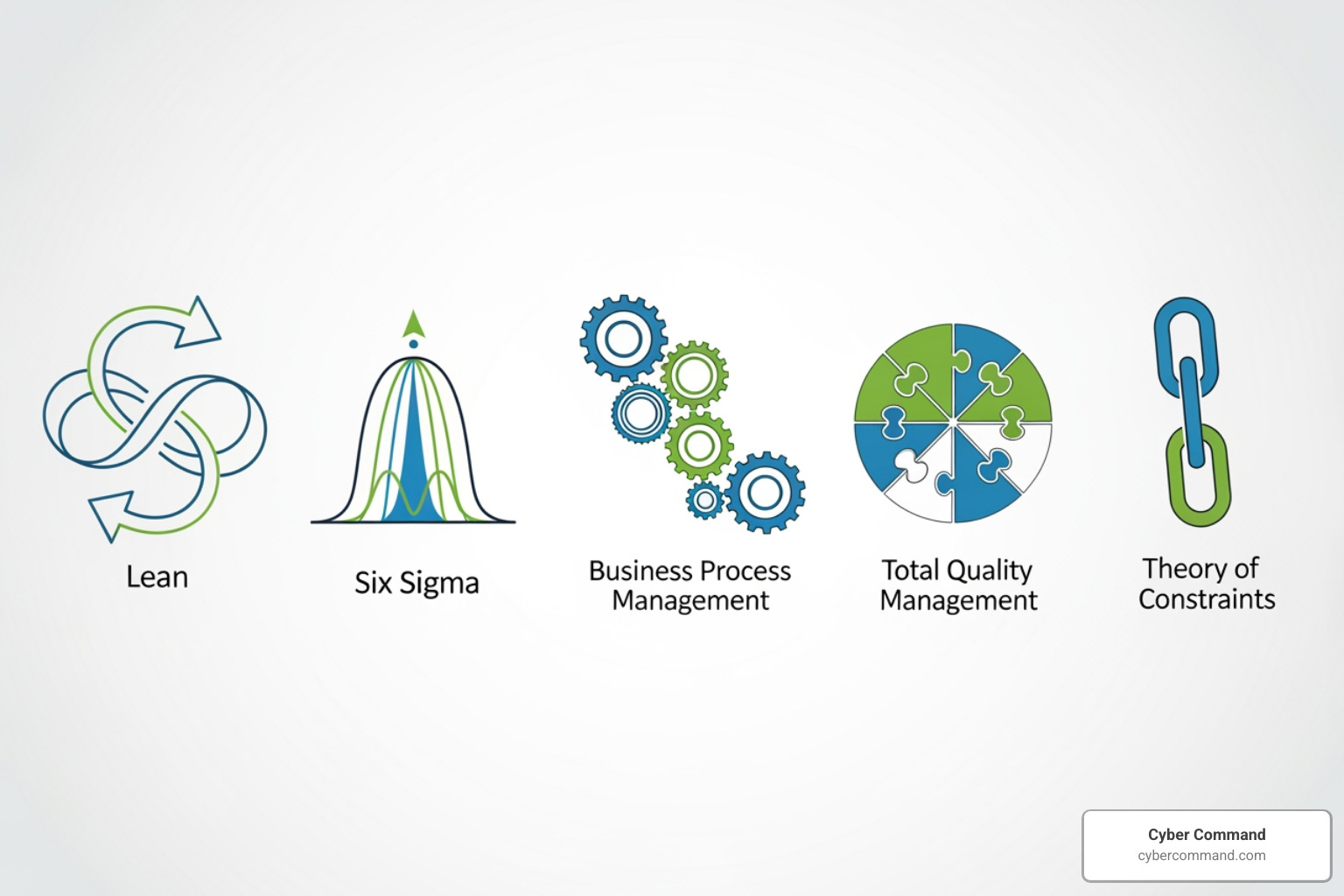
Process improvement services leverage proven methodologies to analyze, redesign, and optimize operations. While many frameworks exist, a few stand out as foundational to success.
Here are some of the core methodologies we often use:
- Lean Six Sigma: A powerful combination of two methodologies focused on eliminating waste and reducing defects.
- Business Process Management (BPM): A holistic approach to continuously improving all business processes.
- Total Quality Management (TQM): Emphasizes continuous improvement through customer satisfaction and employee involvement.
- Theory of Constraints (TOC): Focuses on identifying and addressing the biggest bottleneck in a system.
- Business Process Reengineering (BPR): A radical redesign of business processes to achieve dramatic improvements.
Each methodology offers unique tools, and the best approach often involves combining elements to suit specific needs. Understanding these frameworks is crucial for any organization starting a process improvement journey. You can learn more about these structured approaches through resources like our guide to Process Improvement | Business Process Management Office.
Lean Six Sigma: Eliminating Waste and Defects
Lean Six Sigma combines Lean principles (eliminating waste) and Six Sigma principles (reducing defects and variation). Together, they form a systematic approach to improve process efficiency and quality.
Our approach with Lean Six Sigma involves:
- Waste and Defect Reduction: We identify and eliminate non-value-adding activities and use statistical analysis to pinpoint the root causes of errors.
- DMAIC Cycle: We follow the Define, Measure, Analyze, Improve, and Control (DMAIC) cycle to structure our improvement projects, ensuring data-driven decisions and sustainable results.
- Value Stream Mapping: This visual tool helps us see the flow of materials and information, identifying all value-adding and non-value-adding steps.
By applying Lean Six Sigma, we help clients achieve significant improvements in cycle time, cost, and quality. It’s a disciplined approach that ensures our process improvement services deliver measurable results, much like how we Define IT Service Management to optimize IT operations.
Business Process Management (BPM): A Holistic Approach
While Lean Six Sigma often focuses on specific projects, Business Process Management (BPM) is an ongoing organizational discipline for optimizing complex business processes. It embeds efficiency into the very DNA of your operations.
Key aspects of our BPM approach include:
- Ongoing Management: BPM treats processes as assets that need continuous monitoring and adjustment to evolve with business needs.
- Workflow Automation: We leverage technology to automate repetitive tasks, freeing up human talent for more strategic activities.
- Process Modeling and Optimization: We visually map processes to create a shared understanding and identify opportunities for improvement, fostering a culture of continuous optimization.
- Technology Integration: We integrate BPM suites and other digital tools to manage, automate, and monitor processes across the organization.
Our process improvement services integrate BPM to ensure changes are part of a robust, adaptable system, helping clients achieve greater agility and resilience.
The Spectrum of Process Improvement Services
Process improvement services encompass a comprehensive suite of solutions customized to meet diverse business needs. It’s about providing the tools, expertise, and support necessary to transform operations from the ground up.
Our services span a wide spectrum to cover every angle of process optimization:
- Process Mapping and Documentation: Creating visual workflows to understand current states.
- Root Cause Analysis: Uncovering the underlying issues causing inefficiencies.
- Change Management: Guiding teams through the implementation of new processes.
- Technology Integration: Incorporating software and automation to improve efficiency.
- AI Implementation: Leveraging artificial intelligence to automate complex tasks and derive insights. While many enterprises are scaling Gen AI, they often miss out on significant productivity gains. We help bridge that gap.
Whether your business is in Florida or Texas, our goal is to provide a customized approach that leads to measurable improvements. We understand that effective IT Infrastructure Management is often a prerequisite for successful process improvement.
Foundational Services: Analysis and Mapping
Before we can improve a process, we must first understand it. Our foundational process improvement services focus on meticulous analysis and mapping to create a clear picture of the current state.
Our foundational services include:
- Process Documentation: We methodically document every step, decision point, and stakeholder in your existing processes to create a clear, accessible record.
- Pain and Waste Sessions: We facilitate workshops with your teams to identify “pain points” (frustrations, delays) and “waste” (non-value-adding activities).
- Performance Assessment: We evaluate current processes against key metrics like cycle times and error rates to establish a baseline for measuring improvement.
- Data Gathering: Our data-driven approach involves collecting quantitative and qualitative data to identify trends, validate assumptions, and prioritize areas for improvement.
This comprehensive groundwork ensures that subsequent improvements are targeted, effective, and built on a solid understanding of reality.
Strategic Services: Redesign and Automation
With a clear understanding of your current processes, we move to the strategic phase: redesign and automation. Here, we leverage innovation and technology to build more efficient, future-ready workflows.
Our strategic services focus on:
- Workflow Optimization: We redesign processes to eliminate unnecessary steps, reduce handoffs, and streamline the flow of work.
- Process Standardization: We standardize processes across departments to reduce variation, simplify training, and ensure predictable outcomes.
- Automation Opportunities: We identify tasks and workflows that can be automated using Robotic Process Automation (RPA) to increase speed and accuracy.
- AI-Powered Capabilities: We help integrate advanced technologies like Agentic AI to revolutionize how work is done, from automating complex decisions to providing predictive insights. We help you capture the 40%+ productivity gains that many businesses miss when scaling Gen AI.
By focusing on redesign and automation, we help clients build a foundation for growth. This often involves a Cloud Migration Process or integrating other advanced technologies to open up new levels of efficiency.
From Theory to Reality: A 4-Step Implementation Approach
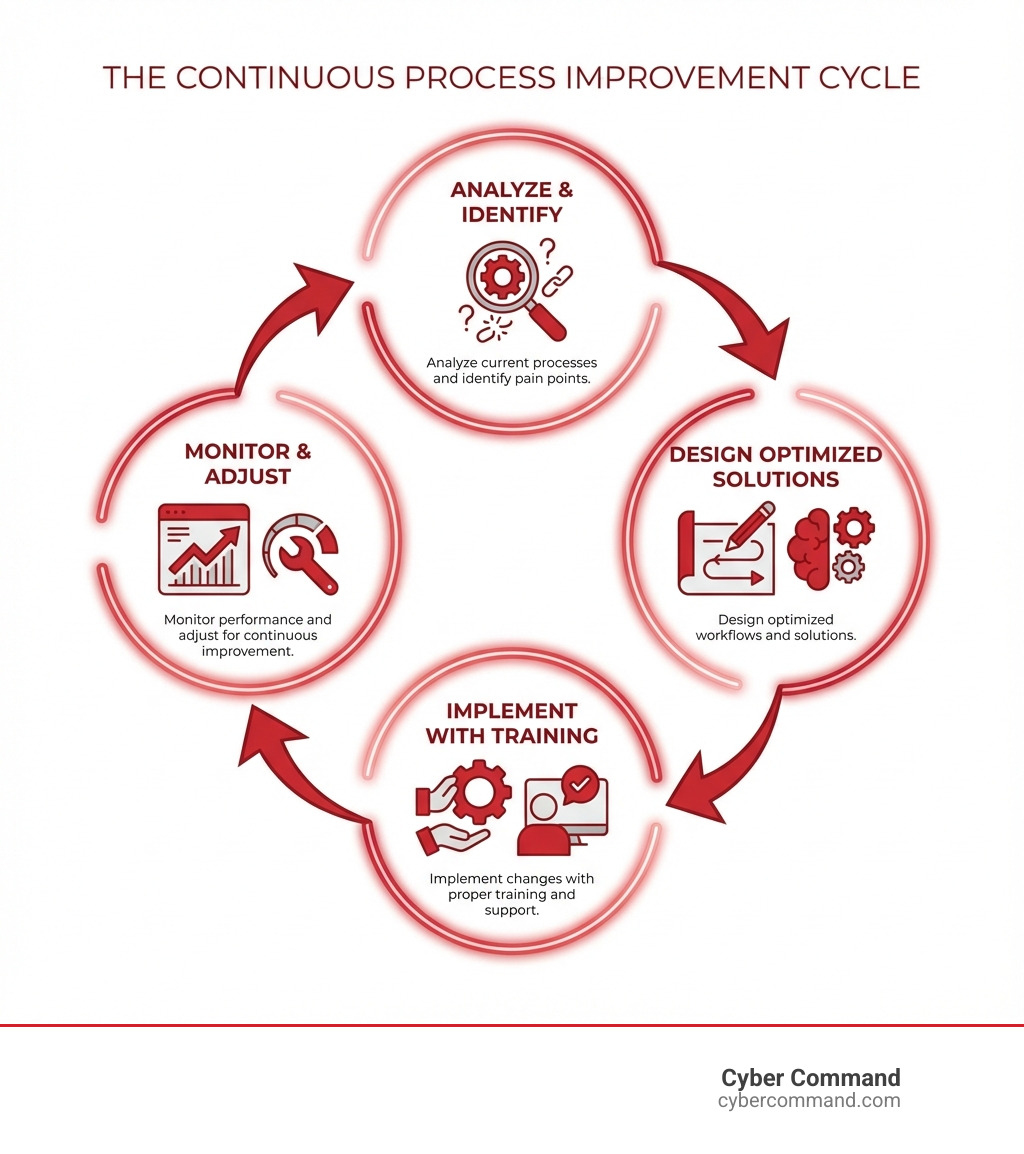
Translating theoretical improvements into real-world results requires a structured approach. Our process improvement services follow a proven, four-step methodology to ensure changes are effective, sustainable, and accepted by your teams.
Here’s our four-step process:
- Assessment & Findy: We begin by thoroughly understanding your current state.
- Design & Planning: We craft the blueprint for your improved future.
- Implementation & Change Management: We put new processes into action with careful attention to your people.
- Monitoring & Continuous Improvement: We ensure the gains are sustained and evolve over time.
This approach ensures our services are robust and adaptable, much like a well-planned Business Continuity and Disaster Recovery Planning for IT Professionals strategy.
Step 1: Assessment & Findy
The first step is a deep dive into your current operations. We can’t fix what we don’t fully understand. Our Assessment & Findy phase involves:
- Current-State Analysis: We examine and document your existing processes, including official procedures and informal workarounds.
- Stakeholder Interviews: We engage with individuals across all levels of your organization to understand practical realities, challenges, and opportunities.
- Identifying Pain Points: Through data analysis and stakeholder input, we pinpoint specific areas where processes are breaking down or causing delays.
- Baselining Metrics: We establish clear, measurable benchmarks for current performance to objectively track progress and quantify the impact of our process improvement services.
Step 2: Design & Planning
With a thorough understanding of your current state, we design a better future. This phase blends creativity with practicality to plan optimized workflows.
Our Design & Planning phase includes:
- Future-State Process Design: We collaborate with your teams to design new, streamlined processes that are efficient, effective, and user-friendly.
- Creating a Roadmap: We develop a detailed plan with timelines, milestones, and dependencies, providing a clear path from current to future state.
- Resource Allocation: We identify the human, technological, and financial resources needed for successful implementation.
- Risk Assessment: We proactively identify potential risks associated with the new processes and develop mitigation strategies to ensure a smoother transition.
This phase is about precision and foresight, ensuring every detail is considered, just as in meticulous Disaster Recovery Planning.
Step 3: Implementation & Change Management
Designing new processes is half the battle; bringing them to life is the real victory. This phase focuses on execution and bringing your teams along on the journey.
Our approach includes:
- Pilot Testing: We often implement new processes on a small scale to test changes and fine-tune the process in a controlled environment.
- Rollout Strategy: We develop a phased or comprehensive rollout plan that minimizes disruption while maximizing adoption.
- Team Training: We equip your employees with the knowledge and skills they need to confidently execute the new processes through workshops and hands-on sessions.
- Communication Plan: Clear and consistent communication is key to managing expectations and building buy-in.
- Managing Resistance: We employ proven change management techniques to address concerns, gather feedback, and transform resistance into engagement.
Step 4: Monitoring & Continuous Improvement
The journey doesn’t end at implementation. This final step ensures that gains are sustained and that your organization continues to evolve, embedding a culture of ongoing excellence.
Our activities include:
- Tracking Performance: We continuously monitor the performance of new processes against baselined KPIs to provide objective evidence of improvements.
- Feedback Loops: We create channels for ongoing feedback from employees and customers to identify issues and suggest refinements.
- Iterative Adjustments: Based on performance data and feedback, we make small, targeted tweaks to continuously optimize performance.
- Sustaining Gains: We put mechanisms in place, such as updated documentation and regular audits, to prevent regression and lock in improvements.
This continuous vigilance is why we emphasize asking, What Are Good Reasons to Do Yearly Disaster Recovery Testing?—consistent checks lead to consistent resilience.
Choosing the Right Partner: What to Look for in a Provider
Choosing the right partner to guide your process improvement services journey is critical. The provider’s expertise and approach can make all the difference.
When evaluating potential partners, prioritize the following:
- Industry Experience: Look for a provider with a proven track record and a deep understanding of your specific industry.
- Proven Methodologies: Ensure they use established frameworks like Lean Six Sigma or BPM for a structured, data-driven approach.
- Collaborative Approach: The best partners work with you, fostering buy-in and creating customized, sustainable solutions.
- Scalability: Their services should be flexible enough to scale with your evolving needs, from a small business in Central Florida to a growing enterprise in Texas.
- Technology Expertise: Your partner must be able to seamlessly integrate IT solutions, automation, and AI into your optimized processes.
At Cyber Command, we are more than a vendor; we are an extension of your business. We offer proactive, 24/7/365 U.S.-based support with transparent pricing, ensuring we are genuinely invested in your success, as we advise in How to Choose the Right Managed Service Partner: Expert Tips.
The Role of IT and Cybersecurity Expertise
In modern business, process improvement services are deeply intertwined with IT and cybersecurity. A holistic approach is essential for operational excellence and resilience.
Here’s why this expertise is non-negotiable:
- Data Security Management: As we streamline processes, we ensure sensitive data is protected throughout its lifecycle, adhering to best practices and regulations.
- Secure Workflows: We design workflows with security controls built-in from the start, reducing vulnerabilities and mitigating risks.
- Compliance: Our expertise helps ensure your improved processes meet all relevant compliance obligations (e.g., HIPAA, GDPR, NIST), protecting your business from penalties.
- Integrating Secure Technology: We ensure any new technology—from cloud solutions to AI—is robust, secure, and properly configured to safeguard your operations.
Our background in enterprise-grade IT and cybersecurity allows us to deliver solutions that improve both efficiency and security. This integrated approach highlights the Explore Benefits of Cybersecurity in Managed Services for all aspects of your business.
Questions to Ask Potential Process Improvement Services
To find a provider that aligns with your needs, we recommend asking a series of probing questions to assess their capabilities and approach.
Key questions to ask include:
- What is your approach to process improvement, from assessment to monitoring?
- How do you measure success and what KPIs do you track?
- What is your experience in our industry or with similar business challenges?
- How do you manage change and ensure employee buy-in?
- What role does technology, automation, and AI play in your recommendations?
- Can you provide case studies or references for similar projects?
- How do you ensure improvements are sustainable long-term?
- What are your pricing models and what is included?
- How do you collaborate with our internal teams?
- What ongoing support do you offer after implementation?
Asking these questions will help you select the partner that best suits your organization’s needs in Florida or Texas.
Conclusion
In today’s competitive landscape, embracing process improvement services is a strategic imperative. A systematic approach to optimizing workflows can transform your operations, solve common challenges, drive growth, and build a sustainable competitive advantage. The journey from inefficiency to excellence requires a structured approach, expert guidance, and a partner who can bridge the gap between business strategy and technology.
As your trusted partner, Cyber Command brings enterprise-grade IT, cybersecurity, and platform engineering expertise to the table. Our proactive, 24/7/365 U.S.-based support and transparent, all-inclusive pricing ensure we act as a true extension of your business. We are dedicated to helping organizations in Winter Springs, Orlando, Jacksonville, Tampa Bay, and Plano, Texas, achieve greater efficiency, resilience, and profitability.
Investing in process improvement services is an investment in your future. It’s about building a more agile and robust organization capable of navigating change. Let us help you achieve tangible, long-term value through optimized processes. Explore how our Managed IT Services can support your journey towards operational excellence.