
March 12, 2026
Runbook vs Playbook: Key Differences for IT Success in Central Florida
Discover runbook vs playbook: compare the essentials with Florida-focused scenarios to boost resilience and security in 2026.
If you’ve spent any time in IT operations or incident response, you’ve heard the terms “runbook” and “playbook” thrown around. They sound similar, and people often use them interchangeably, but they serve two very different—and equally critical—functions. Getting this distinction right is the first step toward building a truly resilient operation for any business in Orlando, Kissimmee, or anywhere in Central Florida.
Let’s cut through the confusion. A runbook is your tactical, step-by-step checklist. Think of it as a detailed recipe: precise instructions for a routine, repeatable task, like how to properly restart a specific application server. A playbook, on the other hand, is your high-level strategic guide. It’s the game plan for a complex, unpredictable event like a data breach, outlining what needs to happen, why, and who is responsible for each part of the response.
Defining The Core Difference In IT Operations
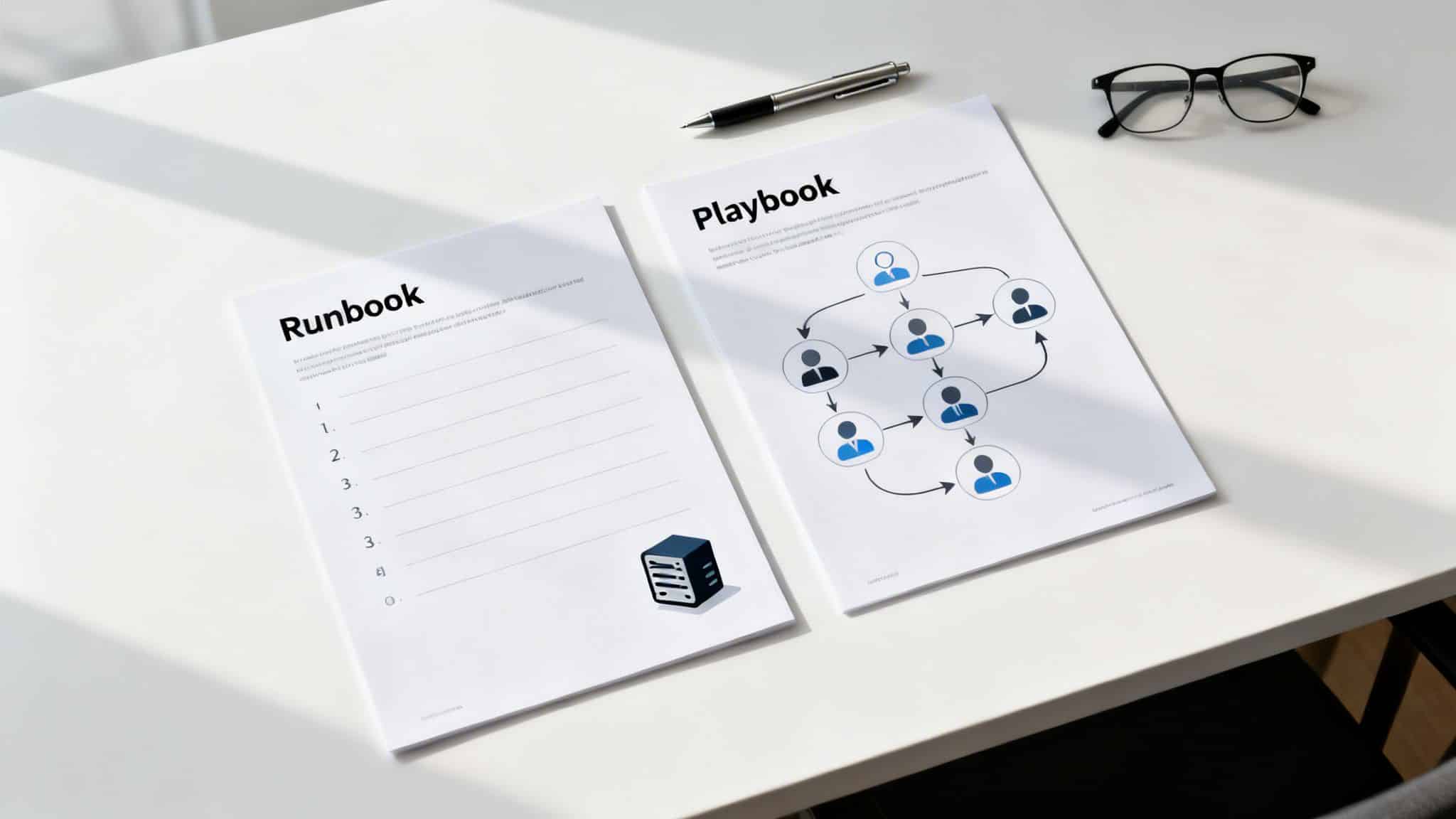
For professional service firms across Central Florida—from law offices in Winter Park to medical practices in Sanford—these documents aren’t just paperwork; they’re the backbone of operational maturity. They work together. A playbook orchestrates the overall response to a major incident, and it will often call on specific runbooks to execute the necessary technical steps.
Here’s a simple way to think about it: your playbook is the documented fire escape route for the building. Your runbook is the set of instructions printed on the side of the fire extinguisher. You need both to handle the emergency effectively.
Runbook vs Playbook at a Glance
To make the differences even clearer, here’s a quick breakdown of how these two documents stack up against each other.
Attribute
Runbook (The ‘How’)
Playbook (The ‘What’ and ‘Why’)
Purpose
To execute a known, repeatable operational process.
To guide a strategic response to a dynamic, complex incident.
Focus
Tactical and procedural. Provides step-by-step instructions.
Strategic and adaptive. Outlines roles, goals, and communication.
Structure
Linear, prescriptive checklist or standard operating procedure (SOP).
Flexible, scenario-based guide with decision trees.
Example Use Case
Onboarding a new employee’s IT account.
Responding to a company-wide ransomware attack.
In the world of IT and cybersecurity, this distinction can mean the difference between containing a problem in minutes and suffering a breach that lasts for weeks. The precision of runbooks is proven to reduce human error by up to 70% during high-pressure situations. For businesses leaning on co-managed or fully managed IT, having both in place can slash Mean Time to Resolution (MTTR) by as much as 40%—a massive win for business continuity.
A runbook is all about consistency and execution for known tasks. A playbook is about strategy and coordination for unknown variables. One is a recipe, the other is a game plan.
Ultimately, you can’t have a mature IT operation without both. The playbook provides the strategic framework that keeps your team aligned during a crisis, ensuring everyone knows their role. To get a better handle on this strategic tool, you can explore resources that define the meaning of a playbook and its impact on team productivity. Now that we’ve set the stage, let’s dive into specific examples for Central Florida businesses.
When you’re weighing a runbook vs a playbook, think of the runbook as the bedrock of reliable, predictable IT operations. It’s a detailed, step-by-step guide designed to make sure recurring tasks get done the exact same way, every single time. By leaving nothing to chance, runbooks cut down on human error and remove all the guesswork.
This level of standardization is what powers consistent service delivery. For a medical practice in Lake Mary handling sensitive patient data, or an accounting firm in Altamonte Springs managing financial records, predictable IT isn’t just a convenience—it’s an absolute must for compliance and client trust.
The Role of Runbooks in Daily IT Support
Ever wonder how a helpdesk can resolve your issue so quickly and efficiently? Chances are, they’re following a well-defined runbook. The technician uses a pre-approved script to diagnose and fix the problem, creating a consistent and repeatable experience for you. This structured approach is what allows managed IT providers to deliver the same great results, over and over again.
Just think about these common scenarios where runbooks are absolutely essential:
- New Employee IT Onboarding: A runbook lays out every single step, from creating user accounts and setting permissions to configuring a new laptop. This ensures every new hire is ready to go on day one, and no security protocols get missed.
- Software Troubleshooting: When a critical application crashes, a runbook guides the technician through the first line of defense—clearing the cache, checking configurations, looking for known bugs—before escalating the ticket.
- Device Security: If a laptop is lost or stolen, a runbook provides the precise procedure for securing it. It includes steps to remotely lock the device, wipe its data, and revoke access credentials to keep company information safe.
A runbook turns a complicated operational task into a simple, follow-the-steps process. This doesn’t just make things more efficient; it also creates a clear, auditable trail for every action taken, which is critical for regulatory compliance in industries like healthcare and finance.
Runbooks and Critical System Maintenance
The real value of a runbook becomes crystal clear during high-stakes procedures on critical infrastructure. Tasks like server maintenance or patching come with significant risk; one wrong move could trigger extended downtime or even data loss. Runbooks keep this risk in check by enforcing a strict, proven methodology.
A runbook for a Critical Server Patching Procedure would break down like this:
- Pre-Patch Checklist: Verify that system backups were successful, notify stakeholders about the maintenance window, and confirm that rollback procedures are ready to go.
- Execution Steps: Follow the exact sequence of commands to apply patches, reboot servers, and monitor system health right after the update.
- Post-Patch Validation: Run a series of tests to confirm all services are operating correctly and the patch hasn’t introduced any new problems.
- Contingency Actions: Provide clear instructions on what to do if a patch fails, including exactly how to initiate a rollback to the last stable state.
For any Central Florida business, this documented, repeatable process is how a managed security provider strengthens your security posture. It helps ensure that every critical task is done right, safeguarding your operational stability and data. This focus on procedural discipline is a key differentiator in the runbook vs playbook debate, highlighting the runbook’s essential role in execution.
While runbooks are your go-to for standardizing routine IT tasks, playbooks are built for the complete opposite: a full-blown crisis. When you’re staring down a sophisticated ransomware attack or a massive data breach, a simple checklist just won’t cut it. This is where playbooks become absolutely critical, shifting your team’s focus from just executing tasks to managing a strategic response.
Unlike the linear, step-by-step format of a runbook, a playbook is a flexible, scenario-based guide. It’s designed to answer the big questions: what needs to be done, who is responsible, and why it’s important right now. It gets everyone on the same page, from the technical team in the trenches to executive leadership, legal counsel, and the communications department.
Orchestrating a Coordinated Defense
Think of a major security incident as a complex battle on multiple fronts. You’re fighting technical skirmishes to contain the threat, navigating legal obligations, and managing customer communications all at once. A playbook is the master plan from your command center, ensuring every move is part of a single, cohesive strategy, not just a bunch of isolated fixes.
For any business, this strategic coordination is make-or-break. A ‘HIPAA Breach Notification’ playbook for a medical practice in Orlando, for example, would ensure a structured response. It would guide the team to not only contain the technical threat but also meet strict regulatory deadlines, protecting both patient data and the practice’s reputation.
A runbook ensures a task is done correctly every time. A playbook ensures the right tasks are done in the right order when everything goes wrong.
This master plan doesn’t exist in a vacuum; it directs the use of specific runbooks. The playbook might call for the IT team to execute a “Isolate a Compromised Server” runbook, while at the same time guiding the leadership team on how to communicate with stakeholders. This layered approach is the core difference in the runbook vs playbook debate.
From Chaos to Control: A Real-World Example
Imagine a law firm in Winter Park discovers its client data has been encrypted by ransomware. Without a playbook, the response is pure chaos. The IT team scrambles to restore backups, partners start worrying about liability, and no one has a clue what to tell anxious clients.
Now, picture the same scenario with a ‘Ransomware Response’ playbook in hand. The process is transformed from chaotic to controlled:
- Phase 1: Activation: The playbook is triggered immediately, assigning the managed Security Operations Center (SOC) as the lead for technical containment.
- Phase 2: Coordination: It clearly defines roles, assigning legal decisions to the firm’s partners, internal communication to HR, and external communication to a designated spokesperson.
- Phase 3: Execution: The playbook then calls on specific runbooks—one to isolate affected network segments, another to analyze the malware, and a third to begin data restoration from verified backups.
Organizations that ignore this strategic divide often pay a heavy price. A Ponemon Institute survey revealed that teams using playbooks can slash the financial impact of a data breach by a staggering 28% just by improving collaboration. This level of preparation ensures predictable IT support and strengthens operational uptime, freeing up leadership to focus on recovery and growth.
This structured, strategic approach is what turns a potential business-ending catastrophe into a manageable incident. By crafting your incident response plan for max efficiency, you build the resilience needed to withstand modern threats. A playbook is the document that makes it happen.
Stuck on something like this right now?
Talk it through with a real US-based engineer, 24/7, no phone trees: (407) 587-0089.
Book a Free Strategy SessionComparing Runbooks And Playbooks In A Real-World Scenario
Let’s move past the theory and see how runbooks and playbooks work together during a real-world crisis. Imagine a sophisticated phishing attack hits a prominent Orlando-based law firm. This isn’t just a technical glitch; it’s a full-blown business crisis that demands a perfectly coordinated response.
The second the breach is detected, the firm’s managed Security Operations Center (SOC) doesn’t just start clicking buttons. They activate the “Phishing Incident Response” playbook. This document is the strategic guide for the entire incident, the master plan that keeps everyone on the same page.
Orchestrating The Response With A Playbook
The playbook’s first job is to end the chaos before it starts. It immediately assigns specific duties and communication channels to key people—the SOC team, the firm’s partners, the IT helpdesk, and even the HR department.
This is where solid security incident response planning pays off. Instead of running around in silos, everyone knows their role and works in concert.
Once the “who” is established, the playbook directs the “what” by calling on several specific runbooks. Each runbook is a precise, step-by-step checklist for a single technical task, designed for speed and accuracy when the pressure is on.
This flowchart shows how the master playbook directs the execution of individual runbooks.
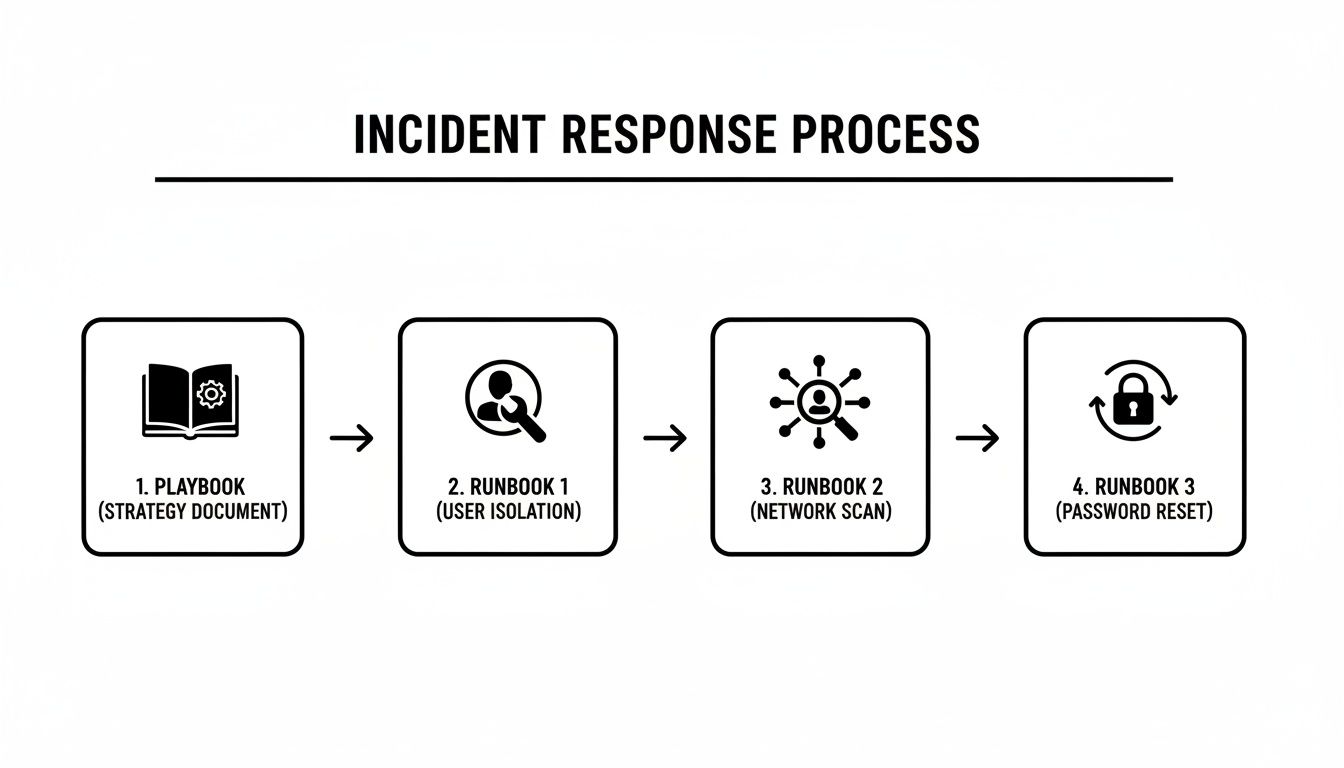
As you can see, the playbook sits at the top, delegating tactical tasks to three distinct runbooks below it. It’s the brain of the operation.
Executing The Tasks With Runbooks
With the strategy set, the playbook directs the SOC team to execute a series of pre-approved technical procedures, each governed by its own runbook:
-
Runbook 1: Isolate Compromised User Account: The first priority is containment. This runbook gives the analyst the exact steps to suspend the user’s network access, kill all active sessions, and preserve the machine for forensic analysis. No guesswork involved.
-
Runbook 2: Scan Network for Lateral Movement: With the initial entry point contained, the next runbook guides the team through a comprehensive network scan. The goal is to hunt down any signs that the attacker moved beyond the first machine.
-
Runbook 3: Force Company-Wide Password Reset: To mitigate further risk, a third runbook is triggered. It outlines the procedure for a mandatory, firm-wide password reset, complete with communication templates for the helpdesk and HR to use when notifying employees.
The playbook acts as the general, directing the battle strategy. The runbooks are the field manuals for the soldiers on the ground, ensuring each specific mission is executed flawlessly.
To see this in action, let’s map out the response phases for our law firm example.
| Incident Response Example Phishing Attack on a Law Firm |
| :--- | :--- | :--- |
| Response Phase | Governing Document | Key Actions and Responsibilities |
| Detection & Analysis | Phishing Incident Response Playbook | SOC team identifies the breach via an EDR alert. Playbook is activated, assigning roles to IT, legal partners, and HR. |
| Containment | Runbook #1: Isolate Compromised User | Helpdesk analyst follows the runbook to immediately suspend the user’s account and network access to stop the threat from spreading. |
| Eradication | Runbook #2: Scan for Lateral Movement | SOC analyst uses the runbook to scan all endpoints and servers, identifying and removing any other traces of the attacker. |
| Recovery | Runbook #3: Force Password Reset | IT team triggers the password reset runbook. The HR team uses the playbook’s communication plan to inform all employees. |
| Post-Incident Activity | Phishing Incident Response Playbook | The playbook guides the post-mortem meeting, documentation updates, and client communication strategy, ensuring all legal and regulatory obligations are met. |
As the table shows, the playbook provides the overarching strategy while the runbooks handle the specific, hands-on tasks.
This layered approach, strongly recommended by frameworks like NIST SP 800-61, has a massive impact. Research shows that organizations with mature runbooks and playbooks can cut incident response costs by as much as 35%. For a law firm in Maitland facing e-discovery demands or a medical group in Kissimmee, that’s a game-changer.
This example cuts to the heart of the runbook vs. playbook relationship. The playbook provides the “what” and “why” (the strategic response), while the runbooks provide the “how” (the tactical execution). One can’t function effectively without the other.
Putting Runbooks and Playbooks to Work in Your Business
Knowing the difference between a runbook and a playbook is one thing. Actually putting them into practice can feel like a mountain to climb. The secret for business leaders in Central Florida is to start small. Focus on your biggest operational headaches and most significant risks first.
You don’t need a huge library of documents from day one. What you need are a few targeted procedures that solve real problems right now.
A small Orlando-based business, for instance, can get quick wins by creating simple runbooks for common helpdesk tickets. Think about routine tasks like setting up a new employee’s laptop or handling a standard password reset. Documenting these processes ensures everyone does it the same way every time, cutting down on errors and freeing up your team.
But for any business handling sensitive data—like a Winter Park law firm managing client records or a Sanford medical practice protecting patient information—the priority has to be strategic. You need to start with playbooks for your biggest threats, like a ransomware attack or a critical system failure.
Start with a Risk Assessment, Not with Writing
Your first step isn’t writing; it’s assessing. Before you can document a fix, you have to know what you’re up against. This is where a managed IT partner shines, conducting a risk assessment to find your company’s specific weak spots and operational bottlenecks.
This assessment tells you exactly which documents to create first. The process usually involves:
- Identifying High-Frequency Tasks: What are the most common tickets hitting your helpdesk? These are perfect candidates for your first runbooks.
- Pinpointing Critical Systems: Which servers, applications, or databases would cause the most chaos if they went down? These need runbooks for maintenance and restoration, pronto.
- Evaluating Major Threats: What are the most likely and most damaging security incidents for your industry? Think phishing, data breaches, or ransomware. These demand strategic playbooks.
A proper risk assessment gives you a clear roadmap. It changes the conversation from, “We should probably document some stuff,” to, “We need a runbook for server patching by Q2 and a playbook for data breaches immediately.”
Once these priorities are clear, your IT partner can help develop, test, and maintain these crucial documents. For many businesses, especially those in regulated fields like healthcare or finance, having well-documented procedures is a core part of their business continuity and disaster recovery services. These documents are the foundation of a truly resilient operation.
Empowering Your Business Through Smart Documentation
Building out runbooks and playbooks isn’t about just handing off tasks to your IT provider. This process empowers you, the business owner, to have far more productive conversations about your operational health. When procedures are written down, they become measurable, transparent, and real.
Instead of vaguely asking, “Is our IT secure?” you can ask, “Can you walk me through the playbook for how we’d respond to a ransomware attack?”
Or, “What does the runbook for onboarding a new partner’s tech look like?”
This simple shift builds a culture of accountability. It makes sure your internal team and external partners are all on the same page, whether handling daily chores or a full-blown crisis. An experienced managed IT partner won’t just build these documents for you; they’ll build them into their service. The helpdesk uses the runbooks, and the Security Operations Center (SOC) lives by the playbooks. This is how you build a business that can take a punch.
How a Partner Manages Your IT Resilience for You
Knowing the difference between a runbook and a playbook is great, but your job isn’t to become a master document-writer. That’s where a good IT partner comes in. An experienced managed services partner already has a library of proven, battle-tested runbooks and playbooks, ready to be fine-tuned for your business.
This is a fundamental part of building real operational resilience for companies across Central Florida.
For businesses in Orlando, Kissimmee, or Sanford, this means you get enterprise-grade preparation without the enterprise price tag or the in-house headache. A partner doesn’t just write documents and hand them over; they weave them into the fabric of their service, turning documented steps into the tangible results that protect your company.
How a Partner Uses Runbooks and Playbooks Daily
The true value of this partnership becomes crystal clear in both the daily grind and during a crisis. These two types of documents fuel different parts of the managed service, ensuring your IT runs with both clockwork consistency and strategic protection. This documented, proactive approach is what modern IT management is all about.
Here’s how a partner like Cyber Command puts them to work for you:
-
24/7 Helpdesk Support: When you call with a problem, our U.S.-based technicians pull up detailed runbooks to deliver fast, consistent support. Whether they’re troubleshooting software or locking down a device, they follow a pre-approved, step-by-step process designed to deliver a reliable fix every time.
-
Security Operations Center (SOC): Our 24/7 SOC lives and breathes by strategic playbooks. When an alert signals a potential threat, the playbook instantly guides the entire response—from initial containment to final cleanup—ensuring a coordinated, swift, and effective defense.
This structured way of doing things is what lets you get back to running your business, confident that a solid framework is protecting you.
A great IT partner doesn’t just promise resilience; they prove it with documented procedures and transparent reporting. They use runbooks for daily efficiency and playbooks for crisis management, creating a complete shield around your business.
Choosing the right provider is about more than just finding tech support; it’s about finding a team that builds and manages this resilient framework on your behalf. This documented system, backed by clear reporting and constant improvement, is what ensures your technology is always working for your business.
For more guidance, check out our article on how to choose the right managed service partner for expert tips. This level of preparation is the key difference between a simple IT vendor and a true partner invested in your success.
Frequently Asked Questions
When we talk with business owners in Orlando and throughout Central Florida about runbooks and playbooks, a few key questions always come up. Here are the straight answers to the things leaders want to know most.
Can I Use A Runbook Instead Of A Playbook?
Not when things get complicated. Think of a runbook as your go-to for a predictable, technical job, like restoring a single file from a backup. It gives your team the exact, repeatable steps to get a known task done right, every time.
A playbook, on the other hand, is your strategic guide for a crisis. It’s what you need for a ransomware attack because it coordinates multiple teams, forces critical decisions, and handles communications. They aren’t interchangeable—they’re designed to work together. A playbook will often call on several runbooks to carry out its overall strategy.
How Often Should We Update These Documents?
Treat them like living documents, not something you write once and file away. The best practice is to review them at least once a year or anytime you have a major change to your technology, key staff, or business processes.
The most critical rule: runbooks and playbooks must be updated after any security incident or major outage. This is where you bake in the lessons you just learned, hardening your defenses and making your response that much sharper for next time. A dedicated IT partner should make this review a standard part of their service.
Does My Small Florida Business Really Need These?
Absolutely. IT problems and cyber threats don’t just target big corporations; they hit businesses of all sizes. Documenting your routine tasks with runbooks saves a surprising amount of time and cuts down on simple mistakes, making your whole operation more efficient.
More importantly, having a strategic playbook for a potential data breach or system failure can mean the difference between a small headache and a business-ending catastrophe. For a small law firm in Lake Mary or a medical practice in Kissimmee, the damage from one poorly handled incident will always cost more than the investment in getting prepared. Working with a managed provider makes this level of readiness both affordable and achievable.
At Cyber Command, LLC, we build and manage the documented frameworks that protect your business, from tactical runbooks for the helpdesk to strategic playbooks for the SOC. Let us handle the procedures so you can focus on growth. Learn more at /.
This article is for general informational purposes only and is not legal, compliance, insurance, or other professional advice. Threats, technologies, and regulations change quickly; confirm current requirements with your own advisors before acting. See our full disclaimer.