
Testing in the Fast Lane: Agile and DevOps Approaches

Why Agile and DevOps Testing Changes Everything for Modern Software Delivery
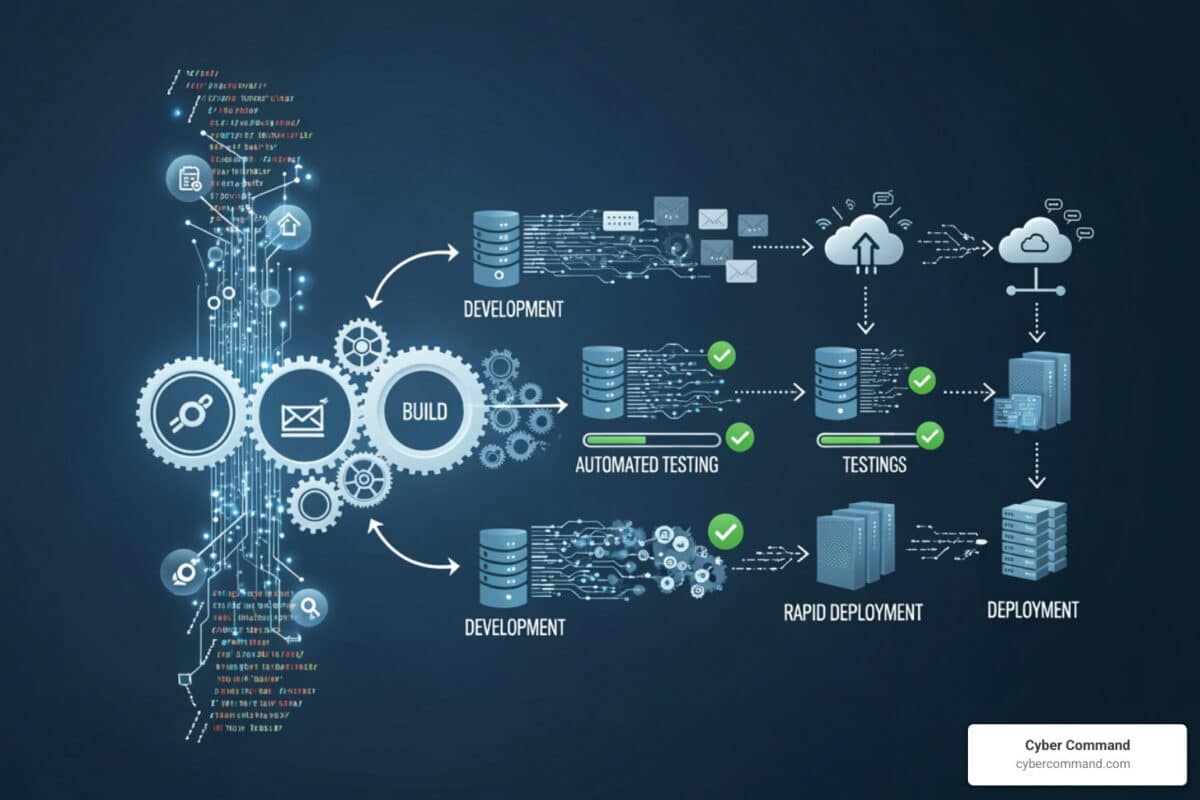
Agile and DevOps testing is a continuous approach to quality assurance that integrates automated testing throughout the entire software development lifecycle, enabling teams to deploy code 208 times more frequently and 106 times faster than traditional methods.
Key Components of Agile and DevOps Testing:
- Shift-Left Testing – Moving quality checks earlier in development to catch defects when they’re cheapest to fix
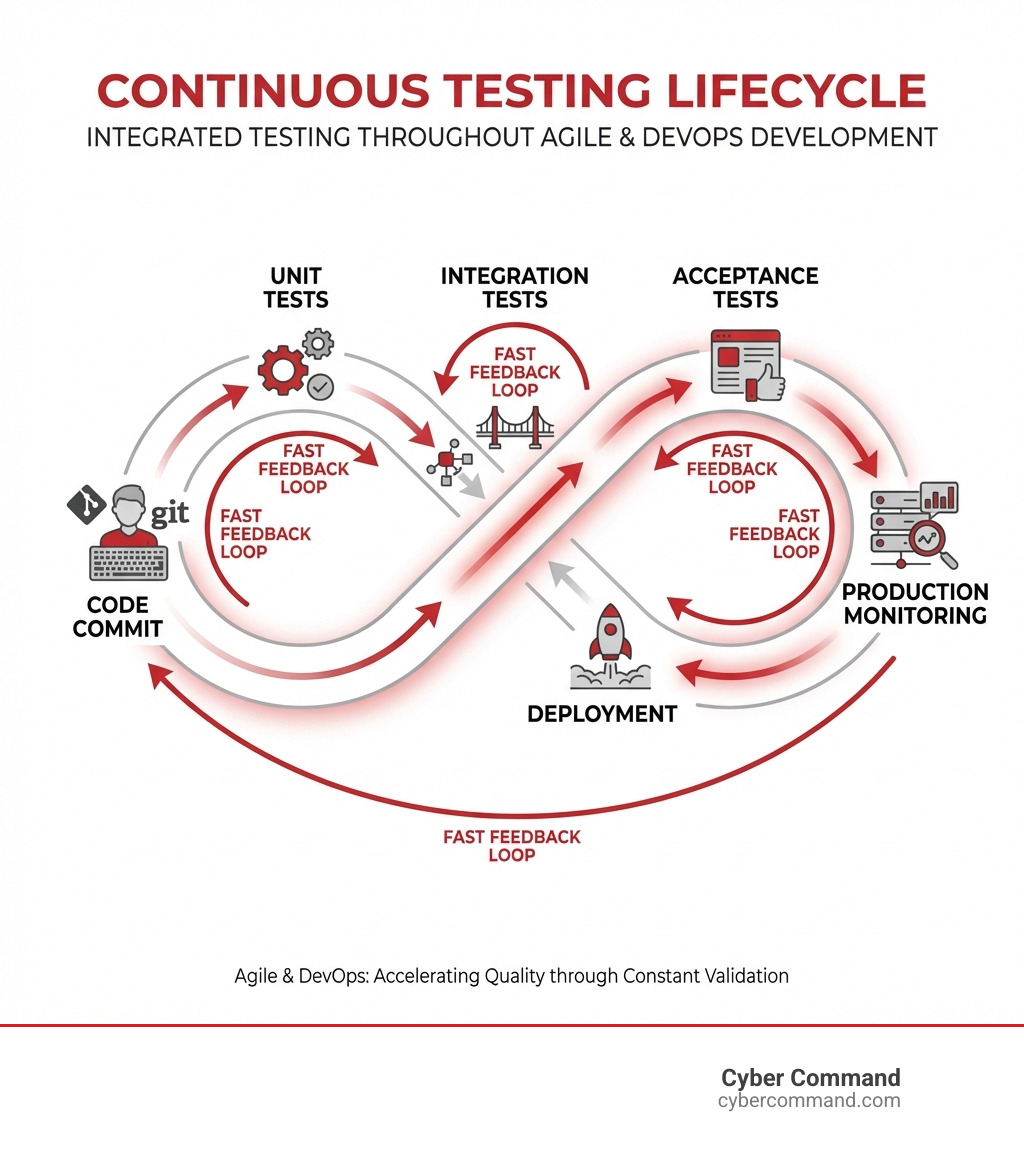
- Continuous Testing – Running automated tests constantly throughout the pipeline, not just at the end
- Test Automation Pyramid – Prioritizing fast unit tests over slower end-to-end tests
- Shared Responsibility – Developers and testers collaborating on quality from day one
- Fast Feedback Loops – Getting test results in minutes, not hours or days
The world of software development has fundamentally changed. Agile promised faster iterations. DevOps promised reliable deployments. Together, they’ve created what one industry expert calls “the perpetual sprint” – continuous motion where development never truly stops.
This creates a problem. Traditional testing assumes you can pause development to validate what’s been built. But in modern environments, code merges multiple times per day. Features evolve in production. Microservices update independently. The clean separation between “building” and “validating” has disappeared.
For business leaders, this shift is both opportunity and challenge. On one hand, 85% of organizations practicing Agile use test automation as a key enabler, achieving a 30% reduction in time-to-market. On the other, implementing these practices requires rethinking roles, processes, and culture.
The uncomfortable truth is that testing practices that worked in waterfall environments can’t keep up with truly continuous development. Manual regression testing becomes a bottleneck. Defects finded late cost exponentially more to fix. Teams struggle with environment issues, integration complexity, and the sheer speed of change.
I’m Reade Taylor, Founder and CEO of Cyber Command, where I’ve spent years helping businesses transform their technology operations through secure DevOps practices and modern quality engineering. Having built my career engineering enterprise-grade systems at IBM Internet Security Systems, I’ve seen how agile and DevOps testing can either accelerate innovation or become a critical vulnerability when implemented poorly.
This guide will show you how to implement continuous testing that actually works – not as theory, but as a practical system you can build step by step. We’ll cover the core principles, walk through implementation strategies, address common challenges, and show you how to measure success.
Key agile and devops testing vocabulary:
Core Principles of Agile and DevOps Testing
When we talk about agile and devops testing, we aren’t just talking about clicking buttons faster. We’re talking about a fundamental shift in how we perceive quality. To understand this, we often look to the CALMS framework: Culture, Automation, Lean, Measurement, and Sharing.
In a traditional setup, development teams would write code and then “throw it over the wall” to an operations or testing team. That’s an anti-pattern we work hard to break. In an Agile and DevOps world, quality is everyone’s job. We focus on lean principles—eliminating waste like long waiting periods for test results—and sharing knowledge across disciplines.
One of the most vital principles is the “Shift-Left” approach. This means we move testing as far to the start of the development process as possible. Instead of waiting for a “testing phase” at the end of a six-month project, we test on day one. This creates a fast feedback loop where developers know within minutes if their change broke something. Research shows that quality and testing in DevOps are the primary levers for reducing time-to-market.
At Cyber Command, we see this evolution as the bridge between raw code and a stable business product. If you’re looking to scale, you can’t rely on manual checks; you need the architectural support found in modern Cloud Computing DevOps services to handle the load of continuous validation.
Shifting Left for Early Defect Detection
“Shift-left” is more than a buzzword; it’s a survival strategy. In the “perpetual sprint,” if you find a bug in production, it’s already too late—your reputation and your revenue are at risk. Predictive testing allows us to anticipate where errors might occur based on historical data and code complexity.
The biggest change here is developer responsibility. We encourage our partners to adopt Test-Driven Development (TDD). In TDD, you write the test before you write the code. It sounds backward, but it ensures that your code is testable from the very first line. This practice provides assurance that the code operates as designed and prevents the “hard-to-test” code spaghetti that plagues legacy systems. For a deeper dive into these techniques, check out the research on test-driven development.
Continuous Testing vs Traditional Methods
Traditional testing is like a physical exam you get once a year. Continuous testing is like a heart rate monitor you wear 24/7. In a continuous environment, the target is always moving. We use context-aware intelligence to adapt our testing scope. For example, a minor UI tweak shouldn’t trigger a full three-hour database regression suite, but a core algorithm change absolutely should.
| Feature | Traditional Testing | Continuous Testing |
|---|---|---|
| Timing | After “Dev Complete” | Every commit & merge |
| Responsibility | Siloed QA Team | Shared (Dev, Test, Ops) |
| Goal | Find bugs before release | Proactive quality optimization |
| Feedback | Days or Weeks | Minutes |
| Environment | Static Staging | Dynamic, production-integrated |
True continuous testing integrates production-integrated insights. We don’t just test in a vacuum; we look at how users actually use the software in the real world (using tools like Splunk or Google Cloud’s Observability suite) and feed that data back into our test scenarios.
How to Implement Continuous Testing in Your Pipeline
Implementing agile and devops testing doesn’t happen overnight. You can’t just buy a tool and call it “DevOps.” We recommend starting with a “skeleton pipeline.” Build a simple path that takes a single line of code through a unit test, an acceptance test, and a deployment script. Once that path is clear, you can start adding complexity.
The goal is to eliminate testing “phases” entirely. We want validation to happen in the background, always-on. This requires a robust CI/CD integration where every merge triggers an automated suite. This is a core part of our Secure DevOps services, ensuring that speed never comes at the cost of security.

Automating the Agile and DevOps Testing Pyramid
To keep your pipeline fast, you must follow the Test Automation Pyramid. Mike Cohn’s model suggests that your test suite should be bottom-heavy:
- Unit Tests (The Base): These are fast, cheap, and written by developers. They test small pieces of logic in isolation.
- API/Acceptance Tests (The Middle): These test how different parts of the system talk to each other. They are slower than unit tests but more comprehensive.
- UI/End-to-End Tests (The Top): These should be the smallest part of your suite. They are “brittle” (easy to break) and slow, so we only use them for critical user journeys.
By catching most errors at the unit level, you find them earlier and cheaper. High-performing teams focus on test automation capabilities to ensure their builds stay “green” and reliable.
Curating and Pruning Your Test Suite
A common pitfall in agile and devops testing is “hoarding” tests. If you have 5,000 tests and 500 of them fail randomly every time (we call these “flaky tests”), nobody will trust the results. A suite of ten reliable tests is infinitely better than a thousand untrusted ones.
We use the Page Object Pattern to decouple UI tests from the actual system, making them less likely to break when a button moves three pixels to the left. Most importantly, we invest in refactoring. If a test is expensive to maintain, it usually points to an architectural problem in the software itself. To keep your pipeline healthy, you must actively mitigate flaky tests by either fixing them or pruning them from the “blocking” part of your pipeline.
Overcoming Challenges in Modern Testing Environments
It’s not all sunshine and rainbows. Transitioning to agile and devops testing involves significant problems. One of the biggest is “environment state uncertainty.” In a world of microservices and feature flags, it’s hard to know exactly what the “environment” even looks like at any given second.
Then there’s the “Brownfield” problem. If you’re working on a system that’s ten years old and has zero tests, you can’t stop everything to write a million lines of automation. In these cases, we focus on high-value functionality first. We write tests for every new feature and slowly build a “safety net” around the old stuff.
Fostering Collaboration Across Agile and DevOps Testing Teams
The “social” aspect of DevOps is often harder than the technical one. We have to break down the silos between Dev, Test, and Ops. This is where the Software Development Engineer in Test (SDET) role comes in. These aren’t just “manual testers”; they are engineers who build the tools that allow developers to test their own code.
We also promote the idea of “Team Test Advisors.” Instead of a QA person being a gatekeeper who says “No, you can’t release,” they become a consultant who helps the team design better tests. This shared responsibility is at the heart of our Platform Engineering approach, where we provide the “paved road” (the tools and infrastructure) so developers can move fast without falling off a cliff.
Measuring Success and Business Benefits
How do you know if your agile and devops testing is working? You look at the data. Organizations that master these practices see a 30% reduction in time-to-market and significantly higher customer satisfaction. 76% of organizations report that faster feedback cycles are the top benefit of their automation efforts.
We track several key KPIs to measure health:
- Deployment Frequency: How often are we pushing code to production?
- Change Failure Rate: What percentage of our deployments result in an incident?
- Mean Time to Recovery (MTTR): How fast can we fix it when it breaks?
- Test Coverage: Are we testing the parts of the code that actually matter to the business?
- Defect Findy Rate: Are we finding bugs in the unit test phase or the production phase?
Frequently Asked Questions about Agile and DevOps Testing
What is the ‘shift-left’ approach in testing?
Shift-left is the practice of moving testing to the earliest possible point in the development process. Instead of waiting for a finished product, we test requirements, designs, and individual lines of code as they are written. This catches bugs when they are simple and cheap to fix, rather than complex and expensive.
How does test automation support CI/CD pipelines?
Test automation is the engine of the CI/CD pipeline. Without it, you’d have to stop and manually check every change, which kills your velocity. Automation allows for “Continuous Validation,” where the system automatically runs thousands of checks on every code commit, giving developers immediate feedback and ensuring only “clean” code reaches production.
Can manual testing survive in a DevOps environment?
Absolutely, but its role changes. We move away from boring, repetitive manual regression (which machines do better) and toward “Exploratory Testing.” This is where human testers use their intuition and business knowledge to find edge cases and usability issues that an automated script would never catch. Manual testing becomes a high-value, creative activity rather than a checkbox exercise.
Conclusion
Transitioning to agile and devops testing is a journey from “reactive firefighting” to “proactive quality optimization.” It requires a blend of the right tools, a bottom-heavy testing pyramid, and a culture where everyone owns the “green” build.
At Cyber Command, we specialize in helping businesses across Florida—from Winter Springs and Orlando to Tampa Bay and Jacksonville—and our neighbors in Plano, Texas, steer this complexity. We act as an extension of your team, providing 24/7/365 U.S.-based support to ensure your pipelines are fast, secure, and reliable. Whether you are struggling with a “brownfield” legacy system or building a new cloud-native application, we have the expertise to get you into the fast lane.
Understanding the nuance between different modern approaches is key to your strategy. To learn more about how to structure your organization for success, read my take on Bridging the Gap: DevOps vs. Platform Engineering.
Ready to modernize your delivery? Let’s build something stable together.