
Navigating the Future: Crafting Your Organization’s AI Roadmap


Why AI Roadmap Development Matters for Your Business
AI roadmap development is the process of creating a strategic blueprint that guides your organization’s artificial intelligence initiatives from planning to deployment. Here’s what it involves:
Core Components of AI Roadmap Development:
- Strategic Alignment – Connect AI initiatives to your business goals and capabilities
- Readiness Assessment – Evaluate your data, infrastructure, talent, and processes
- Phased Implementation – Start with quick wins, then scale to enterprise-wide deployment
- Governance Framework – Establish security, compliance, and ethical guidelines
- Success Metrics – Define clear KPIs to measure ROI and business impact
By 2024, 78% of organizations had already implemented AI in some form. Even more telling: 92% of companies plan to expand their AI investment over the next three years, with the AI industry projected to quadruple in size.
But here’s the harsh truth: most AI initiatives fail without a proper roadmap.
Organizations rush to “sprinkle some AI on top” of existing processes, chase technology-first fantasies, or copy-paste strategies from competitors. The result? Scattered projects that don’t integrate, wasted resources, and executive teams demanding to know what went wrong.
A well-crafted AI roadmap changes everything. It’s not just a list of technologies you want to implement. It’s a living blueprint that connects your AI use cases with your actual business capabilities—your data, your infrastructure, your people, and your governance requirements. It defines success at each stage, from proof-of-concept to enterprise-wide rollout, ensuring your investments deliver tangible value rather than ending up as expensive experiments.
Without a roadmap, you risk falling behind competitors who are already using AI to streamline operations, reduce costs, and open up new revenue streams. With one, you transform AI from a buzzword into a competitive advantage.
I’m Reade Taylor, Founder and CEO of Cyber Command, and I’ve spent my career helping businesses steer complex technology changes, from enterprise cybersecurity to cloud-native infrastructures. Through our work in AI roadmap development, we’ve helped organizations cut through the hype and build practical, security-focused AI strategies that align with their growth objectives.
The Foundation: Aligning Your AI Vision with Business Strategy

Getting started with artificial intelligence (AI) can feel like navigating a maze without a map. Companies today are in a race to keep up with the rapid advances in technology. But with so many options and complexities, it’s hard to know where to start. We believe the answer lies in aligning your AI vision directly with your core business strategy. This means understanding your organization’s “what” (its capabilities) before diving into the “how” (AI implementation).
This is where capability-based planning shines. Instead of just looking at AI technologies, we focus on which business capabilities can be augmented or automated with AI to drive real value. This approach ensures that your AI investments are not just cool tech projects, but strategic moves that support your overall organizational goals and business drivers. For instance, a beverage manufacturer might use capability maps to assign AI support ideas to strategic capabilities, ensuring every AI initiative serves a larger business purpose.
To truly make an impact, your AI initiatives must be business-driven and aligned with your overall organizational strategy. This involves defining an AI vision statement and establishing foundational AI principles that guide your investments and ensure they contribute to measurable business outcomes. For more insights into how AI can be leveraged for business, explore our guide on how AI is used in business. It’s clear that AI is being adopted at a faster rate than ever across the business world; according to Stanford, 78% of organizations had implemented AI in some form by 2024.
Do You Really Need an AI Roadmap?
This is a question we often hear, and it’s a good one. Not everyone loves roadmaps, and some even “love to hate on them.” But here’s the reality: your company is demanding an AI roadmap. You can’t just not give them one. So, how do you create a roadmap that is actually useful and not just “hopium”?
You need an AI roadmap if you want to avoid scattered, one-off AI projects that don’t integrate or drive organization-wide value. Without it, you risk wasting resources on initiatives that don’t align with your core business objectives. If you’re feeling competitive pressure to adopt AI or if your executive team is asking for a clear plan for AI investment, then yes, you absolutely need an AI roadmap development strategy. It’s about channeling that demand into a structured, impactful direction.
To determine if you truly need an AI roadmap, ask yourself:
- Are our AI initiatives currently ad-hoc or disconnected?
- Do we have a clear understanding of the business value each AI project is supposed to deliver?
- Are we struggling to prioritize AI investments?
- Do our stakeholders (business, IT, executive) have a shared vision for AI’s role in our organization?
- Are we concerned about falling behind competitors who are already leveraging AI strategically?
If you answered yes to any of these, an AI roadmap is not just helpful; it’s essential.
Setting Clear, Measurable Objectives for AI
The first step in effective AI roadmap development is setting clear, measurable objectives for your AI initiatives. This isn’t about integrating AI for AI’s sake; it’s about connecting it to meaningful outcomes.
We start by identifying specific pain points, inefficiencies, or growth opportunities within your organization in Florida or Texas that AI can address. For example, perhaps your customer service department in Orlando is overwhelmed by inquiries, or your logistics operations in Plano could benefit from optimized routing. AI should be positioned as the solution to these tangible challenges.
Success must be defined by meaningful outcomes, not just by the deployment of technology. We recommend using the SMART framework (Specific, Measurable, Achievable, Relevant, Time-bound) to set your AI objectives. This ensures your goals are concrete and trackable.
For example, instead of “implement AI in customer service,” a SMART objective would be: “Reduce average customer inquiry response time by 30% using an AI-powered chatbot within the next 12 months, leading to a 15% increase in customer satisfaction.” This objective ties directly to:
- Faster turnaround times: Improving operational efficiency.
- Cost reduction: Potentially by automating routine tasks.
- Revenue growth: Through improved customer satisfaction and retention.
By grounding your objectives in such clear metrics, you create a foundation for measuring the true value and success of your AI roadmap implementation.
The 5-Step Blueprint for Effective AI Roadmap Development
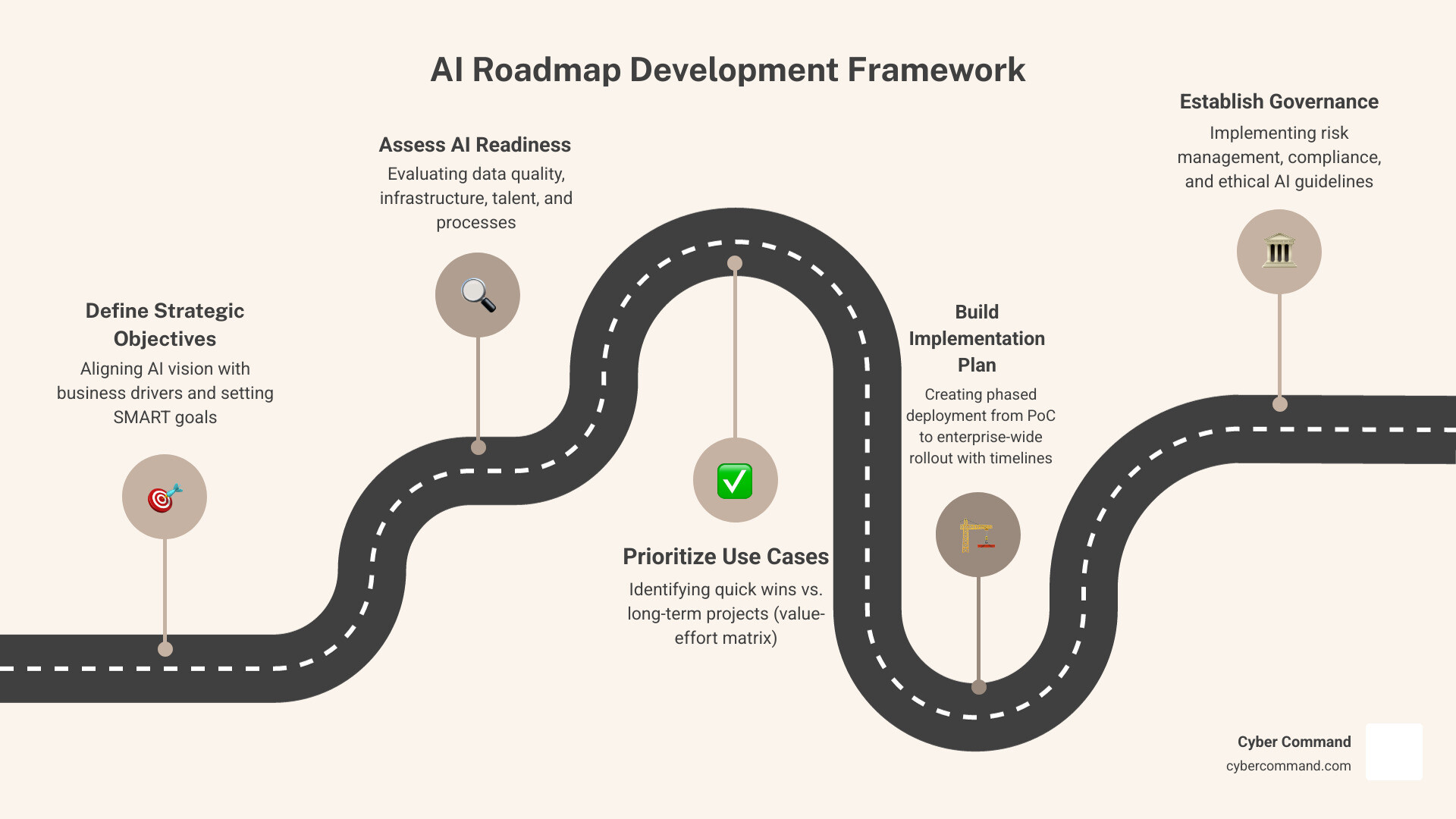
Building an effective AI roadmap is a journey that requires careful strategic planning, phased implementation, diligent resource management, and robust governance. We’ve distilled this complex process into a clear, actionable five-step blueprint to guide your organization, whether you’re in Jacksonville or Tampa Bay, toward AI success.
Step 1: Define Strategic AI Initiatives and Objectives
Our first step is to lay the strategic groundwork. This involves understanding your organization’s core business capabilities and identifying how AI can improve them. We leverage business capability maps to visualize “the what” of your organization, such as customer service, supply chain management, or product development.
Once capabilities are mapped, we prioritize them using frameworks like “Tolerate, Invest, Migrate, or Eliminate” in relation to AI potential. This helps us decide where AI can deliver the most impact. For example, a capability critical for customer experience might be an “Invest” area for AI.
Crucially, we align AI initiatives with your existing business initiatives, ensuring that AI isn’t an isolated project but an integrated part of your growth strategy. This includes defining a clear AI mission statement that articulates AI’s purpose within your organization and establishing foundational AI principles that guide its ethical and responsible use from the outset.
Step 2: Conduct a Comprehensive AI Readiness Assessment
Before diving into implementation, we need to understand your current state. This involves a thorough resource audit, assessing your organization’s AI readiness across several critical dimensions:
- Data Readiness: Do you have access to sufficient, clean, and reliable data? AI thrives on data, so we evaluate its quality, accessibility, and governance.
- Infrastructure and Tooling: Does your existing computing capacity, storage, and tooling support AI workloads? We assess scalability and identify any gaps.
- People and Expertise: Do you have the talent (data scientists, AI engineers, domain experts) and the collaborative culture needed for AI projects? We’ll help identify skills gaps and strategies for talent development or acquisition.
- Processes and Collaboration: Are your workflows and cross-departmental collaboration models conducive to AI development and deployment? Effective governance structures are key here.
We can help you steer this complex evaluation with our AI Readiness Checklist. This assessment helps us pinpoint exactly what resources you have and what you’ll need, creating a realistic foundation for your AI roadmap development.
Step 3: Prioritize Use Cases and Plan Implementation Phases
With a clear understanding of your strategic objectives and readiness, the next step is to identify and prioritize specific AI use cases. We look for opportunities where AI can deliver tangible business value.
Prioritization is key, as you can’t do everything at once. We often use a Value x Effort matrix, where potential AI projects are assessed based on their estimated business value (e.g., revenue increase, cost savings) and the effort required for implementation (e.g., development time, technical complexity). This helps identify:
- Quick wins: Projects with high value and low effort, perfect for initial proof-of-concept (PoC) initiatives. These build momentum and demonstrate early ROI.
- Big projects: High value, high effort projects that require more strategic planning.
- Fill-ins: Low value, low effort projects that can be done when resources allow.
- Time wasters: Low value, high effort projects to avoid.
Based on this prioritization, we plan your implementation in phases, moving from quick wins to enterprise-wide deployment:
- Phase 1: Quick Wins (Proof-of-Concept): Small-scope, technically straightforward projects with minimal investment. These allow us to learn, adjust, and build on early successes.
- Phase 2: Scaling and Growing Infrastructure: Moving from departmental pilots to broader, organizational-level initiatives. This involves formalizing approaches, shared frameworks, and investing in scalable infrastructure and MLOps practices.
- Phase 3: Enterprise-Wide Deployment and Optimization: Standardizing deployment pipelines, reinforcing governance, and deploying AI models across the organization. This phase also focuses on continuous monitoring and optimization.
Step 4: Detail Key Components for your AI roadmap development
Once the strategy, assessment, and prioritization are complete, we move to detailing the actual AI roadmap development document. This isn’t just a simple list; it’s a comprehensive blueprint that guides your entire AI journey.
A strong AI roadmap typically includes:
- Clear Objectives: Reiterate your SMART goals for each AI initiative.
- Resource Audit Summary: A snapshot of your current and required data, infrastructure, talent, and processes.
- Phased Implementation Plan: Detailed steps for each phase (quick wins, scaling, enterprise-wide deployment), including milestones and dependencies.
- Governance Framework: Outlining how AI will be managed, secured, and kept compliant.
We work with you to create detailed timelines, often visualized using a Gantt chart, to track progress and assign responsibilities. This ensures everyone knows what needs to be done, by whom, and by when, keeping your AI initiatives on track and accountable.
Step 5: Establish Governance and Risk Management Frameworks
The rapid advancements in AI bring immense opportunities, but also new risks. Therefore, establishing robust governance and risk management frameworks is not an afterthought; it’s a fundamental part of our AI roadmap development.
We advocate for security by design, integrating cybersecurity from the very beginning of your AI projects. This means conducting risk assessments, defining security requirements, and designing controls and protocols as part of the planning and system design phases. This proactive approach helps prevent common security issues like data breaches and unauthorized access.
Compliance requirements are also paramount. Whether you operate in a regulated industry in Central Florida or Texas, we ensure your AI roadmap adheres to standards like SOC 2, ISO 27001, GDPR, and other relevant regulations. This involves establishing AI policies and conducting regular compliance audits.
Furthermore, ethical AI is a core consideration. We guide you in implementing principles of fairness, transparency, and accountability into your AI systems. This includes addressing potential biases in data or algorithms and ensuring that AI decisions are understandable and explainable. For a comprehensive look at managing AI risks, we align with frameworks such as the Roadmap for the NIST Artificial Intelligence Risk Management Framework (AI RMF 1.0), which promotes trustworthy and responsible AI development.
Sustaining Momentum: Long-Term Success and Optimization
Developing an AI roadmap is a significant achievement, but our work doesn’t stop there. The true value comes from sustaining momentum, continuously measuring performance, and optimizing your AI systems for long-term success. The AI landscape is rapidly evolving, and your roadmap must evolve with it.
We focus on measuring the value and success of your AI initiatives by defining clear Key Performance Indicators (KPIs) tied back to your initial business objectives. This allows us to calculate the Return on Investment (ROI) and demonstrate the tangible impact of AI on your organization.
However, AI models are not “set it and forget it” solutions. They are susceptible to “model drift,” where their accuracy degrades as real-world data or user behavior shifts. We implement strategies for continuous retraining and recalibration of models, ensuring they remain effective and relevant. This iterative process, combined with robust feedback loops, allows for ongoing optimization and adaptability to new technologies and changing business needs.
Measuring the Value and Success of Your AI Initiatives
To truly understand if your AI roadmap is delivering, we need to measure its impact. This goes beyond just technical metrics and dives into quantifiable business outcomes. We work with you to define success metrics that directly correlate with your strategic objectives, such as:
- Customer Satisfaction: Has the AI improved customer experience, leading to higher satisfaction scores or reduced churn?
- Operational Efficiency: Are processes streamlined, leading to faster turnaround times, reduced errors, or lower operational costs?
- Revenue Growth: Has AI contributed to new revenue streams, increased sales, or improved product offerings?
- Risk Reduction: Has AI helped mitigate risks, such as fraud detection or improved cybersecurity posture?
By tracking these KPIs and business outcomes, we can demonstrate the concrete value of your AI investments and make data-driven decisions for future roadmap adjustments.
Ensuring Long-Term Optimization and Adaptability
The AI journey is continuous. To ensure the long-term optimization and adaptability of your AI systems, we accept MLOps (Machine Learning Operations) practices. MLOps integrates development, deployment, and operations for AI models, creating automated, scalable pipelines that ensure reliability and efficiency.
Continuous monitoring of AI systems is crucial. This involves tracking model performance, identifying potential drift, and setting up alerts for anomalies. When model drift occurs, we implement processes for recalibration and retraining, ensuring your AI remains accurate and effective.
Given the rapid pace of AI advancements, your roadmap must be agile. We emphasize an agile methodology, allowing for flexibility and adaptation as new technologies emerge and your business needs evolve. This proactive approach ensures your AI systems remain cutting-edge and continue to provide a competitive advantage. For example, AI and Machine Learning play a vital role in enhancing cybersecurity, particularly in threat detection. Understanding the role of AI and ML in threat detection is critical for organizations looking to leverage these technologies for their security posture.
Frequently Asked Questions about AI Roadmap Development
What are the most common pitfalls to avoid when creating an AI roadmap?
Even with the best intentions, organizations can stumble during AI roadmap development. Here are some common pitfalls we help our clients in Florida and Texas avoid:
- “Sprinkle some AI on top”: This mindset treats AI as a magic dust to be added to existing problems without strategic thought. It leads to superficial, ineffective solutions.
- Technology-first fantasies: Focusing solely on the latest AI tech without connecting it to a clear business problem or value proposition. This often results in expensive experiments with no tangible ROI.
- Copy-paste strategies: Blindly adopting another company’s AI roadmap without considering your unique organizational context, capabilities, and objectives. What works for one may not work for another.
- Lack of business alignment: Developing an AI roadmap in a vacuum, disconnected from the overall business strategy. This leads to projects that don’t move the needle for the organization.
- Underestimating resource needs: Overlooking the significant requirements for quality data, specialized infrastructure, and skilled talent. AI is resource-intensive.
- Ignoring governance: Failing to establish clear frameworks for security, compliance, ethics, and responsible use. This can expose your organization to significant risks.
By being aware of these traps, we can proactively steer your AI roadmap development towards meaningful success.
What is the difference between artificial intelligence vs machine learning?
This is a common question! It’s easy to get these terms mixed up, especially since they’re often used interchangeably.
-
Artificial Intelligence (AI) is the broader concept. Think of it as the overarching goal of creating machines that can simulate human intelligence. This includes tasks like problem-solving, understanding language, recognizing patterns, and making decisions. Essentially, if a program can “reason” or “learn” in a way that mimics human cognitive functions, it falls under AI. We have a more detailed explanation available in our article: what is the difference between artificial intelligence vs machine learning.
-
Machine Learning (ML) is a subset of AI. It’s a specific approach to achieving AI that focuses on enabling systems to learn from data without being explicitly programmed. Instead of writing code for every possible scenario, ML algorithms are trained on large datasets to identify patterns and make predictions or decisions. Examples include spam detection, predictive maintenance, and personalized recommendations.
-
Deep Learning (DL) is a further subset of Machine Learning, inspired by the structure and function of the human brain’s neural networks. Deep learning algorithms use multiple layers of artificial neural networks to learn from vast amounts of data, excelling in tasks like image classification, facial recognition, and generative AI (like the technology behind large language models).
So, all Machine Learning is AI, but not all AI is Machine Learning. ML is one of the most powerful tools we use to bring AI capabilities to life.
How often should an AI roadmap be updated?
The AI landscape is incredibly dynamic, with rapid advancements and evolving technologies emerging constantly. For this reason, an AI roadmap should never be a static document. We view it as a living document that requires regular review and adaptation.
For organizations in Florida and Texas, we typically recommend:
- Quarterly Reviews: A light touch-point every three months to assess progress, address immediate challenges, and make minor adjustments based on new insights or short-term changes in business priorities.
- Annual Strategic Reassessment: A more comprehensive review once a year. This involves re-evaluating your strategic AI initiatives against broader organizational goals, assessing the impact of new AI technologies, and updating your long-term vision. This is when you might significantly shift priorities or introduce new phases based on the previous year’s learnings and market changes.
An AI roadmap development process that incorporates an agile methodology is crucial. This flexibility allows your organization to respond to the fast pace of innovation, ensuring your AI investments remain relevant and continue to deliver maximum value. It’s about being adaptable without losing sight of your ultimate strategic objectives.
Conclusion: Your Partner in AI-Driven Change
Navigating the complex world of Artificial Intelligence requires more than just enthusiasm; it demands a clear strategy, meticulous planning, and unwavering commitment. Through effective AI roadmap development, your organization can transform AI from a buzzword into a powerful engine for innovation, efficiency, and competitive advantage.
We’ve explored how aligning your AI vision with core business strategy, conducting thorough readiness assessments, prioritizing use cases, and establishing robust governance are critical steps. This phased approach, from quick wins to enterprise-wide deployment, ensures that your AI journey is structured, measurable, and impactful. And by embracing continuous optimization, your AI systems will remain relevant and effective in an changing technological landscape.
At Cyber Command, we understand the unique challenges and opportunities that AI presents for businesses across Florida and Texas. Our enterprise-grade IT, cybersecurity, and platform engineering services are designed to be an extension of your team, providing proactive, 24/7/365 U.S.-based support. We cut through the hype to help you build practical, security-focused AI strategies that drive real business value.
Don’t let the complexity of AI hold your organization back. Partner with us to chart a clear course for your AI future. Get expert guidance with our AI Consulting services and transform your AI aspirations into tangible success.