
From Small Business to Enterprise: Designing and Building AI Solutions That Work


Why Enterprise AI Solutions Are Transforming Businesses Today
AI solutions enterprise deployments are accelerating across organizations of all sizes, with 68% of companies now actively using AI and top performers achieving returns 3x higher than slow adopters. Here’s what defines successful enterprise AI adoption:
Core Components of Enterprise AI Solutions:
- Data Infrastructure – Unified data pipelines, governance frameworks, and feature stores that break down silos
- Model Development – AutoML platforms, custom model training, and centralized registries for versioning and tracking
- Deployment & Integration – MLOps workflows, API connections, and seamless integration with existing ERP, CRM, and ITSM systems
- Monitoring & Governance – Real-time performance tracking, human-in-the-loop validation, and responsible AI frameworks
Measurable Business Impacts:
- Workers save 40-60 minutes daily using AI tools, with technical roles saving 60-80 minutes
- 75% of workers report improved speed or quality of output
- AI leaders achieved 1.7x revenue growth and 3.6x greater shareholder returns over three years
- Frontier firms generate 2x more AI messages per employee than median enterprises
The shift from experimentation to production is happening now. ChatGPT enterprise usage grew 8x year-over-year, while API reasoning token consumption jumped 320x. Organizations are moving beyond pilots to build AI into their core workflows—from customer service automation to supply chain optimization and predictive analytics.
But here’s the reality: only 22% of companies qualify as “Frontier Firms” that achieve breakthrough results. The difference isn’t the technology itself—it’s how you architect, deploy, and govern AI across your organization.
I’m Reade Taylor, Founder and CEO of Cyber Command, and I’ve spent years helping businesses move from fragmented IT systems to secure, scalable technology ecosystems that include strategic AI solutions enterprise deployments. Whether you’re running a 20-person team or managing hundreds of employees, the principles of successful AI adoption remain the same: start with solid data foundations, align AI with real business goals, and build security and governance in from day one.
AI solutions enterprise word guide:
Defining the Core Components of an AI Solutions Enterprise
To build a true AI solutions enterprise, you need more than just a few clever prompts. You need a robust architecture that can handle massive data volumes and turn them into actionable insights. At Cyber Command, we see AI as an extension of your Business IT Services, requiring a foundation that is secure, resilient, and scalable.

The backbone of any enterprise AI system consists of several technical layers:
- Data Engineering Pipelines: These move data from silos into unified environments like data meshes or warehouses. Without high-quality data, your AI is essentially a Ferrari with no engine.
- MLOps (Machine Learning Operations): This is the practice of applying DevOps principles to AI. It ensures that models are not just built but also deployed, versioned, and monitored efficiently.
- Predictive Analytics: This allows businesses to look forward rather than backward, using historical data to forecast trends and customer behaviors.
A common point of confusion we encounter is the terminology. If you’ve ever wondered, What is the Difference Between Artificial Intelligence vs. Machine Learning?, think of AI as the broad goal of creating “smart” machines, while Machine Learning (ML) is the specific method of training those machines to learn from data.
Scaling AI Solutions Enterprise-Wide
Scaling AI across an entire organization is where many businesses hit a wall. According to The State of AI in the Enterprise – 2026 AI report, the gap between “Frontier Firms” and slow adopters is widening. Frontier workers send 6x more AI messages than the median worker because they have integrated AI into their daily workflows.
To scale effectively, we focus on:
- Workflow Automation: Moving beyond single tasks to automate multi-step processes across departments.
- API Integration: Connecting AI tools to your existing software stack so data flows seamlessly.
- Custom GPTs and Agents: Creating specialized AI “teammates” that understand your specific company knowledge and protocols.
Building Custom AI Solutions Enterprise Applications
While off-the-shelf tools are great for general tasks, 58% of Frontier Firms use custom AI solutions to gain a competitive edge. These applications are often built using Retrieval-Augmented Generation (RAG) architecture, which allows a Large Language Model (LLM) to “read” your company’s private documents without the need for expensive retraining.
We also advocate for Explainable AI, which provides tools for machine learning interpretability. In a business setting, you can’t just have a model make a decision; you need to understand why it made that decision to build trust among stakeholders and ensure regulatory compliance.
Measurable Impacts and Strategic Benefits of Adoption
The numbers don’t lie: 89% of organizations believe AI and ML will help them boost revenue and enhance operational efficiency. When you invest in AI solutions enterprise level tools, you aren’t just buying software; you’re buying time and precision.
By Unlocking the Benefits of IT Managed Services for Enterprises, businesses can offload the technical heavy lifting and focus on these strategic impacts:
- Revenue Growth: AI leaders achieved 1.7x revenue growth over the last three years compared to their peers.
- Customer Experience: AI-driven search and recommendations, such as those offered by Coveo, personalize interactions to improve user satisfaction.
- Operational Efficiency: Reported data suggests that 89% of organizations see measurable improvements in how they handle day-to-day tasks.
Productivity Gains and Time Savings
The most immediate impact of AI is often felt at the individual worker level. Enterprise workers report saving 40–60 minutes per day. For specialized roles like engineering or communications, those savings jump to 60–80 minutes.
| Metric | Frontier Firms | Slow Adopters |
|---|---|---|
| Revenue Growth | 1.7x | 1.0x (Baseline) |
| Shareholder Return | 3.6x Greater | Standard |
| Custom AI Usage | 58% | < 15% |
| AI Messages/Seat | 2x Median | Median |
These “Frontier Firms” don’t just work faster; they work better. 75% of surveyed workers report that AI has improved the quality of their output, not just the speed.
A Strategic Roadmap for Deployment and Integration
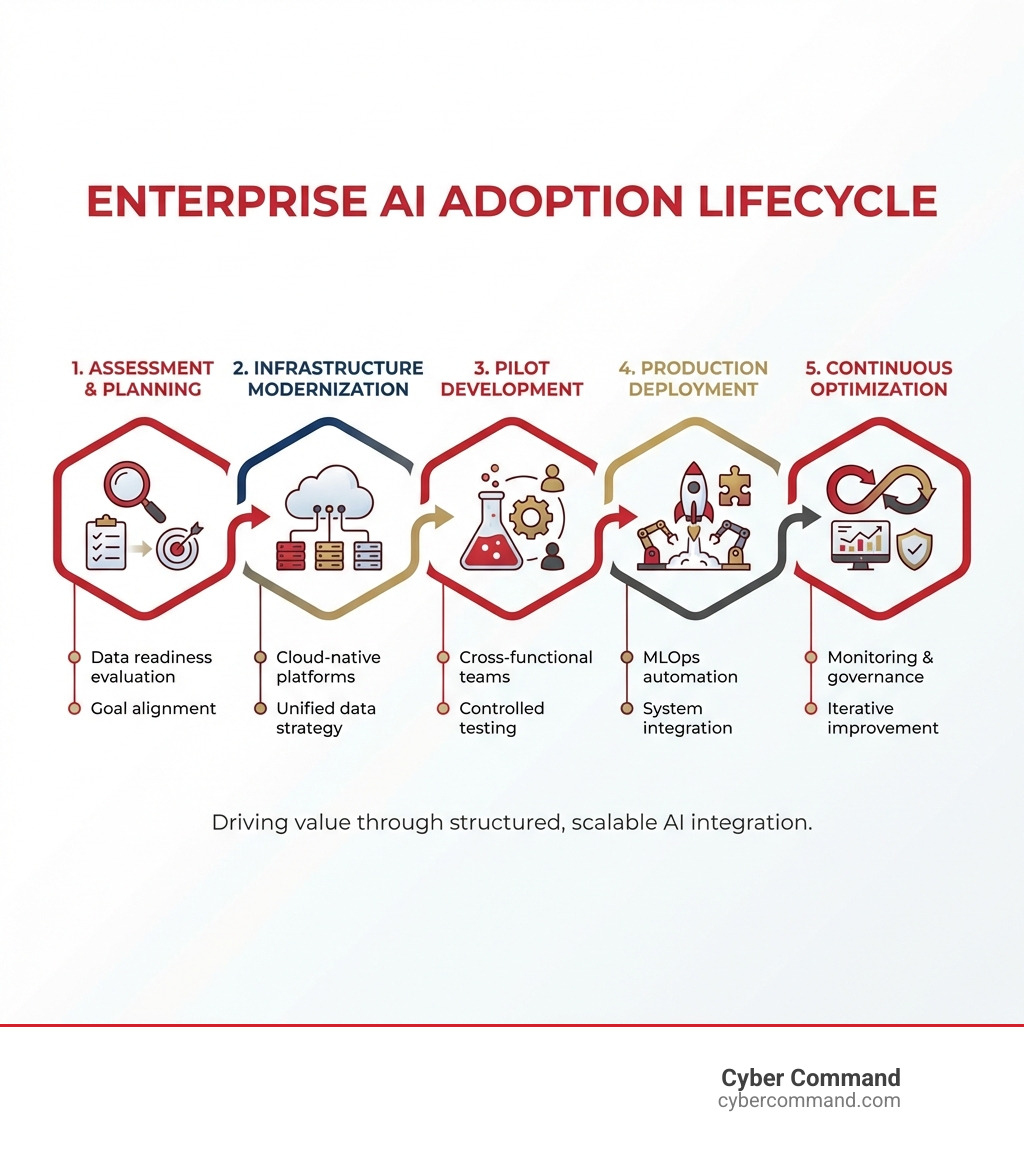
Successful deployment requires more than just a “plug-and-play” mindset. It requires a AI Roadmap Development strategy that aligns technology with your specific business objectives. We’ve found that organizations that jump straight into full-scale deployment without a pilot program often face significant integration challenges.
Before you begin, we recommend going through an AI Readiness Checklist to evaluate your data quality and infrastructure.
- Define Goals: What problem are you solving? Is it customer churn, supply chain delays, or manual data entry?
- Build Cross-Functional Teams: You need more than just IT. You need domain experts who understand the business processes being automated.
- Launch Pilot Programs: Test your AI in a controlled environment to validate its impact before rolling it out enterprise-wide.
Integration with Existing IT Infrastructure
Your AI solutions shouldn’t exist on an island. They need to integrate with your Platform Engineering efforts to ensure they are secure and performant. This often involves breaking down data silos and moving toward cloud-native platforms that can handle real-time processing.
Legacy systems are the biggest hurdle for many Florida-based enterprises. Modernizing these systems into a “living” AI backbone is essential for supporting autonomous agents that need to act on data as it happens.
Data Governance, Ethics, and Security Standards
As AI becomes mission-critical infrastructure, security cannot be an afterthought. Understanding the Role of AI and ML in Threat Detection is vital, but we must also protect the AI itself.
Responsible AI is built on three pillars:
- Transparency: Users should know when they are interacting with an AI and how decisions are being made.
- Accountability: There must be a “human-in-the-loop” to audit AI decisions and step in when things go wrong.
- Security: This includes protecting against “prompt injection” and ensuring that your proprietary data isn’t leaked into public models.
Adhering to frameworks like The Microsoft Responsible AI Standard helps ensure that your systems operate ethically and stay compliant with emerging regulations in Texas and Florida.
Managing Risks in Autonomous Systems
Autonomous systems bring unique risks, such as model hallucinations (where the AI confidently states a falsehood) and data drift (where the model’s accuracy degrades over time as real-world data changes).
To mitigate these, we implement:
- Audit Trails: Detailed records of every decision the AI makes.
- Privacy-by-Design: Ensuring that PII (Personally Identifiable Information) is scrubbed or encrypted before it ever reaches the AI model.
- Continuous Monitoring: Real-time assessments of model accuracy and performance.
Frequently Asked Questions about Enterprise AI
What is the average ROI for enterprise AI solutions?
While results vary, an IDC study found an average ROI of 3.7x for every $1 invested in generative AI. These returns come from a combination of direct cost savings (reducing manual labor) and indirect gains like increased revenue from better customer targeting and faster product development.
How does agentic AI differ from standard automation?
Standard automation follows a rigid “if-this-then-that” logic. Agentic AI, however, can reason. It uses “reasoning tokens” to plan, execute, and adjust multi-step workflows autonomously. For example, while standard automation might move a file when it’s uploaded, an AI agent could read the file, determine it’s an invoice, compare it against a purchase order, and flag it for approval if the numbers don’t match.
What are the primary challenges in scaling AI?
The biggest hurdles aren’t technical—they’re organizational. Data quality remains the number one technical challenge, but talent shortages and organizational readiness (the willingness of staff to change their workflows) are what usually stall AI projects. This is why we emphasize a culture of continuous learning and proactive AI Consulting Orlando to guide teams through the transition.
Conclusion
Building a successful AI solutions enterprise isn’t about chasing the latest hype; it’s about building a sustainable, secure, and value-driven ecosystem. Whether you are in Winter Springs, Jacksonville, or Plano, the need for proactive, 24/7/365 support is universal.
At Cyber Command, we act as an extension of your business, providing the U.S.-based expertise needed to navigate the complexities of AI, cybersecurity, and platform engineering. Ready to move from experimentation to real business impact? Let’s build something that works.