
February 6, 2026 #Seamless Digital Experience for Small Businesses
IT for Real Estate: 2026 Essential Success
Unlock real estate success with essential it for real estate solutions. Streamline operations, boost leads, and secure transactions.
Why IT for Real Estate Matters More Than Ever
IT for real estate is changing how properties are bought, sold, and managed—yet the industry faces a critical gap. While 96% of home buyers start their search online, 61% of real estate firms still rely on outdated systems. This disconnect creates missed opportunities, overwhelming workloads, and potential security vulnerabilities that can cost businesses thousands of dollars and countless hours.
What IT for Real Estate Includes:
- Property Marketing Tools - Virtual tours, 3D floor plans, AI-generated listings, and digital marketing platforms
- Client Management Systems - CRM software for lead tracking, automated communication, and relationship building
- Transaction Software - E-signatures, compliance tools, document management, and digital closing services
- Property Intelligence - Data analytics, market analysis tools, and automated property valuations
- Security Solutions - Protection against business email compromise (BEC), data breaches, and wire fraud
- Cloud Infrastructure - Scalable storage, remote access, and disaster recovery for growing operations
The real estate industry has historically lagged behind other sectors in technology adoption. But the pandemic accelerated change dramatically. Today, 63% of people make offers on homes they haven’t seen in person, 80% of commercial agents plan to increase tech spending, and McKinsey projects $110-180 billion in productivity gains from AI automation in real estate.
The technology you choose isn’t just about efficiency anymore—it’s about survival. Agents who accept modern systems become “super agents” who can handle more listings, serve clients across multiple time zones, and provide experiences that outdated competitors simply can’t match.
I’m Reade Taylor, Founder and CEO of Cyber Command, and I’ve spent years helping businesses transform their relationship with technology—including building security-focused IT ecosystems for real estate firms struggling with outdated systems, data vulnerabilities, and the overwhelming complexity of modern IT for real estate. My goal is to help you understand not just what technology is available, but how to implement it strategically to grow your business without the stress.
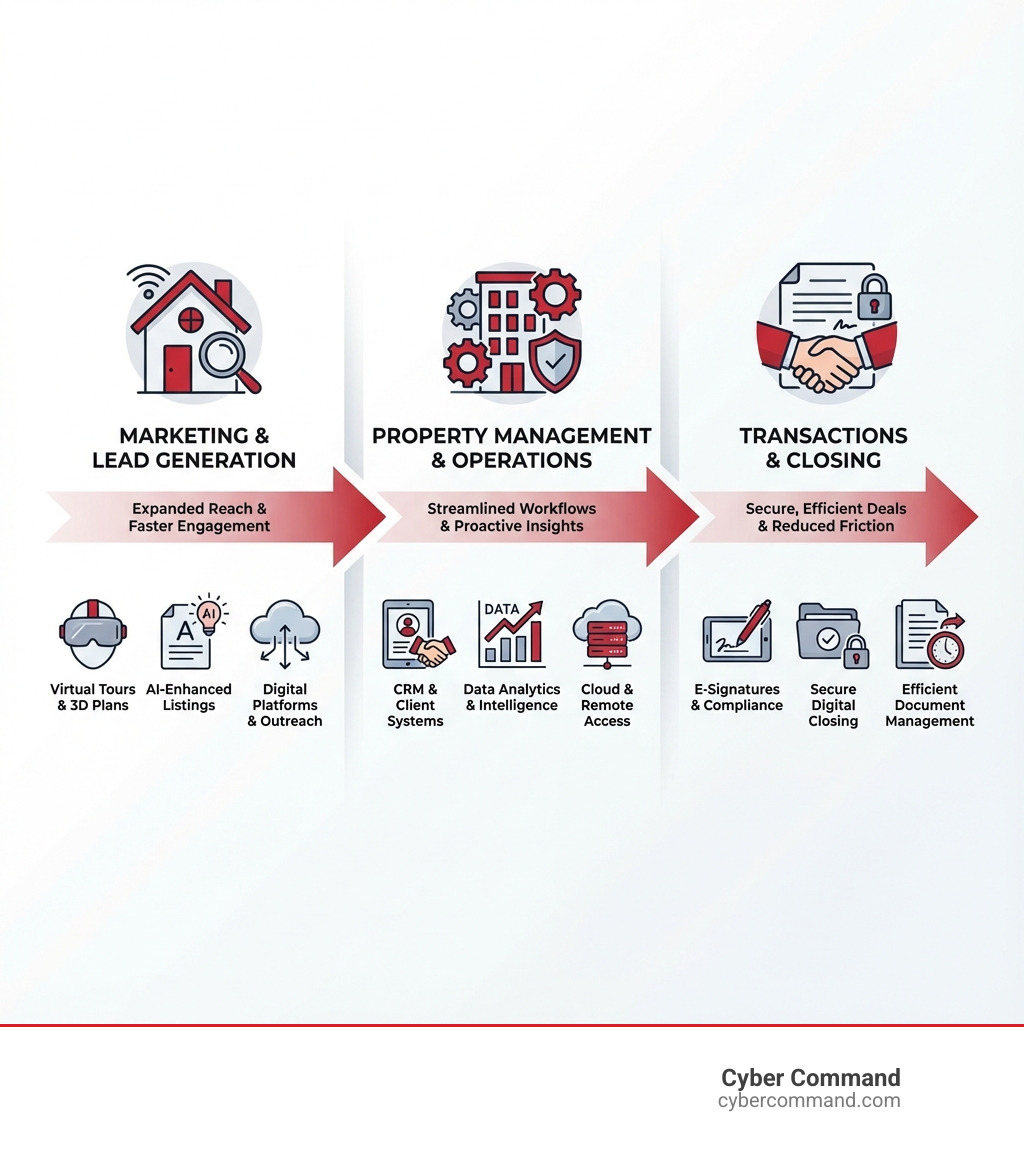
The Proptech Revolution: How Technology is Reshaping Real Estate
The term “proptech,” short for property technology, refers to the application of information technology and platform economics to the real estate industry. It’s a broad umbrella covering everything from smart home devices to sophisticated data analytics platforms, and it’s fundamentally changing how we interact with the built environment. Think of it as the digital backbone that allows real estate to move faster, smarter, and more efficiently.
Historically, real estate has been a notoriously slow adopter of new technologies. But that’s changing rapidly. The proptech revolution is pushing the industry forward, driven by the clear advantages it offers. We’re talking about massive shifts that improve user experiences, streamline operations, and ultimately improve profitability for businesses in our service areas like Orlando, Tampa Bay, and Plano, Texas.
The benefits are not just theoretical. McKinsey projects a staggering $110-180 billion in productivity gains from AI automation in real estate alone. This isn’t just about saving a few bucks; it’s about open uping new levels of efficiency and growth. For a deeper dive into how our services can specifically benefit your operations, explore our Real Estate IT Services.
Key Benefits for Real Estate Professionals
For real estate professionals—be it agents, brokers, or property managers—adopting proptech isn’t just a trend; it’s a strategic imperative. The right technology can be a game-changer, turning daily grind into streamlined success.

One of the most significant advantages is increased efficiency. Imagine automating tedious administrative tasks, freeing up valuable time for client interactions and deal-making. Proptech solutions allow for data-driven decisions, moving professionals away from gut feelings to insights backed by hard numbers. This means smarter investments, more effective marketing campaigns, and better negotiation outcomes.
Improved communication is another huge win. From instant client updates to seamless team collaboration, digital tools break down silos and ensure everyone is on the same page. For property managers, this translates to happier tenants and more efficient building operations. To learn more about how we support property managers, check out our Property Management IT Services.
The National Association of REALTORS® (NAR) actively supports this technological advancement, with initiatives like Second Century Ventures (SCV) and the REACH scale-up program investing in innovative real estate technologies. They even foster continuous learning through the iOi Collective, showing a commitment to a tech-forward future for the industry.
The Historical Shift in Real Estate Technology
The journey of technology in real estate has been a fascinating one, moving from rudimentary tools to sophisticated platforms. According to Wikipedia, the history of property technology can be divided into three stages, highlighting the industry’s evolution:
- 1980-2000 (Early Adoption): This era saw the introduction of personal computing, with real estate companies beginning to use spreadsheet and accounting software like Microsoft Excel. It was a foundational period, slowly digitizing internal processes.
- 2000-2008 (Dot-Com Era): With the rise of the internet, the focus shifted to moving property listings online. Companies began targeting consumers with digital media, laying the groundwork for the online search dominance we see today. Zillow is a prime example of this information moving online.
- 2008-Present (Modern Platforms): The widespread availability of high-speed internet and mobile technology ushered in an era of advanced online data and services. This period has seen the explosion of diverse proptech solutions, from digital dashboards for property management to smart home technologies and mobile applications.
The COVID-19 pandemic served as an unprecedented accelerator, forcing even the most traditional firms to accept digital solutions. Virtual tours, online closings, and remote work became necessities, proving that technology could sustain and even improve real estate operations during challenging times.
Looking ahead, the future of IT for real estate is one of continuous innovation. We anticipate even greater integration of AI, IoT, and advanced analytics, further streamlining operations and creating more intelligent, responsive properties. Explore more about these trends in our Real estate tech insights.
Core IT for Real Estate: A Digital Toolkit for Success
This section covers the essential software and platforms that power modern real estate businesses, from initial marketing to the final signature. These tools are no longer luxuries but necessities for anyone looking to thrive in the competitive markets of Florida and Texas.
Enhancing Property Marketing and Lead Generation
Effective property marketing and lead generation are synonymous with technology. 96% of home buyers start their search online, and if your listings aren’t optimized for this digital journey, you’re missing out.

- Digital Marketing: This encompasses everything from targeted social media campaigns to search engine optimization (SEO) for your listings. Tools like Matterport’s Digital Pro package offer HDR photos, flythrough videos, and 2D/3D floor plans. Speaking of which, 67% of buyers say they want to see floor plans on listings, and 58% crave virtual tours.
- Virtual Tours & AI-Powered Descriptions: These are non-negotiable. Not only do 58% of buyers want virtual tours, but they also significantly boost engagement. Imagine a condo listing that went unnoticed; after AI-powered virtual staging, it saw a 72% spike in listing views and a 44% increase in qualified leads. AI can also generate professional text descriptions for your listings, saving you time and ensuring compelling copy.
- Property Intelligence: This is about leveraging data to the fullest. Property intelligence tools collect and use a wide variety of spatial data points, from basic property info and sales data to neighborhood insights and visual data like digital twins. This information can auto-fill MLS listings, generate accurate measurements, and even defurnish virtual spaces with a single click, allowing buyers to visualize a blank canvas.
- CRM Platforms & Lead Management: A robust Customer Relationship Management (CRM) system is the heart of your lead management strategy. Platforms like Follow Up Boss, Top Producer, and Real Geeks help agents organize leads, track communications, and automate drip campaigns. This means fewer missed opportunities and a more organized approach to nurturing prospects. For more strategies custom to agents, see our Technology for Real Estate Agents.
Streamlining the Buyer and Seller Experience
The days of paper-only processes and endless in-person showings are rapidly fading. Modern IT for real estate empowers both buyers and sellers with unprecedented convenience and transparency.
The most striking change? The rise of sight-unseen offers. In 2020, people became much more comfortable buying properties without seeing them in person, thanks in part to the massive increase in 3D virtual tours. A Redfin survey even found that 63% of people made an offer on homes they hadn’t seen in person! This is a testament to the power of immersive digital experiences.
- 3D Virtual Tours: These aren’t just for marketing; they are critical for the buyer’s journey. They allow potential buyers to explore properties at their leisure, from anywhere in the world, providing a comprehensive understanding that static photos can’t match.
- Digital Showing Management: Tools like ShowingTime, ShowingSmart, and Showing Pro streamline the appointment booking process directly from property listings. This reduces back-and-forth communication, making it easier for serious buyers to schedule visits and for sellers to manage their schedules with minimal disruption.
- Automated Communication & Client Portals: Keeping clients informed is crucial. Automated updates and secure client portals provide sellers with real-time feedback on showings and offers, while buyers can track their favorite properties and receive personalized recommendations. This level of transparency builds trust and reduces stress for all parties.
By embracing these technologies, real estate professionals can offer a superior, more efficient experience, which is particularly valuable in markets in places like Jacksonville or Plano. Find how automation can revolutionize your operations with our insights on Automation for Real Estate.
Securing and Accelerating Transaction Completion
The final hurdle in any real estate journey is transaction completion, traditionally a paperwork-heavy, time-consuming process. However, modern IT for real estate has transformed this, making it faster, more secure, and significantly more efficient.
- E-signatures: Tools like DocuSign have revolutionized how documents are signed. The average time for a document to be signed and completed decreased by six times, from nearly two weeks to just two days, using DocuSign. Imagine the time savings for your agents and clients! Camden Property Trust even saved over $25,000 each year on shipping costs by switching to digital.
- Compliance Software & Digital Audit Trails: Platforms like SkySlope and BrokerSumo are compliance-focused. They help brokerages and agents stay compliant with document storage, digital audit trails, and automated tracking throughout the transaction. This not only reduces human error but also provides an indisputable record for regulatory adherence.
- Document Management: Centralized document management systems ensure that all contracts, disclosures, and related paperwork are securely stored and easily accessible. This eliminates lost files and streamlines the entire process, from initial offer to final closing.
- Reduced Closing Times: The cumulative effect of e-signatures, automated workflows, and efficient document management is a dramatically reduced closing time. This is a win for everyone involved, translating to quicker commission payouts for agents and faster access to new homes or investments for clients.
To illustrate the stark contrast, consider this:
Aspect
Manual Process (Outdated Systems)
Digital Process (Modern IT)
Document Signing Time
Nearly two weeks
Two days
Shipping Costs
Significant (e.g., $25K annually)
Minimal to none
Compliance Tracking
Manual, prone to error
Automated, auditable
Document Accessibility
Physical files, limited access
Cloud-based, 24/7 access
Transaction Speed
Slow, bottlenecked
Accelerated, streamlined
For a comprehensive look at how software can streamline your transactions, check out our guide on Real Estate Transaction Software.
Overcoming Challenges and Future-Proofing Your Business
Adopting new technology comes with problems, but strategic planning and understanding future trends can ensure a smooth transition and long-term success. We understand that change can be daunting, but the alternative—being left behind—is far more costly.
Navigating the Challenges of Technology Adoption
While the benefits of IT for real estate are clear, we also recognize the problems. It’s not always a smooth ride, and many firms in Florida and Texas face similar challenges:
- Integration Issues: Many real estate firms still rely on a patchwork of disparate systems that don’t “talk” to each other. This leads to agents manually entering the same client information into five different systems, wasting valuable time and increasing the risk of errors. Integrating these systems requires careful planning and expertise.
- Cost Concerns: The initial investment in new software, hardware, and training can seem significant. However, delaying investment often leads to higher operational costs in the long run due to inefficiencies and missed opportunities. It’s about viewing IT as an investment, not just an expense.
- Data Security: With more data being handled digitally, cybersecurity becomes paramount. The real estate industry is a prime target for cybercriminals, with threats like Business Email Compromise (BEC) and phishing attacks leading to potential wire transfer fraud. In fact, cybersecurity is the most desired tech tool not currently offered by brokerages. Protecting sensitive client information and financial data is non-negotiable. We dig deeper into this critical area in our Network Security for Real Estate guide.
- Employee Training: Even the best technology is useless if your team doesn’t know how to use it. A lack of proper training can lead to frustration, underutilization of tools, and resistance to adoption.
- Keeping Up with Technology: The pace of technological change is relentless. As one of the biggest challenges, 41% of real estate executives cite keeping up with technology. It’s a continuous learning curve, requiring ongoing investment in understanding new tools and trends.
Overcoming these challenges requires a proactive approach, strategic partnerships, and a commitment to continuous improvement. It’s about building a robust IT infrastructure that supports, rather than hinders, your business goals.
The Future of IT for Real Estate: AI, Smart Buildings, and Sustainability
The horizon of IT for real estate is brimming with exciting innovations that promise to redefine the industry. We’re looking at a future where properties are not just structures but intelligent, responsive entities.
- Artificial Intelligence (AI): Beyond generating listing descriptions and virtual staging, AI is set to revolutionize market analysis, predictive analytics for property values, and even negotiation support. McKinsey projects $110-180 billion in productivity gains from AI automation in real estate. AI-powered chatbots are already providing instant customer service, handling repetitive inquiries and freeing up agents for more complex tasks.
- Smart Buildings & IoT: In commercial real estate, smart buildings are becoming central to operational efficiency and sustainability. Utilizing sensors, automation, and the Internet of Things (IoT), these buildings can monitor and control everything from lighting and HVAC to security and occupancy. This leads to accelerated decarbonization efforts, predictive maintenance (reducing operational costs), and improved occupant comfort. The National Association of REALTORS®’ iOi Collective is actively fostering innovation in this space, recognizing its transformative potential.
- Sustainability: Proptech is a powerful ally in the push for greener buildings. Smart building systems can significantly reduce energy consumption and carbon footprints, aligning with growing demand for environmentally responsible properties.
- Venture Capital Trends: Investment in real estate technology is booming. Nearly 8,000 companies globally offer technology solutions across the built environment, a 300% increase in the last 10 years. Venture capital funding for proptech hit a record $4 billion in Q1 (2022), signaling strong confidence in the sector’s future growth. This influx of capital fuels the development of cutting-edge solutions that will soon become standard.
The future is about creating more efficient, sustainable, and human-centric spaces, and technology is the key enabler. Stay ahead of the curve by exploring the latest Real Estate Technology Trends.
The Role of Cloud Computing and Scalable IT for Real Estate
For real estate businesses in Florida and Texas, embracing cloud computing isn’t just a convenience; it’s a strategic move for resilience and growth. Cloud services provide the flexibility and power needed to steer the dynamic real estate landscape.
- Scalability: Cloud computing allows your IT infrastructure to grow (or shrink) with your business needs. Whether you’re a small agency in Winter Springs or a large brokerage expanding across Central Florida, the cloud can scale effortlessly, ensuring you always have the resources you need without over-investing in physical hardware.
- Data Accessibility: With cloud-based solutions, your team can access critical data, applications, and documents from anywhere, at any time, on any device. This is crucial for agents constantly on the go, allowing them to work efficiently from a client’s home, a coffee shop, or their office in Jacksonville.
- Cost-Effectiveness: By moving to the cloud, you can reduce upfront capital expenditures on servers and other hardware. Instead, you pay for what you use, turning large fixed costs into predictable operational expenses. This makes advanced IT for real estate more accessible, especially for smaller firms.
- Disaster Recovery: Cloud providers offer robust disaster recovery solutions, ensuring your data is backed up and quickly recoverable in the event of a local outage, natural disaster, or cyberattack. This peace of mind is invaluable, especially in regions prone to extreme weather.
- Remote Work Enablement: The pandemic highlighted the necessity of remote work capabilities. Cloud computing makes this seamless, empowering your team to collaborate effectively whether they’re in the office or working from home.
Cloud computing forms the backbone of modern real estate operations, providing the agility and security required in today’s market. Learn more about how we can help you leverage the cloud effectively with our Cloud Computing Real Estate services.
Frequently Asked Questions about IT in Real Estate
What is the most important technology for a real estate agent today?
A combination of a robust Customer Relationship Management (CRM) system for lead and client management, digital marketing tools including social media and virtual tour capabilities, and secure transaction management software are fundamental for modern agents. These tools allow agents to manage their pipeline, market properties effectively, and close deals efficiently.
How can small real estate agencies afford advanced IT solutions?
Small agencies can leverage cloud-based Software-as-a-Service (SaaS) platforms, which offer affordable monthly subscriptions instead of large upfront investments. Partnering with a managed IT service provider like us can also provide access to enterprise-grade tools, expert support, and cybersecurity at a predictable, all-inclusive cost, acting as an extension of your team.
What are the biggest cybersecurity risks in real estate?
The biggest risks include Business Email Compromise (BEC) leading to wire transfer fraud, phishing attacks aimed at stealing credentials, and data breaches that expose sensitive client financial information. Threat actors are increasingly abusing Remote Monitoring and Management (RMM) tools, often tricking employees into installing malicious software. Proactive monitoring, strong security protocols, and regular employee training are essential to mitigate these threats.
Conclusion
Embracing technology is no longer a choice but a necessity for survival and growth in the real estate industry. From AI-driven marketing to secure, cloud-based transaction management, the right IT for real estate solutions empower professionals to work more efficiently, serve clients better, and gain a significant competitive edge. We’ve seen how technology transforms market analysis, improves client experiences, and secures transactions, all while improving the bottom line.
The question isn’t whether you’ll eventually upgrade your tech stack; it’s whether you’ll do it before your competition leaves you behind. By partnering with an expert like Cyber Command, you can build a secure and scalable technology foundation that drives your business forward, allowing you to focus on what you do best: building relationships and closing deals. Ready to modernize your operations? Explore our comprehensive IT Solutions for Real Estate.