
Myspace Is Coming Back… Begin Ranking Your Friends

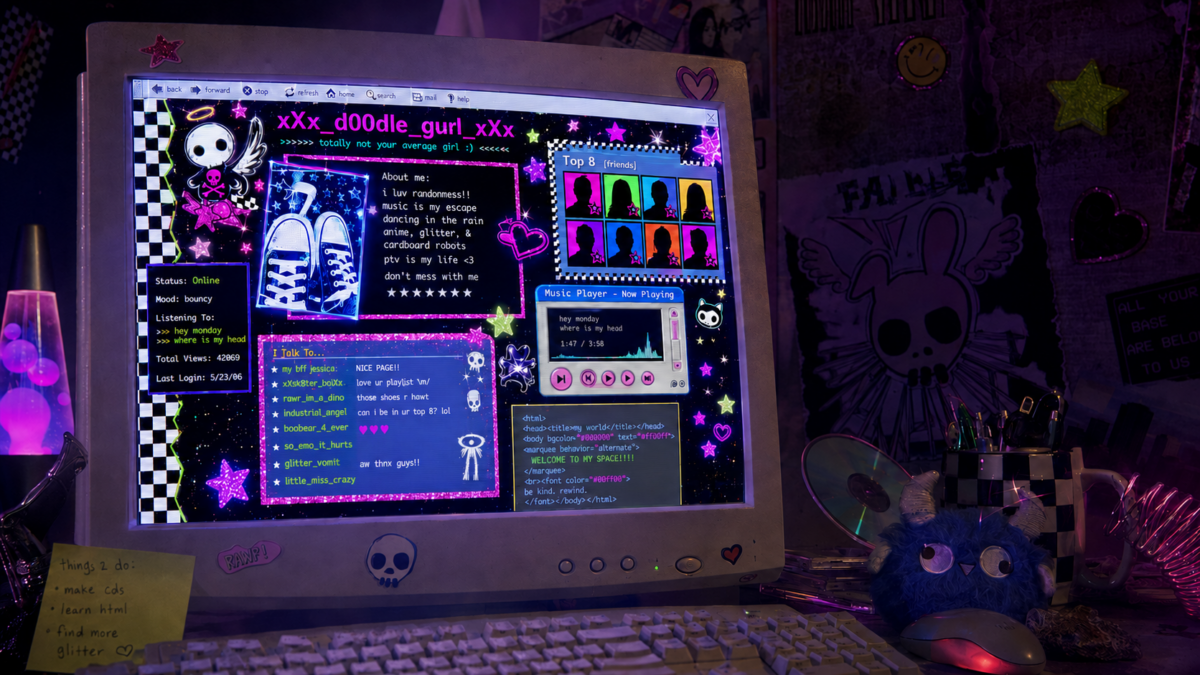
The internet spent twenty years getting cleaner, smarter, and more addictive. Maybe what it needs now is glitter text, profile music, and the social consequences of a Top 8
Somewhere, a Millennial just heard the opening notes of an emo song that has been playing in their head for over two decades.
That is because Myspace, the former center of the digital universe and the only website ever capable of ending a friendship through basic list management, may be preparing for another run.
Current owners Chris and Tim Vanderhook have confirmed that they intend to relaunch the platform, according to reporting surrounding Tommy Avallone’s new documentary, Myspace. They say they are waiting for the right moment and want to build something meaningfully different from today’s algorithm-heavy social networks. People reports that the brothers remain committed even after earlier revival attempts lost more than $150 million.
And honestly? Good. Bring it back. Bring back the glitter. Bring back the music. Bring back the completely unnecessary cursor that trails tiny flames across the screen. The modern internet has had twenty years to become elegant, efficient, and personalized. It responded by showing us seventeen consecutive videos we never asked to see.
Before the Algorithm Became Your Manager
Myspace belonged to a period when a social profile was not merely a feed. It was a room. You decorated it. You chose the colors. You selected the song that would ambush visitors at full volume. You pasted in HTML you did not understand and prayed that it did not move your About Me section six feet to the left.
Was it tasteful? Absolutely not. But it was yours.
Today, nearly every social platform offers the same basic bargain: supply the content and the platform will decide who sees it, when they see it, and what you should watch next. Your personality gets poured into the same white rectangle as everyone else’s. The software does not ask what kind of digital room you want to build. It asks what will keep somebody else scrolling for another eleven seconds.
Myspace, at its best, worked in the opposite direction. The page was the product of the person. It was messy, expressive, occasionally unreadable, and sometimes powerful enough to launch a band from a garage into an actual audience.
Yes, Myspace Was Actually That Big
It is easy to remember Myspace as an ancient internet joke, like dial-up noises or asking Jeeves a question. But for a brief and spectacular period, Myspace was not merely popular. It was the internet’s main entrance.
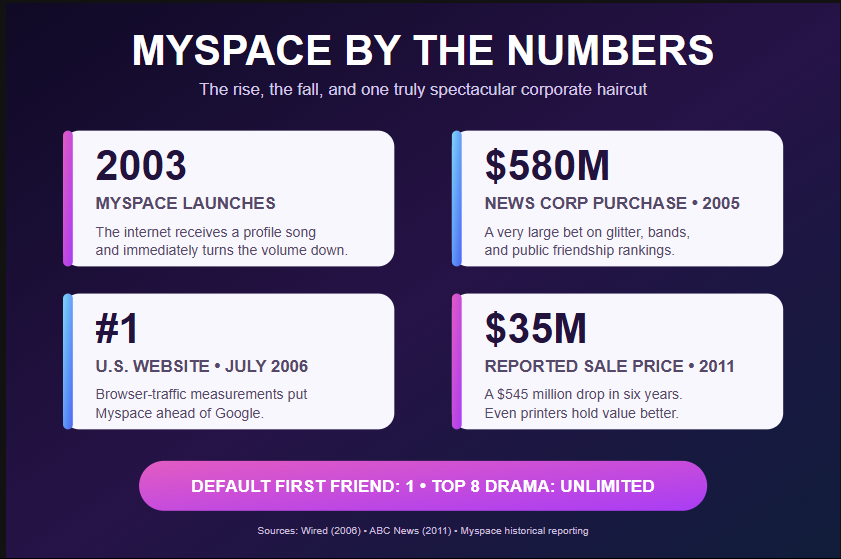
At its peak, Myspace was a cultural machine. Wired reported in 2006 that it accounted for 4.45% of all U.S. browser traffic. That is an astonishing amount of human attention devoted to profile surveys, webcam photos, and deciding whether your cousin still belonged in slot seven.
The Top 8 Was Social Media Without Anesthesia
Modern platforms quietly rank everyone in your life using data you cannot see. Myspace had the courage to make you do it publicly.
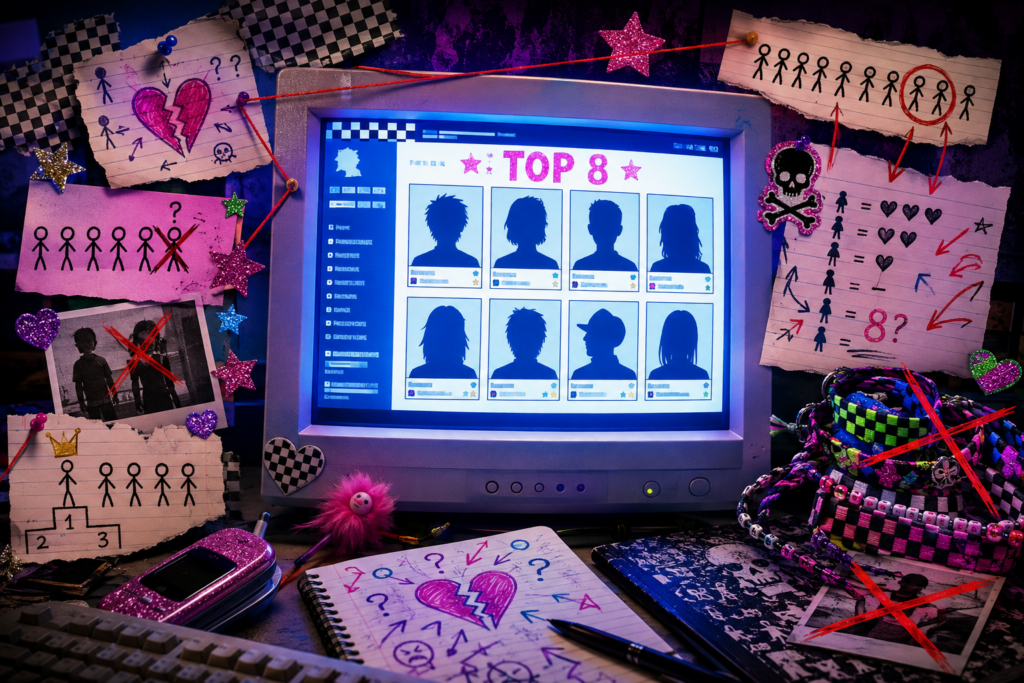
The Top 8 was a visible list of your most important friends, closest allies, current crushes, favorite bands, and whichever person you desperately hoped would notice they had been promoted from sixth to fourth. It was primitive. It was cruel. It was also refreshingly honest. Nobody needed an analytics dashboard. If you were removed from the Top 8 on Tuesday, you knew the quarterly relationship report was not going well.
But Please Bring Back the Fun, Not the Security Problems
Nostalgia cannot be the entire product plan. Old Myspace also struggled with spam, phishing, malware, creepy messages, broken pages, and the general security philosophy of ‘perhaps this animated skull is safe.’ A modern revival needs strong privacy controls, real moderation, account protection, sensible defaults, and a firm policy against letting random profile code become a loaded weapon.
There is also a painful lesson in digital stewardship. In 2019, Myspace acknowledged that a server migration had wiped out years of uploaded music, photos, and video, potentially including tens of millions of songs. That was not simply lost data. It was a chunk of internet culture disappearing because somebody apparently discovered backups after the migration meeting.
Make the Internet Weird Again
Myspace does not need to reclaim the entire social internet to succeed. It does not need two billion users, a metaverse, or a CEO testifying before Congress while pretending not to understand how notifications work. It only needs to become a place people enjoy visiting. That sounds like a modest goal until you remember how few social networks still seem designed around enjoyment. A platform built around creativity, personal spaces, music discovery, chronological updates, and visible human choices could feel genuinely new precisely because it is borrowing from something old.
So yes, bring back Myspace.
Bring back the Top 8. Bring back the song that starts before the page finishes loading. Bring back the profile background that makes the text impossible to read. Bring back Tom, even if Tom wisely declines. Keep the phishing, malware, spam, and catastrophic data migrations in 2006 where they belong.
The modern internet is optimized. It is personalized. It is frictionless. And increasingly, it feels like nobody actually lives there.
Maybe what social media needs now is a little less perfection, a little more ownership, and one beautifully irresponsible amount of glitter.