Download Backout Plan Template & Protect Your Business

A routine update can turn into a business problem fast. At 4 PM on a Friday, a law office loses access to its document system. A dental practice can't reach patient files. A finance team suddenly can't trust the numbers on screen because a line-of-business application started throwing errors right after a patch.

That moment tells you whether your business has a plan or just optimism.

A backout plan template is the document that decides what happens next. Not in theory. In the hour when your staff is waiting, clients are calling, and someone on the IT side is trying to answer the most expensive question in the room: do we fix forward, or do we roll back now?

Most Central Florida businesses already know they need backups. Fewer have a rollback process that is clear enough to use under pressure, approved by leadership, and tied to security response. That gap matters most in regulated environments like law, finance, healthcare, and multi-site operations where one bad change can ripple across users, vendors, and compliance obligations.

When Good IT Changes Go Bad

A failed change rarely starts with drama. It starts with a normal ticket.

A vendor approves a patch. Someone schedules an after-hours deployment. The change looks small enough to be safe. Then the phones start.

A concerned office worker stares at multiple computer monitors displaying a critical application down error message.

In Orlando and Winter Springs, I’ve seen the same pattern across professional firms and medical practices. The first few minutes get wasted debating whether the issue is temporary. Then people start trying side fixes. Someone restarts a service. Someone else blames the internet. Meanwhile, damage comes from delay.

What business owners feel

You don't experience a failed deployment as a technical event. You experience it as:

  • Interrupted revenue when staff can't work
  • Client-facing confusion when systems go offline
  • Compliance exposure when access, logging, or protected data handling becomes uncertain
  • Weekend burnout when a simple rollback turns into an improvised recovery effort

A proper backout plan turns that mess into a sequence.

A backout plan isn't an IT formality. It's a decision tool for protecting operating hours, client trust, and recoverability.

That distinction matters. If your team treats rollback as “restore from backup if needed,” the business is still exposed. Restore from what backup? Approved by whom? In what order? What if the failed change touched a vendor-managed tool, Microsoft 365 policy, endpoint stack, or cloud platform dependency?

Why generic templates fail under pressure

Most downloadable templates are too shallow. They list placeholders for “backout steps” but don't force the hard decisions in advance.

What works better is a template built around the business context:

  • Your critical applications
  • Your vendor dependencies
  • Your escalation chain
  • Your compliance requirements
  • Your acceptable downtime

If you're already reviewing changes to cloud systems or regulated data workflows, it's worth reading this practical guide on how to avoid failure. The lesson applies beyond migrations. Problems usually begin before the change window, not during it.

The difference between a scare and an outage

Two firms can suffer the same failed update and get very different outcomes.

One spends the evening guessing. The other opens a written plan, checks the trigger criteria, gets authorization, rolls back in sequence, validates the restore, and watches the environment for instability.

That's why a backout plan template belongs in business continuity, not just change management. It gives your team a repeatable response before the next patch, server migration, network change, or cloud rollout goes sideways.

Anatomy of a Bulletproof Backout Plan Template

A strong backout plan template isn't long because it looks impressive. It's detailed because ambiguity causes downtime.

The template should answer one question cleanly: if this change fails, who decides, who acts, what gets restored, and how do we prove the business is stable again?
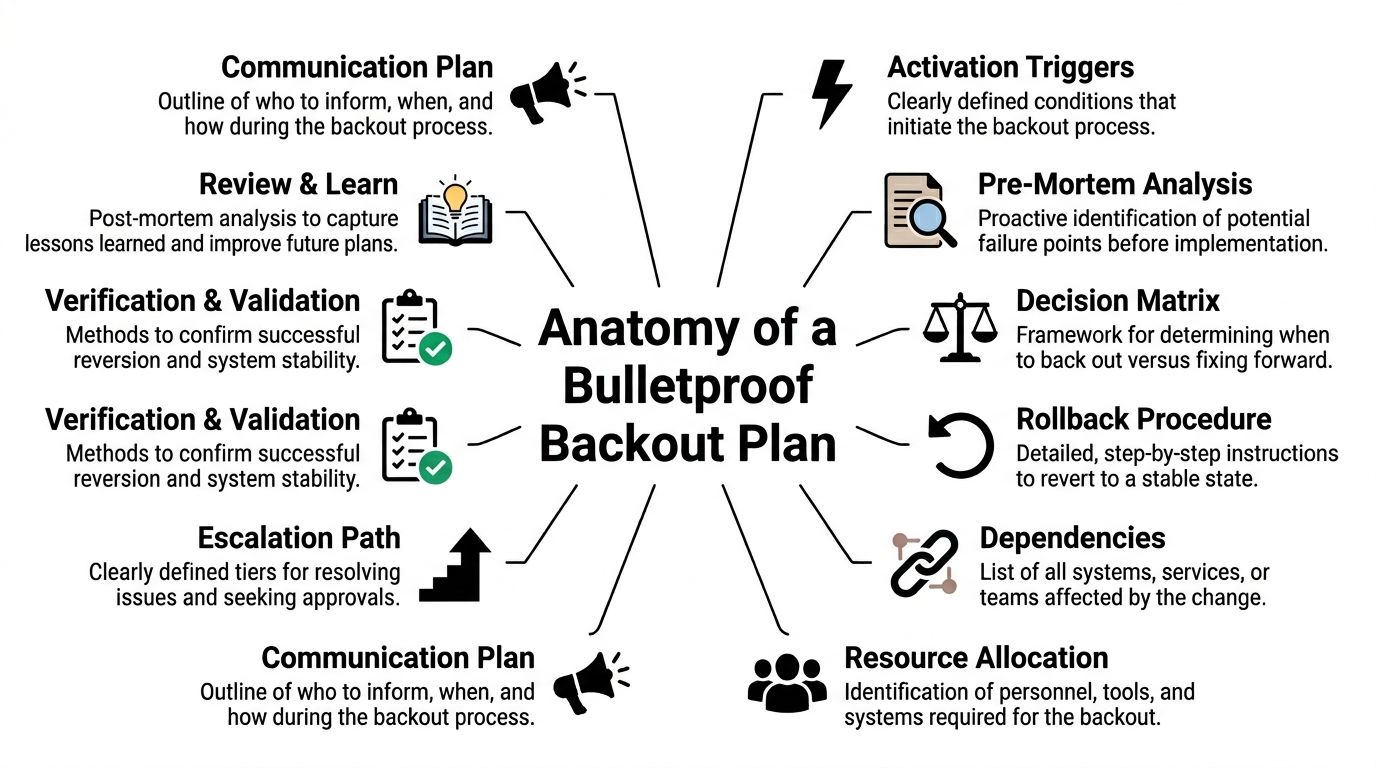
A diagram outlining the essential components of a robust and effective IT system backout plan strategy.

Start with scope

Scope means the exact systems, users, data sets, integrations, and locations covered by the plan.

This sounds basic, but weak plans fail here first. If your accounting application depends on identity services, a database server, and a vendor-hosted connector, the scope has to name all three. If your Winter Springs office can tolerate longer downtime than your Orlando front desk, the plan should say so.

A simple scope table helps:

Item What to document
Primary system Application, server, cloud service, or network component being changed
Dependent systems Authentication, storage, integrations, print, VoIP, vendor tools
Business units affected Legal, billing, patient scheduling, field operations, finance
Locations affected Office-by-office impact if you operate across sites
Out of scope Systems explicitly not covered by this rollback plan

Build the plan on recoverability, not hope

For regulated businesses, backup discipline is part of the foundation. Under the HIPAA backup planning requirements and 3-2-1 backup rule, backout planning should sit on 3 copies of data, 2 media types, and 1 offsite copy. That same reference notes that HIPAA requires data backup plans with defined RPOs and RTOs.

For a practice, firm, or financial office, that means your template should state:

  • Recovery Time Objective as the maximum acceptable outage
  • Recovery Point Objective as the acceptable amount of data loss
  • Backup source that supports rollback
  • Retention logic that aligns with your operating and compliance needs

If you want a useful companion to this thinking, a broader technology risk management framework can help leadership connect operational change risk to governance, vendors, and resilience.

Define triggers before the outage

Triggers are the predefined conditions that start the backout process.

Good triggers are measurable. Bad triggers are emotional.

Examples of usable trigger language include:

  • RTO breach risk if the service won't be restored within the allowed downtime
  • Critical function failure such as login, charting, billing, or matter access
  • Performance degradation that materially affects operations
  • Security concern if the change causes suspicious behavior, unauthorized configuration drift, or logging failure

The trigger should remove debate. If the condition is met, the team acts.

Name the decision makers and the doers

A professional template separates authority from execution.

Use named roles, not job titles alone, if possible. If a key person is unavailable, list a backup approver. Most businesses need these roles covered:

  • Change owner who understands the intended deployment
  • Business approver who can judge operational impact
  • Rollback authority who can authorize the backout
  • Technical executor who runs the rollback steps
  • Security contact who determines whether the event is operational, malicious, or both
  • Communications owner who updates internal stakeholders and external parties if needed

A useful template also records vendor contacts, support contracts, and escalation numbers in the same document. Don't make your team hunt for them while systems are down.

Include communications, dependencies, and validation

Many failures get technically fixed before they get operationally closed. Users still don't know what happened, vendors are still out of sync, and nobody has confirmed the restored system is trustworthy.

Your template should include:

Communication plan

List who gets notified, by what method, and at what stage. Separate internal staff, leadership, vendors, and client-facing communications.

Dependency map

Document external providers, identity systems, firewalls, endpoint tooling, cloud workloads, and line-of-business connectors.

Verification checklist

Use a short test list that proves business usability after rollback:

  • Authentication works
  • Core transactions complete
  • Recent data is present
  • Audit logs are intact
  • Security controls are functioning

For teams that need a working foundation, this disaster recovery plan template is a practical starting point. The key is to adapt it to rollback-specific decisions, not just backup recovery.

Creating Your Step-by-Step Rollback Procedure

The rollback procedure is the part people think they have until they need it. Then they discover they've documented the intention to roll back, not the actual path.

A reliable backout plan template needs a procedure that an experienced engineer can execute quickly and another engineer can follow under stress without improvising.

A person uses a stylus on a tablet screen to fill out a business process flowchart template.

Before the change window opens

The best rollback starts before the deployment.

The VA rollback guidance describes a rigorous process that includes defining triggers such as an RTO breach greater than 4 hours, getting CIO authorization, restoring from a pre-patch snapshot, and verifying integrity. That same guidance notes 92% success rates when pre-backups are verified, compared with 65% for ad-hoc restores.

That gap is the difference between procedure and guesswork.

The pre-change checklist that matters

Use a written checklist before any material change:

  1. Capture a baseline
    Record the current system state. That includes version numbers, configuration snapshots, service status, active integrations, and known-good test results.

  2. Verify the backup, not just its existence
    Confirm the restore point is recent, complete, and accessible. A backup you haven't verified is only a file with good intentions.

  3. Inventory dependencies
    List what will break if the rollback happens. Include cloud apps, identity providers, endpoint agents, shared drives, print services, vendor connectors, and remote sites.

  4. Stage the rollback commands
    If your team uses tools like Ansible, PowerShell, hypervisor snapshots, or vendor rollback packages, prepare them in advance. The change window isn't the time to write commands from memory.

  5. Assign real people to each action
    One person approves. One executes. One validates business functions. One owns communications.

Practical rule: If a rollback step requires memory, it isn't documented well enough.

Decide when to fix forward and when to back out

Not every issue requires reversal. Some can be corrected in place. The problem is that teams often spend too long trying.

A compact decision matrix helps:

Condition Better choice
Core application unavailable Back out
Minor defect with stable service Fix forward if risk is low
Security control disabled by change Back out and escalate to security
Unknown root cause during deployment Back out
Vendor dependency failing with no confirmed workaround Back out

Business owners don't need every technical detail here. They do need confidence that the threshold for rollback is already agreed.

Execute the rollback in a controlled order

Rollback should follow a sequence, not a scramble.

Freeze additional changes

Stop all non-essential work on the affected system. Don't let a second technician introduce a second variable.

Get the formal go-ahead

If your plan requires executive, CIO, or delegated approval, get it and log the time. During incidents, missing approvals create audit and accountability problems later.

Restore the known-good state

That might mean reverting a snapshot, uninstalling a patch, reapplying a prior configuration, or restoring a previous cloud deployment package. Use scripted steps where possible.

Reconnect dependencies carefully

Bring back authentication, database links, integrations, and line-of-business services in the right order. A successful server rollback still fails the business if SSO, printing, or data exchange stays broken.

Validate more than uptime

A server that responds to ping isn't the same as a business service that's safe to use.

Use layered validation after the rollback:

  • Technical checks such as service status, error logs, scheduled tasks, agent health
  • Data integrity checks such as checksums, record consistency, or application-level validation
  • Business checks such as opening a matter, posting a payment, viewing a chart, or processing a claim
  • Security checks such as logging, MFA, endpoint telemetry, and alert flow

The federal guidance referenced above requires integrity verification and automated testing, not just restoration. That's a useful standard for any SMB. If your law firm can log in but document permissions are wrong, the rollback isn't complete. If your dental practice can access schedules but audit logs stopped writing, the rollback isn't complete.

Watch the system after the rollback

Immediate success can be misleading. A system may appear stable and fail again after users reconnect, synchronization resumes, or overnight jobs run.

Build a post-backout observation period into your template. During that window, the team should:

  • Monitor application behavior
  • Review security events
  • Check integrations and vendor syncs
  • Confirm user-reported issues are declining
  • Document every action taken

Use plain language in the plan. “Observe for stability” is too vague. “Monitor authentication, transaction processing, and security logging during the observation window” is better.

A good rollback procedure isn't elegant. It's usable. That's what counts when the phones are ringing.

Backout Plans in Action Real-World Scenarios

A backout plan template becomes valuable when it matches the kind of failures your business is likely to face. That's where many firms miss. They use one generic template for every change, every office, and every vendor.

That approach breaks down fast in multi-site and regulated environments.

Scenario one: a law firm loses access after a security update

A Plano law firm pushes a Microsoft 365-related security change late in the day. Within minutes, staff can't reliably access email and shared documents. Attorneys are still working active matters, and support staff can't tell whether the issue is identity-related, endpoint-related, or vendor-side.

A weak plan would say “contact Microsoft and troubleshoot.”

A useful plan would do something tighter:

  • Freeze additional policy changes
  • Check whether the issue meets the rollback trigger based on business impact
  • Review the dependency list for identity, document access, and endpoint controls
  • Use the vendor-inclusive checklist to involve the external provider immediately
  • Revert the specific change package or policy set
  • Validate matter access, email flow, and security logging before returning users to normal operations

The vendor angle matters more than most firms realize. According to the VA-based rollback reference for multi-location operations/viab_1_9_installation_back-out_rollback_plan.pdf), 35% of incidents stem from unmanaged third-party vendor updates, and generic templates often fail multi-site businesses because they lack location-specific RTO variances. That same reference notes this can lead to 15-20% higher downtime costs.

For a law office, that means one office may need faster restoration than another because court deadlines, intake, and billing aren't equally sensitive.

Scenario two: a dental practice struggles after a cloud migration

An Orlando dental practice moves a clinical application or imaging workload to a new cloud environment. The migration technically completes, but users report slow retrieval, intermittent file errors, and uncertainty about whether recent patient data is fully consistent.

This isn't the moment for vague confidence.

A practical backout plan would ask:

If patient care operations are impaired and data validation isn't clean, why stay in the broken target environment?

For a practice, rollback decisions should include both operations and compliance logic. If the restored environment can be proven stable and the migrated environment can't be trusted yet, revert fast and investigate later.

The plan should identify:

  • the last verified restore point
  • the sequence for reconnecting workstations and imaging systems
  • who confirms application usability on the clinical side
  • how to document the event for compliance review

Scenario three: a multi-location industrial company loses network stability

A Central Florida industrial business changes network switch configurations across more than one site. The result isn't a full outage. It's worse in some ways. Intermittent connectivity, broken device communication, and site-by-site inconsistency.

Generic backout plans usually collapse here. They assume one system, one site, one rollback. Real operations aren't that neat.

A stronger template handles the situation by breaking rollback into location-aware stages:

Site condition Backout response
Primary site unstable Roll back immediately to last known-good config
Secondary site degraded but usable Hold, assess impact, then roll back if threshold is met
Vendor-managed segment involved Escalate using vendor contact and rollback ownership list
Shared dependency affected across sites Coordinate rollback centrally, validate locally

For industrial and field-service organizations, that site-by-site detail keeps one bad network change from becoming a company-wide event.

What all three examples have in common

The best backout plan template isn't generic and isn't purely technical.

It accounts for:

  • Business function first
  • Vendor participation
  • Location-specific recovery expectations
  • Clear authority to reverse course
  • Validation that proves the business is usable again

That's what makes the document operational instead of decorative.

Integrating Your Backout Plan with Cyber Incident Response

A backout plan that only covers failed IT changes is incomplete.

Sometimes the “bad update” isn't bad code. It's malicious activity, unauthorized access, a compromised admin account, or a ransomware event that used normal change paths to create abnormal damage. In those cases, rolling back without security oversight can make the problem worse.
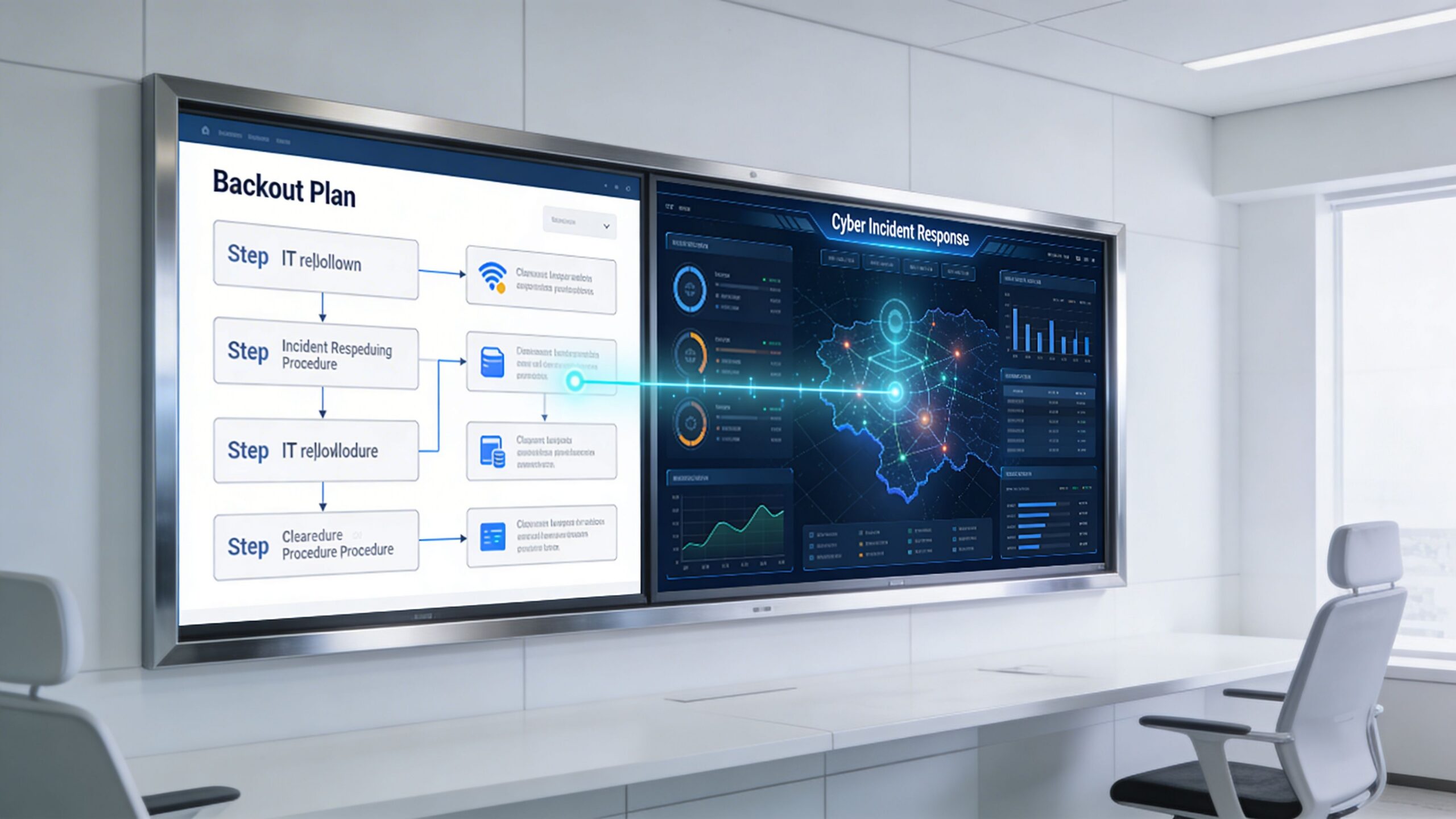
A large conference room display showing a digital backout plan flowchart and cyber incident response data analytics.

Why the old model is too narrow

The old model says: change failed, restore previous state, move on.

That works only if the event is purely operational. It fails if:

  • the rollback source is already compromised
  • the failed change reopened a known vulnerability
  • attacker persistence survives the backout
  • logs and telemetry are incomplete
  • the “deployment issue” was unauthorized change activity

The IT Toolkit 2025 disaster recovery guidance identifies a major gap here. It notes that only 36% of SMBs have backout plans designed for cyber incidents, even though SMBs faced 43% of cyberattacks, and templates rarely define decision authority during an active threat or integrate with SOC-monitored reversions.

That's the blind spot.

Add cyber decision points to the template

Your backout plan template should include a branch for security review before rollback proceeds.

That branch should answer questions like:

  • Was this change approved through normal process?
  • Do logs show expected admin behavior?
  • Could the failure indicate tampering rather than ordinary error?
  • Will rollback restore a vulnerable state that still needs containment?
  • Who has authority to approve backout during an active threat?

If those questions are missing, the team may restore service quickly while preserving the attacker’s foothold.

During a suspected cyber event, speed matters, but sequence matters more. Contain, assess, then revert with evidence.

What SOC-linked rollback looks like in practice

In a mature process, rollback is coordinated with security operations.

That doesn't mean every failed patch becomes a crisis. It means the plan creates an explicit handoff when indicators point to malicious activity or uncertainty.

A workable integration usually includes:

Security escalation path

List who gets engaged if the event may be cyber-related. That can be an internal security lead, an external incident responder, or a 24/7 SOC.

Evidence preservation

Before rollback wipes away traces, capture logs, snapshots, alerts, and administrative activity records needed for investigation.

Safe-state validation

After rollback, confirm the environment isn't just operational. Confirm endpoint telemetry, MFA, logging, alerting, and access controls are functioning as expected.

Compliance follow-up

For firms handling regulated data, document what changed, who approved the action, what data was affected, and how system integrity was confirmed.

Businesses that need to formalize that connection should also review a practical incident response plan for max efficiency. A rollback plan and an incident response plan shouldn't live in separate universes.

A rollback can create security risk too

Some leaders assume rollback is always the safer option. It isn't.

Rolling back may re-enable a flawed configuration, restore a vulnerable application version, or undo a security control that was functioning correctly. That's why the template needs a short risk review before execution.

Use a simple compare-and-decide method:

Question If yes
Does rollback restore a previously exposed weakness? Add compensating controls first
Is the current state potentially malicious? Preserve evidence and involve security
Will rollback remove forensic data? Capture what you need before action
Can the system be isolated before reversion? Isolate to reduce spread risk

The practical goal is resilience, not just restoration. A business owner in Orlando doesn't need a more technical rollback. They need one that won't trade downtime for security debt.

Keeping Your Plan Alive Testing and Maintenance

A backout plan template that isn't tested will fail at the worst time.

People change roles. Vendors change support paths. systems get renamed. Cloud workloads move. A rollback sequence that worked six months ago may now miss a dependency, an integration, or an approval step that your business relies on every day.

Test the plan the way your business operates

The Axcient disaster recovery planning guide for MSPs reports that organizations with tested plans achieve 75% faster recovery than those using ad-hoc responses. It also notes that setting clear RTOs, such as under 4 hours for most SMBs, and testing against them can cut recovery costs by up to 30%.

Those gains don't come from owning a template. They come from rehearsal.

What to test on a regular basis

Don't limit testing to “can we restore a server.”

Run practical drills that reflect business reality:

  • Change rollback drill for a failed patch or software deployment
  • Vendor failure drill where a third-party update has to be reversed
  • Location-specific drill for one office or branch losing a critical service
  • Security-linked drill where rollback and incident review happen together

A short test cadence table keeps this manageable:

Test type What success looks like
Technical rollback System reverts cleanly and services restart correctly
Business validation Staff can complete key workflows after rollback
Vendor escalation Contacts respond and responsibilities are clear
Security validation Logging, alerting, and access controls remain intact

Track the right results

You don't need a pile of test paperwork. You need evidence that the plan works and keeps improving.

Focus on a few useful outputs:

RTO performance

Did the test complete within the target downtime window?

Recovery quality

Were users able to work, or did the rollback only restore partial function?

Documentation accuracy

Did the contact list, dependency map, and procedure match reality?

Improvement actions

What needs to be updated before the next test?

The best maintenance habit is simple. Every real incident and every test should change the document.

Tie testing to accountability

Many SMBs miss an easy win here.

Backout plan maintenance belongs in leadership review, not only in the IT queue. Quarterly business reviews are a good place to examine failed changes, test outcomes, vendor issues, and whether recovery objectives still match the business.

If you're building a formal practice around this, review how to test a disaster recovery plan. The same discipline applies to rollback readiness.

A living plan should be updated when:

  • A critical system changes
  • A new vendor is introduced
  • An office is added or consolidated
  • A compliance requirement shifts
  • A test exposes confusion or delay

That cycle is what turns a backout plan template into an operating safeguard instead of a forgotten file.


If your business in Orlando, Winter Springs, or the surrounding Central Florida market needs a rollback plan that covers operations, vendors, compliance, and cyber response, Cyber Command, LLC can help you build and maintain one that works under pressure. The goal isn't just to recover. It's to keep your team productive, reduce avoidable downtime, and make every change safer before it goes live.

Data Center Disaster Recovery Guide for Florida SMBs

June in Central Florida changes how business owners think. One day you are focused on payroll, patient flow, client deadlines, or a vendor issue. The next day, a storm track shifts, schools start sending alerts, and someone in the office asks whether the servers are protected if power goes out for longer than expected.

For many small and mid-sized companies, that question still gets answered with a backup drive, a few cloud apps, and a lot of hope. That is not data center disaster recovery. That is partial preparation.

A real recovery plan assumes two things at once. First, Florida brings physical risk. Hurricanes, flooding, utility instability, and building access problems can take systems offline even when your office itself survives. Second, cyber risk does not pause for weather. Medical practices, law firms, accounting firms, engineering teams, and multi-location service businesses are all targets because they depend on data, deadlines, and client trust.

If your operations rely on a server closet, a small on-prem stack, a colocation rack, or a mix of local infrastructure and cloud software, you need a plan that tells your team what happens next when something fails. Not a binder on a shelf. A usable, tested process.

Why Your Florida Business Needs a Real DR Plan Now

A typical Central Florida scenario is not dramatic at first. A business owner in Orlando watches the forecast, moves a few appointments, tells staff to take laptops home, and assumes that if the office is closed for a day or two, work can resume shortly after the storm passes.

Then problems show up.

Power does not return on schedule. Internet service is unstable across part of the region. A file server shuts down hard. A virtual machine comes back corrupted. Someone cannot access the practice management platform. Another employee realizes the backup job has been failing. If the business also gets hit with a phishing-driven ransomware event during the same period, the disruption stops being an inconvenience and becomes a survival issue.

A professional man watches a severe storm from his office while monitoring hurricane data on computer screens.

Downtime gets expensive fast

For small and mid-sized firms, the damage usually starts before anyone uses the word disaster. Staff cannot work. Clients cannot get answers. Revenue pauses while costs keep running.

The financial side is not abstract. The average cost of IT downtime reaches $5,600 per minute, which can escalate to over $300,000 per hour for mid-sized firms. For data-intensive businesses, daily losses can run into the millions (Systnet disaster recovery statistics).

That is why data center disaster recovery cannot be treated as a “big company” problem. A dental practice with digital imaging, a law office with document management, or an architecture firm with project files can all be knocked flat by the same issue. They just feel it in different ways.

Practical view: If your team cannot access the systems that produce revenue, schedule work, or satisfy compliance, you already have a disaster scenario. The building does not need to be underwater.

Florida risk is physical and cyber at the same time

Hurricanes get the attention because they are visible. The less visible problem is that most businesses have stacked dependencies. Battery backups, local storage, ISP handoffs, firewall appliances, hypervisors, Microsoft 365, line-of-business apps, vendor portals, and remote access all have to work together.

If one weak point fails, the whole business can stall.

That is why companies reviewing their continuity posture often start with broader IT support maturity first, not just backup software. A useful place to frame that conversation is this guide to business IT support in Florida, because recovery only works when the rest of the environment is documented, maintained, and monitored.

A real DR plan answers basic but urgent questions clearly. Which systems come back first? Who approves failover? Where do clean backups live? How do employees keep working if the office is closed? How do you know the outage is a storm problem and not an active breach?

If those answers are vague, the plan is not ready.

Assessing Your Risks and Defining Recovery Goals

Most businesses start in the wrong place. They shop for backup tools before they decide what matters.

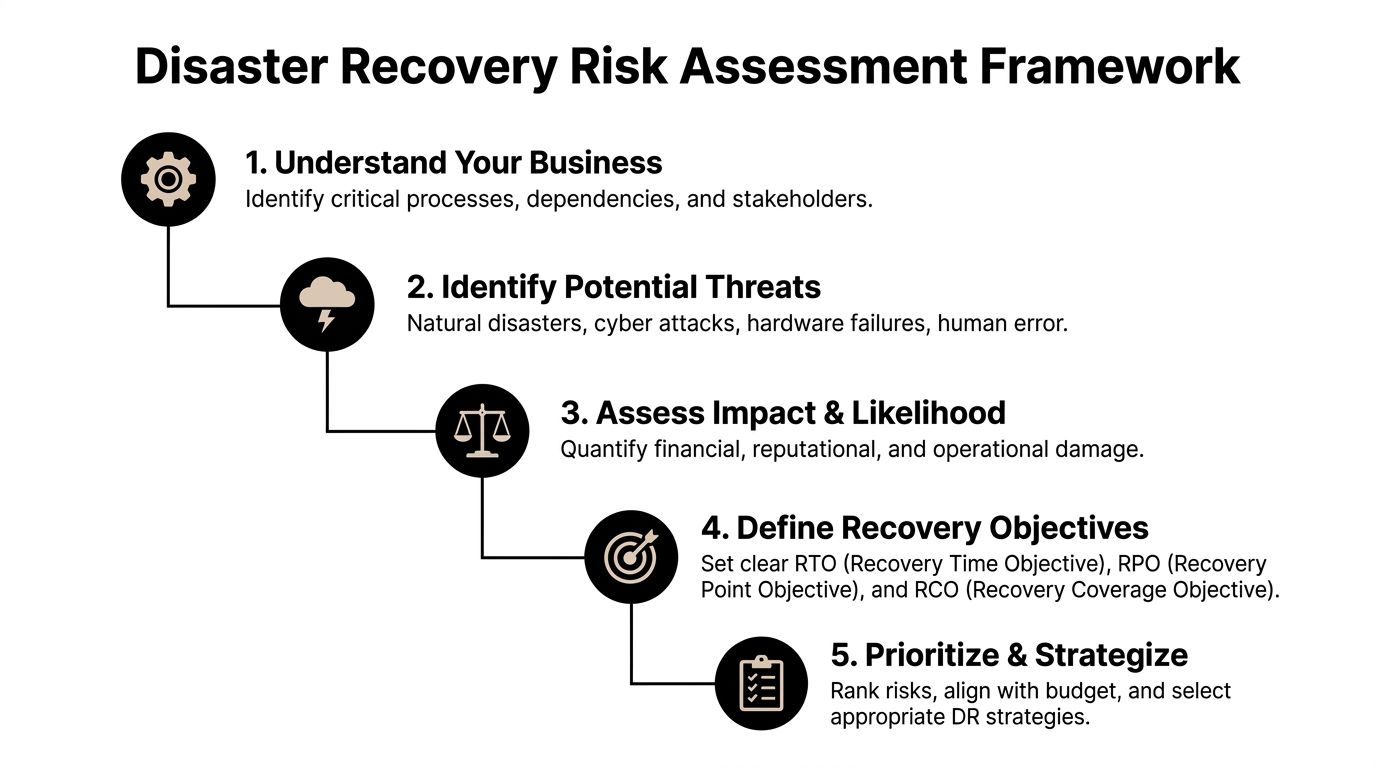
The better approach is simpler. Identify the processes that must keep running, then map the systems behind them. That is the beginning of a Business Impact Analysis, or BIA.

Infographic

Start with business functions, not hardware

A Winter Springs law firm usually does not care about “the hypervisor” in the abstract. It cares about document access, time entry, billing, email, and client communications. An Orlando dental group cares about imaging, scheduling, claims, and patient records. An engineering office cares about CAD files, project folders, version control, and secure remote access.

Write those business functions down first.

Then ask these questions:

  1. What stops revenue immediately if it goes offline?
  2. What creates legal or compliance exposure if data is unavailable?
  3. What can wait until later in the day or the next business day?
  4. What depends on something else behind the scenes?

That last question is where many SMB plans break down. A cloud app may still depend on local identity services, internet routing, or a workstation image your staff can use.

Put RTO and RPO into plain English

Two recovery terms matter more than the rest.

RTO, or Recovery Time Objective, means how long you can tolerate a system being down.

RPO, or Recovery Point Objective, means how much data loss you can tolerate.

Here is the plain-English version:

Business example What matters most
Dental scheduling platform Low RTO. You need it back quickly so the day does not collapse.
Client file repository for a law firm Low RTO and low RPO. You need fast access and very little data loss.
Marketing website Higher RTO. It matters, but it is not usually the first system to restore.
Archived historical files Higher RTO and often a more flexible RPO.

A lot of owners initially say everything is critical. It almost never is. If everything is Tier 1, nothing is prioritized.

Tip: If losing a system for four hours means canceled appointments, missed deadlines, or staff standing idle, it belongs near the top of the recovery list.

Use a tiered model to control cost

A practical tiering model keeps spending aligned with business impact. A tiered approach to recovery can reduce unnecessary infrastructure spending by 30-40%. By classifying applications into mission-critical (Tier 1, RTO 0-4 hours), business-essential (Tier 2, RTO 12-24 hours), and non-urgent (Tier 3), organizations can align recovery costs with business impact (LightEdge on successful disaster recovery planning).

That matters for SMBs because overspending on low-priority recovery is common. So is underspending on the systems that keep the business alive.

A sensible breakdown often looks like this:

  • Tier 1 systems: Core line-of-business apps, identity services, key file systems, critical databases, secure remote access.
  • Tier 2 systems: Reporting tools, internal collaboration platforms, departmental apps, secondary integrations.
  • Tier 3 systems: Archive workloads, test environments, old reference repositories, non-urgent internal tools.

A simple risk review catches blind spots

The BIA should also identify threats, not just priorities. In Central Florida, that means looking at both local weather and routine operational failures.

Consider whether your business is exposed to:

  • Hurricane-related disruption: Power loss, building closure, flooding, ISP outage, delayed vendor access.
  • Cyber events: Ransomware, account compromise, malicious encryption, backup tampering.
  • Technical failures: Failed storage, bad patches, expired certificates, hardware faults, replication issues.
  • Human error: Accidental deletion, misconfiguration, improper shutdowns, missed alerts.

Many teams handle this work as part of a broader cyber security risk assessment, because the same systems that affect security also affect recovery.

Once you know what the business cannot live without, your data center disaster recovery plan becomes much easier to design. You stop buying vague protection and start defining what must be restored, in what order, and how fast.

Choosing the Right Recovery Architecture for Your Budget

At this stage, many Florida SMBs overspend, underspend, or buy the wrong kind of protection entirely.

The right data center disaster recovery architecture is not the one with the most features. It is the one that restores the right systems, in the right order, at a cost your business will sustain year after year.

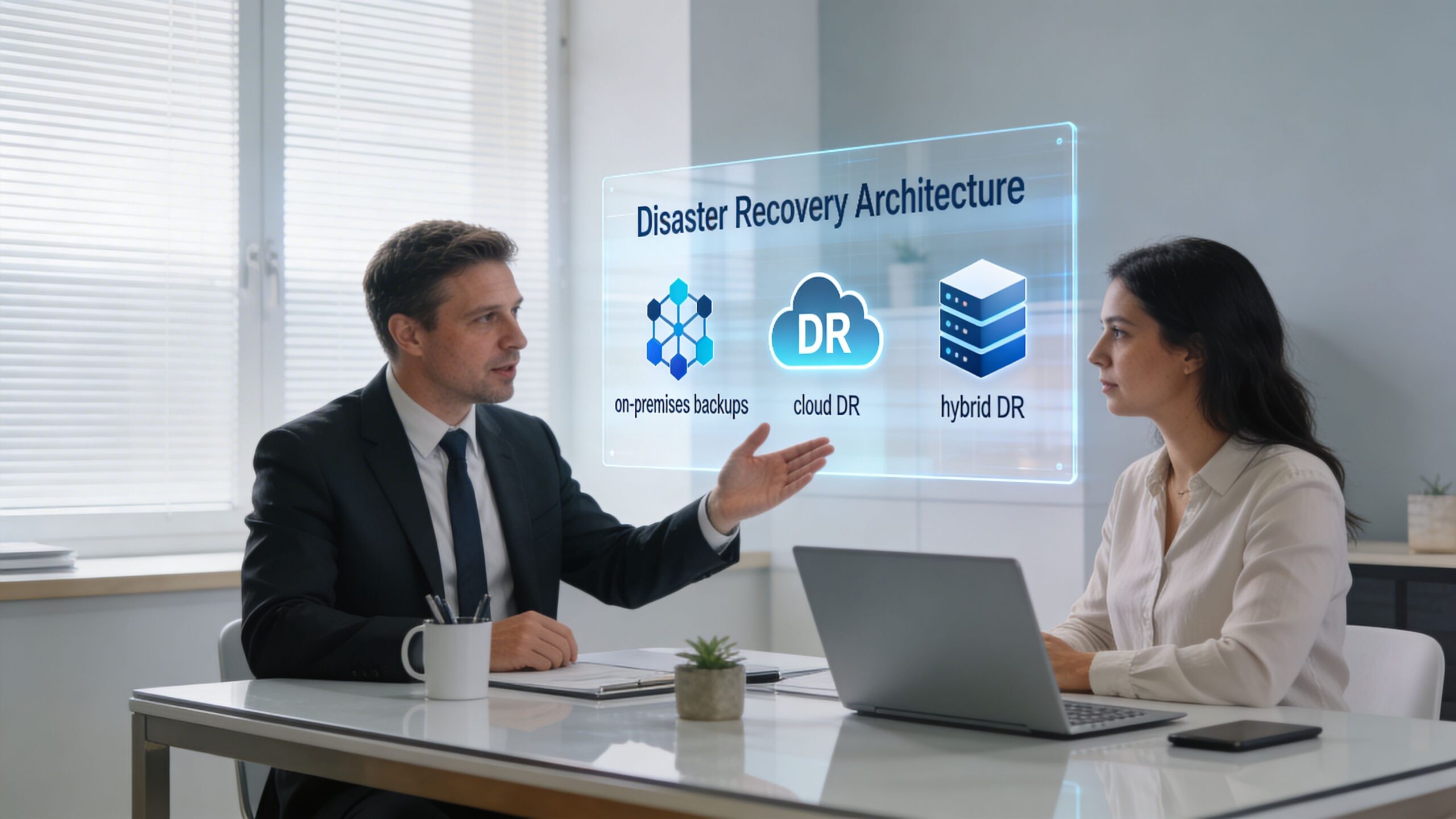
A professional man and woman discussing disaster recovery architecture strategies in a modern office environment.

Three common models SMBs consider

Most small and mid-sized businesses evaluate some version of these options.

Model What it looks like Where it works Where it fails
On-prem backups only Local NAS, backup appliance, USB rotation, server images in the office Fast restores for small mistakes and isolated file loss Weak against building loss, flood, fire, major theft, or ransomware that reaches local storage
Hybrid-cloud recovery Local backup plus replicated offsite or cloud-based recovery copies Strong balance of speed, resilience, and cost Requires good design, testing, and retention planning
Fully managed DRaaS Replication and failover managed through a service provider Helpful for firms that need outside expertise and clear runbooks Can become expensive if every workload is treated like a top-priority workload

On-prem only still has a place. It is useful for fast file restores, quick VM rollbacks, and local operational recovery. But by itself, it is often not enough in Florida. If your office or local facility is unreachable, your local backups may be unreachable too.

A fully managed DRaaS model can solve a lot of operational headaches. It can also create unnecessary spend if you apply it broadly to low-priority systems that do not need near-immediate recovery.

That is why the hybrid approach tends to make the most sense for many SMBs.

Why hybrid fits Central Florida better than enterprise playbooks

Enterprise guidance often assumes you can fund distant secondary sites, duplicate infrastructure, and complex multi-cloud orchestration. Most local SMBs do not need that. They need a plan that restores critical services quickly without forcing enterprise-grade complexity into a mid-market budget.

For SMBs in hurricane-prone regions like Florida, a hybrid-cloud DR strategy can be significantly more cost-effective than enterprise-level options. This approach helps reduce reactive recovery costs by up to 40% while achieving aggressive RTOs under 4 hours without the high price tag of traditional geographically distant sites (Encor Advisors on data center disaster recovery).

That statement matches what works in practice.

A good hybrid design usually includes:

  • Fast local recovery for deleted files, failed patches, and day-to-day restore events.
  • Offsite or cloud-based copies that stay isolated enough to survive a building issue or widespread compromise.
  • Air-gapped or logically separated backups so ransomware cannot encrypt the same systems meant to save you.
  • Priority-based replication so Tier 1 systems recover first.

Key takeaway: Fastest is not always best. The best architecture is the one that restores your most important systems first without forcing you to pay premium recovery costs for everything else.

What works for different Florida SMB profiles

A few examples make the trade-offs clearer.

Professional services firms

Law offices, accounting firms, and architecture studios usually need document systems, line-of-business apps, and secure remote work to recover quickly. They often do well with a hybrid setup that keeps recent local copies for speed and hardened cloud recovery for larger events.

These firms should be cautious about overcommitting to all-cloud recovery if their file workflows are heavy, latency-sensitive, or tightly tied to local identity and printing.

Medical and dental practices

Practices need scheduling, imaging, chart access, secure communication, and compliance-aware recovery procedures. In these environments, “we have backups” is not enough. The backup chain has to support a clean restore path for the applications staff use all day.

Hybrid often wins here too. It supports rapid local restoration for common incidents and offsite recovery if the office cannot operate.

Industrial and multi-location businesses

These organizations often have a different pain point. Power instability, site connectivity, and location-specific operational dependencies matter as much as cyber risk. They may need partial local survivability at one site even if failover happens elsewhere.

Architecture choices depend on physical environment too

Recovery planning is not only about software. Rack layout, power protection, cooling, and physical handling still matter. For businesses evaluating facility constraints or expansion planning, resources that explain how modern data centers are physically structured can help leadership understand why site conditions affect resilience, not just capacity.

A weak environment can undermine a strong backup strategy. Poor cabinet power planning, no documented dependencies, and no clean shutdown procedure can turn a recoverable outage into a messy rebuild.

Tools, staffing, and management overhead matter

The architecture decision is also a staffing decision.

If your internal team is small, every extra moving part increases operational risk. Replication jobs, storage retention, immutable backup settings, runbook maintenance, hypervisor configuration, Microsoft 365 backup, database consistency checks, and restore testing all need owners.

That is why some firms use managed options selectively. They keep direct control over certain systems and outsource the recovery stack for others. Cyber Command, LLC is one example of a provider that offers virtualized disaster recovery, cloud-based failover, and DRaaS as part of managed or co-managed IT operations. That model fits businesses that want predictable support around both infrastructure and security without building a full internal recovery function.

If you are sorting through those choices, this guide to cloud disaster recovery options is a useful next step because it frames recovery architecture as a business decision, not a product checklist.

The important point is simple. Do not buy recovery around the loudest threat. Buy it around your operations. In Central Florida, that usually means planning for a storm-driven outage, a localized power problem, and a security event all within the same design.

Building Your Incident Response and Failover Playbook

A recovery platform can be solid and still fail under pressure if nobody knows who does what in the first hour.

That is why your data center disaster recovery plan needs a playbook, not just technology. When ransomware hits, a host fails, or your office loses power, people need a sequence. They need contacts, decisions, escalation rules, and communication templates that already exist before the incident starts.

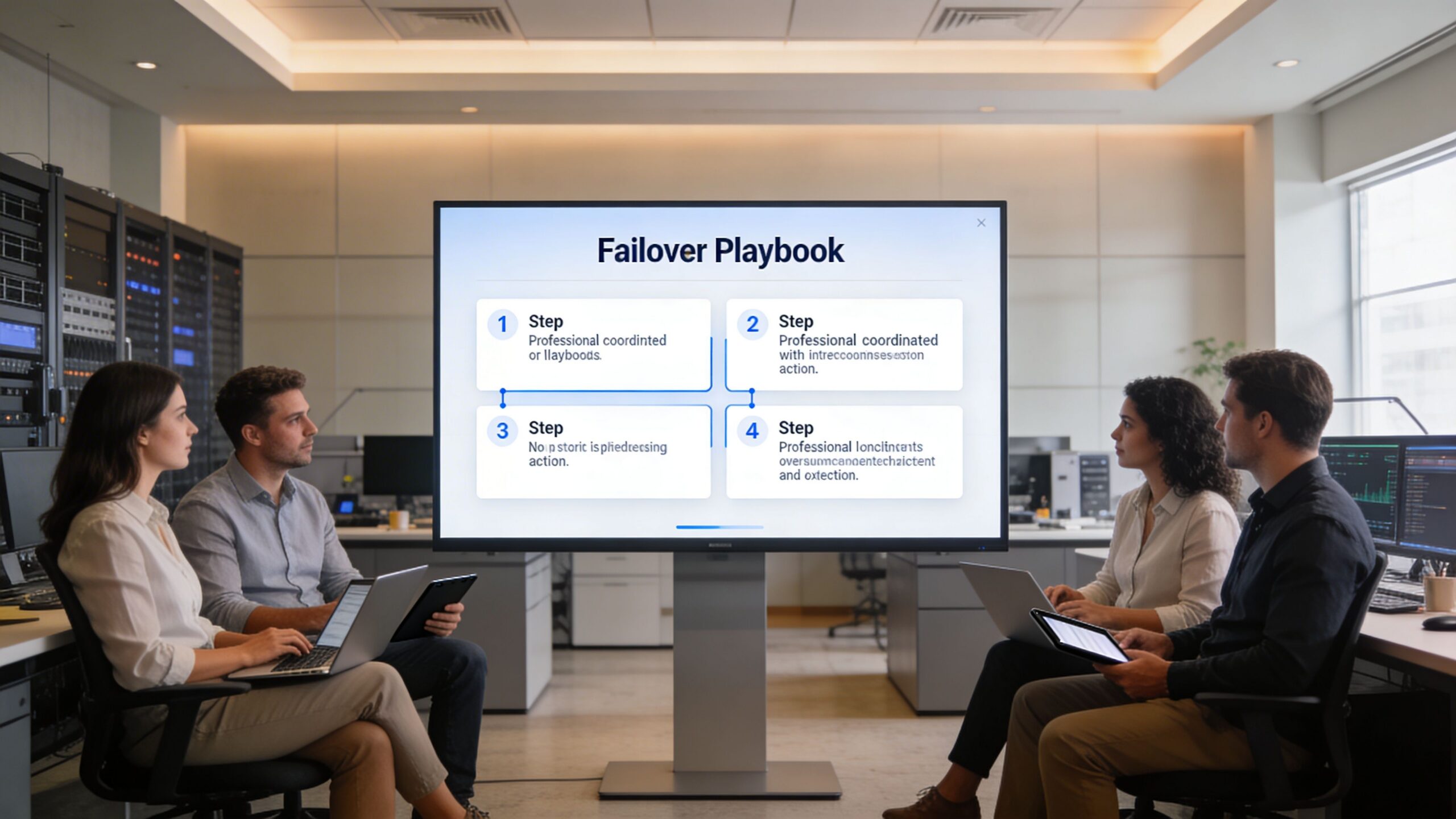
A professional team collaborating in a modern office space while reviewing a data center failover playbook presentation.

The first hour determines the rest of the outage

Most SMB incidents go sideways for one reason. People start improvising.

Someone restarts the wrong server. Someone else reconnects a suspected infected device. A manager sends a vague all-staff message. Meanwhile, nobody has confirmed whether the problem is hardware failure, internet loss, or active encryption.

That confusion is expensive. Recent data shows that 34% of organizations hit by ransomware take over a month to recover their data, up from 24% just two years prior. With security breaches being a leading cause of outages, a rapid, playbook-driven response is critical (Secureframe disaster recovery statistics).

What your playbook should contain

A workable playbook does not need to be long. It needs to be usable.

Include these elements:

  • Decision authority: Name the person who can declare a DR event, approve failover, and authorize outside communications.
  • Technical ownership: List who checks backups, who validates the scope, who handles network isolation, and who coordinates restore order.
  • Contact paths: Keep current numbers for leadership, IT, security, critical vendors, internet providers, line-of-business app support, and facility contacts.
  • System priority list: Put Tier 1, Tier 2, and Tier 3 systems in recovery order.
  • Communication templates: Pre-write staff updates, client notices, and vendor escalation messages.
  • Evidence handling: If the event may involve a breach, preserve logs and timeline notes before systems get changed.

A practical first-60-minute checklist

Here is the format I recommend for SMBs.

Minutes 0 to 15

Confirm what happened before anyone starts “fixing” it.

  • Identify the symptom: Is it outage, encryption, corrupted data, inaccessible internet, or failed authentication?
  • Check blast radius: One user, one site, one application, or the whole environment?
  • Freeze unnecessary changes: Stop ad hoc restarts and random reconnects until someone leads the response.

Minutes 15 to 30

Contain the problem and preserve recovery options.

  • Isolate affected systems if compromise is suspected.
  • Verify backup status and the last known good restore point.
  • Escalate to security responders if there are indicators of ransomware or account compromise.

Minutes 30 to 60

Choose the path and communicate it.

  • Declare the incident level: Operational issue or true disaster event.
  • Start failover or restore actions for the systems already marked as highest priority.
  • Send a controlled internal update so staff know what they can and cannot do.

Tip: Your first communication to staff should reduce risk, not just share information. Tell them whether to stay off VPN, avoid opening email, switch to alternate systems, or report specific symptoms.

Database and application specifics matter

Generic backup language is not enough for application-heavy environments. If your business depends on SQL-based software, medical systems, billing platforms, or custom line-of-business apps, your playbook should spell out what “restored” means.

That includes service order, dependency checks, and data validation.

For teams that want a technical refresher on one part of that process, this guide on backing up your MySQL database is a useful example of why database-aware backup procedures matter more than copying files.

The SOC role during a cyber-driven outage

In a ransomware or suspicious outage scenario, the recovery team and the security team must work together. If you restore too early without containment, you can reintroduce the same threat into clean systems.

Many plans fail in the field at this point. They focus on restoring systems but not on proving those systems are safe to restore.

A 24/7 SOC helps by handling tasks that SMBs often cannot do alone:

  • Threat hunting across endpoints and identity systems
  • Containment guidance so infected assets are isolated correctly
  • Alert correlation to separate a hardware outage from a breach
  • Recovery coordination so restore actions do not destroy evidence or reopen the incident

A useful playbook balances both. It tells your staff how to keep the business moving while your technical team verifies that the recovery path is clean.

Testing Your Plan and Staying Compliant

An untested recovery plan is worse than an incomplete one. At least an incomplete plan makes people cautious. An untested plan makes them confident for no reason.

That false confidence shows up in meetings all the time. A company says it has backups, documented procedures, and recovery targets. Then the first live test reveals expired credentials, missing dependencies, bad replication assumptions, or a restore sequence nobody has ever performed.

Testing turns documentation into something usable

Recovery plans fail in small ways before they fail in big ways.

A tabletop exercise can reveal role confusion. A restore drill can expose application dependencies. A full failover simulation can uncover networking gaps, timing issues, and communication breakdowns that were invisible on paper.

Best practice dictates full-scale DR testing must occur at least annually. However, managed IT providers that implement quarterly recovery drills can reduce actual recovery time by 40-60% compared to firms relying on manual procedures and less frequent testing (Serverion on cloud disaster recovery planning).

That is the practical case for testing more often than the minimum. The goal is not to impress an auditor. The goal is to remove surprises before a real event does it for you.

A realistic SMB testing rhythm

Most SMBs do not need dramatic, all-day simulations every month. They do need a schedule.

A workable approach looks like this:

  • Quarterly tabletop exercises: Leadership, IT, and key department heads walk through a ransomware event, a storm outage, or a server failure.
  • Quarterly restore drills: Recover a file set, a VM, a database, or a critical SaaS dataset and validate the result.
  • Annual full-scale test: Simulate a real failover for the highest-priority systems and measure recovery against target recovery times.

Use each test to answer a few direct questions:

Test question Why it matters
Did the team meet the intended restore order Priorities often drift after system changes
Was the recovered data usable A successful restore that breaks the app still fails the business
Did staff know who approved each action Delays often come from decision bottlenecks, not technology
Were communications clear Confused employees create secondary problems during outages

Compliance reality: Auditors and insurers care less about promises than proof. Meeting notes, test records, screenshots, exception logs, and remediation follow-ups carry more weight than a policy document alone.

Compliance is tied to recoverability

If you operate in healthcare, legal, financial, or public-facing environments, recovery is not just an uptime issue. It affects privacy, record access, and operational integrity.

A documented testing program supports several things at once:

  • Evidence for auditors that controls are real and maintained
  • Stronger insurer conversations because your firm can show tested procedures
  • Cleaner vendor oversight when third-party systems are part of the recovery chain
  • Lower operational chaos because staff practice decisions before a live event

Good testing also forces one healthy discipline. It keeps the environment documented. Every time a team runs a drill, it finds outdated contacts, changed applications, forgotten dependencies, or undocumented exceptions. That is not failure. That is the value of the exercise.

If a plan has not been tested since the last server upgrade, office move, line-of-business app change, or security stack change, assume the plan is partially wrong. Then fix it before hurricane season, before the next phishing campaign, and before the next compliance review.

Making Resilience Your Competitive Advantage in Florida

The strongest Florida businesses do not treat data center disaster recovery as an insurance expense they hope never to use. They treat it as operational discipline.

Clients notice when your firm stays available during regional disruption. Patients notice when scheduling and records remain accessible. Staff notice when they get clear instructions instead of confusion. Referral partners notice when your systems keep working while other firms scramble.

Resilience is built from decisions, not products

The pattern is consistent.

First, identify the business functions that matter. Then define realistic recovery targets. After that, choose an architecture that fits both your risk and your budget. Finally, test it often enough that your team trusts the process because they have already used it.

That is what turns a backup strategy into resilience.

In Florida, the plan has to match local reality

A Central Florida business does not need a copy-and-paste enterprise template. It needs a plan built for storms, power loss, remote work interruptions, and cyber threats that can arrive on the same week.

The cost of getting this wrong can be existential. According to research, a significant majority of companies that suffered a data center outage for an extended period filed for bankruptcy within one year. This highlights the existential threat of inadequate DR planning. As noted earlier, that is why recovery planning belongs in core business strategy, not a back-burner IT project.

The companies that come through disruption well usually have the same habits. They know what must come back first. They know who makes the call. They know where the clean backups are. They know the plan has been tested. And they have support in place before the emergency starts.

If you can say those things with confidence, resilience becomes a business advantage. If you cannot, the time to fix it is now, while the skies are still clear.


If your business in Orlando, Winter Springs, or the surrounding Central Florida market needs a practical disaster recovery plan, Cyber Command, LLC can help you assess risks, define recovery priorities, and build a recovery process that fits your environment, compliance needs, and budget.