
The Complete Guide to Business Workflow Optimization


Why Business Workflow Optimization Matters Now More Than Ever
Business workflow optimization is the systematic process of analyzing, improving, and automating your organization’s workflows to improve efficiency, reduce costs, and eliminate bottlenecks. It involves removing unnecessary steps, standardizing processes, and leveraging technology to help your team focus on high-value work instead of repetitive tasks.
Key elements of business workflow optimization include:
- Process Analysis – Mapping current workflows to identify inefficiencies and bottlenecks
- Automation – Using technology to handle repetitive, manual tasks
- Standardization – Creating consistent processes that reduce errors and improve quality
- Continuous Improvement – Regularly reviewing and refining workflows based on performance data
- Technology Integration – Connecting disparate systems to eliminate manual handoffs
Think of a process that’s been taking too long to complete, costing too much to execute, or constantly failing to deliver quality results. That’s the reality for most growing businesses today.
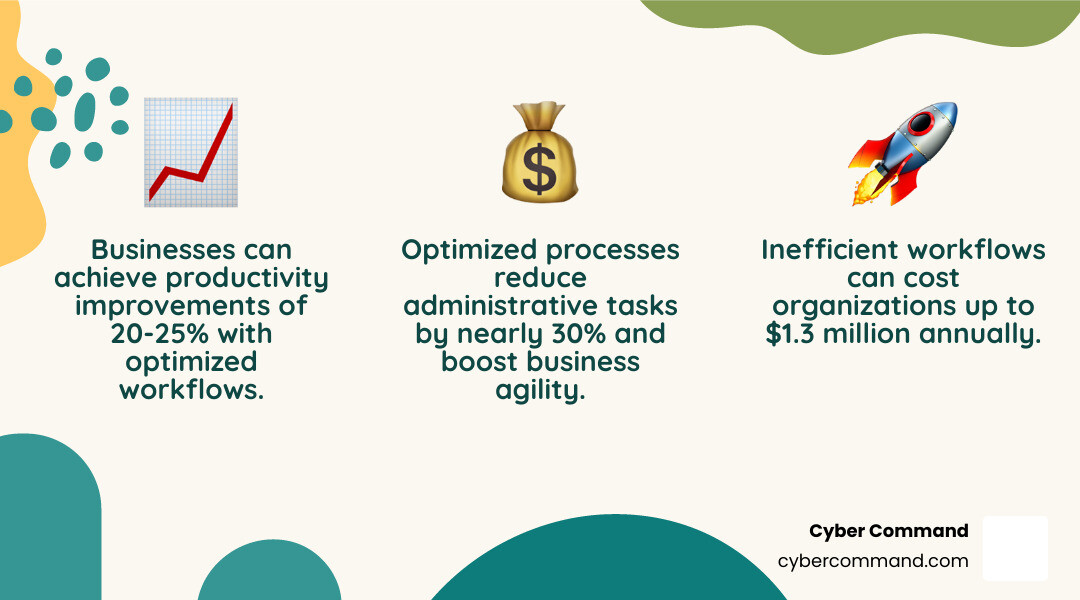
Research shows that businesses can lose up to $1.3 million annually due to inefficient workflows and manual processes. Even more startling, 54% of office workers spend more time searching for files than doing actual work. In hybrid and remote work environments, these inefficiencies multiply as teams juggle multiple tools, work across time zones, and manage competing priorities.
The opportunity is clear. Organizations that effectively implement workflow optimization see productivity improvements of 20-25% and reduce time wasted on administrative tasks by nearly 30%. More importantly, optimized workflows create a competitive advantage—companies with streamlined processes consistently outperform their competitors by delivering faster, responding to market changes more effectively, and keeping employees engaged.
But workflow optimization isn’t just about speed or cost savings. It’s about building a foundation that supports sustainable growth. When your workflows are optimized, your systems become more reliable. Your data becomes more accessible. And your business becomes more agile in responding to both opportunities and challenges.
I’m Reade Taylor, founder and CEO of Cyber Command, and I’ve spent years helping businesses transform inefficient technology systems into streamlined operations through business workflow optimization. My background as an engineer with IBM Internet Security Systems taught me that the best solutions combine deep technical expertise with clear communication and a genuine focus on business outcomes.
Understanding Workflow Optimization: The Foundation for Growth
What is Business Workflow Optimization?
At its heart, business workflow optimization is about making things work better, faster, and smarter. It’s a systematic approach to analyzing, improving, and automating the sequential tasks that make up your business operations. Imagine a well-oiled machine where every gear turns smoothly, without friction or wasted motion. That’s the goal!
We dive deep into how tasks are currently performed, looking for bottlenecks, redundant steps, and opportunities to reduce manual effort. Our aim is to eliminate unnecessary steps, reduce errors, and maximize overall productivity. It’s a continuous journey of refinement, ensuring that our processes are always evolving to meet the demands of a dynamic business environment.
Why is this so crucial for modern businesses? In today’s world, inefficiency isn’t just an annoyance; it’s a competitive disadvantage. Businesses in Florida and Texas, like yours, face constant pressure to deliver more with less, adapt quickly to market changes, and keep customers happy. Optimized workflows enable us to do just that, turning potential headaches into strategic advantages.
Workflow Optimization vs. Business Process Optimization (BPO)
While often used interchangeably, it’s helpful to understand the subtle difference between workflow optimization and the broader concept of Business Process Optimization (BPO). Think of it this way: a workflow is a series of tasks that accomplish a specific outcome, like “onboarding a new employee” or “processing a customer order.” Workflow optimization zeroes in on making that specific sequence of tasks as efficient as possible.
Business Process Optimization (BPO), on the other hand, takes a more holistic view. It encompasses the entire business process—which might involve multiple workflows across different departments—and seeks to improve it from end-to-end. BPO is a strategic approach that analyzes and improves existing business processes to ensure they align with our overall business strategy and goals. As IBM notes, process optimization is a keystone of digital change initiatives, meaning it’s not just about tweaking a task, but about fundamentally changing how we operate. Workflow optimization is a critical component within this larger BPO strategy, focusing on the individual gears that drive the whole machine.
The Core Benefits of Optimized Workflows
The rewards of investing in business workflow optimization are substantial and far-reaching, impacting every facet of our operations:
- Increased Efficiency and Productivity: This is often the first benefit we notice. By streamlining processes and eliminating unnecessary steps, we can significantly speed up task completion. Organizations that effectively implement automation technologies see productivity improvements of 20%–25%, according to McKinsey. Imagine what your team could achieve with that much extra time!
- Cost Reduction: Less waste, fewer errors, and reduced manual effort directly translate into financial savings. A Harvard Business Review study revealed that companies implementing structured workflows reduced time wasted on administrative tasks by nearly 30%. This means lower operational costs, less rework, and optimized resource allocation.
- Improved Quality and Consistency: Optimized workflows lead to standardized procedures. This consistency reduces the likelihood of human error, ensuring that products and services meet higher quality standards more reliably. Better quality means happier customers and a stronger reputation.
- Improved Agility and Responsiveness: When our processes are lean and efficient, we can adapt more quickly to changing market conditions, customer demands, or new regulations. Companies that streamline their processes consistently outperform competitors by delivering products faster and responding to market changes more effectively.
- Improved Employee Satisfaction: Let’s be honest, repetitive, manual tasks are boring and frustrating. By automating these “busywork” activities, we free our teams to focus on more creative, challenging, and valuable work. This leads to higher job satisfaction, increased engagement, and reduced burnout. Our team members in Winter Springs, Orlando, Jacksonville, Tampa Bay, Central Florida, Plano, and across Florida and Texas are happier when they’re making a real impact.
- Competitive Advantage: All these benefits combine to give us a significant edge. Faster delivery, better quality, lower costs, and a more agile operation mean we can outperform rivals and better serve our clients.
A Step-by-Step Guide to Implementing Business Workflow Optimization
Starting on a business workflow optimization journey might seem daunting, but by breaking it down into manageable steps, we can achieve remarkable results.

Step 1: Analyze and Map Your Current Workflows
Before we can improve anything, we need to understand it. This initial phase is about gaining a clear, unbiased picture of how work truly gets done.
- Identify Key Processes: We begin by identifying the processes that are most critical to our business, cause the most headaches, or consume the most resources. These could be anything from customer onboarding and sales order processing to IT support ticket resolution or payroll.
- Document the “As-Is” State: This involves carefully documenting every step of the chosen workflow. Who does what? When do they do it? What tools are used? What information is needed? We’re not looking for perfection here, but accuracy.
- Visual Mapping: Creating a visual diagram—like a flowchart or swimlane diagram—is incredibly helpful. It makes complex processes easier to understand and highlights dependencies and handoffs.
- Gather Employee Feedback: The people doing the work often have the best insights. We’ll conduct interviews, surveys, or workshops with team members to understand their experiences, pain points, and informal workarounds. These “shadow processes” are often where the biggest inefficiencies hide!
- Uncover Informal Workarounds: Sometimes, employees create their own ways of getting things done because the official process is too cumbersome. Identifying these workarounds is crucial, as they reveal where the official process is breaking down.
Step 2: Identify Inefficiencies and Set Clear Goals
With our current workflows mapped, it’s time to put on our detective hats and find the culprits of inefficiency.
- Pinpoint Bottlenecks: These are the points where work consistently slows down or gets stuck. It could be an approval step that takes too long, a manual data entry task, or a lack of clear ownership.
- Identify Redundant Steps: Are there tasks being duplicated? Are multiple people reviewing the same information unnecessarily? We look for anything that doesn’t add value.
- Define SMART Goals: Our optimization efforts need clear targets. We’ll set Specific, Measurable, Achievable, Relevant, and Time-bound (SMART) goals. For example, instead of “improve customer service,” we might aim to “reduce average customer support ticket resolution time by 15% within the next six months.”
- Establish Key Performance Indicators (KPIs): To track our progress, we need metrics. KPIs for workflow optimization often include:
- Cycle Time: The total time it takes to complete a process from start to finish.
- Error Rates: The frequency of mistakes or defects within a process.
- Resource Utilization: How effectively our team members and tools are being used.
- Cost Per Transaction: The expense associated with completing a single instance of a workflow.
Step 3: Redesign the Workflow and Implement Changes
Now for the exciting part: designing a better way!
- Create the “To-Be” State: Based on our analysis and goals, we’ll design a new, optimized workflow. This involves eliminating redundant steps, automating manual tasks, standardizing procedures, and re-sequencing activities for maximum efficiency.
- Communicate Changes Effectively: Change can be unsettling. We’ll communicate the “why” behind the changes, explaining the benefits for the business and, crucially, for the employees themselves. Transparency builds trust.
- User Adoption Strategies: To ensure our efforts aren’t in vain, we need our teams to accept the new workflows. This means involving them in the design process, making the new tools user-friendly, and showcasing how the changes will make their jobs easier and more impactful.
- Provide Training and Support: Comprehensive training is non-negotiable. We’ll equip our employees with the knowledge and skills needed to operate within the new workflows and use any new technologies. This can involve workshops, online modules, or even peer-to-peer mentoring. Resources like online academies offer valuable on-the-job skills and training.
Step 4: Monitor, Measure, and Foster Continuous Improvement
Optimization isn’t a one-time project; it’s a continuous journey.
- Track KPIs: We’ll continuously monitor the KPIs we established in Step 2 to gauge the effectiveness of our optimized workflows. Are we meeting our goals? Where can we still improve?
- Create Feedback Loops: Encourage employees to provide ongoing feedback about the new processes. They are on the front lines and will spot new opportunities or unforeseen challenges.
- Kaizen Methodology: Embracing a “Kaizen” mindset—the Japanese philosophy of continuous improvement—means we’re always looking for small, incremental improvements. As Kate Vitasek, a Forbes contributor, aptly puts it, “True process optimization requires a mindset of continuous review and improvement. This can be especially important in the period after implementing changes to your process.”
- Periodic Reviews: We’ll schedule regular, perhaps quarterly or bi-annual, in-depth reviews of our workflows to ensure they remain aligned with our evolving business objectives and continue to deliver optimal performance.
Key Strategies and Technologies for Optimization
Proven Methodologies for Streamlining Processes
To effectively optimize business workflows, we often draw upon established methodologies that have proven their worth across various industries:
- Lean Methodology: Originating from manufacturing principles, Lean focuses on eliminating waste (Muda) in all its forms—overproduction, waiting, unnecessary transport, over-processing, excess inventory, unnecessary movement, and defects. The goal is to maximize customer value while minimizing resources.
- Six Sigma Principles: This is a statistics-based methodology aimed at reducing defects and variation in processes. By identifying and removing the causes of errors, Six Sigma helps us achieve near-perfect quality. For example, call centers frequently rely on Six Sigma principles to make customer support agent performance more consistent.
- Agile and Kanban: These methodologies, popular in software development, are highly effective for managing workflows. Agile promotes iterative development and flexibility, while Kanban uses visual boards (like digital whiteboards with “swimlanes”) to visualize work, limit work-in-progress, and manage flow, making bottlenecks immediately apparent.
- Theory of Constraints (TOC): TOC focuses on identifying the biggest limiting factor, or “bottleneck,” in a system and then systematically improving it until it’s no longer the constraint. This ensures that optimization efforts are always directed where they will have the greatest impact.
The Role of Technology and Automation
Technology isn’t just a tool in business workflow optimization; it’s a game-changer. It allows us to automate repetitive, rules-based tasks, freeing our human talent for more strategic work.

- Automating Repetitive Tasks: This is where technology truly shines. Tasks like data entry, sending routine notifications, generating reports, or routing approvals can be automated, significantly reducing human error and speeding up processes.
- Workflow Management Software: These platforms are designed to manage and automate workflows, providing visual tools to design processes, assign tasks, track progress, and ensure compliance. The workflow management system market is projected to reach USD 70.9 billion by 2032, reflecting a substantial compound annual growth rate (CAGR) of 23.30%, showing the massive demand.
- AI-Enabled Automation: The future is here! 92% of executives anticipate implementing AI-enabled automation in workflows by 2025. AI and machine learning are enabling more intelligent automation, capable of handling unstructured data, making decisions, and adapting to new situations. This lifts automation beyond simple rules-based tasks to more complex problem-solving.
- Enterprise Process Automation (EPA): EPA takes automation to an organizational scale, orchestrating complex, cross-functional workflows across multiple enterprise platforms (like CRM, HR, ERP). This enables businesses to transform how they operate, scaling efficiency across the entire organization. We dig deeper into this in our guide to Enterprise Process Automation.
- Integration Capabilities: Modern workflow tools excel at integrating with other software we already use. This seamless connection between different systems eliminates manual data transfers and ensures a smooth flow of information, minimizing friction and maximizing efficiency.
Real-World Examples of Successful Optimization
Let’s look at how business workflow optimization plays out in the real world:
- Manufacturing: Manufacturers have long pioneered workflow optimization. By implementing streamlined production systems, they’ve been able to significantly increase output and reduce the time it takes to bring a product to market. This often involves techniques like just-in-time production, where materials arrive exactly when needed, minimizing inventory costs and waste.
- Retail: In retail, efficient inventory management is key. Optimizing workflows can involve automating stock alerts, streamlining the ordering and receiving process, and using data analytics to predict demand more accurately. This ensures shelves are stocked, reducing lost sales and improving customer satisfaction.
- Call Centers: These environments are ripe for optimization. By applying methodologies like Six Sigma, call centers can improve the consistency of agent performance, reduce call handling times, and improve customer satisfaction. Automation can also route calls more intelligently or handle routine inquiries, freeing agents for complex issues.
- IT Help Desks: For us at Cyber Command, optimizing IT support workflows is paramount. Automating ticket routing based on issue type, integrating self-service portals, and using knowledge bases to resolve common problems quickly can drastically improve response times and user satisfaction.
Overcoming Challenges and Ensuring Success
No journey worth taking is without its bumps in the road. Business workflow optimization is no different.
Common Problems in Business Workflow Optimization
We’ve identified a few common challenges that can derail even the best-laid plans:
- Employee Resistance to Change: Humans are creatures of habit. Introducing new ways of working can be met with skepticism or fear, especially if employees don’t understand the “why” or feel their jobs are threatened.
- Lack of Executive Buy-in: Without clear support from leadership, optimization initiatives can lose momentum, funding, and the necessary authority to drive change across departments.
- Information Silos: When departments operate in isolation, information doesn’t flow freely, creating bottlenecks and preventing a holistic view of processes. This makes cross-functional optimization incredibly difficult.
- Low Adoption of New Tools: Investing in powerful workflow software is useless if employees don’t use it. Poor onboarding, complex interfaces, or a lack of perceived value can lead to tools gathering digital dust.
- Inadequate Scenario Planning: Sometimes, we optimize for the “happy path” but fail to account for exceptions, errors, or unusual circumstances. This can lead to new bottlenecks or workarounds when things don’t go exactly as planned.
Strategies for Ensuring User Adoption and Engagement
Overcoming these challenges requires a thoughtful approach, focusing on our most valuable asset: our people.
- Involve Employees in Design: The people closest to the work often have the best insights into current inefficiencies and potential solutions. Involving them in the analysis and redesign phases fosters ownership and reduces resistance.
- Communicate the “Why”: Clearly articulate the benefits of optimization, not just for the company, but for individual employees. Explain how it will reduce their workload, eliminate frustrating tasks, and free them for more meaningful contributions.
- Comprehensive Training: Provide thorough, hands-on training for new tools and processes. Make it accessible and ongoing, ensuring everyone feels confident and supported.
- User-Friendly Tools: Whenever possible, choose workflow tools that are intuitive and easy to use. A steep learning curve can be a major barrier to adoption.
- Change Management: This isn’t just a buzzword; it’s a critical discipline. Effective change management involves planning, supporting, and guiding individuals through the transition, addressing concerns, and celebrating successes along the way.
When to Engage a Consultant for Expert Guidance
While many aspects of business workflow optimization can be tackled internally, there are times when bringing in external expertise can be a game-changer.
- Lack of Internal Expertise: If our team lacks experience in process mapping, Lean methodologies, or specific automation technologies, a consultant can provide the necessary knowledge and guidance.
- Need for an Objective Perspective: Sometimes, familiarity breeds blindness. An external consultant brings a fresh, unbiased viewpoint, identifying inefficiencies or political roadblocks that internal teams might overlook.
- Complex Cross-Departmental Processes: Optimizing workflows that span multiple departments can be challenging due to competing priorities or established silos. A consultant can act as a neutral facilitator, ensuring alignment and progress.
- Limited Internal Resources: If our team is already stretched thin, dedicating significant time to a major optimization project might not be feasible. A consultant can provide the necessary bandwidth to drive the initiative forward.
| Feature | DIY Optimization | Consultant-led Optimization |
|---|---|---|
| Expertise | Relies on internal knowledge and learning | Access to specialized knowledge, tools, and best practices |
| Objectivity | Can be influenced by internal biases/politics | Provides an unbiased, external perspective |
| Resources | Uses existing staff, potentially stretching | Dedicated resources focused solely on optimization |
| Speed | May be slower due to learning curve | Often faster due to experience and proven methodologies |
| Cost | Lower direct cost, higher indirect cost (time) | Higher direct cost, potentially higher ROI |
Consultants don’t work “in” your business; they work “on” your business. They bring a wealth of experience from diverse industries, accelerating our optimization journey and ensuring we implement best practices custom to our unique needs.
Frequently Asked Questions about Business Workflow Optimization
How do you measure the success of workflow optimization?
Measuring success is crucial to ensure our efforts are paying off. We typically look at a combination of quantitative and qualitative metrics:
- Key Performance Indicators (KPIs): As discussed, these are our go-to for hard data. We track improvements in:
- Cycle Time: A reduction indicates faster processing.
- Throughput: An increase means we’re handling more work in the same amount of time.
- Error Rates: A decrease signifies improved quality and fewer mistakes.
- Cost per Transaction: A reduction shows increased cost efficiency.
- Employee Satisfaction Scores: Happier employees often mean more productive employees. Surveys can gauge how new workflows impact their daily work.
- Customer Satisfaction: Optimized internal processes should lead to better service and products for our customers, reflected in higher satisfaction scores and loyalty.
What are the first steps for a small business to optimize workflows?
For small businesses, starting small and focusing on quick wins is key:
- Identify One Repetitive Process: Don’t try to optimize everything at once. Pick one process that causes frequent headaches or consumes a lot of manual time. Common examples include invoicing, customer onboarding, or managing social media posts.
- Map the Process: Even a simple flowchart on a whiteboard can reveal surprising inefficiencies.
- Look for Quick Wins: Can one or two steps be eliminated? Is there a free or low-cost tool that can automate a small part of the process?
- Use Accessible Automation Tools: Many user-friendly, affordable tools are available that can automate tasks without requiring extensive technical knowledge.
How often should workflows be reviewed?
Business workflow optimization is an ongoing process, not a destination. To foster a culture of continuous improvement:
- Continuous Improvement Culture: Encourage every team member to constantly look for small ways to improve their daily tasks.
- Major Reviews Quarterly or Bi-Annually: For significant workflows, schedule dedicated review sessions every three to six months. This allows us to assess performance, gather feedback, and make larger adjustments.
- Constant Small Adjustments: Don’t wait for a formal review. If an obvious improvement is identified, implement it quickly and communicate the change.
Conclusion: Changing Your Business with Optimized Workflows
In the dynamic business landscape of Florida and Texas, the ability to adapt and operate efficiently isn’t just an advantage—it’s a necessity. Business workflow optimization is more than just a buzzword; it’s a strategic imperative that directly impacts our bottom line, our team’s morale, and our ability to serve our clients effectively.
We’ve seen how optimizing workflows can lead to:
- Significant increases in efficiency and productivity.
- Substantial cost reductions by eliminating waste and manual effort.
- Improved quality and consistency in our products and services.
- Improved agility, allowing us to respond rapidly to market changes.
- Greater employee satisfaction as mundane tasks are automated.
This journey requires a blend of strategic thinking, a keen eye for detail, and the smart application of technology. It’s about fostering a mindset of continuous improvement, where we’re always looking for better ways to work.
At Cyber Command, we understand these complexities. We act as an extension of your business, offering enterprise-grade IT, cybersecurity, and platform engineering services with proactive, 24/7/365 U.S.-based support. We’re here to help you steer the intricacies of workflow optimization, leveraging our expertise to design and implement solutions that drive measurable business outcomes.
Don’t let inefficient workflows hold your business back. Let us help you transform your operations, boost your productivity, and secure a competitive edge.