
Empowering Learning: Top Education IT Solutions for Modern Schools


Why Education IT Solutions Are Critical for Modern Schools
Education IT solutions are comprehensive technology systems designed for K-12 schools, colleges, and universities. They help manage student data, enable remote learning, protect against cyber threats, and streamline administrative operations.
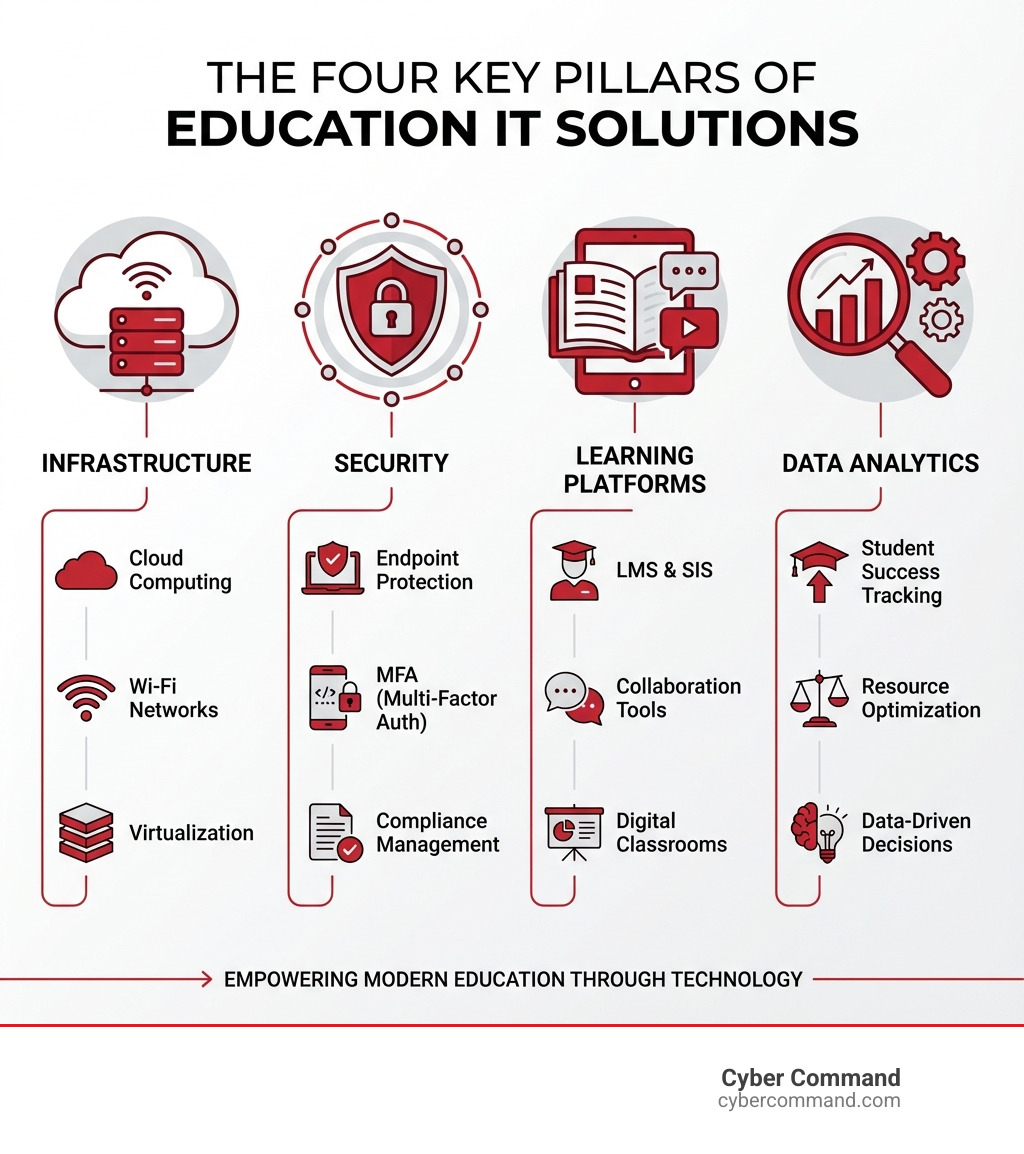
Key components of effective Education IT solutions include:
- Infrastructure & Connectivity – Cloud platforms, high-density Wi-Fi, and modernized networks
- Cybersecurity & Compliance – Multi-factor authentication, endpoint protection, and FERPA compliance
- Learning Platforms – Learning Management Systems (LMS), Student Information Systems (SIS), and collaboration tools
- Support & Management – 24/7 monitoring, proactive maintenance, and managed security services
The stakes for educational institutions are higher than ever. 79% of higher-education institutions were compromised by ransomware attacks in 2023, leading to an estimated $9 billion in downtime and recovery costs. Schools face a perfect storm of limited budgets, outdated systems, and sophisticated cyber threats while needing to support both in-person and remote learning.
However, the right technology can transform education by enabling personalized learning, streamlining workflows, and preparing students for a tech-driven future. The challenge is implementing these solutions without overwhelming IT teams or diverting resources from the core mission of education.
I’m Reade Taylor, Founder and CEO of Cyber Command. My team and I help educational institutions transform their relationship with technology through secure, reliable Education IT solutions. We understand that schools need partners who communicate clearly, work proactively, and deliver enterprise-grade security without enterprise-level complexity.
This guide will walk you through the essential components of modern Education IT solutions, from infrastructure and cybersecurity to emerging technologies like AI, providing practical insights for building a secure and efficient technology environment.
The Modern Educational Landscape: Key IT Challenges and Opportunities

The educational landscape, from Winter Springs to Plano, Texas, is evolving rapidly. This change presents both significant IT challenges and incredible opportunities. Institutions often struggle with tight budgets, aging infrastructure, and a digital divide. However, these problems also pave the way for innovative Education IT solutions that can revolutionize the student experience, empower faculty, and enable personalized learning.
Primary IT Challenges for Today’s Schools
Educational institutions face numerous IT problems, with cybersecurity being one of the most pressing. Ransomware attacks disrupt operations, leading to significant learning time loss and recovery costs. Another key vulnerability is stolen credentials, responsible for 31% of breaches in schools in 2022, highlighting the need for stronger identity management. Data privacy is also a constant concern due to the vast amounts of sensitive information held by institutions.
Other major challenges include:
- Underfunding: Limited budgets lead to understaffed IT departments and delayed technology upgrades.
- Managing Diverse Devices: The mix of personal and school-issued devices creates a complex environment to manage and secure.
- Supporting Remote Learners: Hybrid models require robust, accessible, and secure infrastructure for learning from anywhere.
- Equitable Access: Bridging the digital divide by ensuring all students have reliable technology and internet access remains a fundamental challenge.
The Promise of Digital Change in Education
Despite these challenges, the potential of digital change is immense. Strategic implementation of Education IT solutions offers significant benefits:
- Improved Student Outcomes: Technology delivers dynamic content and personalized learning paths, leading to deeper engagement and better academic results.
- Improved Faculty Efficiency: Digital tools automate routine tasks like grading and lesson planning, freeing up educators to focus on teaching.
- Streamlined Administrative Tasks: Integrated platforms automate processes from admissions to finance, reducing errors and increasing operational efficiency.
- Data-Driven Decision Making: IT systems provide valuable data on performance and resource use to inform strategic decisions and optimize allocation.
- Personalized Student Journeys: Technology can tailor communication and support services for each student, creating a more effective educational journey.
- Increased Collaboration: Digital platforms facilitate seamless communication among students, faculty, and staff, regardless of location.
Core Components of a Robust Education IT Solutions Strategy

Building a future-ready institution requires an integrated approach to technology. Effective Education IT solutions create a cohesive ecosystem, focusing on robust IT infrastructure, flexible hybrid learning, and integrated platforms for operational efficiency.
Modernizing IT Infrastructure for Scalability and Performance
A strong, scalable IT infrastructure is the foundation of a digital learning environment. Modernization is key, especially for schools operating on outdated systems.
- Cloud Computing: Moving to the cloud offers scalability, reduced hardware costs, and flexibility, allowing institutions to scale resources based on demand. We’ve seen the Benefits of Moving to the Cloud for optimizing IT operations.
- Hyperconverged Infrastructure (HCI): HCI simplifies IT by integrating compute, storage, and networking into a single system, reducing complexity and improving performance.
- High-Density Wi-Fi: This is a necessity for ensuring reliable, fast internet access across campus to support countless devices simultaneously.
- Network Modernization: Upgrading switches, firewalls, and cabling is crucial for handling increased bandwidth and improving security.
- IT Infrastructure Management: Proactive monitoring, maintenance, and strategic planning are paramount to ensure systems run efficiently and securely.
- Data Center Migration: Migrating on-premise data centers to the cloud or a co-location facility can reduce operational costs and improve disaster recovery.
Enhancing Collaboration and Supporting Hybrid Learning
Education IT solutions are pivotal in enabling remote/hybrid learning and fostering collaboration.
- Unified Communication Platforms: Tools like Microsoft Teams create secure virtual classrooms for real-time communication, video conferencing, and file sharing. You can Learn more about Teams for creating secure and collaborative virtual classrooms.
- Learning Management Systems (LMS): An LMS serves as the central hub for course content, assignments, and communication, ensuring a consistent learning experience.
- Digital Teaching Tools: Interactive whiteboards, educational apps, and virtual labs enrich the learning experience and make subjects more engaging.
- Secure Virtual Classrooms: Security is vital. Solutions like application virtualization provide secure access to resource-intensive applications on any device. This includes Strategies for Securing Remote Workforces with VPN MFA to protect educational resources.
- Device Management: Centralized management of all devices ensures software is updated, security policies are enforced, and technical issues are resolved quickly.
Streamlining Operations with Integrated Platforms
Integrated IT solutions are the backbone of efficient administration, connecting systems and automating workflows.
- Student Information Systems (SIS): An SIS is the central repository for all student data. Integrating it with an LMS ensures data consistency and reduces manual entry. Explore solutions from providers like PowerSchool.
- Workflow Automation: Automating routine tasks like admissions or course registration reduces administrative burden and speeds up processes.
- IT Service Management (ITSM): An ITSM platform streamlines IT support by managing incidents and service requests, minimizing downtime. Platforms like ServiceNow IT Service Management can connect departments and secure campuses.
- Automated Admissions: Automated systems guide applicants through the process, creating a smoother, more efficient experience.
- HR Process Unification: Integrating HR systems streamlines payroll, benefits, and talent acquisition.
- Resource Optimization: Integrated solutions provide visibility into resource use, allowing for optimization of scheduling and energy consumption for significant cost savings.
Fortifying Your Institution: Cybersecurity and Compliance in Education
Campus security encompasses robust online defenses and unwavering data privacy. For schools across Florida and Texas, protecting sensitive data, intellectual property, and critical infrastructure is a paramount concern, as a single breach can devastate an institution’s reputation and finances.
Navigating Top Cybersecurity Threats in Education
Educational institutions are unique targets due to their wealth of personal data, limited budgets, and diverse user base. This combination creates a fertile ground for attacks. The most prevalent threats include:
- Ransomware: These attacks encrypt critical data and demand payment, causing massive disruption. The 234% increase in ransomware attacks on educational institutions from 2021 to 2022 underscores this threat’s urgency.
- Phishing Attacks: Social engineering tactics trick users into revealing credentials or clicking malicious links, remaining a highly effective attack vector.
- Data Breaches: The exposure of sensitive data, whether from external attacks or internal vulnerabilities, can lead to severe consequences like identity theft and regulatory fines.
- Insider Threats: Threats can come from disgruntled employees, careless staff, or compromised student accounts that expose data or disrupt systems.
- Denial-of-Service (DoS) Attacks: These attacks flood a system with traffic, making online learning platforms and administrative services unavailable.
A significant portion of these attacks exploit human vulnerabilities, with 31% of breaches in schools in 2022 caused by stolen credentials.
Proactive Defense: Mitigation and Security Solutions
Mitigating these threats requires a multi-layered, proactive defense strategy that protects your institution without hindering learning.
- Multi-Factor Authentication (MFA): MFA adds a critical security layer by requiring more than one verification method, dramatically reducing risks from stolen credentials. Understanding the Role of MFA in Strengthening Identity Access Management is key.
- Importance of Zero Trust Architecture for Modern Security: A Zero Trust model assumes no user or device is trusted by default, verifying every access request to secure resources more effectively.
- Next-Generation Firewalls (NGFW): These provide intelligent defense with features like intrusion prevention and deep packet inspection. We can help with Strengthening Security with Next Gen Firewalls.
- Endpoint Detection and Response (EDR): EDR solutions continuously monitor endpoints for malicious activity, providing real-time threat detection and automated response.
- Cybersecurity Awareness Training: Staff and students are your first line of defense. Regular training on phishing, password practices, and data handling is essential. We can help Boost Human Security with Cybersecurity Awareness Training.
- Backup and Disaster Recovery Solutions: A robust backup plan ensures critical data can be restored quickly after an attack or system failure, minimizing downtime.
Ensuring Data Privacy and Regulatory Compliance
Handling sensitive personal information makes data privacy and compliance non-negotiable.
- FERPA (Family Educational Rights and Privacy Act): This federal law protects student education records and requires strict access controls. Non-compliance can result in the loss of federal funds.
- GDPR (General Data Protection Regulation): This regulation impacts any institution handling data of EU citizens, setting a high standard for data privacy.
- Data Encryption: Encrypting data in transit and at rest is a fundamental measure that protects information if it’s compromised. We prioritize Effective Data Encryption Best Practices for Data Protection.
- Access Control Policies: Granular access controls ensure only authorized individuals can access specific data and systems based on their roles.
- Regular Security Audits: Periodic assessments help identify vulnerabilities, ensure regulatory compliance, and validate security measures.
- What is PII in Cybersecurity: Understanding and protecting Personally Identifiable Information (PII) is central to compliance. Our team assists with Compliance Mapping for Businesses a Guide on GDPR and HIPAA and can help you Master Cybersecurity Compliance for IT Managed Services.
The Future is Now: AI, Automation, and Emerging Trends in Education IT
The future of education is being shaped by advancing technologies like AI and automation. For schools in Florida and Texas, these innovations offer unprecedented opportunities to personalize learning, streamline operations, and prepare students for a technologically advanced world.
The Role of AI and Automation in Modernizing Education IT solutions
AI and automation are powerful tools changing how we teach, learn, and manage educational institutions.
- Personalized Learning Paths: AI analyzes student performance and engagement to recommend custom content and activities, creating individualized educational experiences.
- AI-Powered Tutors and Assistants: AI chatbots and virtual assistants provide instant student support, freeing up educators for deeper interactions. Microsoft offers tools like AI-enabled reading practice with Reading Coach and Microsoft 365 Copilot to streamline tasks.
- Administrative Task Automation: AI can handle repetitive tasks like scheduling and grading, reducing faculty workload. For example, Microsoft 365 Copilot Chat can help Reduce time-consuming administrative tasks.
- Predictive Analytics for Student Success: AI algorithms identify at-risk students, enabling early intervention to improve retention and outcomes.
- Understanding the Role of AI and ML in Threat Detection: AI and machine learning are also revolutionizing cybersecurity by detecting threats faster and more accurately than human analysis alone.
- AI integration toolkits: These resources provide guidance for responsibly integrating AI practices into institutions.
Future Outlook and Emerging EdTech Trends
The horizon of Education IT solutions is constantly expanding. Key emerging trends include:
- Augmented/Virtual Reality (AR/VR): Immersive learning experiences are becoming more accessible, allowing students to explore virtual environments for science, history, and more.
- Gamification: Integrating game-like elements like points and badges boosts student engagement and motivation.
- Social-Emotional Learning (SEL) Tools: Technology can foster SEL skills through platforms for mindfulness and collaborative projects. Learn more about Social and emotional learning and how data can help.
- Digital Literacy Skills: Teaching critical digital citizenship, online safety, and ethical AI use is more important than ever.
- Data Analytics: Advanced analytics will continue to provide deeper insights into curriculum effectiveness and resource allocation.
- Lifelong Learning Platforms: IT solutions will increasingly support flexible learning opportunities for individuals throughout their careers.
Strategic Implementation of Education IT Solutions
Implementing advanced Education IT solutions requires careful planning, strategic procurement, and ongoing management. For institutions in Florida and Texas, navigating technology complexities while adhering to budgets is a familiar challenge. A strategic approach to procurement, funding, and partnerships is indispensable.
IT Procurement, Funding, and Cost Optimization
Making smart financial decisions is crucial. We help clients achieve maximum value from their IT investments.
- Flexible Pricing Models: Seek vendors with flexible pricing for the education sector, such as subscriptions or volume discounts, to achieve significant savings.
- E-rate funding tools: The E-rate program provides discounts to schools for internet access and internal connections. Using tools to steer the application process can open up substantial federal funding for IT upgrades.
- Grant Applications: Actively pursuing grants for educational technology can supplement budgets and fund innovative projects.
- Total Cost of Ownership (TCO) Analysis: Understanding the TCO—including maintenance, support, and downtime costs—is vital for making informed procurement decisions.
- Resource Optimization: Leveraging cloud services allows institutions to pay only for resources they use, eliminating expensive, underused on-premise infrastructure.
- Managed IT Services Pricing: Partnering with an MSP often provides a more predictable and cost-effective IT budget than a full in-house team, thanks to transparent, all-inclusive pricing.
Partnering with a Managed Service Provider (MSP) for Education IT solutions
For many institutions, managing complex IT in-house is overwhelming. Partnering with a dedicated MSP is a game-changer, providing enterprise-grade IT services to your campus.
- Access to Expertise: MSPs provide a team of certified specialists in cybersecurity, cloud architecture, and more, an expertise level that is often too expensive to maintain in-house.
- Proactive Support: Our 24/7/365 U.S.-based support monitors your systems around the clock, resolving issues before they cause disruption and minimizing downtime.
- Cost Savings: Outsourcing IT converts unpredictable capital expenses into predictable operational ones, eliminating costs for hiring, training, and equipment. Explore How Much Does Managed IT Services Cost to see potential savings.
- Scalability: An MSP can easily scale services to meet changing needs, like a sudden shift to remote learning or a new academic year.
- Focus on Core Mission: Entrusting IT management to experts allows educational leaders to refocus on their primary mission: educating students.
- What Does a Managed IT Services Provider Do: We handle everything from network maintenance and cybersecurity to cloud management and strategic IT planning.
- How to Choose the Right Managed Service Partner Expert Tips: When selecting an MSP, look for clear communication, a proven track record, and a commitment to understanding your unique needs.
Frequently Asked Questions about Education IT
How can IT solutions help my institution save money?
Education IT solutions drive cost savings by automating tasks, optimizing resources with cloud services, reducing downtime through proactive maintenance, and preventing costly data breaches. Migrating to the cloud can eliminate expensive on-premise hardware costs. Partnering with an MSP provides enterprise-level services with predictable, all-inclusive pricing, making it more cost-effective than a large in-house team.
What are the first steps to modernizing our school’s IT infrastructure?
Start with a comprehensive IT assessment to identify gaps, outdated systems, and security vulnerabilities. Next, develop a strategic roadmap focusing on priorities like cloud migration for scalability, network upgrades (especially high-density Wi-Fi) for reliable connectivity, and implementing foundational security like Multi-Factor Authentication. We can assist with this assessment and planning.
What is the most critical cybersecurity measure for a school to implement?
While a multi-layered approach is best, implementing Multi-Factor Authentication (MFA) is a critical first step. It provides a powerful barrier against unauthorized access, which is crucial as many breaches stem from stolen credentials. MFA adds a verification layer beyond a password, making it significantly harder for criminals to gain access.
Conclusion
The journey to empowering learning is intertwined with robust Education IT solutions. We’ve explored the challenges institutions face, from ransomware threats to supporting diverse learning environments, and highlighted the immense opportunities of digital change—enhancing student outcomes, improving faculty efficiency, and streamlining operations.
By embracing integrated and secure Education IT solutions, institutions can overcome these challenges and build a resilient foundation for the future. This involves modernizing infrastructure, fostering collaboration, and fortifying defenses with advanced cybersecurity. The strategic integration of AI and automation further promises to personalize learning and boost efficiency.
At Cyber Command, we are your strategic partner in this digital evolution. With our proactive, 24/7/365 U.S.-based support and transparent, all-inclusive pricing, we act as an extension of your IT team. Let us manage the complexities of modern IT, so your educators can focus on what they do best: inspiring the next generation.
Explore our Managed IT Services and find how we can help your institution thrive in the digital age.