
From Vision to Victory: Crafting Your IT Strategy with Expert Consulting


Why IT Strategic Consulting Is the Bridge Between Where You Are and Where You Need to Be
IT strategic consulting is a specialized service that helps organizations align their technology initiatives with their business goals. Instead of just fixing problems, consultants create a comprehensive roadmap that transforms technology from a cost center into a competitive advantage. This involves assessing your current state, defining a future vision, and creating an actionable plan to bridge the gap. You may need it if IT costs are rising without results, systems are disconnected, your team is stuck troubleshooting, or technology is holding back growth.
Long-term business success is impossible without the right technology. Yet for many businesses, IT feels more like a liability than an asset. Budgets balloon, systems operate in silos, and security threats loom while your internal team is stuck in perpetual firefighting mode.
The IT strategy consulting market is projected to grow to over $92 billion by 2029, reflecting a shift in how businesses view technology. It’s no longer enough to simply “keep the lights on.” Organizations need technology that drives business value and adapts to rapid market changes.
However, 67% of digital change projects get delayed due to a lack of IT knowledge. Without the right expertise, technology initiatives can stall or fail. That’s where IT strategic consulting comes in. Unlike managed IT services that focus on day-to-day operations, strategic consulting takes a holistic view, starting with your business goals to design the technology foundation you need.
IT strategic consulting bridges the gap between business vision and technical reality. It helps you answer critical questions about which systems to keep, how to prioritize initiatives, and how to ensure your investments deliver measurable ROI. According to a Gartner survey, 66% of CEOs believe digital change is necessary for survival. But change without strategy is just expensive chaos. You need a clear roadmap that connects technology to your bottom line.
I’m Reade Taylor, founder and CEO of Cyber Command. I founded Cyber Command to prove that IT professionals can be proactive partners who turn technology from a costly liability into a competitive advantage.
What Is IT Strategic Consulting and Why It’s a Business Imperative
At its core, IT strategic consulting is about making technology work for your business. It defines how IT can best support your overarching business strategy, moving it from a support function to a critical enabler integrated into your products and services. In today’s landscape, a well-defined IT strategy is essential for innovation and change.
IT strategic consulting helps you achieve:
- Business Goal Alignment: Ensuring every IT investment contributes directly to organizational goals.
- Digital Change: Guiding your organization through the complexities of adopting new technologies and business models.
- Operational Efficiency: Optimizing IT processes and systems to streamline workflows and maximize productivity.
- Risk Management: Proactively identifying and mitigating technological risks, including cybersecurity threats and compliance challenges.
Signs Your Business Needs IT Strategic Consulting
Your current IT setup might be actively hindering your growth. Key indicators include:
- Stagnant Growth Despite IT Investment: IT budgets are growing, but you’re not seeing measurable improvements in business metrics.
- Rising IT Costs with No Clear ROI: You’re pouring money into IT, but it’s hard to quantify the benefits or see bottom-line improvements.
- Disconnected Systems and Operational Silos: Incompatible systems create duplicated work, inconsistent data, and operational bottlenecks.
- Security Vulnerabilities and Compliance Concerns: You’re constantly worried about cyber threats or struggling to meet industry regulations.
- Inability to Scale: Your IT infrastructure can’t keep up with your business growth, causing systems to fail and processes to break.
- Internal Team is Overwhelmed: Your IT staff is stuck in “maintenance mode,” spending all their time troubleshooting rather than innovating.
If these resonate, an external perspective could be invaluable. We can help shift your focus from reactive problem-solving to proactive IT management, ensuring your technology supports your future.
Aligning Technology with Overarching Business Objectives
The fundamental purpose of IT strategic consulting is to bridge the gap between your business vision and your technology capabilities, ensuring every dollar spent on IT supports your business objectives.

Aligning technology with business objectives is crucial for success. We engage with stakeholders, analyze business processes, and translate high-level goals into concrete IT requirements and Key Performance Indicators (KPIs).
According to a Gartner survey, 66% of CEOs believe digital change is necessary for survival. This underscores the importance of a well-defined IT strategy. Without it, technology decisions are guesswork. A solid strategy connects technology with your business goals, helping you reduce waste, scale faster, and improve performance.
The Anatomy of an Engagement: Process, Roles, and Roadmaps
This section details the structured approach consultants take to move from assessment to a fully realized strategy.
The Core Roles and Responsibilities of an IT Strategy Consultant
An IT strategic consultant is a multifaceted professional who bridges the gap between technology and business. Their key roles include:
- Analyst: Conducts thorough assessments of your current IT infrastructure, applications, and processes to identify strengths, weaknesses, and gaps.
- Strategist: Develops comprehensive IT strategies aligned with business goals, defining a future-state vision and crafting actionable roadmaps.
- Project Manager: Defines project milestones, assigns responsibilities, and allocates resources within the strategic roadmap, ensuring alignment with IT project management services.
- Change Agent: Guides your organization through the adoption of new technologies and processes, managing digital change and addressing resistance.
- Technology Advisor: Serves as an expert resource, offering guidance on complex issues, vendor selection, and best practices in IT governance, security, and innovation.
The 5 Essential Steps of the Consulting Process
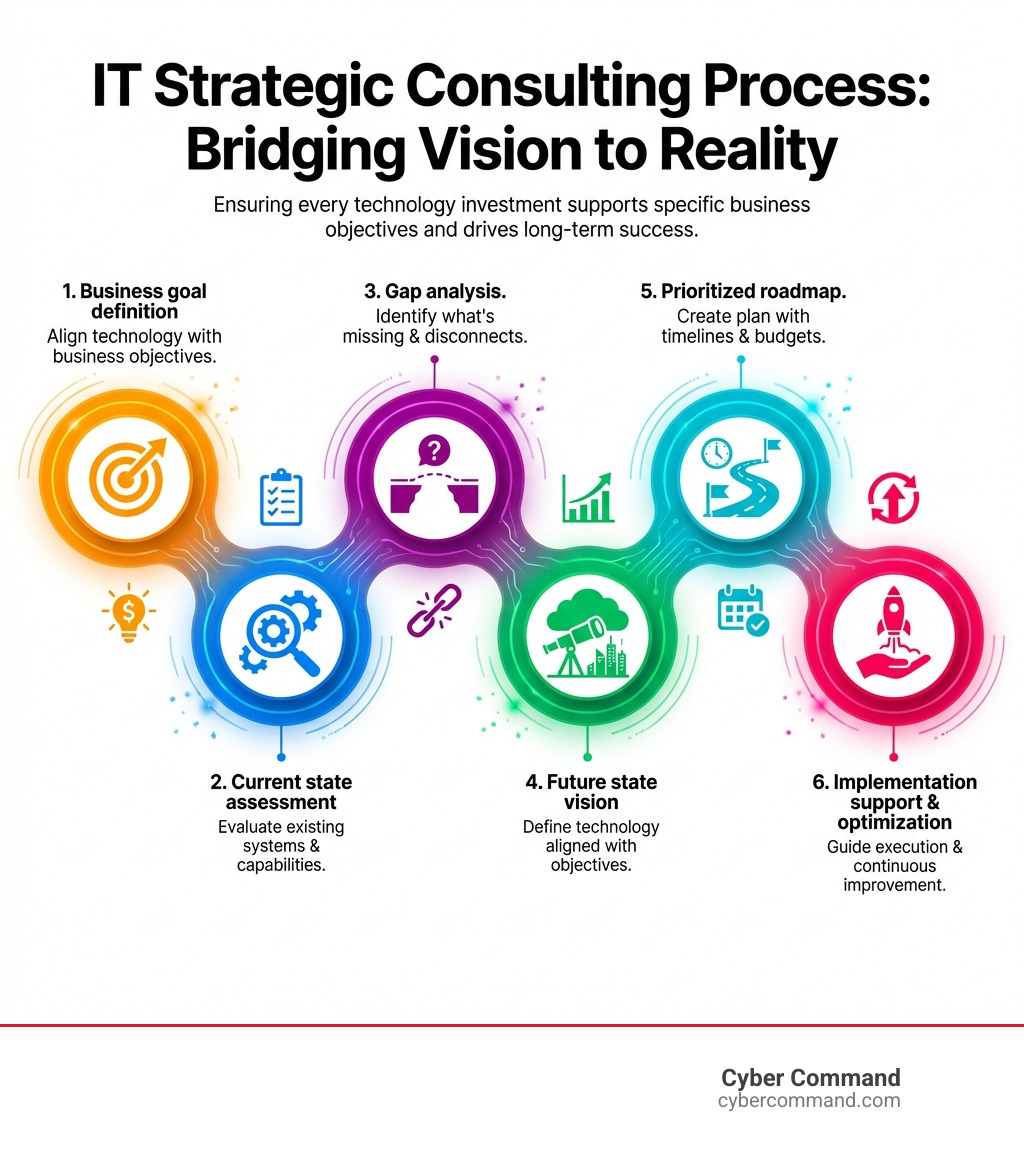
Our approach to IT strategic consulting follows a structured, five-step process to ensure thoroughness and alignment.
- Needs Assessment & Findy: We engage with stakeholders to understand your business challenges, strategic priorities, and current IT pain points.
- Current State Analysis: We dive deep into your existing IT environment, assessing everything from data centers and networks to application portfolios and spending.
- Future State Visioning: We work with you to envision a future where your IT systems, people, and processes are fully aligned with your business strategy, often through “art of the possible” workshops.
- Roadmap Development: We transform the vision into a concrete plan by conducting a gap analysis and defining prioritized initiatives with clear timelines, budgets, and resource requirements. This can include AI roadmap development.
- Implementation & Optimization: We support the execution of initiatives and establish metrics to monitor effectiveness, ensuring continuous improvement and ongoing value.
Key Components of a Comprehensive IT Strategy Roadmap
A comprehensive IT strategic roadmap is your blueprint for success, guiding technology investments over 3-5 years. Key components include:
- Executive Summary: A high-level overview of objectives, recommendations, and expected business impact.
- Business Goals and Objectives: A clear articulation of the business outcomes the IT strategy will support.
- Current State Analysis Summary: A recap of your existing IT environment’s strengths and weaknesses.
- Future State Vision: A description of the target IT landscape and how it enables business goals.
- Technology Initiatives and Projects: A prioritized list of specific projects required to reach the future state.
- Timelines & Milestones: A phased approach with clear timelines for execution.
- Budget & Resource Allocation: A detailed breakdown of estimated costs and human resources required.
- Risk Assessment and Mitigation Plan: Identification of potential risks and plans to mitigate them, such as a disaster recovery plan.
- Governance and Ownership: Defined roles, responsibilities, and decision-making processes.
- Key Performance Indicators (KPIs): Metrics to measure the success and ROI of the strategy.
Opening up Business Value: The Tangible Benefits of IT Strategic Consulting
This section explores the concrete outcomes and advantages organizations gain from expert guidance.
Driving Operational Efficiency and Cost Savings
One of the most immediate benefits of IT strategic consulting is improved operational efficiency and substantial cost savings. We examine your processes and technology to identify redundancies and opportunities for optimization through:
- Process Automation: Automating manual, repetitive tasks to free up your team for higher-value activities.
- System Consolidation: Streamlining your application portfolio to reduce licensing costs, maintenance, and complexity.
- Vendor Contract Negotiation: Leveraging industry expertise to negotiate more favorable terms with technology vendors.
- Cloud Cost Optimization: Analyzing cloud usage to ensure you get the most value and prevent unnecessary spend, contributing to cloud migration cost savings.
- Resource Optimization: Ensuring your IT team and assets are deployed effectively to eliminate waste and maximize productivity.
By focusing on these areas, we help transform your IT department from a cost center into a lean, efficient engine.
Enhancing Cybersecurity and Ensuring Compliance
Robust cybersecurity and unwavering compliance are non-negotiable. IT strategic consulting helps build a resilient defense and steer the complex regulatory landscape by:
- Proactive Risk Management: Identifying potential vulnerabilities in systems, processes, and human factors before they can be exploited.
- Security Posture Assessment: Evaluating existing security controls to pinpoint weaknesses and recommend strategic improvements.
- Compliance Mapping (HIPAA, GDPR, etc.): Mapping your IT practices to specific compliance requirements to meet legal obligations and avoid penalties.
- Incident Response Planning: Developing a clear plan to respond to and recover from a cyberattack, minimizing damage and downtime.
- Zero Trust Architecture: Implementing a security model that assumes no user or device is trusted by default, strengthening defenses.
Our goal is to integrate security into your IT strategy, limiting risk and building a culture of security. Learn more about protecting your assets with our cybersecurity resources.
Fueling Agility, Innovation, and Growth
IT strategic consulting is a powerful catalyst for agility, innovation, and sustainable business growth, enabling you to adapt and seize new opportunities. We empower your business by:
- Business Flexibility: Designing IT systems and processes that can quickly adapt to market shifts and new business models.
- Scalable Infrastructure: Ensuring your IT infrastructure can seamlessly scale to support growth without disruption.
- Data-Driven Decision Making: Leveraging data analytics to gain insights into customer behavior, operational performance, and market trends.
- Leveraging Emerging Technologies (AI/ML): Guiding you in adopting cutting-edge technologies like AI and ML to forecast trends and improve efficiency. 77% of global companies are exploring AI; we help you harness its power.
- Supporting Remote/Hybrid Work: Crafting robust strategies and recommending tools like virtual private networks (VPNs) for computers to support distributed teams securely.
By embracing these advancements, your business gains the flexibility to pivot and the foundation to grow. Explore the possibilities with our cloud computing solutions.
Choosing Your Partner: Selection, Challenges, and Future-Proofing Your Strategy
Finding the right firm is as critical as the strategy itself. This section guides you through the process.
How to Select the Right IT Strategy Consulting Firm
Selecting the right IT strategic consulting firm is a pivotal decision. It’s about finding a partner who understands your vision and can translate it into an actionable technology plan. When selecting a firm, consider the following:
- Expertise and Experience: Look for a proven track record in your industry. A firm with deep expertise, like Cyber Command’s 25+ years in tech, brings invaluable insights.
- Methodologies and Offerings: A good consultant has a clear process. Ask about their methodologies for assessment, roadmap development, and change management.
- Cultural Fit and Communication: Ensure their values and communication style align with your organization. They should be able to explain complex concepts clearly.
- Case Studies and Testimonials: Review their past work with similar organizations and speak with references to verify their capabilities and impact.
- Long-Term Partnership Focus: Choose a firm committed to a long-term partnership, supporting implementation, monitoring progress, and making continuous improvements.
Ask potential partners how they align IT with business needs, manage change, and ensure ROI to find a firm that can deliver results.
Common Challenges and How to Overcome Them
IT strategic consulting engagements can face challenges. Recognizing them proactively ensures a smoother outcome.
- Resistance to Change: A major hurdle, as 67% of digital change projects are delayed. Overcome by fostering transparent communication, explaining the “why,” and involving stakeholders early.
- Rapid Technological Advancements: Keeping investments relevant is a constant battle. Overcome by building flexibility into your strategy with adaptable, modular solutions and continuous monitoring of trends.
- Misalignment Between IT and Business: Silos can lead to strategies that don’t deliver business value. Overcome with clear governance and shared KPIs that measure both tech performance and business outcomes.
- Budget and Resource Constraints: Balancing goals with finite resources is key. Overcome by prioritizing initiatives based on ROI and exploring phased implementations.
- Scope Creep: Uncontrolled project expansion leads to overruns. Overcome by defining clear scopes from the outset and using a rigorous change management process.
Emerging Trends Shaping the Future of IT Strategy
To future-proof your business, your IT strategy must account for emerging trends.
- Artificial Intelligence & Machine Learning (AI/ML): AI is becoming foundational for predictive analytics, automation, and customer service. Integrating AI is paramount, as 77% of companies are exploring it.
- Green IT & Sustainability: A growing emphasis on eco-friendly technology, including optimizing data center energy and using sustainable cloud solutions.
- Hyper-automation: Combining AI, ML, and RPA to automate as many business and IT processes as possible to streamline operations.
- Platform Engineering: Building internal platforms to help developers deliver software faster and more reliably. Platform engineering is crucial for accelerating digital product development.
- Advanced Cybersecurity: As threats evolve, strategies like Zero Trust frameworks and AI-integrated security operations are becoming essential for proactive defense.
These trends underscore the need for continuous strategic evaluation to innovate and lead.
Frequently Asked Questions about IT Strategy
What is the difference between IT strategy and IT implementation?
Strategy is the “what” and “why”—the high-level plan aligning technology with business goals. It defines what you want to achieve and why. Implementation is the “how”—the hands-on process of building, deploying, and integrating the technology outlined in the strategy, turning the blueprint into working systems.
How does IT strategy consulting support digital change?
IT strategic consulting acts as the architect for digital change. It creates the blueprint to ensure new technologies drive specific business outcomes, improve customer experience, and create a competitive advantage. Consultants guide organizations through this complex process, identifying the right technologies, optimizing workflows, and managing the cultural shift required for success. Learn more about insurance company digital transformation.
How long does an IT strategy consulting engagement take?
The duration varies based on company size, complexity, and scope. A typical engagement can range from a few weeks for a targeted assessment to several months for a comprehensive, enterprise-wide strategic plan and roadmap. Follow-up engagements can extend this partnership.
Turn Your IT Vision into a Competitive Advantage
In today’s business world, technology is a strategic imperative. IT strategic consulting is the essential bridge connecting your business aspirations with the technological capabilities needed to achieve them. It transforms IT from a reactive cost center into a proactive engine for growth, efficiency, and innovation.
Expert consulting aligns technology with business objectives, drives efficiency, improves cybersecurity, and fuels agility. By engaging with a trusted partner, you can steer complex technologies, overcome challenges, and capitalize on emerging trends.
At Cyber Command, we understand your business is unique. We offer proactive, 24/7/365 U.S.-based support with transparent, all-inclusive pricing, acting as a true extension of your team. We turn your IT vision into a tangible competitive advantage, ensuring your technology investments are transformative.
Don’t let technology hold you back. Let us help you future-proof your business and achieve victory through a carefully crafted IT strategy.
Schedule a Technology Strategy Session with us today and let’s start building your path to success.