
Unlock Peak Performance Strategies for Operational Efficiency


Why Operational Efficiency Solutions Drive Business Success
Operational efficiency solutions help organizations maximize productivity while minimizing costs and waste. If you’re looking to implement these solutions, here’s what you need to know:
Key Operational Efficiency Solutions:
- Process Optimization – Streamline workflows and eliminate bottlenecks
- Automation & RPA – Automate repetitive tasks to free up staff (80% of employees report automation lets them focus on valuable work)
- AI & Machine Learning – Enable data-driven decisions (78% of companies use AI for at least one task)
- Cloud Computing – Improve agility, scalability, and security
- Employee Training – Invest in skills development and collaboration
- Continuous Improvement – Apply Lean, Six Sigma, or Kaizen methodologies
What is Operational Efficiency?
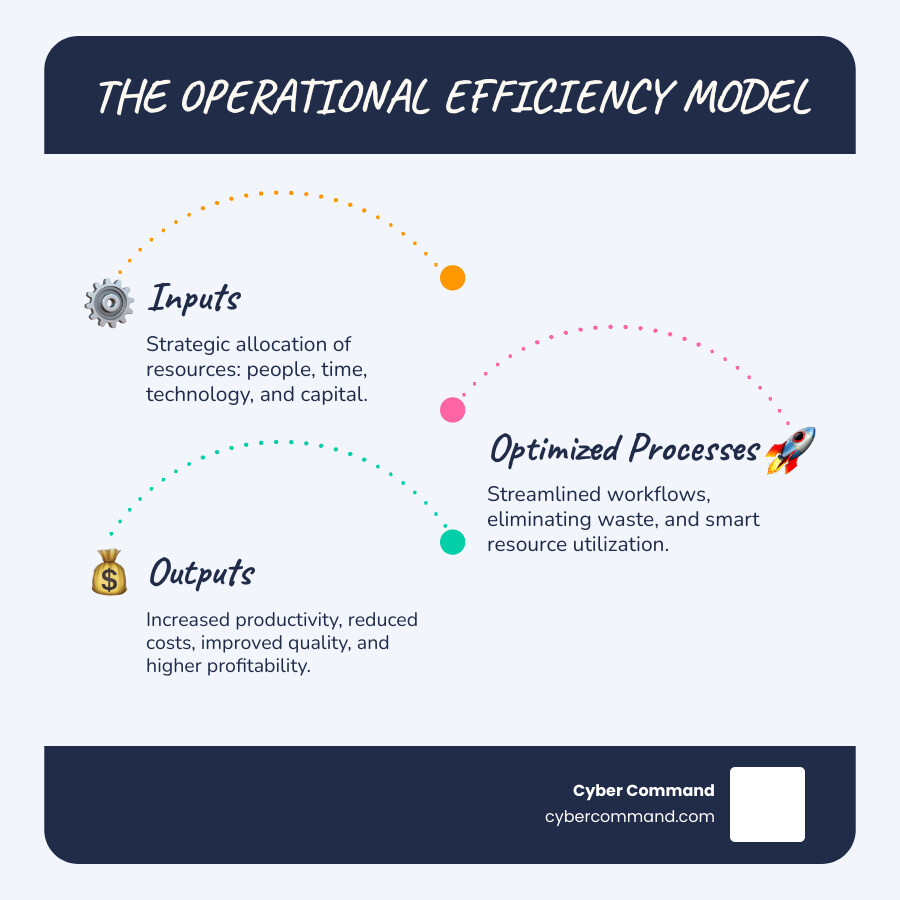
Operational efficiency means getting the most output from your inputs. It’s about using your resources—people, time, technology, and money—as smartly as possible.
Think of it this way: if you can produce the same quality product or service while spending less time or money, you’re operating efficiently. Classic management thinkers like Peter Drucker have highlighted this distinction for decades; you can find a concise overview of the concept on Wikipedia’s entry on efficiency.
Why It’s Crucial for Your Business
Every hour your team spends troubleshooting legacy systems or manually entering data is an hour they can’t spend serving customers or growing your business.
Here’s what operational efficiency delivers:
- Increased Profitability – Organizations using these solutions have reported improvements in operational efficiency by as much as 45%
- Competitive Advantage – Faster service delivery and better quality keep you ahead
- Resource Optimization – Do more with what you already have
For growing businesses, inefficient operations create a cascade of problems. Unexpected costs pile up. Systems break down at the worst times. Your team gets frustrated. Customers wait too long.
The good news? You don’t need to accept this as normal.
Modern operational efficiency solutions can transform how your business runs. They reduce waste, cut costs, and free your team to focus on what matters most.
My name is Reade Taylor, and I’ve spent my career helping businesses turn technology from a costly liability into a competitive advantage through operational efficiency solutions. After years of working with large, enterprise-grade systems, I founded Cyber Command to deliver reliable, proactive IT that actually makes businesses run better.
Relevant articles related to operational efficiency solutions:
Understanding and Measuring Your Current Operational State
Before we can improve anything, we need to know where we stand. Think of it like mapping out a journey; you need to pinpoint your starting location before you can chart the best course to your destination. Understanding your current operational state is the first critical step toward achieving peak performance.

We’ve found that key factors influencing operational efficiency are intertwined: people, processes, and technology. A weakness in one area can ripple through the others, creating bottlenecks and inefficiencies. To truly optimize, we need to conduct a thorough current state assessment of existing processes, workflows, and resource allocation. This helps us identify areas of improvement and pinpoint specific bottlenecks that might be holding us back. For example, we might find that a particular team or individual has an overly high workload that’s affecting their productivity. By restructuring or reallocating tasks, we can reduce costs and identify areas of improvement.
How to Measure Operational Efficiency
How do we know if we’re actually getting more efficient? We measure it! Organizations often use a metric called the “operational efficiency ratio” to measure this. It’s a straightforward calculation: you add your operating expenses and cost of goods sold, then divide that sum by your net sales. A lower or declining ratio generally indicates that a company is improving its operational efficiency performance.
But it’s not just about one number. We also rely on Key Performance Indicators (KPIs) to get a comprehensive view. These can include:
- Cycle time: How long it takes to complete a process from start to finish. Shorter cycle times usually mean happier customers and faster delivery.
- Throughput: The rate at which products or services are produced. Higher throughput with consistent quality is often a sign of efficiency.
- Inventory turnover: How quickly inventory is sold and replaced. Efficient inventory management avoids holding costs and obsolescence.
- Accounts receivable turnover: How quickly a company collects on its credit sales. Faster collection means better cash flow.
- Overtime hours: Excessive overtime can signal understaffing or inefficient processes.
- Order and picking accuracy: Errors here lead to returns, rework, and unhappy customers.
- Empty warehouse space: Too much unused space can indicate poor inventory planning or an inefficient layout.
By tracking these KPIs over time and comparing them to industry benchmarks, we can make data-driven decisions and promote a culture of continuous improvement. This approach helps us identify and address issues promptly, similar to how we conduct a thorough cybersecurity risk assessment to proactively protect your business.
Key Factors That Influence Efficiency
We’ve seen that operational efficiency isn’t a standalone concept; it’s deeply influenced by several interconnected factors.
- Human factors: This is all about our people. Are employees equipped with the right skills and knowledge? Are they motivated and engaged? Well-trained and empowered employees are more likely to identify inefficiencies and contribute to solutions. Investing in their development and fostering a positive work environment directly impacts productivity.
- Organizational factors: This covers our company’s structure, workflows, and culture. A well-designed and coordinated organization ensures resources are allocated effectively, and tasks are executed smoothly. Clear roles, efficient decision-making processes, and streamlined workflows are critical. A culture that accepts feedback and continuous improvement will naturally drive efficiency.
- Technological factors: Technology is a game-changer. Automation, data analytics, and integrated systems can revolutionize how we operate. When technologies are effectively adopted and used, they can streamline processes, reduce errors, and optimize resource utilization. This isn’t just about having the latest gadgets; it’s about strategic implementation and integration.
Core Strategies for Improving Operational Efficiency
Improving operational efficiency solutions requires a multi-faceted approach, addressing various aspects of an organization’s processes, technology, and workforce. It’s about working smarter, not just harder. We focus on three core strategies to achieve this: process optimization, employee empowerment, and continuous improvement. By embracing these principles, we can significantly improve operational efficiency and reduce costs across the board.
Streamline and Optimize Business Processes
At the heart of operational efficiency lies process optimization. This involves a thorough analysis of existing workflows to identify bottlenecks, redundancies, and inefficiencies. Imagine a manufacturing company using value stream mapping to visualize its entire production process, from raw material acquisition to product delivery. This visual representation often reveals excessive inventory buildup or unnecessary movement of materials, which can then be addressed.
Our goal is to remove inefficiencies, increase quality, and drive business value. We do this by:
- Process mapping: Visualizing every step of a process helps us understand how work flows, identify non-value-adding steps, and uncover areas for improvement.
- Workflow analysis: We scrutinize each task within a workflow to determine its necessity, sequence, and resource requirements.
- Eliminating redundancies: We cut out duplicated efforts or unnecessary steps that add no value to the final output.
- Standardizing procedures: Creating clear, consistent guidelines for repeatable tasks ensures uniformity, reduces errors, and makes training easier.
Process optimization is a keystone of modern digital change initiatives. It helps us improve project management, streamline operations, avoid bottlenecks, and produce continuous improvement across multiple existing processes. This is why we champion process optimization as a foundational element for any business looking to excel. Furthermore, leveraging digital process automation can take these efforts to the next level.
Empower Employees Through Training and Collaboration
Our employees are our greatest asset, and their role in achieving and maintaining operational efficiency cannot be overstated. When employees are well-trained and feel empowered, they perform tasks more effectively, contribute valuable insights for improvement, and foster innovation.
We believe in:
- Investing in employee training: Regular workshops on emerging technologies, cross-training across different roles, and continuous learning programs improve skills and increase operational flexibility. For instance, a software development company might offer regular workshops on new programming languages or methodologies to keep their team at the cutting edge.
- Creating open communication channels: Facilitating regular team meetings, feedback sessions, and using collaborative platforms ensures that information flows freely. This helps us understand and address operational challenges promptly.
- Fostering a collaborative culture: Encouraging teamwork through project management tools and virtual workspaces allows multiple individuals to contribute simultaneously, streamlining development processes and accelerating project timelines. This also boosts human security with effective cybersecurity awareness training.
- Encouraging feedback: Seeking employee feedback and conducting performance reviews are crucial for continuous refinement. Employees on the front lines often have the best insights into where inefficiencies lie and how to fix them.
Implement Continuous Improvement Methodologies
Operational efficiency is not a one-time fix; it’s an ongoing journey. We accept continuous improvement methodologies to ensure we’re always refining our processes and striving for better.
- Lean management principles: Lean focuses on eliminating waste (Muda) in all its forms—overproduction, waiting, unnecessary transport, over-processing, excess inventory, unnecessary movement, and defects.
- The 5S methodology: This is a lean tool for organizing workspaces for maximum efficiency and effectiveness. It stands for Sort, Set in Order, Shine, Standardize, and Sustain. A hospital implementing 5S in its emergency department might reorganize supply closets, standardize equipment locations, and implement visual management systems to ensure everything is easily accessible.
- Value stream mapping: As mentioned earlier, this technique helps visualize the flow of materials and information to identify and eliminate non-value-adding steps. A bank, for example, might use it to analyze its loan approval process, uncovering delays and unnecessary paperwork.
- Kaizen: This Japanese concept translates to “continuous improvement” and involves creating a culture where employees are encouraged to identify and implement small, incremental changes. These small changes, over time, lead to significant efficiency gains. Think of a call center adopting Kaizen, where agents suggest minor improvements to call scripts or customer interaction processes, collectively boosting overall service quality and speed. We recognize the profound impact of implementing Kaizen for continuous improvement.
- Six Sigma: This methodology focuses on reducing variability and defects in processes to achieve near-perfect quality. A pharmaceutical company applying Six Sigma to its production process could dramatically reduce variability in drug formulation, ensuring consistent product quality.
By applying these principles, often supported by advanced capabilities in platform engineering, we ensure that our operations are not just efficient today, but continuously evolving to meet future demands.
Leveraging Technology: Your Guide to Modern Operational Efficiency Solutions
Technology isn’t just a tool; it’s a transformative force that underpins modern operational efficiency solutions. It enables us to digitalize operations, achieve scalability, and drive unprecedented agility. In today’s business environment, embracing digital change through strategic technology adoption is no longer optional—it’s essential for survival and growth. This is where robust IT infrastructure management services become invaluable.

Accept Automation and RPA for Repetitive Tasks
One of the most impactful ways technology boosts efficiency is through automation. Manual, repetitive tasks are prime candidates for automation, freeing up our human talent for more strategic and engaging work.
- Automating manual processes: This can range from simple scripting to complex workflow automation. For instance, a financial services firm might deploy Robotic Process Automation (RPA) bots to handle data entry, account reconciliations, and report generation. This not only speeds up these tasks but also significantly reduces the chance of human error.
- Robotic Process Automation (RPA): RPA involves using software robots to mimic human interactions with digital systems. These “bots” can log into applications, enter data, calculate, and complete a wide range of tasks.
- Reducing human error: When machines handle repetitive, rule-based tasks, the likelihood of errors plummets, leading to higher quality output and less rework.
- Freeing up staff for high-value work: This is where the magic happens. Research shows that nearly 80% of employees report that automation has allowed them to spend more time on valuable activities, such as enhancing customer relationships. Imagine your team members, instead of slogging through spreadsheets, focusing on innovation, problem-solving, or building stronger client bonds. This is the promise of automation.
Implementing IT service management software can further streamline these automated processes, ensuring they are managed effectively and contribute to overall operational excellence.
Harness AI and Machine Learning for Smarter Decisions
Artificial Intelligence (AI) and Machine Learning (ML) are not just buzzwords; they are powerful operational efficiency solutions that enable us to make smarter, data-driven decisions at an unprecedented scale.
- Predictive analytics: AI can analyze vast amounts of historical data to predict future trends, such as equipment failures or customer demand. This allows us to move from reactive to proactive strategies. Imagine using IoT sensors on production equipment to predict maintenance needs, thus minimizing downtime.
- Data-driven decision-making: AI-powered systems can analyze complex datasets in real-time, providing insights that human analysts might miss. This helps us optimize business processes, identify bottlenecks, and adapt to market trends faster.
- Supply chain optimization: AI can revolutionize supply chain management by optimizing routes, forecasting demand, and managing inventory more effectively. For example, medical manufacturers can use AI to determine optimal delivery routes for devices, ensuring timely and efficient distribution.
- Customer service improvement: AI-powered chatbots and virtual assistants can handle common customer queries, freeing up human agents for more complex issues and enhancing overall customer satisfaction.
The adoption is widespread: a recent survey found that 78 percent of companies use artificial intelligence for at least one task. AI helps operations managers streamline processes, reduce costs, and improve efficiency by analyzing data for real-time decision-making, finding bottlenecks, and predicting equipment failures. We explore more about how AI is used in business and help clients with AI roadmap development to integrate these capabilities effectively.
Adopt Cloud Computing for Agility and Security
Cloud computing is another cornerstone of modern operational efficiency solutions, offering unparalleled agility, scalability, and robust security.
- Migrating to the cloud: Moving our IT infrastructure and applications to cloud platforms provides flexibility, allowing us to scale resources up or down as needed without significant capital expenditure. This is why many organizations are exploring the benefits of moving to the cloud.
- Scalable infrastructure: Cloud environments can effortlessly handle fluctuating workloads, ensuring that our operations remain smooth even during peak demand.
- Improved data security: Reputable cloud providers invest heavily in cutting-edge security measures, often surpassing what individual businesses can achieve on their own. This includes advanced encryption, access controls, and continuous monitoring.
- Disaster recovery: Cloud-based disaster recovery solutions offer faster recovery times and greater resilience against disruptions, ensuring business continuity.
Our cloud migration services guide businesses through this transition, ensuring a smooth and secure shift that open ups these efficiency gains.
Common Mistakes to Avoid When Improving Efficiency
While the path to operational efficiency is paved with good intentions, it’s also littered with common pitfalls. We’ve learned that avoiding these mistakes is just as crucial as implementing the right strategies.
- Unclear goals: Diving into efficiency initiatives without clearly defined objectives is like setting sail without a destination. We need to establish explicit, measurable goals to track progress and determine success. Without them, efforts can become scattered and ineffective.
- Lack of communication: Change is hard, and without transparent and consistent communication, employees can feel disenfranchised or resistant. Keeping everyone informed about why changes are being made, how they will impact their roles, and what the benefits will be is vital for buy-in and successful implementation.
- Ignoring employee input: The people closest to the processes often have the best insights into where inefficiencies lie and how to fix them. Failing to solicit and act on employee feedback is a missed opportunity for valuable solutions and can lead to resentment. We encourage a culture where every voice matters.
- Overcomplicating solutions: Sometimes, in our zeal to optimize, we introduce overly complex solutions that create new problems. Simplicity and practicality should always be prioritized. A complex process or solution is inherently less efficient and harder to maintain.
- Neglecting change management: Implementing new operational efficiency solutions requires more than just new technology or processes; it requires people to adapt. Neglecting a structured change management approach—which includes training, support, and addressing concerns—can lead to resistance, low adoption rates, and ultimately, project failure. This is a common challenge, especially during significant transitions like data center migration challenges.
By being mindful of these potential missteps, we can steer the journey to operational efficiency more smoothly and effectively.
Frequently Asked Questions about Operational Efficiency
We often get asked similar questions when discussing operational efficiency solutions. Here are some of the most common ones:
What are the three main factors of operational efficiency?
We typically define the three main factors of operational efficiency as:
- Cost reduction: Minimizing the expenses associated with producing goods or services without compromising quality. This involves streamlining processes to eliminate waste and optimize resource utilization.
- Time optimization: Accelerating the speed at which tasks are completed, products are delivered, or services are rendered. This means reducing cycle times and eliminating delays to improve responsiveness.
- Quality maintenance: Ensuring that products or services consistently meet or exceed standards, even as costs are reduced and time is optimized. Efficiency should never come at the expense of quality.
What is the difference between operational efficiency and operational effectiveness?
This is a great question, and it’s easy to confuse the two!
- Operational efficiency is about “doing things right.” It focuses on optimizing processes to maximize output with minimal input, reducing waste, and performing tasks in the best possible way. It’s about how well you use your resources.
- Operational effectiveness is about “doing the right things.” It focuses on whether your efforts and strategies align with your overall business goals and future plans. It’s about ensuring your efficient operations are contributing to the right outcomes for your business.
Think of it this way: you can be incredibly efficient at digging a ditch (doing it quickly and cheaply), but if the ditch is in the wrong place, you’re not effective. True success comes from being both efficient and effective.
| Feature | Operational Efficiency | Operational Effectiveness |
|---|---|---|
| Focus | How well tasks are performed | Whether the right tasks are being performed |
| Goal | Maximize output, minimize input, reduce waste | Align operations with strategic goals and future plans |
| Question Asked | Are we doing this process in the best way? | Is this process the right one for our business objectives? |
| Impact | Cost reduction, speed, quality consistency | Competitive advantage, market position, long-term growth |
What are some real-world examples of operational efficiency solutions?
We’ve seen these solutions implemented across various industries:
- Manufacturing: Implementing just-in-time (JIT) inventory management, as pioneered by Toyota, ensures that parts arrive precisely when needed, minimizing storage costs and waste. Automated production lines also boost throughput and consistency.
- Public Sector: Government agencies, facing flat budgets and limited staff, are increasingly adopting operational efficiency solutions. For instance, El Paso County Criminal Justice Coordination Department in Texas automated pretrial processes, enhancing accuracy and streamlining overall case management. This frees up staff for more impactful activities. We’ve also seen cities increase customer use of self-service payment options, like IVR and Text-to-Pay, by 10% within three months, and cut average monthly shut-offs in half by empowering customers with these convenient options.
- Retail: Optimizing supply chains through data analytics for demand forecasting helps retailers avoid overstocking or understocking, reducing waste and lost sales. Efficient store layouts and automated checkout systems also improve customer experience and operational flow.
- Finance: Financial services firms use Robotic Process Automation (RPA) for repetitive administrative tasks like data entry, account reconciliations, and report generation. This speeds up processing, reduces errors, and frees up human employees for more complex, client-facing work.
Conclusion: Achieving Long-Term Success and Profitability
Achieving operational efficiency is not just about cutting costs; it’s a strategic imperative that drives long-term success and profitability. We’ve explored how understanding your current state, implementing core strategies like process optimization and employee empowerment, and leveraging technology such as automation, AI, and cloud computing, are all vital components of effective operational efficiency solutions.
This journey is continuous, requiring consistent application, continuous evaluation, and adaptability. By focusing on doing things right and doing the right things, you can build a more agile, resilient, and profitable business.
At Cyber Command, we understand that navigating this landscape can be complex. That’s why we act as an extension of your business, offering enterprise-grade IT, cybersecurity, and platform engineering services with proactive, 24/7/365 U.S.-based support and transparent, all-inclusive pricing. We’re here to help you turn technology into a competitive advantage and lift your business with managed IT support services.
Ready to open up peak performance and achieve operational excellence? Let us help you revolutionize your operations. Find how we can help you achieve operational excellence with our Managed IT Services.