
The ROI of IT: How to Achieve Cost-Effective Solutions


Why Smart IT Investment Matters More Than Ever
Cost-effective IT solutions are about getting maximum value from every technology dollar you spend, not just cutting corners. With many SMBs spending a significant portion of their revenue on technology, optimizing that spend is critical.
Here is what cost-effective IT means in practice:
- Strategic spending – Investing in solutions that align with business goals and deliver measurable ROI.
- Waste elimination – Identifying and removing redundant software, underused licenses, and inefficient processes.
- Resource optimization – Making existing infrastructure work harder through virtualization, cloud migration, and automation.
- Proactive management – Preventing expensive emergencies through monitoring, maintenance, and planning.
- Smart outsourcing – Leveraging managed services for expertise without full-time staffing costs.
The challenge is not just about spending less; it is about spending smarter. Many businesses waste 30% or more of their software budgets on unused licenses or maintain expensive, unnecessary on-premise infrastructure.
The good news is that a structured approach to IT cost optimization can reduce expenses by 25-40% while improving operational efficiency. The key is identifying the highest-impact initiatives for your business.
I am Reade Taylor, Founder and CEO of Cyber Command. I have spent my career helping businesses turn wasteful IT spending into a strategic advantage. I have seen how the right cost-effective IT solutions free up resources for growth and build more resilient technology foundations.
Deconstructing IT Costs & Building a Strategic Foundation
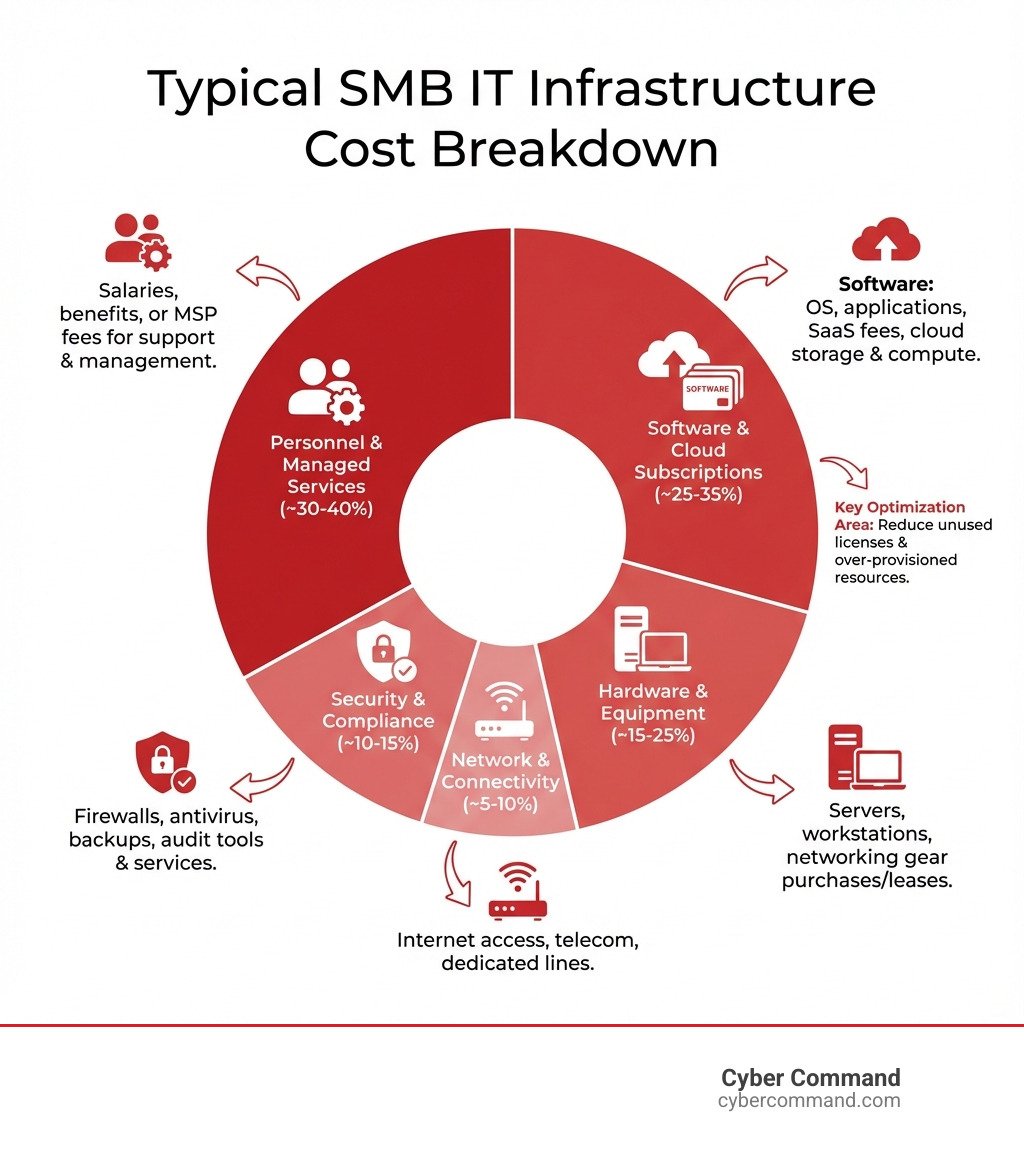
Understanding where your IT budget goes is the first step toward achieving cost-effective IT solutions. For many SMBs in Florida and Texas, IT infrastructure costs can feel like a labyrinth of expenses. Cyber Command helps you steer and simplify that complexity.
Understanding Your Primary IT Expenditures
Your main IT costs typically fall into several key areas:
- Hardware Expenses: Physical components like servers, storage, networking gear, and computers. These are often large upfront capital expenditures.
- Software Licensing Fees: Recurring costs for operating systems, productivity suites, and specialized applications, especially with SaaS models.
- Maintenance and Support: Ongoing work to keep systems running, including updates, patches, and technical support.
- Energy Consumption: The often-overlooked cost of powering and cooling IT equipment, especially servers.
- Hidden Costs: These expenses drain resources and include unused software (often 30% of software spend), redundant applications, shadow IT (unapproved tech), and legacy systems. A recent McKinsey study found older systems can consume 74% of a company’s IT spend while hindering agility.
Developing a Strategic IT Roadmap
An IT roadmap, developed through services like our IT Project Management Services, aligns technology with your business goals. A good roadmap should:
- Align IT with Business Goals: Ensure technology supports objectives like market expansion or improved customer service.
- Plan for Upgrades: Proactively budget for hardware refreshes to avoid sudden failures and large, unplanned expenses.
- Measure Return on Investment (ROI): Define clear metrics to track the success of IT projects and justify future spending.
- Prevent Surprise Expenses: Anticipate future needs to ensure your IT infrastructure can scale with your business.
This foresight is key to managing IT expenditures. Our IT Infrastructure Management Services can help build this plan.
How to Prioritize Cost-Saving Initiatives
To decide where to start, we use an “impact vs. budget” analysis:
- Identify Quick Wins (High Impact, Low Cost): Initiatives like auditing software licenses or optimizing cloud usage that offer significant savings with minimal investment.
- Focus on High-Impact Projects (High Impact, High Cost): Larger initiatives like cloud migration or infrastructure modernization that promise substantial long-term benefits.
- Implement Phased Approaches: Break down complex projects into smaller, manageable phases to reduce risk and budget incrementally.
- Leverage Expert Frameworks: We adapt principles from leading research firms. For example, Gartner suggests 10 rules for rapid IT cost reduction that can help organizations cut costs significantly by renegotiating contracts and consolidating infrastructure. We tailor these principles to your specific needs.

Prioritizing correctly ensures that your efforts yield the best possible returns without disrupting critical operations.
Infrastructure Optimization: Doing More with Less
One of the most direct paths to cost-effective IT solutions is optimizing your core infrastructure, making existing resources work harder and smarter instead of simply buying more hardware.
Adopting Virtualization to Slash Hardware Costs
Virtualization runs multiple independent systems on a single physical server.
- What is Virtualization? It creates virtual versions of IT resources like servers, storage, and networks, allowing one powerful server to host several virtual machines.
- How it Saves Money:
- Reduced Footprint: Fewer servers mean less space, energy, and cooling costs.
- Lower Hardware Needs: Buy and replace less hardware, cutting capital expenditures.
- Improved Resource Utilization: Maximize the use of your hardware, extracting more value from your investment.
- Simplified Management: Managing fewer physical machines streamlines maintenance.
Our IT Management Services can guide you through this transformative process.
The Financial Upside of Hardware Standardization
Standardizing your hardware simplifies support, speeds up onboarding, and streamlines security. The benefits include:
- Simplified Troubleshooting: Our support team can resolve issues faster on uniform equipment.
- Faster Onboarding: New employees get set up quickly with pre-configured, standard devices.
- Streamlined Security: Pushing patches across a uniform fleet is more efficient and secure.
- Bulk Purchasing Power: Buying the same equipment in larger quantities often opens up volume discounts.
We have seen businesses reduce IT support calls by nearly 40% in the first year after standardizing workstations. It is a cornerstone of our Business IT Services.
Practical Steps to Optimize IT Energy Consumption
You can significantly reduce energy consumption with these steps:
- Invest in Energy-Efficient Hardware: Prioritize models with strong energy ratings when upgrading.
- Efficient Cooling Techniques: Use strategies like hot and cold aisle containment to cut energy use in server rooms.
- Automatic Shutdown Policies: Power down non-critical systems or use low-power states during off-peak hours.
- Consolidate and Virtualize: Fewer physical servers directly lower your energy bill.
Leveraging Cloud, Software, and Audits for Smart Savings
The digital landscape offers powerful tools for achieving cost-effective IT solutions, particularly through cloud adoption, smart software choices, and diligent asset management.
How to Leverage Cloud Computing for Cost-Effective IT
Cloud computing is a game-changer for cost efficiency. It shifts costs from large upfront capital expenditures (CapEx) to a more flexible operational expenditure (OpEx) model.
- Pay-as-You-Go Models: This scalability means you only pay for the resources you consume, avoiding waste from over-provisioning. For example, a small retail shop saved $20,000 annually by moving to a cloud-based inventory system.
- Cloud Models (Public, Private, Hybrid): A hybrid cloud, mixing public services (like AWS or Azure) and private infrastructure, often provides the most agile and cost-effective approach.
- Eliminating On-Premise Costs: Migrating to the cloud can eliminate hardware refreshes and maintenance, with businesses often reducing IT costs by 20-30%.
- Improved Scalability: The cloud allows your IT resources to grow or shrink with your business needs, a key benefit we highlight in Elevate Your Business: Scalability of Managed IT Services.
However, expert management is crucial, as studies show significant public cloud spending can be wasted without it.
| Feature | On-Premise Infrastructure | Cloud Infrastructure |
|---|---|---|
| Cost Model | High CapEx (upfront hardware purchase) | Low CapEx, High OpEx (pay-as-you-go subscription) |
| Scalability | Limited, requires manual upgrades | Highly elastic, scales up or down on demand |
| Maintenance | Internal IT team responsible for all hardware | Provider handles hardware maintenance |
| Energy Costs | Significant for power and cooling | Included in service, no direct energy bill |
| Downtime | Higher risk due to single points of failure | High availability, built-in redundancy |
| Security | Full control, but full responsibility | Shared responsibility model, provider expertise |
| Flexibility | Lower, tied to physical assets | High, access resources from anywhere |
Reducing Fees with Open-Source Software
Open-source software (OSS) can be a powerful tool for cost savings by eliminating licensing fees.
- Benefits: Besides no licensing fees, OSS offers customization flexibility and strong community support.
- Popular Tools: Consider options like LibreOffice, GIMP, and Linux for server environments.
While the software is free, we can help you evaluate the implementation and support costs to ensure it is the right fit for your security and functional needs.
The Role of Regular IT Asset Management and Audits
Effective IT asset management and regular audits are critical for eliminating waste.
- Software License Waste: Studies show most organizations waste about 30% of their software spending on unused licenses. Regular audits identify this waste.
- Identifying Redundant Software: Audits can reveal where different departments purchased similar tools, allowing you to consolidate and save.
- SaaS Auditing: We help track every subscription, user count, and usage pattern to ensure you are only paying for what you truly need.
- Tracking Asset Lifecycle: Proper tracking from procurement to disposal allows for better planning and maximizes the lifespan of your investments.
The Human & Process Element of Cost-Effective IT Solutions
Technology is vital, but the human element and operational processes are equally crucial for achieving cost-effective IT solutions.
Outsourcing to Managed IT Services for Expertise and Savings
For many SMBs, an in-house IT department is prohibitively expensive. Managed IT services are a cost-effective alternative.
- Predictable Monthly Costs: A fixed monthly fee allows for clear budgeting and eliminates surprise IT costs.
- Access to Specialized Expertise: Gain a full team of experts in cybersecurity, cloud management, and more, without the high cost of full-time staff.
- Proactive Support: Our 24/7/365 U.S.-based monitoring prevents problems, which is far more cost-effective than reacting to disasters. Businesses often reduce IT costs by 25-40% while improving efficiency with managed services.
- Reduced Downtime: Proactive monitoring and rapid response keep your operations running smoothly.
Learn more about Why Choose Managed IT Services? and our IT Managed Services for Small Business.
Automating IT Operations to Boost Efficiency
Automating repetitive, manual IT tasks frees up human resources and reduces errors.
- Key Areas for Automation: User onboarding and offboarding, software patching, system monitoring, and data backups.
- Benefits: Automation saves time, reduces the chance of costly human error, and allows your team to focus on strategic work that drives business growth.
Strategies for Negotiating Better IT Vendor Terms
Getting the best terms on software, hardware, and service contracts is a critical part of cost-effective IT.
- Our Approach: We use data on your actual usage to negotiate from a position of strength. We also regularly review contracts, look for bundling opportunities, and explore alternatives to ensure you get maximum value from every vendor.
How Employee Training and Remote Support Cut Costs
Investing in your employees’ IT literacy is a smart play.
- Security Awareness Training: Human error is a leading cause of breaches. Training on phishing and safe browsing drastically reduces risk, as we explain in Impact of Cybersecurity Threats on Small Business Operations.
- Efficient Use of Tools: Training ensures you get more value from your software investments.
- Faster Issue Resolution: Our U.S.-based remote IT support resolves most issues quickly, reducing downtime and eliminating travel costs. As our clients have shared in How 24/7 IT Support Transformed My Company’s Operations, this is a game-changer.
Why Proactive Cybersecurity is a Cost-Effective Measure
Cybersecurity is not an optional expense; it is a non-negotiable investment. For businesses in Florida and Texas, robust cybersecurity is a cornerstone of cost-effective IT solutions.
The True Cost of a Security Breach
The impact of a cybersecurity incident extends far beyond immediate recovery costs. It includes:
- Financial Losses: Costs for investigation, data recovery, and potential ransom payments.
- Reputational Damage: A breach erodes customer trust, leading to lost business.
- Business Interruption: Downtime grinds your business to a halt, crippling productivity.
- Legal and Regulatory Fines: Depending on the data compromised, you could face hefty penalties.
Investing in proactive cybersecurity is always cheaper than dealing with the aftermath of a breach. Recent reporting indicates that the average data breach can cost small businesses tens of thousands of pounds or dollars when all direct and indirect costs are added up, making prevention far more economical than recovery.
High-Impact, Low-Cost Security Investments
You do not need an unlimited budget for a strong security posture. Many high-impact measures are surprisingly affordable.
- Multi-Factor Authentication (MFA): This is a highly effective control that significantly reduces account takeover risk. With credential theft being a primary cause of breaches, implementing MFA is critical.
- Regular Backups: Automated, encrypted backups are your safety net against ransomware and hardware failure.
- Employee Security Training: Your employees are your human firewall. Regular training on phishing and social engineering is a low-cost, high-return investment.
- Endpoint Protection: Robust antivirus and anti-malware software on all devices is essential.
- Vulnerability Scanning: Regularly scan your systems for weaknesses that attackers could exploit.
These foundational measures, which can be implemented affordably, align with frameworks like the What is the NIST Cybersecurity Framework?. Proactive security is an insurance policy for your business continuity.
Frequently Asked Questions about Cost-Effective IT
What is the difference between IT cost-cutting and IT cost optimization?
IT cost-cutting is a short-term, reactive measure to immediately reduce expenses, often by eliminating services or deferring maintenance. This can harm long-term performance and lead to higher costs later.
IT cost optimization, in contrast, is a strategic, proactive approach. It focuses on getting more value from every dollar by eliminating waste, improving efficiency, and aligning IT with business goals. Optimization is about spending smarter, not just less, while maintaining or improving capabilities.
How much should a small business budget for IT?
While there is no single answer, a common benchmark for small businesses is 3% to 6% of annual revenue. However, it is more important to focus on the ROI of technology investments. A higher IT spend that boosts productivity and provides a competitive advantage is more valuable than a low budget that leaves you inefficient or vulnerable.
Can I implement these IT solutions myself?
While some basic IT tasks can be handled in-house, truly cost-effective IT solutions often require specialized expertise, especially for complex areas like:
- Cloud migration and optimization
- Advanced cybersecurity
- Server virtualization
- Strategic IT roadmap development
Attempting complex projects without the right expertise can lead to costly mistakes, security vulnerabilities, and downtime. Partnering with IT professionals ensures solutions are implemented correctly, securely, and with your long-term success in mind.
Conclusion
Achieving cost-effective IT solutions is well within reach for businesses in Florida and Texas. It is not about cutting corners but adopting a strategic mindset that prioritizes value, eliminates waste, and leverages modern technology to its fullest.
By understanding your IT spending, developing a clear roadmap, optimizing infrastructure, and embracing the cloud, you can transform IT from a cost center into a strategic asset. Investing in proactive cybersecurity, employee training, and expert managed IT services builds a resilient, efficient, and secure foundation for growth.
At Cyber Command, we are your strategic partner. Our proactive, 24/7/365 U.S.-based support and transparent, all-inclusive pricing provide enterprise-grade IT, cybersecurity, and platform engineering services without the enterprise-level headaches. We act as an extension of your team, dedicated to maximizing the ROI of your technology investments.
Ready to turn your IT spending into a strategic advantage? Discover the benefits of a Co-Managed IT partnership with us and let us build a more cost-effective and secure future for your business.