
July 18, 2026
Managed Cybersecurity Services Orlando: A 2026 SMB Guide
Protect your Orlando business. Our guide to managed cybersecurity services orlando covers costs, key features, and how to choose the right local partner.
You’re probably dealing with this right now. Business is moving, your team is busy, clients expect fast responses, and technology has become the backbone of everything from scheduling to billing to customer communication. In Orlando, Winter Park, Winter Springs, Sanford, Lake Mary, and across Central Florida, that usually means a small or mid-sized company is trying to grow while also depending on systems that were never designed with serious security oversight in mind.
That’s where risk creeps in. It isn’t always a dramatic attack. Sometimes it’s a missed patch on a laptop, weak sign-in security on email, backups that exist but haven’t been tested, or a provider that says “we handle security” when they really mean antivirus and basic support. For many local companies, the primary challenge isn’t a lack of concern. It’s a lack of time, internal expertise, and a clear way to separate effective protection from marketing.
Managed cybersecurity services in Orlando solve that gap when they’re done right. They give Florida businesses a practical path to stronger protection, better accountability, and faster response without having to build a full internal security team from scratch.
Table of Contents
- Why Orlando Businesses Need a Digital Fortress
- Defining Managed Cybersecurity Services
- Core Components of a Robust Security Partnership
- The Business Case for Central Florida SMBs
- How to Choose the Right Cybersecurity Partner in Orlando
- Decoding Pricing and ROI for Managed Cybersecurity
- Your Next Step to Secure Your Florida Business
Stuck on something like this right now?
Talk it through with a real US-based engineer, 24/7, no phone trees: (407) 587-0089.
Book a Free Strategy SessionWhy Orlando Businesses Need a Digital Fortress
An Orlando business owner can do a lot of things right and still be exposed.
A law office downtown may have strong client relationships and reliable staff. A dental practice in Winter Park may run a smooth schedule and keep patients happy. A field service company in Seminole County may be growing fast and adding devices, users, and cloud apps every quarter. None of that automatically creates cyber resilience. In fact, growth often widens the attack surface before leadership realizes it.
The local business environment makes that more urgent. Central Florida companies rely heavily on email, cloud files, mobile devices, line-of-business software, payment systems, and third-party vendors. That combination creates lots of openings for account compromise, ransomware, data loss, and plain operational disruption.
Growth creates exposure
Most small businesses don’t neglect security because they don’t care. They neglect it because the day gets full. The owner is focused on revenue. The office manager is juggling vendors. The internal IT contact is handling support tickets, not threat monitoring. Security becomes reactive.
That’s the exact pattern attackers look for.
A business doesn’t need to be famous to be worth targeting. It just needs usable data, money movement, or weak controls.
For Orlando and surrounding Central Florida cities, the practical issue is resilience. Can your business keep operating if an employee clicks the wrong link, an account gets taken over, or a server goes down after suspicious activity? If the answer is “we’d have to figure it out,” then the business has a security gap.
Security has to support operations
Managed cybersecurity works when it’s tied to business continuity, not just technical alerts. Good protection means someone is accountable for watching systems, identifying suspicious behavior, helping contain problems, and making sure recovery works effectively.
That changes cybersecurity from a vague IT add-on into something much more useful. It becomes part of how your company protects revenue, client trust, and day-to-day operations across Orlando and Central Florida.
Defining Managed Cybersecurity Services
Managed cybersecurity services are best understood as a dedicated external security team on retainer. Instead of hiring analysts, building processes, and staffing around the clock on your own, you contract with a provider to deliver those security functions continuously.
That sounds simple, but many Florida buyers get misled at this point.

What a real managed security provider does
A true Managed Security Service Provider, or MSSP, doesn’t just install tools and wait for something to break. The defining technical distinction between an MSSP and a general IT managed service provider is the presence of a dedicated Security Operations Center staffed by analysts focused on threat monitoring, triage, and incident escalation, rather than general IT support. MSSPs also deliver continuous services under an SLA that typically includes 24/7 monitoring, continuous log ingestion from endpoints and networks, SIEM management aligned with NIST SP 800-92, and recurring vulnerability scanning aligned with NIST SP 800-40, as outlined in this Orlando MSSP overview.
That matters because a helpdesk technician and a security analyst do different jobs. One solves user problems. The other looks for malicious behavior, validates alerts, and escalates incidents using documented playbooks.
What buyers should listen for
If a provider says they offer security, ask what that means. You’re listening for signs of real operational depth, such as:
- Dedicated SOC coverage: Someone is actively reviewing alerts and suspicious events, not just forwarding notifications.
- Continuous log collection: The provider is ingesting data from endpoints, firewalls, servers, and cloud systems for security analysis.
- Incident triage and escalation: There’s a defined path for identifying, validating, and containing real threats.
- Vulnerability management: Weaknesses are found, prioritized, and tracked instead of being left as open recommendations.
A lot of confusion in the Orlando market comes from providers bundling basic IT support with a few security tools and calling the whole package “cybersecurity.” That’s not the same thing as managed detection, monitoring, investigation, and response.
Why the distinction matters in practice
If your team gets locked out of email, a general IT provider may reset passwords and restore access. If an attacker is actively using those credentials across multiple systems, a real security partner investigates scope, isolates affected accounts or hosts, preserves evidence, and helps contain lateral movement.
Practical rule: If the provider can’t clearly explain who watches alerts, how incidents are escalated, and what happens after detection, you’re probably buying IT support with security add-ons, not managed cybersecurity services in Orlando.
Core Components of a Robust Security Partnership
A strong security partnership isn’t one service. It’s a set of connected operating disciplines. The global managed security market is built around outsourced 24/7 monitoring, threat intelligence, vulnerability assessment, incident response, firewall management, and compliance reporting, with measurable performance tied to metrics like MTTD and MTTR. In Orlando, MSSPs serve organizations that lack internal security operations by handling continuous log ingestion across endpoints, networks, and cloud environments, with SIEM operations aligned to NIST SP 800-137, according to managed security market and Orlando service scope data.
Here’s what that looks like when it’s useful to an SMB.

Monitoring that means something
Lots of providers say they “monitor.” A key question is what they monitor, how they validate suspicious activity, and what they do when they find it.
A mature partner collects logs from multiple systems and correlates them so a single odd event doesn’t get ignored. That’s how repeated failed sign-ins, unusual mailbox activity, endpoint alerts, and firewall events get turned into an actual investigation instead of a pile of disconnected noise.
Vulnerability management and patch discipline
Most breaches don’t start with movie-style hacking. They start with neglected basics. Vulnerability management identifies weaknesses, while patching and configuration control reduce the chances those weaknesses turn into incidents.
This has to be operational, not ceremonial. A monthly spreadsheet with unresolved items isn’t enough. The provider should know which systems matter most, which exposures are aging, and who owns remediation.
Response capability
Detection without response is just better visibility into your own problems.
A useful security partner helps contain incidents fast. That may include isolating a host, disabling a compromised account, validating backup readiness, or coordinating internal and third-party response steps. Some organizations use a fully managed model, while others split duties with internal IT leadership.
The best security relationship is one where containment steps are already agreed on before the emergency starts.
Compliance and reporting
For many Central Florida businesses, security isn’t just about blocking attacks. It’s also about proving controls exist and are being maintained.
Healthcare groups, financial firms, contractors, and professional services organizations often need documented reporting, recurring reviews, and evidence that controls are active. That’s why mature engagements include regular reporting and business reviews, not just technical work in the background.
The six building blocks in plain language
- Threat detection and response: The provider watches for suspicious activity and acts when something appears credible.
- Vulnerability management: Systems are reviewed for weaknesses, and remediation is tracked.
- Employee security training: Users learn how to recognize risky emails, requests, and login behavior.
- Data protection and backup: Sensitive data is protected, and recovery is tested, not assumed.
- Compliance support: Controls and reporting align with the business’s regulatory obligations.
- Incident planning: The team knows who decides what during an event.
Some businesses also want identity governance, vendor coordination, and executive reporting rolled into the relationship. That’s common in firms with lean internal teams. If you want a quick visual example of how cybersecurity evaluation is often presented in the local market, this Orlando cybersecurity recognition graphic reflects the kind of category buyers often encounter while vetting providers.

The Business Case for Central Florida SMBs
Cybersecurity in Central Florida isn’t one-size-fits-all because the business mix isn’t one-size-fits-all.
A medical practice in Winter Springs handles sensitive patient information and scheduling systems that can’t stay down for long. An accounting firm in Orlando depends on email trust, document security, and controlled access to financial records. An engineering company in Lake Mary may have project data, vendor relationships, and remote staff who connect from job sites or home offices. A manufacturer or industrial operator in the region may care less about buzzwords and more about uptime, recovery, and whether an incident halts production or dispatch.

Foundational controls matter more than flashy ones
In the Orlando SMB market, approximately 60 to 75 percent of cyber incidents are prevented by foundational hygiene controls alone, specifically MFA, systematic patch management, and isolated backups, according to local Orlando cybersecurity guidance. That same guidance stresses a layered architecture made up of protection, monitoring and investigation, and response and recovery.
That’s an important trade-off. Many owners think the first step is buying advanced monitoring. Often it isn’t. If MFA is inconsistent, patching is ad hoc, and backups haven’t been validated, the business is exposed before any SOC tooling enters the picture.
A local business lens
Many Orlando companies make better decisions when they think like operators, not technicians.
Business type
What usually matters most
Professional services
Email security, identity controls, document access, client confidentiality
Medical practices
Account protection, device management, backup validation, compliance alignment
Financial firms
Strong access control, logging, incident handling, documentation
Industrial and field service teams
Uptime, remote device security, vendor access control, recovery readiness
A practical security stack for Central Florida SMBs usually starts with the basics and then layers on monitoring and response. That’s also why businesses planning growth should think about operations and marketing together. If you’re expanding a service business, Digital Skyrocket’s guide for service companies is useful because growth increases digital exposure. More inbound leads, more customer communication, and more staff activity usually mean more accounts, more data, and more risk to manage.
Compliance can’t be bolted on later
Florida healthcare providers, defense contractors, and financial firms face specific compliance obligations, and generic security packages often leave out that scope. When that happens, businesses end up with technical tools that don’t fully match their contractual or regulatory exposure. The result is often confusion during audits, insurer reviews, or incident response.
Security that ignores your industry requirements is incomplete, even if the dashboard looks good.
For managed cybersecurity services in Orlando to deliver business value, they have to match local operating reality. That means protecting revenue, supporting uptime, and fitting the compliance burden your company already carries.
How to Choose the Right Cybersecurity Partner in Orlando
Buying managed cybersecurity services in Orlando gets easier when you stop listening to package names and start asking operational questions.
A lot of local marketing blurs the line between IT support and true managed security. In Orlando, that distinction is often hidden from buyers, and 90 percent of local provider listings don’t clearly reflect the nuance between general support and a real security operation with dedicated analysts. That gap is highlighted in the earlier Orlando MSSP definition source, but the practical point is simple. If you don’t ask sharper questions, you can sign a contract that sounds secure without delivering true security depth.
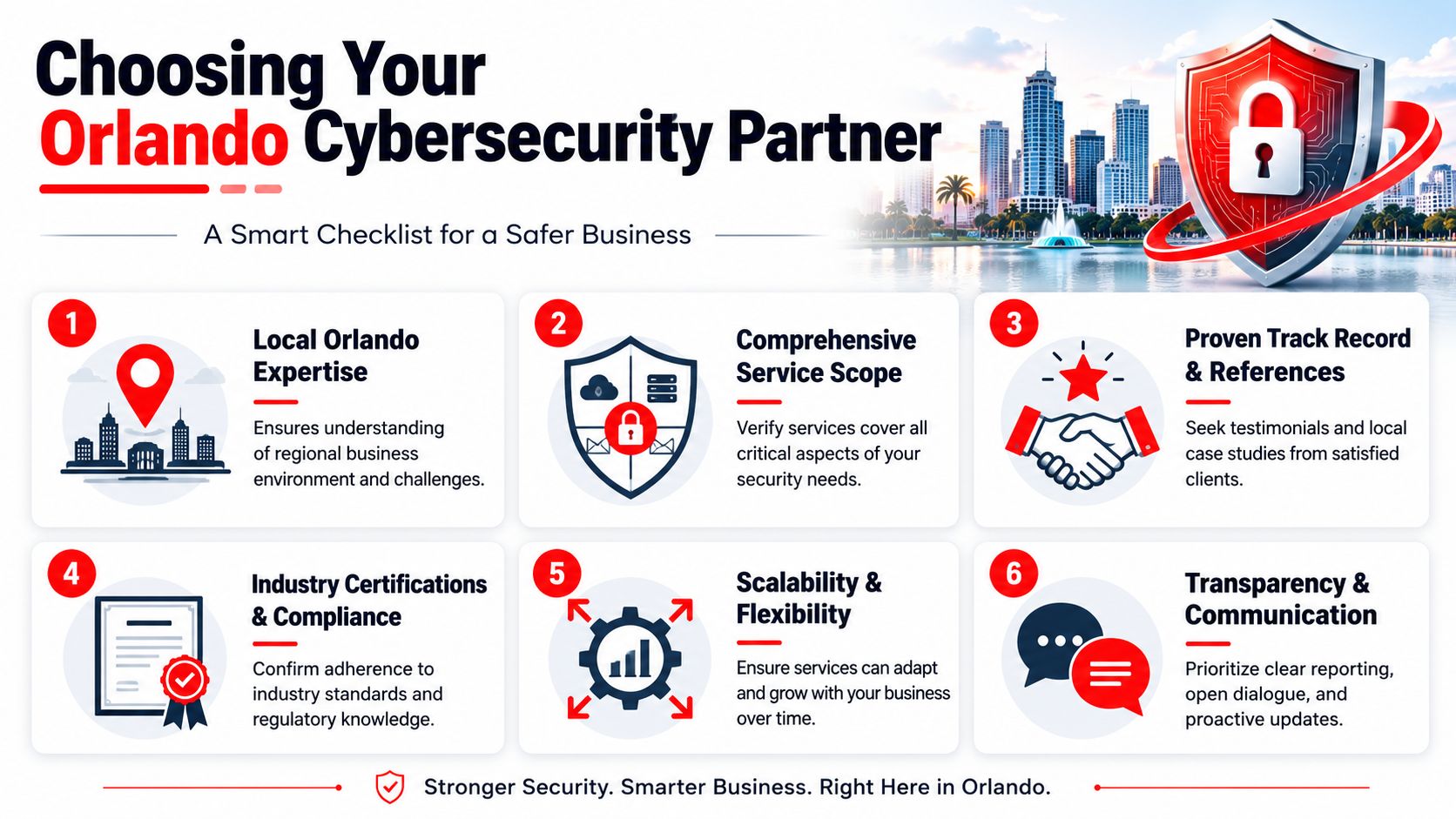
Questions that reveal real capability
Use these in discovery calls and proposal reviews.
-
Who is watching security alerts after hours?
If the answer is vague, outsourced without oversight, or mixed into general helpdesk duties, that’s a warning sign. -
What data do you collect for security analysis?
You want a clear explanation of endpoint, firewall, server, and cloud visibility. -
What happens when you confirm suspicious activity?
Ask for the first containment steps, escalation path, and communication process. -
How do you handle vulnerability remediation?
Good providers don’t just scan. They assign, track, and review remediation progress. -
What reporting will leadership receive?
Executive summaries, recurring reviews, and accountability matter more than raw alert counts. -
How do you support my industry in Florida?
This matters for healthcare, financial services, legal, industrial, and community organizations.
What weak proposals tend to look like
Some proposals look polished but avoid accountability. Watch for signs like these:
- Tool-heavy language: The proposal lists products but not operating responsibilities.
- No incident workflow: There’s no plain-language explanation of what happens during a security event.
- Backup ambiguity: The provider says backups are “included” but doesn’t define testing, retention, or recovery validation.
- Compliance blur: They say they support compliance but can’t map services to your actual obligations.
Normalize the quote before you compare it
Don’t compare providers only by monthly price. Compare line by line.
Ask whether the flat rate includes endpoint protection, patch cadence, email security oversight, backup accountability, vendor administration, incident triage, reporting, and review meetings. A lower price may mean key work has been excluded.
One local example of how Orlando cybersecurity firms may present credibility in the market can be seen in this Orlando cybersecurity company graphic. The useful takeaway isn’t the badge itself. It’s that buyers still need to verify what sits behind the branding.

Buyer test: If a provider can’t explain the human process behind the tools, the tools won’t save you when something goes wrong.
Decoding Pricing and ROI for Managed Cybersecurity
Most Orlando business owners don’t need perfect pricing on day one. They need a realistic range and a way to judge value.
In Orlando and the broader Central Florida market, small businesses with 10 to 100 employees typically spend between $1,000 and $5,000 per month on managed cybersecurity services covering endpoint protection, email security, firewall management, and basic SOC monitoring, according to Central Florida managed cybersecurity pricing data. In the same market, security-forward managed IT plans that include MDR, SIEM, and advanced compliance generally cost between $160 and $250 per user monthly, compared with baseline support at $110 to $180 per user.
What changes the monthly cost
Pricing usually shifts based on a few practical realities:
- User count and device count: More people and more endpoints mean more monitoring, support, and policy enforcement.
- Compliance scope: Regulated environments often need more documentation, review, and control oversight.
- Response expectations: Faster containment and deeper incident support generally require more mature service delivery.
- Environment complexity: Multiple locations, cloud systems, remote users, and vendor integrations add work.
Those ranges are useful, but they don’t answer the bigger question. Is it worth it?
ROI is mostly about avoiding expensive uncertainty
The strongest ROI case for managed cybersecurity usually isn’t “security helps us make money directly.” It’s “security reduces the chance that one preventable event turns into a business crisis.”
When email goes down, billing stops. When backups fail, recovery gets slower and more expensive. When an attacker gets access to one account, the issue can spread into finance, client records, or operations. A fixed monthly investment is easier to manage than a chaotic incident with legal, operational, and reputational consequences.
A smart way to think about ROI is to compare predictable recurring cost against the business impact of downtime, client disruption, leadership distraction, and remediation work. Even simple planning exercises can help. This IT cost planning visual reflects the broader budgeting mindset many companies use when deciding whether to keep reacting or shift to a managed model.

Don’t buy by headline fee alone
A low monthly number can be misleading if it excludes response, reporting, testing, or accountability for backups and patching. A higher fee may be justified if it closes the gaps that create risk.
That’s why the best pricing conversations focus on service scope first, then cost.
Your Next Step to Secure Your Florida Business
For Orlando and Central Florida SMBs, cybersecurity has become an operating requirement. Not a side project. Not a line item to revisit after the next close, next hire, or next expansion.
The practical path is clear. Get the basics right. Separate real security operations from generic IT support. Vet providers based on process, accountability, and fit for your industry. Then invest at the level your business needs, not the level a generic package assumes.
If you’re evaluating options, one local example is Cyber Command, LLC, which provides managed and co-managed cybersecurity support in the Orlando area with SOC-backed monitoring, incident response support, compliance assistance, and managed IT integration for organizations that need an outsourced security function without building one internally.
The right next step isn’t buying the biggest stack. It’s getting a clear view of your current gaps, your operational exposure, and the level of managed cybersecurity services Orlando businesses need to stay resilient.
If your business in Orlando, Winter Springs, or the broader Central Florida area needs a practical review of security gaps, recovery readiness, and provider accountability, talk with Cyber Command, LLC. A focused consultation can help you determine whether your current setup is just checking boxes or protecting the business.
Get updates like this in your inbox
Plain-English alerts when something like this breaks, and the occasional guide. No sales sequences; unsubscribe with one click.
This article is for general informational purposes only and is not legal, compliance, insurance, or other professional advice. Threats, technologies, and regulations change quickly; confirm current requirements with your own advisors before acting. See our full disclaimer.