Backup and Disaster Recovery for Florida SMBs

Monday opens normally in Orlando. Staff log in, phones ring, patients or clients start arriving, and then one screen shows an encryption notice. Another can’t reach the server. Scheduling stops. Billing stops. Intake stops. If you run a law office, dental practice, CPA firm, architecture studio, or multi-location service business in Central Florida, that moment stops revenue faster than most owners expect.

Florida businesses usually think about storms first. They should. But in practice, I see just as many shutdowns caused by ransomware, failed updates, aging storage, accidental deletion, and power problems that expose weak recovery planning. A backup file sitting somewhere isn’t the same as being able to keep the business operating.

Why Your Florida Business Needs a Real Recovery Plan

An Orlando law firm can survive a bad weather day. It has a much harder time surviving two days without document access, case notes, or billing. A Winter Springs dental office can reschedule around one broken workstation. It can’t function well if imaging, charts, and e-prescribing stay offline through a full patient schedule.

That’s the point business owners miss. Backup protects copies of data. Disaster recovery restores operations, systems, access, and the order everything has to come back online.

A concerned woman stands in an office looking at a computer screen showing a ransomware data encryption message.

What owners usually assume

Most owners I talk to believe they’re covered because someone told them backups are running. That’s a dangerous half-truth. More than 60% of organizations believe they can recover from a downtime event within hours, but only 35% could. Only 40% of technology leaders express confidence that their current backup and recovery solution can sufficiently protect critical assets in a disaster (Spanning).

That gap matters in Central Florida because disruption rarely arrives one problem at a time. A hurricane can trigger power instability, internet issues, office closure, and rushed remote work. A cyberattack can hit on the same week your key employee is out and your vendor is slow to respond.

Practical rule: If your team has never restored the systems you rely on, you don’t have proven recovery. You have hope.

Backup is one piece, not the whole strategy

You still need backups, and business owners should understand the basic types of backup because full, incremental, immutable, local, and cloud copies all play different roles. But none of those choices by themselves answer the hard questions:

  • Who restores what first
  • How employees work during the outage
  • Where your clean copy lives if the office is unavailable
  • How long the business can wait
  • How you communicate with clients, patients, and vendors

A real recovery plan treats downtime like a business interruption issue, not a server issue. That means deciding in advance what must come back first, who owns each task, and what fallback process keeps money moving while systems are restored.

For Florida SMBs, backup and disaster recovery isn’t a technical add-on. It’s continuity planning for hurricanes, cybercrime, hardware failure, and plain bad luck.

Understanding RTO RPO and Business Impact

A lot of business owners tune out when they hear technical acronyms. Don’t. Two of them decide whether your company closes for an inconvenience or a crisis.

RTO means how long you can be down

Recovery Time Objective, or RTO, is the maximum downtime your business can tolerate before the damage becomes unacceptable. It is comparable to the amount of time your front door can stay locked before the day starts going sideways.

For a medical office, that might mean electronic records and scheduling need to return fast. For a law firm, document management and email may be first. For an accounting office during tax season, the tax platform and file storage move to the top immediately. If you want a plain-English breakdown, this guide to Recovery Time Objectives (RTOs) is useful for non-technical leadership.

RPO means how much data you can afford to lose

Recovery Point Objective, or RPO, is the acceptable amount of lost work between the last good copy and the outage. Think of it as the paperwork gap you’d have to recreate.

If your backup last ran the night before and your server fails at 3 p.m., your business may lose a full day of entries, notes, uploads, or financial activity. Some firms can absorb that. Many can’t.

A dentist may be able to re-enter a few administrative notes. A financial firm may not be able to rebuild the same day’s reconciliations cleanly. A law office may have ethical and operational issues if document versions disappear.

Business impact decides what matters most

Not all systems deserve the same recovery target. That’s where a Business Impact Analysis, or BIA, comes in. It sounds formal, but the exercise is practical. You identify what the business needs to operate, rank those systems, and assign realistic recovery goals.

Start with these questions:

  1. What system stops revenue first
    For many SMBs, it’s scheduling, payments, phones, or line-of-business software.

  2. What system creates legal or compliance exposure
    Client files, patient data, retention systems, and audit records usually land here.

  3. What can wait until tomorrow
    Archive storage, old project data, and less-used internal systems often belong in a lower tier.

A recovery plan fails when it restores everything slowly instead of restoring the right things first.

Why prioritization matters

Many plans break at this stage. Recent reports show that 40% of business disruptions stem from recovery plans that are not aligned with business priorities. That misalignment is why 68% of SMBs that suffer an outage experience downtime lasting more than a full day (Warren Averett).

Those numbers line up with what happens in the field. Teams restore servers in technical order instead of business order. They bring back file shares before scheduling. They recover archived folders before the application that produces invoices. They restore data but forget the dependency chain, such as identity access, internet failover, VPN access, printing, or vendor-hosted application access.

A simple tier model works better than one big plan

Business tier What belongs here Recovery expectation
Tier 1 Systems that stop patient care, client service, billing, or communication Fastest recovery target
Tier 2 Important operational systems that staff need soon after Restored after core operations
Tier 3 Archives, historical data, low-use tools Restored later

For a Central Florida business, this model keeps you honest. It forces a decision: if the office is dark, internet is unstable, or ransomware hits, what gets your team working again first?

That’s what backup and disaster recovery should answer.

Choosing Your Recovery Architecture On-Prem Cloud or Hybrid

Architecture choices aren’t abstract. They affect recovery speed, cost, maintenance burden, and how much risk you carry if your office loses power or access.

A simple way to think about it is this. On-premise recovery is like owning a generator at your building. Cloud-based recovery is like relying on outside infrastructure to keep operations available elsewhere. Hybrid gives you both a local path for speed and an offsite path for serious disruption.

A comparison chart outlining the pros and cons of on-premise, cloud-based, and hybrid backup and disaster recovery architectures.

On-premise recovery

On-premise means your backup storage and much of your recovery capability sit inside your office or under your direct control.

That setup can work well when you need very fast restores of local files, large imaging data, or line-of-business systems that staff access all day. It also appeals to firms that want tighter physical control over hardware.

The trade-off is obvious in Florida. If the building has a power event, flood issue, fire, theft, or network equipment failure, the recovery environment may be affected by the same incident as production.

On-premise works best when:

  • You need fast local restores for large files or busy production systems
  • You have in-house IT capability to monitor hardware, storage health, patching, and backup jobs
  • You also keep protected offsite copies so a building-level incident doesn’t take out everything

Cloud recovery and DRaaS

Cloud-based recovery, often delivered as Disaster Recovery as a Service, shifts recovery infrastructure offsite. That can be a strong fit for firms with multiple locations, hybrid work, or limited appetite for maintaining local recovery hardware.

The biggest strength is geographic separation. If your Winter Springs office is unavailable, you still have a path to restore systems elsewhere. The biggest limitation is dependency on provider design, internet performance, and the quality of the failover plan.

Cloud recovery is often a practical option for SMBs that want operational simplicity. It’s also worth reviewing broader cloud disaster recovery options if you’re comparing hosted failover, cloud backups, and full recovery environments.

Cloud recovery protects you from local events better than local-only recovery. It doesn’t remove the need to plan users, access, sequencing, and vendor dependencies.

Hybrid recovery

For many Central Florida SMBs, hybrid is the most sensible architecture. You keep a local recovery path for quick restores and an offsite copy or standby environment for real disaster scenarios.

That matters when you have two very different recovery jobs:

  • restoring a deleted folder quickly for a staff member
  • keeping the business alive when the office, server, or network is down

Hybrid designs also fit regulated environments well. A medical practice may need fast file-level recovery during normal operations, but also an offsite path for continuity if the local environment is compromised.

On-Premise vs. Cloud vs. Hybrid Recovery Architectures

Attribute On-Premise Cloud (DRaaS) Hybrid
Control Highest direct hardware control Lower direct control, provider-managed components Shared control
Local restore speed Often strong for local workloads Depends on bandwidth and design Strong for priority local restores
Resilience to office-level disaster Weak unless paired with offsite copy Stronger for geographic separation Strongest balance for most SMBs
Maintenance burden Highest Lower internal burden Moderate
Complexity Lower if environment is simple Moderate, depends on provider Highest if poorly designed
Best fit Firms with strong IT ownership and local performance needs Firms that want offsite resilience and simpler operations Firms that need both speed and broader continuity

What works and what doesn’t

What works is choosing architecture based on business operations.

A law office with heavy document use may need fast local recovery plus offsite failover. A dental group with imaging, scheduling, and compliance concerns often benefits from hybrid. A smaller accounting firm with cloud-first apps may lean more heavily on DRaaS if access control and restore testing are solid.

What doesn’t work is buying storage first and asking business questions later. It also doesn’t work to put every workload in one basket, whether that basket is a closet server or a single cloud platform.

Use architecture to support the recovery order you already defined. Not the other way around.

How to Create a Practical Disaster Recovery Policy

A disaster recovery policy should be short enough to use under stress and detailed enough that your team doesn’t guess. If it reads like a generic compliance template, it won’t help when your office is dealing with a ransomware screen, failed storage array, or building outage.

The policy has one job. Tell people exactly what to do, in what order, with what authority.
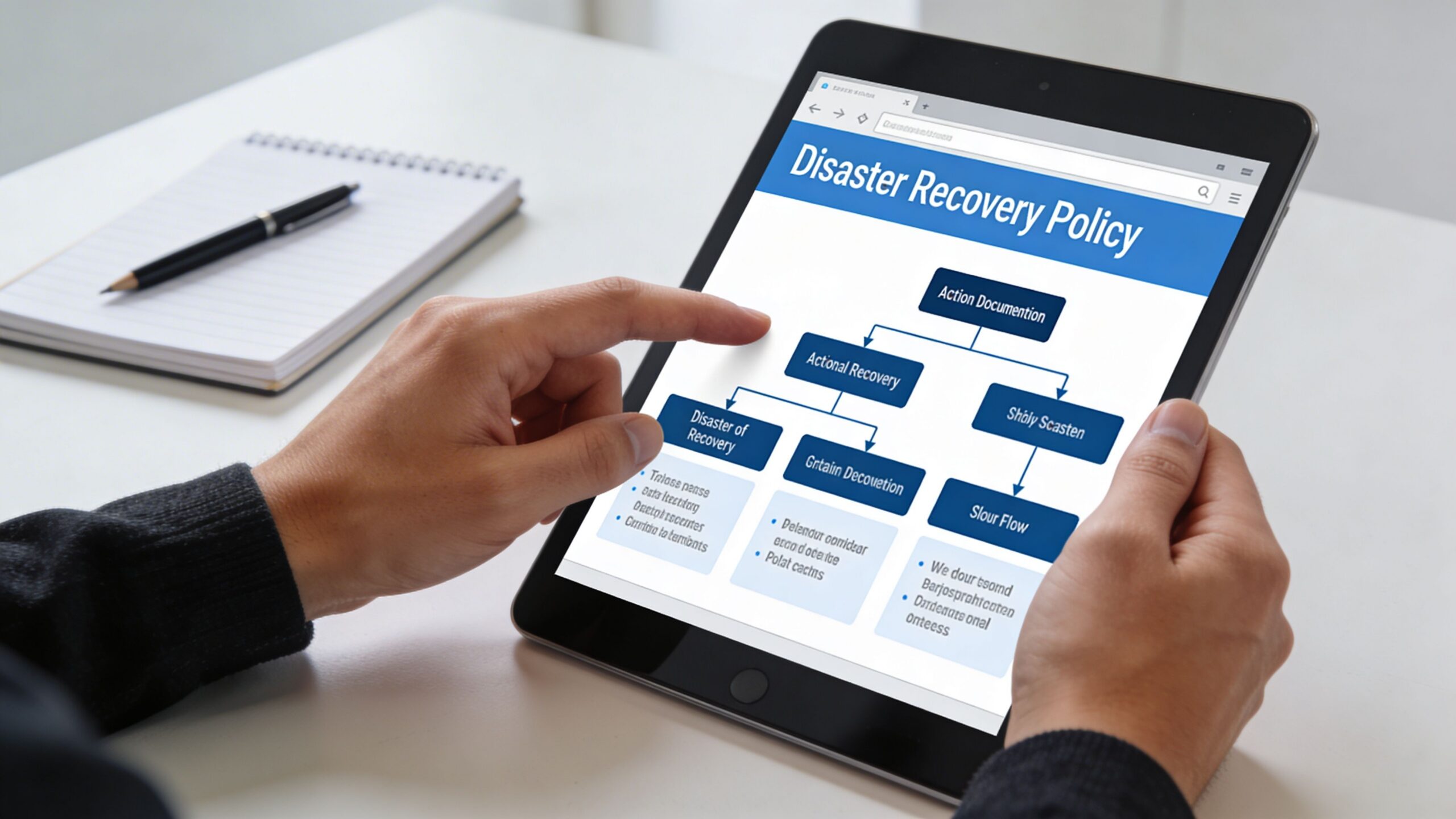
A person reviewing a disaster recovery policy flowchart on a tablet computer in an office setting.

Put the business inventory first

Start with a clean inventory of what matters:

  • Core applications such as practice management, document management, accounting, scheduling, and email
  • Infrastructure dependencies such as servers, cloud tenants, firewalls, switches, identity platforms, and internet circuits
  • Data locations including laptops, local servers, SaaS platforms, cloud drives, and line-of-business vendors
  • Critical vendors whose systems your team can’t operate without

Most weak plans fail here. They list “server outage” as an event but never identify the applications and dependencies attached to that server.

Assign roles before you need them

During an outage, confusion wastes more time than bad hardware. Your policy should name who makes decisions and who executes tasks.

A practical small-business structure usually includes:

Role Responsibility
Business owner or executive Declares business impact and approves major recovery decisions
IT lead or managed provider Runs technical recovery steps and escalation
Department manager Validates business function after restore
Communications owner Notifies staff, clients, patients, and vendors
Compliance or privacy contact Reviews obligations involving sensitive data

Write names, alternates, phone numbers, and non-email contact methods into the document. If email is down, an email-only contact list is useless.

Build the checklist in recovery order

Your runbook should follow the order of operations, not the order equipment appears in a rack.

A practical checklist often looks like this:

  1. Contain the problem
    Is this ransomware, hardware failure, accidental deletion, or site outage? Isolation may matter before restoration begins.

  2. Declare the recovery mode
    Are you restoring files, failing over a server, or shifting staff to remote work?

  3. Restore Tier 1 systems first
    Focus on systems that keep patient care, client communication, billing, or scheduling moving.

  4. Validate access with real users
    A server being “up” doesn’t mean the front desk can print, the attorney can open a file, or the accountant can post transactions.

  5. Document what changed
    Track restored versions, temporary workarounds, and any security concerns discovered during recovery.

A good policy doesn’t try to predict every failure. It gives your team a clear chain of command and a repeatable decision path.

Tailor the policy to your industry

A generic plan won’t satisfy the operational realities of regulated businesses.

For healthcare practices, the requirement is more specific. HIPAA mandates a documented Contingency Plan with specific RTO and RPO targets, and expert benchmarks show that deploying a hybrid solution with automated verification can reduce effective RTO by up to 80% (Accountable HQ). That matters in real clinical workflows where scheduling, chart access, and e-prescribing can’t stay down long without affecting care.

For law firms, the policy should address client confidentiality during emergency access, remote work controls, and how ethical walls remain enforced if normal systems are unavailable.

For accounting and financial firms, document retention, access controls, and audit trail preservation should be explicit. Recovery isn’t complete if the data returns without the records needed to prove integrity.

Include the communication script

Most businesses focus on systems and forget people. Your policy should include prewritten templates for:

  • Internal staff updates
  • Client or patient notifications
  • Vendor escalation requests
  • Public-facing service disruption messages

Short, calm, and factual beats long and vague. During a recovery event, people need to know what’s affected, what to do next, and when the next update arrives.

Validating Your Plan Before Disaster Strikes

A backup and disaster recovery plan that nobody has tested will fail at the worst possible time. Not because the idea was bad, but because reality always exposes missing permissions, broken dependencies, expired credentials, and undocumented shortcuts.

That’s why validation matters more than how polished the document looks.

The testing gap is real

The numbers here are ugly. 71% of organizations perform no failover testing to ensure their outage prevention protocols work, 62% fail to conduct regular system backup and restoration exercises, and 25% have no controls in place to prevent malicious access to their backup infrastructure (Secureframe).

That combination is exactly what attackers want. If backups aren’t tested and backup systems aren’t protected, recovery can fail twice. First during the attack, then again during the attempted restore.

Testing doesn’t have to shut down your office

Owners often resist testing because they assume it means a painful all-day outage. It doesn’t.

Use layers of validation:

  • Tabletop exercise
    Leadership and operations staff walk through a realistic outage scenario and identify decision gaps.

  • File-level restore test
    Restore selected files or folders to confirm backup integrity and permissions.

  • Application recovery test
    Recover a non-production instance of a key application and verify staff can use it.

  • Failover simulation
    Conduct an after-hours or planned test of the broader recovery path.

A useful resource on structuring those exercises is this guide to disaster recovery testing.

Untested recovery plans usually fail on the small details. Service accounts, application sequence, printer mapping, remote access, line-of-business licensing, and user validation.

What to verify each time

Don’t treat testing like a box-checking exercise. Validate outcomes that matter to the business:

Test area What to confirm
Data integrity Files open, databases mount, and restored records are usable
Access control Correct users can log in and unauthorized access remains blocked
Dependency chain Authentication, networking, storage, and application sequence work together
Communication Staff know who declares the event and where updates come from
Recovery timing Actual restore time is compared to your target

The best tests create evidence. Save screenshots, timestamps, notes on what failed, and the actions needed to fix it. That turns testing into operational improvement instead of annual theater.

For Central Florida firms, I recommend tying tests to seasonal risk and business cycles. Don’t run your only meaningful exercise when everyone is already overloaded.

Evaluating DR Vendors and Managed Services

Most SMBs shouldn’t try to run mature backup and disaster recovery alone. The issue isn’t intelligence. It’s bandwidth, specialization, and the fact that recovery depends on constant maintenance that owners and office managers rarely have time to supervise.

The right vendor isn’t just selling storage. They’re taking responsibility for design assumptions, monitoring, recovery sequence, testing discipline, and security controls around the backup environment itself.
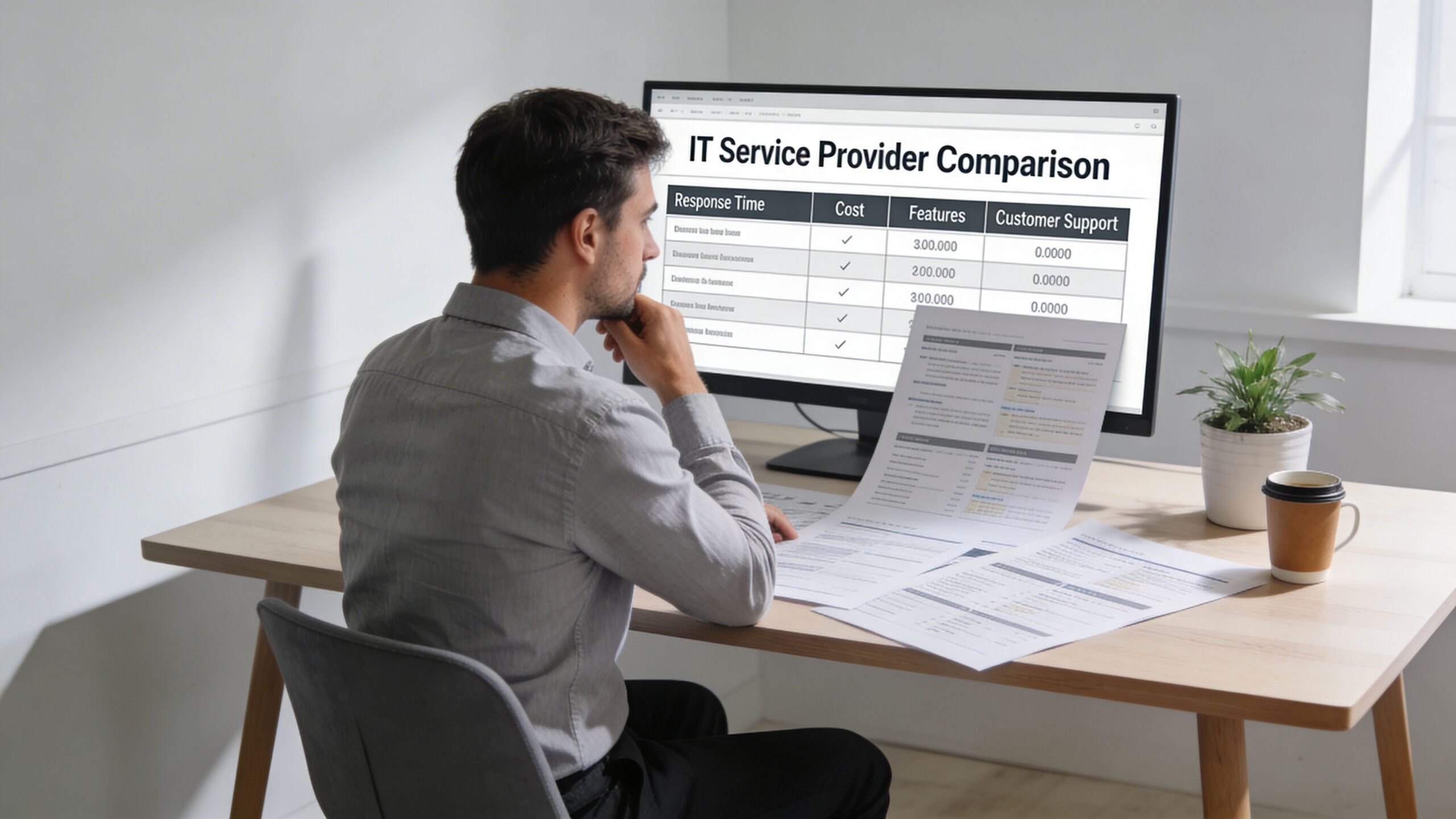
A professional man sitting at a desk reviewing IT service provider comparison reports on his computer.

Ask operational questions, not marketing questions

Don’t start with “How much storage do we get?” Start with the questions that expose whether the provider understands business continuity.

Ask things like:

  • What is your process when recovery starts at 2 a.m. on a weekend
  • Who validates the restore with our staff
  • How do you protect backup systems from unauthorized access
  • How often do you require restore testing
  • How do you handle SaaS data, local servers, and cloud workloads differently
  • What dependencies do you map before declaring a plan complete
  • How do you support firms in regulated fields like healthcare, finance, or legal

A serious provider should answer in operational detail, not generic promises.

Look for evidence of process maturity

You want proof that the vendor runs repeatable systems. That includes documented runbooks, named escalation paths, monitoring, reporting, and regular review meetings.

A vendor should be able to explain:

Evaluation area What good looks like
Monitoring Backup jobs, storage health, failures, and unusual activity are actively reviewed
Security Backup infrastructure is segmented, access is restricted, and changes are auditable
Testing Restores and failover exercises happen on a schedule, not only after incidents
Communication Clear contacts, escalation rules, and client-facing status updates exist
Fit The vendor understands your industry workflow, not just generic infrastructure

Regional experience matters in Florida

Ask directly how the provider handles hurricanes, office closures, generator limitations, internet instability, and remote work surges. A vendor can be technically capable and still unprepared for how Central Florida businesses operate during a regional event.

If you’re comparing managed options, review providers that specialize in disaster recovery as a service companies and compare them on process depth, not brochure language.

One option in this category is Cyber Command, LLC, which provides managed backup and disaster recovery, monitoring, failover planning, and SOC-backed security support as part of broader managed IT and cybersecurity services. That kind of bundled model can make sense when your recovery plan depends on helpdesk, endpoint protection, vendor management, and incident response all working together.

The wrong vendor gives you backup status emails. The right vendor shows you how the business will run when systems fail.

Warning signs

Walk away if a provider can’t explain testing cadence, can’t define recovery order, or treats compliance as somebody else’s problem. Also be cautious if every answer points back to a single product. Good recovery design is about process and fit, not just platform branding.

Your Actionable Disaster Recovery Checklist

If you’re a busy owner in Orlando, Winter Springs, or anywhere in Central Florida, start here. Don’t wait for the perfect project plan.

Print this and work through it

  1. List your three most critical business applications
    Pick the systems that stop revenue, service delivery, or compliance first.

  2. Set a downtime limit for each one
    Decide how long each system can be unavailable before the business is in trouble.

  3. Decide how much recent work you can afford to lose
    Be honest. For some systems, even a small data gap creates operational pain.

  4. Inventory where your data lives
    Include local servers, cloud apps, Microsoft 365 or Google Workspace data, laptops, shared drives, and vendor platforms.

  5. Map dependencies
    Note what each critical system needs to function, such as internet, identity access, printers, phones, or third-party software.

  6. Confirm you have both backup and a recovery process
    A copy of data is not the same thing as a working restoration sequence.

  7. Review who does what during an outage
    Name decision-makers, technical responders, department validators, and communications contacts.

  8. Protect the backup environment
    Limit access, review permissions, and make sure the recovery platform isn’t exposed to the same risk as production.

  9. Schedule your first test
    Start with a tabletop exercise, then move to a controlled restore test.

  10. Review the plan on a calendar
    Update it when systems change, staff leave, offices move, or vendors change.

A workable backup and disaster recovery program starts with clarity, not complexity.

Frequently Asked Questions About Disaster Recovery

What’s a realistic monthly budget for managed DR for a 20-person company in Florida

There isn’t one honest flat number that fits every business. Cost depends on how many systems you need to protect, how fast you need them back, whether you need local and cloud recovery, compliance requirements, and how much testing and vendor coordination is included. A small office with mostly SaaS apps will look different from a medical or legal practice with local systems and larger files.

How does a good DR plan help with HIPAA or financial compliance

It creates documented recovery procedures, access control expectations, testing evidence, and defined responsibilities. Auditors and assessors usually care less about buzzwords and more about whether you can show that sensitive systems and data can be restored in a controlled, documented way.

Why can’t I just use Dropbox or Google Drive as my backup

File sync isn’t the same as backup and disaster recovery. Sync tools are useful for collaboration, but they don’t replace versioned backup strategy, application-aware recovery, recovery sequencing, security controls, or tested failover planning. If bad data syncs, deletion syncs, or ransomware-encrypted files sync, you may just spread the problem faster.


If your business in Orlando, Winter Springs, or the broader Central Florida area needs a practical backup and disaster recovery plan, Cyber Command, LLC can help you evaluate your current gaps, define realistic recovery priorities, and build a managed approach that supports uptime, security, and compliance without turning recovery into a guess during an actual outage.

Your Guide to a Business Continuity Plan Test in Florida

That printed business continuity plan (BCP) sitting on a shelf feels reassuring, doesn't it? For most businesses I talk to, it’s a source of confidence. But in reality, it often provides a false sense of security.

A business continuity plan test is the only way to know if that document will actually work when disaster strikes. It’s the critical process of simulating a crisis to see if your plan can withstand real-world pressure. Without it, your BCP is just a collection of unproven guesses that will almost certainly crumble when you need them most.

Why Your Business Continuity Plan Will Likely Fail

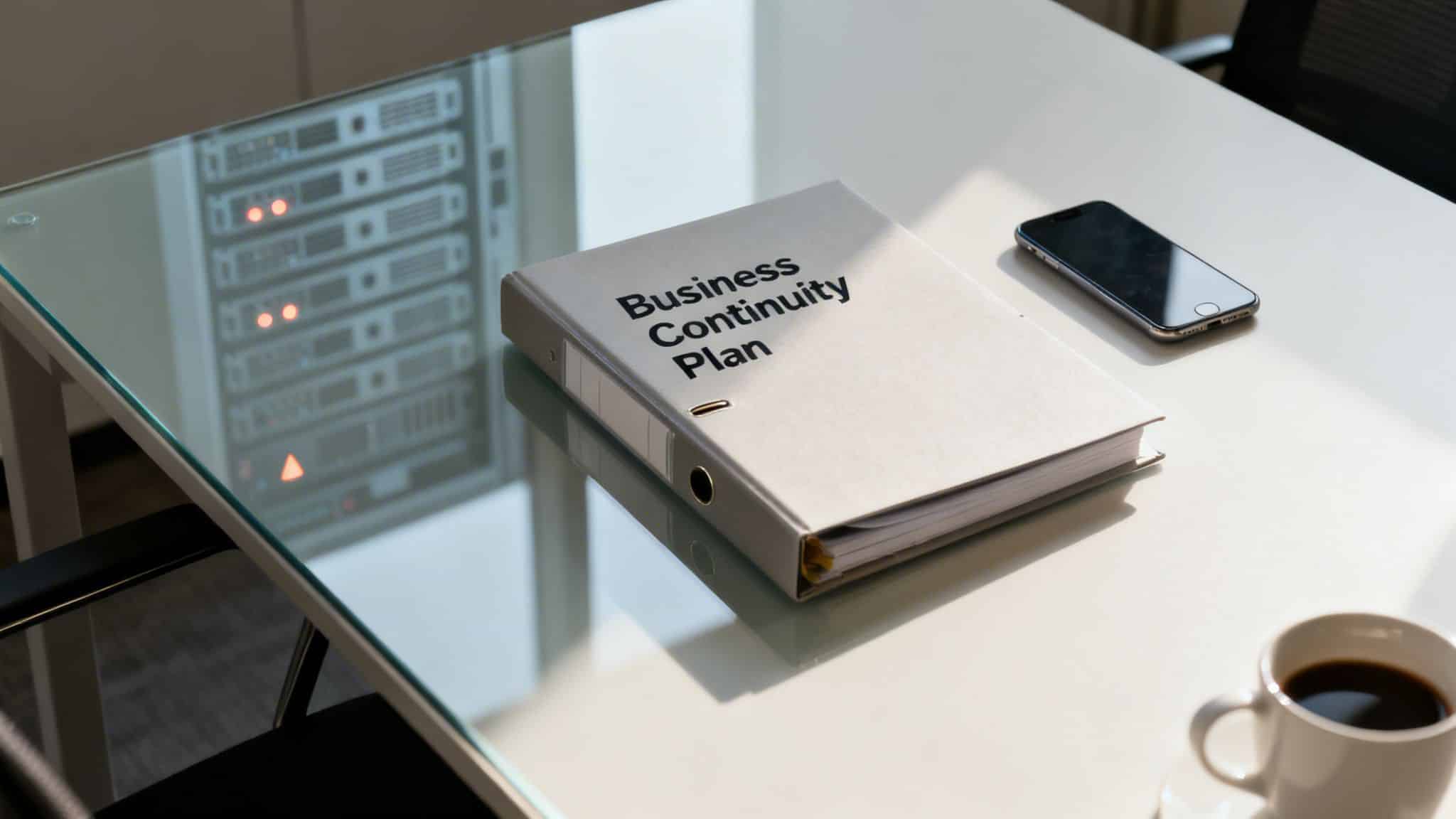
A 'Business Continuity Plan' binder on a glass desk with a smartphone and coffee.

It’s easy to feel prepared when you’re staring at a well-organized BCP binder. But I've seen firsthand that an untested plan is one of the biggest gambles an organization can take. For businesses across Central Florida, from Orlando law firms to Lakeland logistics companies and Winter Park medical practices, the gap between what's written down and what actually happens during a crisis can be massive.

This gap exists because a static document just can't keep up with your dynamic business. Technology changes, people move into new roles, and new software dependencies pop up constantly. An untested plan is simply a minefield of hidden flaws waiting for the worst possible moment to detonate.

The Dangers of an Untested Strategy

A plan that hasn't been put through its paces is loaded with dangerous assumptions. These unverified details can quickly escalate a manageable incident into a full-blown operational catastrophe. The most common failure points we uncover during tests include:

  • Undocumented Dependencies: Your plan might perfectly outline how to restore your main server, but does it account for the third-party software license server that has to be online first? We see small, overlooked dependencies like this halt recovery processes all the time.
  • Outdated Contact Information: It’s such a simple thing, but it can be a catastrophic flaw. When key personnel can't be reached because their contact info is six months old, your response is dead in the water before it even starts.
  • Wildly Optimistic RTOs: Setting a recovery time objective (RTO) of four hours sounds impressive on paper. But a business continuity plan test often reveals the actual time to restore from backups and reconfigure systems is closer to 24 hours—or even longer.

The hard truth is that a shocking number of companies are rolling the dice. Recent studies reveal a troubling trend: 56% of organizations have never performed a full simulation of their business continuity plan. This is a huge risk, especially when you realize a poorly constructed plan is just as dangerous as having no plan at all.

Without testing your plan, you’re not just putting the business at risk—you’re risking your people’s jobs and your company’s reputation. Over the past few years, a significant number of small businesses have lost hundreds of thousands of dollars from entirely preventable downtime.

Cybersecurity Threats Magnify the Risk

For businesses in Orlando, Tampa, and across Florida, the threat landscape is dominated by cybersecurity concerns. A ransomware attack doesn't care about your nicely printed plan. It will exploit the very gaps that a business continuity plan test is designed to find, like slow data recovery speeds, fuzzy communication protocols, or compromised credentials.

Imagine a sophisticated phishing attack bypasses your email filters and compromises your network on a Monday morning. Your plan says to isolate affected systems and restore from backups. But the test you never ran would have shown that your backup system itself was vulnerable or that your team wasn't actually trained on the specific incident response steps for a modern cyberattack. A key concern for construction or manufacturing businesses in Kissimmee, for instance, is how to handle a disruption to their Operational Technology (OT) systems, which a standard BCP might overlook.

This is why a proactive business continuity plan test is the single most important action you can take to build real resilience. It’s not about fear-mongering; it's about replacing dangerous assumptions with battlefield-tested certainty. Understanding the complete business continuity lifecycle is the first step toward building a plan that actually works when everything is on the line.

Choosing the Right Test for Your Business

A conference table displaying cards outlining business continuity plan test stages: walk-through, tabletop, functional, and full simulation, with a pen and an alarm clock.

There’s no single right way to test your business continuity plan. The perfect approach depends entirely on your company’s size, complexity, and how much risk you can stomach. Picking the right test is all about getting the most bang for your buck—finding those critical gaps in your plan without overwhelming your team.

For businesses here in Central Florida, this means matching the test to your reality. A bustling Tampa dental practice has entirely different cyber risks and recovery priorities than a multi-location engineering firm in Winter Springs. Let's walk through the main types of tests, from simple reviews to full-blown drills, so you can find the perfect fit for your organization.

Plan Walk-Throughs: A Simple Starting Point

A plan walk-through is exactly what it sounds like. It’s the most basic test where you get your key people in a room to read through the BCP, page by page. This isn't about simulating a crisis; it’s a sanity check on the document itself.

The goal is to answer simple questions. Does everyone actually understand their role? Is the emergency contact list up to date? Do the recovery steps make logical sense?

  • Pros: It's low-cost, requires very little time, and is dead simple to organize. We always recommend this as the first step for any business just getting started.
  • Cons: This test won't reveal how your team makes decisions under pressure or if your tech will actually work. It only confirms the plan is logical on paper.
  • Best For: Small teams, brand-new businesses, or as an annual "sanity check" for companies in any industry, from Kissimmee professional services to Apopka industrial shops.

Tabletop Exercises: Talking Through a Disaster

A tabletop exercise is a guided, discussion-based session where your team works through a simulated disaster scenario. A facilitator walks you through an incident as if it's happening right now, forcing you to explain what you'd do based on the BCP.

For example, a facilitator might say, "It's 9:00 AM on a Tuesday. We've just gotten a report that your main server is offline due to a suspected ransomware attack. What's the very first thing your team does?" This sparks crucial conversations about communication, decision-making, and who’s responsible for what. For more depth, a detailed guide on how to test a disaster recovery plan can provide excellent structure for these discussions.

A tabletop exercise is where you discover the human element of your plan. It’s a low-stress way to pressure-test your team’s response and find the communication gaps and moments of hesitation that a simple document review will never uncover.

Functional Tests: Making Sure Your Tech Actually Works

While a tabletop exercise tests your people and processes, a functional test validates your technology. This is where the rubber meets the road. You’re actually testing specific components of your BCP to see if they perform as expected.

This could mean restoring a critical server from backups, switching over to your secondary internet connection, or firing up your emergency communication system. This type of test is absolutely vital for any organization that leans heavily on its IT. An accounting firm in Lake Mary, for instance, might run a functional test to ensure all staff can securely connect to remote desktops and cloud software during a power outage.

Full Simulations: The Real-World Drill

A full simulation is the most comprehensive—and resource-intensive—test you can run. This is a live drill that mimics a real disaster as closely as possible. It often involves physically moving staff to a recovery site, activating all backup systems, and processing real business transactions in a sandboxed recovery environment.

Because these tests are complex and can disrupt operations, they’re usually reserved for organizations with mature BCPs and high-risk profiles. Think of a large financial institution or a critical infrastructure provider in the Orlando area that needs to meet strict regulatory requirements.

To help you decide where to begin, here's a quick look at how these tests stack up.

Comparison of Business Continuity Plan Test Types

This table compares the four main types of BCP tests, helping you match the right one to your organization's complexity, resources, and goals.

Test Type Complexity Resource Impact Best For
Plan Walk-through Low Low New businesses, annual plan reviews, or teams just starting with BCP testing.
Tabletop Exercise Low-Medium Low-Medium Professional services, medical practices, and any business wanting to test team response and communication.
Functional Test Medium Medium IT-dependent firms needing to validate specific recovery systems, like backup restores or network failover.
Full Simulation High High Mature organizations with high-risk profiles or strict compliance needs.

The best strategy is almost always a progressive one. Start with a walk-through or tabletop exercise. These are fantastic for building confidence and catching the obvious problems. Once you’ve ironed out those initial kinks, you can move toward functional tests for your most critical systems, building a truly resilient plan over time.

Assembling Your BCP Test Team and Timeline

A business continuity test shouldn’t be a fire drill you throw together at the last minute. It’s a managed project, and like any project, it needs the right people and a realistic schedule to succeed. Without that structure, your test will create more chaos than clarity.

Think of it this way: a disorganized test is worse than no test at all. For a professional services firm in Orlando or a medical spa in Winter Park, a messy run-through just wastes billable hours and kills your team's confidence in the actual plan.

The goal is to assemble a focused team and set a clear timeline. This turns the exercise from a scramble into a productive, insightful project.

Defining Your Core Test Roles

Every test, no matter how simple, needs a cast of characters with clearly defined roles. When the simulation starts, you don't want people wondering who’s supposed to be doing what. Assigning these roles beforehand prevents confusion.

Here are the essential players for your test team:

  • Test Coordinator: This is your project manager. They own the entire BCP test—planning it, scheduling it, and making sure everyone shows up. In a mid-sized accounting firm, this might be the office manager or a senior partner who’s good at herding cats.
  • Department Leads: These are your key players from critical business units like operations, finance, or client services. They aren't just watching; they're actively participating and making the same tough calls they would in a real crisis.
  • Observers/Evaluators: These folks are the silent witnesses. They don’t participate. Their only job is to watch, take detailed notes, and spot what’s working and what’s breaking down. They're looking for communication gaps, decision delays, and any time the team goes off-script from the BCP.
  • Technical Lead: This role is non-negotiable for any test involving IT. This person—ideally from your managed IT partner—manages the technical side of the scenario. They can simulate a server crash or validate that your team is following the correct recovery steps.

Getting your managed IT and cybersecurity partner, like Cyber Command, involved from day one is a game-changer. We often step in as an objective technical lead, designing realistic scenarios based on the threats we see every single day. That outside perspective is priceless, especially for testing your response to something complex like ransomware or a business email compromise (BEC) attack.

Building a Practical Test Timeline

A good timeline gives everyone room to breathe and prepare. Trying to rush it is a recipe for disaster. We've found that a 90-day runway is the sweet spot for most small and mid-sized businesses. It treats the test like the priority it is, not an afterthought.

Rushing a business continuity test is a classic mistake that almost always leads to poor results. A methodical 90-day plan gives you the time for proper scoping, briefing, and coordination—all essential for a test that produces meaningful data.

Here’s a sample project plan you can steal and adapt for your own BCP test:

Phase 1: Initial Planning (90 Days Out)

  • Pick your Test Coordinator.
  • Lock down the scope and objectives. Get specific. For example: "Test our ability to recover client data within 4 hours of a ransomware attack."
  • Choose your test type (walk-through, tabletop, or functional).
  • Finalize the date and send out calendar invites to all key players. Block the time now.

Phase 2: Development and Briefing (60 Days Out)

  • Formally assemble the full test team, including your Observers and Department Leads.
  • Develop the specific scenario and write the facilitator's script. This is where the story of your "disaster" comes to life.
  • Hold a pre-test briefing to cover the ground rules, roles, and logistics. Crucially, do not reveal the scenario itself. This meeting is just to get everyone on the same page about how the day will run.

Phase 3: Final Preparations (30 Days Out)

  • Confirm all your logistics—conference room bookings, virtual meeting links, and any physical materials needed.
  • Send participants the relevant sections of the BCP to review. A little homework goes a long way.
  • The Test Coordinator and Technical Lead should do a final run-through of the script and any technical setups.

Phase 4: Execution and Debrief (Test Day + 1 Week)

  • Run the test.
  • Immediately after, hold a "hot wash" meeting. This is an informal debrief to capture gut reactions and immediate feedback while it's fresh.
  • Schedule a formal post-test review for about a week later. This is where you'll dig into the detailed findings and start outlining your action plan for improvements.

Executing a Test with Realistic Cybersecurity Scenarios

Okay, you’ve got your team and a timeline. Now for the fun part: moving from planning to action. This is where your business continuity plan gets put to the test—where theory meets the very real pressure of a disaster.

Forget generic drills about hurricanes or power outages. While important, they don’t reflect the most persistent and evolving threat facing businesses in Orlando, Tampa, and Winter Springs right now. We need to talk about cybersecurity.

A well-designed test built around a cyberattack will give you more actionable intelligence than any other scenario. This is how you build genuine cyber resilience and prepare for the sophisticated threats that are already knocking on your door.

Crafting a Realistic Ransomware Scenario

A tabletop exercise is the perfect way to run this kind of test. It's essentially a guided, discussion-based walkthrough that forces your team to react to a crisis as it unfolds, minute by minute. The secret is making it feel real and immediate.

Let’s imagine we’re running a test for a healthcare clinic in Lakeland. The facilitator—usually your Test Coordinator or someone from your IT partner—is the storyteller, driving the narrative forward.

Facilitator's Script Example

  • 9:00 AM: "Good morning. We're starting our exercise. It's a normal Tuesday. Just a few minutes ago, at 8:55 AM, Sarah from billing called the helpdesk. She’s seeing a strange message on her screen demanding Bitcoin and can't access any patient records. Around the same time, two nurses reported that all their files have been encrypted. What’s the very first thing we do?"

  • 9:15 AM: "Update: IT has confirmed it looks like a ransomware attack. They suspect at least three servers are compromised, including the main EHR server with all active patient data. According to our BCP, who is the incident commander, and what's their first call?"

  • 9:45 AM: "The attackers left a message with a 24-hour countdown. After that, they say they'll publish all the patient data they stole. Does this change our immediate priorities? How does the marketing lead start drafting an internal communication right now?"

This kind of scripted, time-based approach keeps the exercise moving and forces people to actually open the BCP document. You’ll see right away if the documented steps make sense or cause confusion.

The Role of Observers and Checklists

While your core response team is in the hot seat, the observers have an equally vital job. They are your fact-finders, silently documenting every win and every misstep. Their role isn’t to help solve the problem, but to evaluate the team's response against the plan's objectives.

To make this work, give your observers a checklist. This simple tool turns vague feedback into hard, measurable data.

Observer Checklist Items

  • Communication: Was the incident commander clearly identified within the first 15 minutes? Did department heads actually cascade information to their teams, or did communication stop with them?
  • Decision-Making: Did the team follow the escalation path in the BCP? Was there any hesitation about who had the authority to make big calls, like taking a critical system offline?
  • Technical Response: Did IT immediately move to isolate the affected systems, just like the plan says? Did anyone know the actual process for starting a data restore from backups, or were they just guessing?
  • Resource Gaps: Did you hear phrases like, "I don't know who to call for that," or "I don't have access to that system?" Each one is a glaring hole in your plan.

These notes are pure gold. They will be the centerpiece of your post-test debriefing, pointing directly to the weaknesses a real attacker would happily exploit.

Introducing 'Injects' to Test Adaptability

Real disasters are messy and unpredictable. To see how your team handles true chaos, the facilitator needs to introduce "injects"—unexpected twists designed to derail your plan. Injects prevent the team from just sleepwalking through the checklist and force them to think on their feet.

An effective inject is designed to break a specific part of your plan. It’s a controlled failure that tests your team's ability to think on their feet when the documented solution is suddenly unavailable.

Pro Tips for Effective Injects

  • Key Person Unreachable: "The incident commander is on a flight with no Wi-Fi. Who is their designated backup? Does that person have the authority to make decisions without approval?"
  • Vendor Non-Response: "You've called the emergency number for your critical software provider. It goes straight to a voicemail saying their office is closed for a company-wide retreat."
  • Communication Breakdown: "As a precaution, the email system has been taken offline. How do you communicate with all employees now? What's the backup plan?"

Running a business continuity plan test with this level of realism is about more than just a pass/fail grade. You're actively stress-testing your people, processes, and technology against the threats you’re most likely to face. To add another layer of realism, a pen test black box assessment can simulate an attacker's perspective from the outside, uncovering vulnerabilities you never knew you had.

This process builds the confidence and muscle memory your team needs to respond effectively when it really counts. And as you uncover gaps, our guide on ransomware incident response paths can provide deeper tactical guidance for shoring up your defenses.

Turning Test Results into Actionable Improvements

The goal of a business continuity plan test isn't to get a perfect score. Let's be honest, if your test runs too smoothly, it probably wasn't realistic enough. The true victory comes from what you do after the simulation ends—transforming those messy, uncomfortable moments into a rock-solid plan for getting better.

A "pass or fail" mentality completely misses the point. A successful test is one that finds your weak spots before a real ransomware attack or server meltdown does. This is the continuous improvement loop that separates resilient organizations from those just crossing their fingers and hoping for the best.

This process starts the second your test concludes. It’s all about turning observations into a concrete action plan, complete with clear owners and firm deadlines.

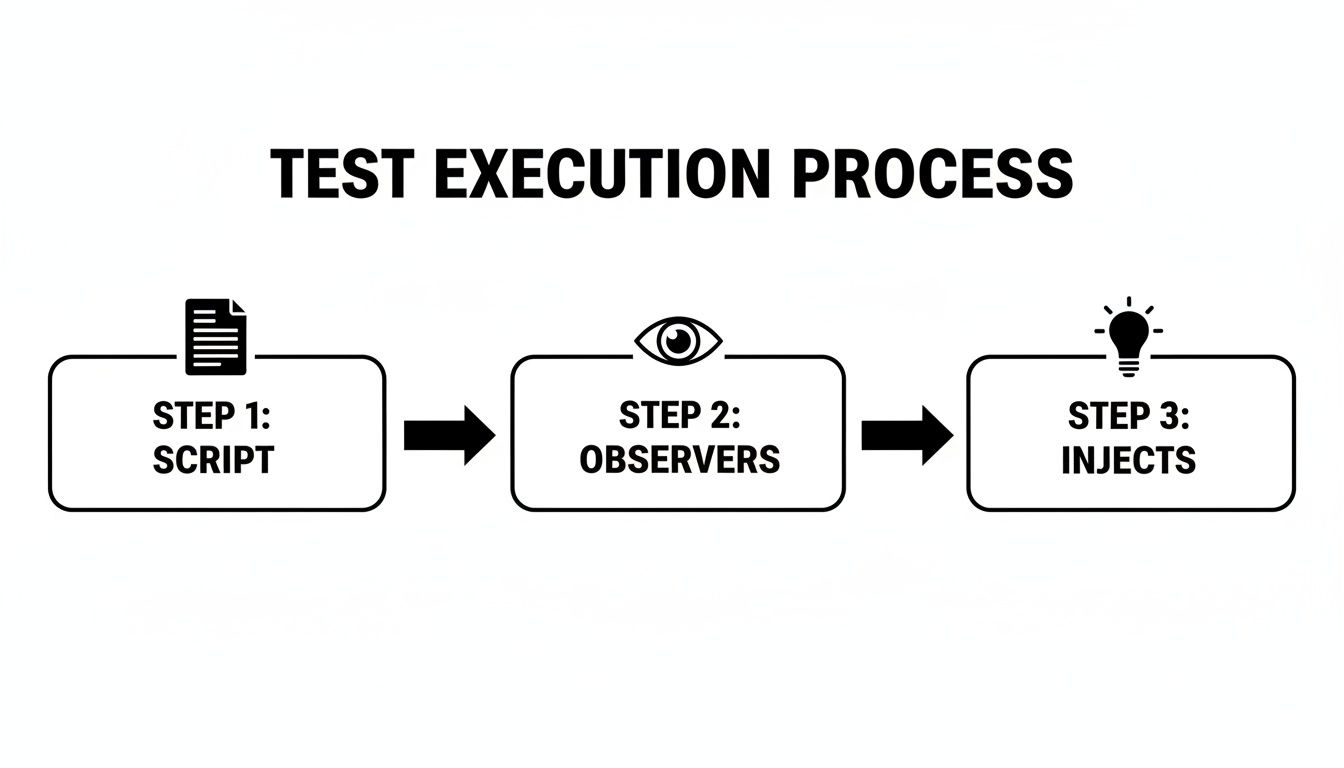
Flowchart illustrating a three-step test execution process including script, observers, and injects.

Think of the test itself as a structured data collection exercise. The script guides the scenario, observers capture what happens, and injects add realism. The quality of your improvement plan depends entirely on the quality of those observations.

Conduct an Immediate Post-Test Debrief

Before anyone even thinks about grabbing a coffee or signing off the video call, you need to run a "hot wash." This is an informal, immediate debriefing session while the experience is still fresh and raw in everyone's minds. It’s your single best chance to capture unfiltered, honest feedback.

The goal here isn't to solve problems on the spot. It's about gathering those crucial initial impressions. Keep it simple and direct.

Key Questions for Your Hot Wash:

  • What was your gut reaction to how that unfolded?
  • What was the single biggest thing that went well?
  • Where did we first get stuck or feel totally confused?
  • Was there anything in the BCP that felt completely wrong or out of date?

This immediate feedback is gold. It captures the emotional friction points and practical hurdles that often get sanitized or forgotten by the time a formal report is written days later. The insights you gain here are invaluable for refining all your emergency protocols, including developing a clear data breach response playbook to ensure you can act decisively during a real incident.

Create a Formal Post-Test Report

Once you've gathered that initial feedback, the Test Coordinator needs to assemble a formal Post-Test Report. This document translates the chaos of the test—the observers' notes, the team's feedback, the unexpected roadblocks—into a structured summary for leadership. It’s not just a recap; it’s the business case for making specific improvements.

Your report should be clear, concise, and focused on outcomes. I recommend structuring it around four key sections:

  1. Executive Summary: A one-paragraph blitz. Give an overview of the test, the main findings, and the highest-priority recommendations. Assume this is the only part a busy executive will read.
  2. Test Objectives vs. Outcomes: Did you meet your goals? If an objective was to "restore client data within 4 hours," state clearly whether you succeeded and by how much. Be blunt.
  3. What Went Well: Don't forget to acknowledge the successes. Did the team communicate clearly? Was the new backup system faster than expected? Celebrating wins builds momentum and morale for the next test.
  4. Areas for Improvement: This is the core of the report. List every identified gap, flaw, and moment of confusion, no matter how small.

The most critical part of your report isn't just listing problems—it's assigning ownership. Every single identified weakness must be converted into an action item with a specific person's name next to it and a realistic deadline.

Build Your Remediation and Action Plan

An "Areas for Improvement" list without names and dates is just a wish list. The final, and most important, step is to create a formal Remediation and Action Plan. This is often just a simple tracking document—a spreadsheet works perfectly—that turns findings into accountable tasks.

For each action item, you need to document a few key things:

  • The Finding: A clear, one-sentence description of the problem (e.g., "Emergency contact list was 6 months out of date.").
  • The Action: The specific task required to fix it (e.g., "HR will verify and update all contact information in the BCP.").
  • Owner: The single individual responsible for getting it done. Not a department, a person.
  • Deadline: The date the task must be completed by.

This simple document transforms your business continuity plan test from a one-off event into a living, breathing process. You run the test, find the gaps, assign the fixes, and then verify those fixes in your next test. This continuous loop is what builds true, lasting resilience.

Common Questions About BCP Testing

After guiding dozens of businesses in Orlando, Tampa, and Winter Springs through BCP tests, we've found the same questions pop up time and again. Let's tackle some of the most common ones we hear from business owners. My answers come from years of hands-on experience helping firms find and fix the weak spots in their plans.

How Often Should We Really Test Our Business Continuity Plan?

This is the number one question, and the answer isn't "as much as possible." It’s about being smart and consistent. For most small and mid-sized businesses, you don't need a disruptive, full-scale simulation every few months.

We recommend a simple tabletop exercise or a plan walk-through at least annually. This is your basic tune-up. It keeps the plan fresh in everyone's minds and is perfect for catching simple but critical errors, like an outdated contact list or a process that changed six months ago.

For your high-risk areas, especially cybersecurity, you need to be more aggressive. A functional test of your data backup and recovery systems should happen at least quarterly. A resource-heavy full-scale simulation? That’s typically only needed every 2-3 years, or after a major business change like moving offices or switching to a new core software platform.

The key is consistency. A drumbeat of smaller, focused tests will build more resilience over time than one massive, “all-hands” test that you only run every few years.

What’s the Biggest Mistake People Make During a Test?

Hands down, the single biggest mistake we see is "testing to succeed." It’s a natural impulse. You design a scenario that’s just a little too easy or predictable, ensuring the team can follow the plan without a single hiccup. Everyone high-fives, and you walk away with a dangerous false sense of security.

The whole point of a business continuity plan test is to find the cracks in the armor. Think of it as a controlled failure exercise. You have to be willing to make things a little messy to get real value.

  • Throw in some curveballs (injects). Introduce unexpected problems that aren't in the script. This forces the team to ditch the checklist and actually think on their feet.
  • Test the systems you’re nervous about, not just the ones you know are rock-solid. If you're not 100% sure your backup system will restore correctly, that's exactly what you need to test.
  • Foster a culture where finding a failure is a win. Uncovering a gap during a drill is infinitely better than discovering it at 2 AM during a real crisis.

A good test should feel a bit challenging, even a little chaotic. That’s how you find the hidden weaknesses a real disaster would exploit without mercy.

Can Our Managed IT Partner Run the Test for Us?

Not only can you, but you'll get far more out of the exercise if you bring in an outside expert. An experienced IT and cybersecurity partner acts as an objective referee, bringing a playbook of scenarios and insights learned from dozens of other businesses in your industry.

When we facilitate a BCP test for a client, we bring a level of realism that’s tough to replicate on your own. We design highly specific technical failure and cyberattack scenarios, like simulating a complete server crash, a sophisticated phishing attack that gets past your filters, or a business email compromise (BEC) incident that targets your finance department.

After the dust settles, our job is to translate the technical chaos into an actionable IT roadmap. We make sure the lessons from the test lead to tangible improvements—the right security controls, necessary hardware upgrades, and better processes—to genuinely strengthen your company's resilience.


Ready to move beyond theory and build a BCP you can actually count on? The team at Cyber Command specializes in creating and running realistic business continuity plan tests for organizations throughout Central Florida. We help you find and fix your weak spots before a real crisis does it for you. Let's build a more resilient future for your business, together. Contact us today for a consultation.