Backup and Disaster Recovery for Florida SMBs

Monday opens normally in Orlando. Staff log in, phones ring, patients or clients start arriving, and then one screen shows an encryption notice. Another can’t reach the server. Scheduling stops. Billing stops. Intake stops. If you run a law office, dental practice, CPA firm, architecture studio, or multi-location service business in Central Florida, that moment stops revenue faster than most owners expect.

Florida businesses usually think about storms first. They should. But in practice, I see just as many shutdowns caused by ransomware, failed updates, aging storage, accidental deletion, and power problems that expose weak recovery planning. A backup file sitting somewhere isn’t the same as being able to keep the business operating.

Why Your Florida Business Needs a Real Recovery Plan

An Orlando law firm can survive a bad weather day. It has a much harder time surviving two days without document access, case notes, or billing. A Winter Springs dental office can reschedule around one broken workstation. It can’t function well if imaging, charts, and e-prescribing stay offline through a full patient schedule.

That’s the point business owners miss. Backup protects copies of data. Disaster recovery restores operations, systems, access, and the order everything has to come back online.

A concerned woman stands in an office looking at a computer screen showing a ransomware data encryption message.

What owners usually assume

Most owners I talk to believe they’re covered because someone told them backups are running. That’s a dangerous half-truth. More than 60% of organizations believe they can recover from a downtime event within hours, but only 35% could. Only 40% of technology leaders express confidence that their current backup and recovery solution can sufficiently protect critical assets in a disaster (Spanning).

That gap matters in Central Florida because disruption rarely arrives one problem at a time. A hurricane can trigger power instability, internet issues, office closure, and rushed remote work. A cyberattack can hit on the same week your key employee is out and your vendor is slow to respond.

Practical rule: If your team has never restored the systems you rely on, you don’t have proven recovery. You have hope.

Backup is one piece, not the whole strategy

You still need backups, and business owners should understand the basic types of backup because full, incremental, immutable, local, and cloud copies all play different roles. But none of those choices by themselves answer the hard questions:

  • Who restores what first
  • How employees work during the outage
  • Where your clean copy lives if the office is unavailable
  • How long the business can wait
  • How you communicate with clients, patients, and vendors

A real recovery plan treats downtime like a business interruption issue, not a server issue. That means deciding in advance what must come back first, who owns each task, and what fallback process keeps money moving while systems are restored.

For Florida SMBs, backup and disaster recovery isn’t a technical add-on. It’s continuity planning for hurricanes, cybercrime, hardware failure, and plain bad luck.

Understanding RTO RPO and Business Impact

A lot of business owners tune out when they hear technical acronyms. Don’t. Two of them decide whether your company closes for an inconvenience or a crisis.

RTO means how long you can be down

Recovery Time Objective, or RTO, is the maximum downtime your business can tolerate before the damage becomes unacceptable. It is comparable to the amount of time your front door can stay locked before the day starts going sideways.

For a medical office, that might mean electronic records and scheduling need to return fast. For a law firm, document management and email may be first. For an accounting office during tax season, the tax platform and file storage move to the top immediately. If you want a plain-English breakdown, this guide to Recovery Time Objectives (RTOs) is useful for non-technical leadership.

RPO means how much data you can afford to lose

Recovery Point Objective, or RPO, is the acceptable amount of lost work between the last good copy and the outage. Think of it as the paperwork gap you’d have to recreate.

If your backup last ran the night before and your server fails at 3 p.m., your business may lose a full day of entries, notes, uploads, or financial activity. Some firms can absorb that. Many can’t.

A dentist may be able to re-enter a few administrative notes. A financial firm may not be able to rebuild the same day’s reconciliations cleanly. A law office may have ethical and operational issues if document versions disappear.

Business impact decides what matters most

Not all systems deserve the same recovery target. That’s where a Business Impact Analysis, or BIA, comes in. It sounds formal, but the exercise is practical. You identify what the business needs to operate, rank those systems, and assign realistic recovery goals.

Start with these questions:

  1. What system stops revenue first
    For many SMBs, it’s scheduling, payments, phones, or line-of-business software.

  2. What system creates legal or compliance exposure
    Client files, patient data, retention systems, and audit records usually land here.

  3. What can wait until tomorrow
    Archive storage, old project data, and less-used internal systems often belong in a lower tier.

A recovery plan fails when it restores everything slowly instead of restoring the right things first.

Why prioritization matters

Many plans break at this stage. Recent reports show that 40% of business disruptions stem from recovery plans that are not aligned with business priorities. That misalignment is why 68% of SMBs that suffer an outage experience downtime lasting more than a full day (Warren Averett).

Those numbers line up with what happens in the field. Teams restore servers in technical order instead of business order. They bring back file shares before scheduling. They recover archived folders before the application that produces invoices. They restore data but forget the dependency chain, such as identity access, internet failover, VPN access, printing, or vendor-hosted application access.

A simple tier model works better than one big plan

Business tier What belongs here Recovery expectation
Tier 1 Systems that stop patient care, client service, billing, or communication Fastest recovery target
Tier 2 Important operational systems that staff need soon after Restored after core operations
Tier 3 Archives, historical data, low-use tools Restored later

For a Central Florida business, this model keeps you honest. It forces a decision: if the office is dark, internet is unstable, or ransomware hits, what gets your team working again first?

That’s what backup and disaster recovery should answer.

Choosing Your Recovery Architecture On-Prem Cloud or Hybrid

Architecture choices aren’t abstract. They affect recovery speed, cost, maintenance burden, and how much risk you carry if your office loses power or access.

A simple way to think about it is this. On-premise recovery is like owning a generator at your building. Cloud-based recovery is like relying on outside infrastructure to keep operations available elsewhere. Hybrid gives you both a local path for speed and an offsite path for serious disruption.

A comparison chart outlining the pros and cons of on-premise, cloud-based, and hybrid backup and disaster recovery architectures.

On-premise recovery

On-premise means your backup storage and much of your recovery capability sit inside your office or under your direct control.

That setup can work well when you need very fast restores of local files, large imaging data, or line-of-business systems that staff access all day. It also appeals to firms that want tighter physical control over hardware.

The trade-off is obvious in Florida. If the building has a power event, flood issue, fire, theft, or network equipment failure, the recovery environment may be affected by the same incident as production.

On-premise works best when:

  • You need fast local restores for large files or busy production systems
  • You have in-house IT capability to monitor hardware, storage health, patching, and backup jobs
  • You also keep protected offsite copies so a building-level incident doesn’t take out everything

Cloud recovery and DRaaS

Cloud-based recovery, often delivered as Disaster Recovery as a Service, shifts recovery infrastructure offsite. That can be a strong fit for firms with multiple locations, hybrid work, or limited appetite for maintaining local recovery hardware.

The biggest strength is geographic separation. If your Winter Springs office is unavailable, you still have a path to restore systems elsewhere. The biggest limitation is dependency on provider design, internet performance, and the quality of the failover plan.

Cloud recovery is often a practical option for SMBs that want operational simplicity. It’s also worth reviewing broader cloud disaster recovery options if you’re comparing hosted failover, cloud backups, and full recovery environments.

Cloud recovery protects you from local events better than local-only recovery. It doesn’t remove the need to plan users, access, sequencing, and vendor dependencies.

Hybrid recovery

For many Central Florida SMBs, hybrid is the most sensible architecture. You keep a local recovery path for quick restores and an offsite copy or standby environment for real disaster scenarios.

That matters when you have two very different recovery jobs:

  • restoring a deleted folder quickly for a staff member
  • keeping the business alive when the office, server, or network is down

Hybrid designs also fit regulated environments well. A medical practice may need fast file-level recovery during normal operations, but also an offsite path for continuity if the local environment is compromised.

On-Premise vs. Cloud vs. Hybrid Recovery Architectures

Attribute On-Premise Cloud (DRaaS) Hybrid
Control Highest direct hardware control Lower direct control, provider-managed components Shared control
Local restore speed Often strong for local workloads Depends on bandwidth and design Strong for priority local restores
Resilience to office-level disaster Weak unless paired with offsite copy Stronger for geographic separation Strongest balance for most SMBs
Maintenance burden Highest Lower internal burden Moderate
Complexity Lower if environment is simple Moderate, depends on provider Highest if poorly designed
Best fit Firms with strong IT ownership and local performance needs Firms that want offsite resilience and simpler operations Firms that need both speed and broader continuity

What works and what doesn’t

What works is choosing architecture based on business operations.

A law office with heavy document use may need fast local recovery plus offsite failover. A dental group with imaging, scheduling, and compliance concerns often benefits from hybrid. A smaller accounting firm with cloud-first apps may lean more heavily on DRaaS if access control and restore testing are solid.

What doesn’t work is buying storage first and asking business questions later. It also doesn’t work to put every workload in one basket, whether that basket is a closet server or a single cloud platform.

Use architecture to support the recovery order you already defined. Not the other way around.

How to Create a Practical Disaster Recovery Policy

A disaster recovery policy should be short enough to use under stress and detailed enough that your team doesn’t guess. If it reads like a generic compliance template, it won’t help when your office is dealing with a ransomware screen, failed storage array, or building outage.

The policy has one job. Tell people exactly what to do, in what order, with what authority.
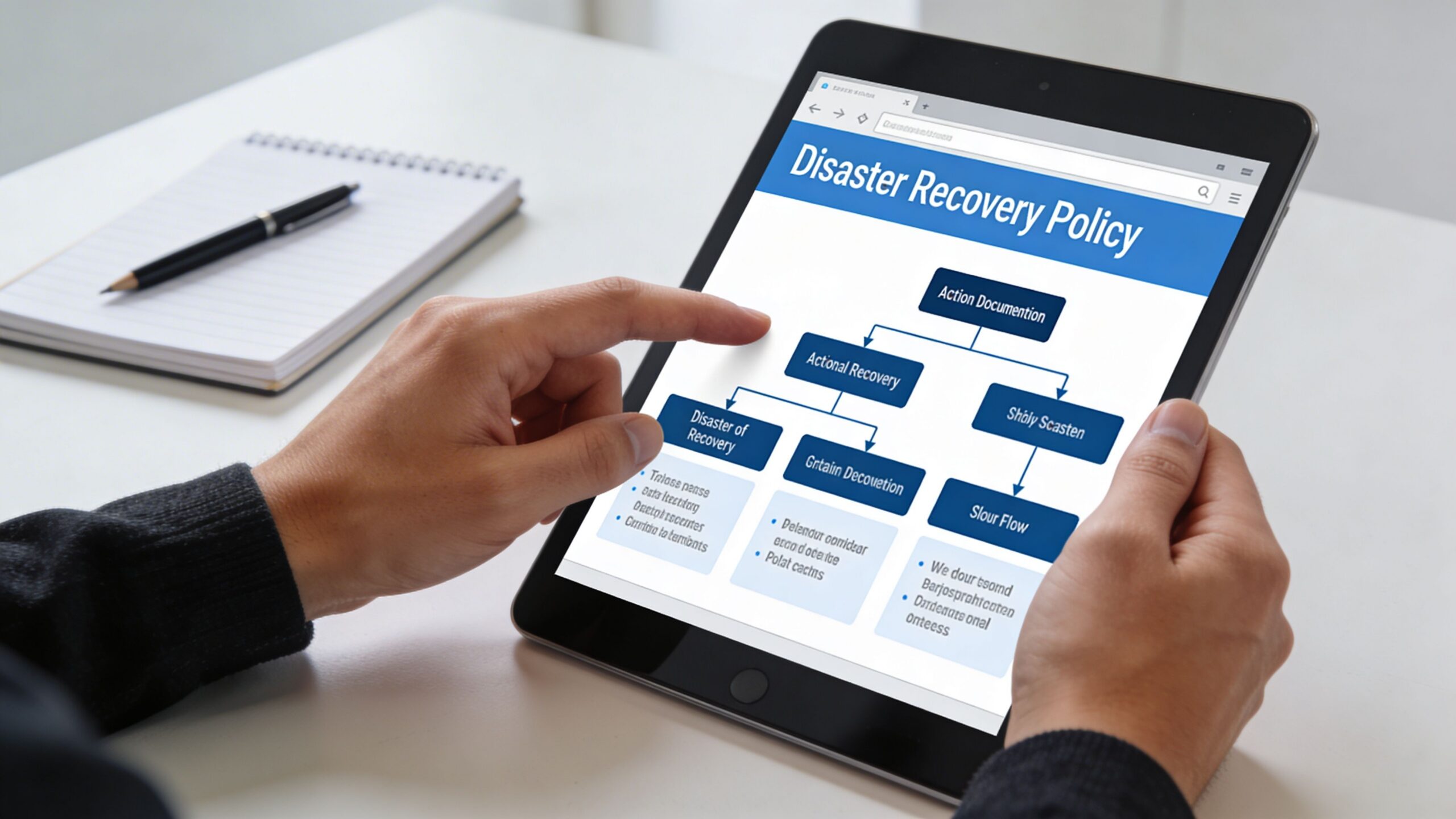
A person reviewing a disaster recovery policy flowchart on a tablet computer in an office setting.

Put the business inventory first

Start with a clean inventory of what matters:

  • Core applications such as practice management, document management, accounting, scheduling, and email
  • Infrastructure dependencies such as servers, cloud tenants, firewalls, switches, identity platforms, and internet circuits
  • Data locations including laptops, local servers, SaaS platforms, cloud drives, and line-of-business vendors
  • Critical vendors whose systems your team can’t operate without

Most weak plans fail here. They list “server outage” as an event but never identify the applications and dependencies attached to that server.

Assign roles before you need them

During an outage, confusion wastes more time than bad hardware. Your policy should name who makes decisions and who executes tasks.

A practical small-business structure usually includes:

Role Responsibility
Business owner or executive Declares business impact and approves major recovery decisions
IT lead or managed provider Runs technical recovery steps and escalation
Department manager Validates business function after restore
Communications owner Notifies staff, clients, patients, and vendors
Compliance or privacy contact Reviews obligations involving sensitive data

Write names, alternates, phone numbers, and non-email contact methods into the document. If email is down, an email-only contact list is useless.

Build the checklist in recovery order

Your runbook should follow the order of operations, not the order equipment appears in a rack.

A practical checklist often looks like this:

  1. Contain the problem
    Is this ransomware, hardware failure, accidental deletion, or site outage? Isolation may matter before restoration begins.

  2. Declare the recovery mode
    Are you restoring files, failing over a server, or shifting staff to remote work?

  3. Restore Tier 1 systems first
    Focus on systems that keep patient care, client communication, billing, or scheduling moving.

  4. Validate access with real users
    A server being “up” doesn’t mean the front desk can print, the attorney can open a file, or the accountant can post transactions.

  5. Document what changed
    Track restored versions, temporary workarounds, and any security concerns discovered during recovery.

A good policy doesn’t try to predict every failure. It gives your team a clear chain of command and a repeatable decision path.

Tailor the policy to your industry

A generic plan won’t satisfy the operational realities of regulated businesses.

For healthcare practices, the requirement is more specific. HIPAA mandates a documented Contingency Plan with specific RTO and RPO targets, and expert benchmarks show that deploying a hybrid solution with automated verification can reduce effective RTO by up to 80% (Accountable HQ). That matters in real clinical workflows where scheduling, chart access, and e-prescribing can’t stay down long without affecting care.

For law firms, the policy should address client confidentiality during emergency access, remote work controls, and how ethical walls remain enforced if normal systems are unavailable.

For accounting and financial firms, document retention, access controls, and audit trail preservation should be explicit. Recovery isn’t complete if the data returns without the records needed to prove integrity.

Include the communication script

Most businesses focus on systems and forget people. Your policy should include prewritten templates for:

  • Internal staff updates
  • Client or patient notifications
  • Vendor escalation requests
  • Public-facing service disruption messages

Short, calm, and factual beats long and vague. During a recovery event, people need to know what’s affected, what to do next, and when the next update arrives.

Validating Your Plan Before Disaster Strikes

A backup and disaster recovery plan that nobody has tested will fail at the worst possible time. Not because the idea was bad, but because reality always exposes missing permissions, broken dependencies, expired credentials, and undocumented shortcuts.

That’s why validation matters more than how polished the document looks.

The testing gap is real

The numbers here are ugly. 71% of organizations perform no failover testing to ensure their outage prevention protocols work, 62% fail to conduct regular system backup and restoration exercises, and 25% have no controls in place to prevent malicious access to their backup infrastructure (Secureframe).

That combination is exactly what attackers want. If backups aren’t tested and backup systems aren’t protected, recovery can fail twice. First during the attack, then again during the attempted restore.

Testing doesn’t have to shut down your office

Owners often resist testing because they assume it means a painful all-day outage. It doesn’t.

Use layers of validation:

  • Tabletop exercise
    Leadership and operations staff walk through a realistic outage scenario and identify decision gaps.

  • File-level restore test
    Restore selected files or folders to confirm backup integrity and permissions.

  • Application recovery test
    Recover a non-production instance of a key application and verify staff can use it.

  • Failover simulation
    Conduct an after-hours or planned test of the broader recovery path.

A useful resource on structuring those exercises is this guide to disaster recovery testing.

Untested recovery plans usually fail on the small details. Service accounts, application sequence, printer mapping, remote access, line-of-business licensing, and user validation.

What to verify each time

Don’t treat testing like a box-checking exercise. Validate outcomes that matter to the business:

Test area What to confirm
Data integrity Files open, databases mount, and restored records are usable
Access control Correct users can log in and unauthorized access remains blocked
Dependency chain Authentication, networking, storage, and application sequence work together
Communication Staff know who declares the event and where updates come from
Recovery timing Actual restore time is compared to your target

The best tests create evidence. Save screenshots, timestamps, notes on what failed, and the actions needed to fix it. That turns testing into operational improvement instead of annual theater.

For Central Florida firms, I recommend tying tests to seasonal risk and business cycles. Don’t run your only meaningful exercise when everyone is already overloaded.

Evaluating DR Vendors and Managed Services

Most SMBs shouldn’t try to run mature backup and disaster recovery alone. The issue isn’t intelligence. It’s bandwidth, specialization, and the fact that recovery depends on constant maintenance that owners and office managers rarely have time to supervise.

The right vendor isn’t just selling storage. They’re taking responsibility for design assumptions, monitoring, recovery sequence, testing discipline, and security controls around the backup environment itself.

A professional man sitting at a desk reviewing IT service provider comparison reports on his computer.

Ask operational questions, not marketing questions

Don’t start with “How much storage do we get?” Start with the questions that expose whether the provider understands business continuity.

Ask things like:

  • What is your process when recovery starts at 2 a.m. on a weekend
  • Who validates the restore with our staff
  • How do you protect backup systems from unauthorized access
  • How often do you require restore testing
  • How do you handle SaaS data, local servers, and cloud workloads differently
  • What dependencies do you map before declaring a plan complete
  • How do you support firms in regulated fields like healthcare, finance, or legal

A serious provider should answer in operational detail, not generic promises.

Look for evidence of process maturity

You want proof that the vendor runs repeatable systems. That includes documented runbooks, named escalation paths, monitoring, reporting, and regular review meetings.

A vendor should be able to explain:

Evaluation area What good looks like
Monitoring Backup jobs, storage health, failures, and unusual activity are actively reviewed
Security Backup infrastructure is segmented, access is restricted, and changes are auditable
Testing Restores and failover exercises happen on a schedule, not only after incidents
Communication Clear contacts, escalation rules, and client-facing status updates exist
Fit The vendor understands your industry workflow, not just generic infrastructure

Regional experience matters in Florida

Ask directly how the provider handles hurricanes, office closures, generator limitations, internet instability, and remote work surges. A vendor can be technically capable and still unprepared for how Central Florida businesses operate during a regional event.

If you’re comparing managed options, review providers that specialize in disaster recovery as a service companies and compare them on process depth, not brochure language.

One option in this category is Cyber Command, LLC, which provides managed backup and disaster recovery, monitoring, failover planning, and SOC-backed security support as part of broader managed IT and cybersecurity services. That kind of bundled model can make sense when your recovery plan depends on helpdesk, endpoint protection, vendor management, and incident response all working together.

The wrong vendor gives you backup status emails. The right vendor shows you how the business will run when systems fail.

Warning signs

Walk away if a provider can’t explain testing cadence, can’t define recovery order, or treats compliance as somebody else’s problem. Also be cautious if every answer points back to a single product. Good recovery design is about process and fit, not just platform branding.

Your Actionable Disaster Recovery Checklist

If you’re a busy owner in Orlando, Winter Springs, or anywhere in Central Florida, start here. Don’t wait for the perfect project plan.

Print this and work through it

  1. List your three most critical business applications
    Pick the systems that stop revenue, service delivery, or compliance first.

  2. Set a downtime limit for each one
    Decide how long each system can be unavailable before the business is in trouble.

  3. Decide how much recent work you can afford to lose
    Be honest. For some systems, even a small data gap creates operational pain.

  4. Inventory where your data lives
    Include local servers, cloud apps, Microsoft 365 or Google Workspace data, laptops, shared drives, and vendor platforms.

  5. Map dependencies
    Note what each critical system needs to function, such as internet, identity access, printers, phones, or third-party software.

  6. Confirm you have both backup and a recovery process
    A copy of data is not the same thing as a working restoration sequence.

  7. Review who does what during an outage
    Name decision-makers, technical responders, department validators, and communications contacts.

  8. Protect the backup environment
    Limit access, review permissions, and make sure the recovery platform isn’t exposed to the same risk as production.

  9. Schedule your first test
    Start with a tabletop exercise, then move to a controlled restore test.

  10. Review the plan on a calendar
    Update it when systems change, staff leave, offices move, or vendors change.

A workable backup and disaster recovery program starts with clarity, not complexity.

Frequently Asked Questions About Disaster Recovery

What’s a realistic monthly budget for managed DR for a 20-person company in Florida

There isn’t one honest flat number that fits every business. Cost depends on how many systems you need to protect, how fast you need them back, whether you need local and cloud recovery, compliance requirements, and how much testing and vendor coordination is included. A small office with mostly SaaS apps will look different from a medical or legal practice with local systems and larger files.

How does a good DR plan help with HIPAA or financial compliance

It creates documented recovery procedures, access control expectations, testing evidence, and defined responsibilities. Auditors and assessors usually care less about buzzwords and more about whether you can show that sensitive systems and data can be restored in a controlled, documented way.

Why can’t I just use Dropbox or Google Drive as my backup

File sync isn’t the same as backup and disaster recovery. Sync tools are useful for collaboration, but they don’t replace versioned backup strategy, application-aware recovery, recovery sequencing, security controls, or tested failover planning. If bad data syncs, deletion syncs, or ransomware-encrypted files sync, you may just spread the problem faster.


If your business in Orlando, Winter Springs, or the broader Central Florida area needs a practical backup and disaster recovery plan, Cyber Command, LLC can help you evaluate your current gaps, define realistic recovery priorities, and build a managed approach that supports uptime, security, and compliance without turning recovery into a guess during an actual outage.
A Guide to Program Release Management for Florida Businesses

Picture this: a team of electricians starts wiring a new hospital wing, but they’re working off a different plan than the plumbers. At the same time, the framing crew puts up a wall right where a critical doorway is supposed to be. The result is pure chaos, costly rework, and a massive safety hazard.

That's exactly what happens inside your business when different software updates and changes aren't coordinated. Program release management is the master blueprint that prevents this chaos. It's the central process for planning, scheduling, testing, and deploying all technology changes across your entire organization, with a strong focus on cybersecurity.

Why Release Management Matters Now

For businesses in Orlando, Winter Springs, and across Central Florida, treating technology updates as a string of separate, unrelated events is a recipe for disaster. This is especially true in regulated fields like healthcare, finance, and legal, where system uptime and data integrity are absolutely non-negotiable.

Without a coordinated strategy, every "minor" patch or new software rollout is a roll of the dice.

Program release management takes the guesswork out of the equation. It creates a single source of truth that orchestrates all the moving parts—from vendor patches and internal software development to security updates and new feature deployments. The goal is simple: make sure every change works together seamlessly, without causing conflicts, downtime, or new security holes for attackers to exploit.

Bridging the Gap Between Technology and Business Goals

Great release management isn't just an IT task; it's a core business strategy that directly protects your bottom line. It gives you the power to answer critical questions before they turn into expensive emergencies:

  • Will this update to our accounting software break our client management system?
  • Have we actually tested this new security patch to make sure it won’t grind our operations to a halt?
  • Who has the final say on approving this change, and what’s our plan to roll it back if things go wrong?

Having clear answers and a defined process shields your business from the operational and financial fallout of failed updates. It's a proactive approach that’s fundamental to building a resilient organization. For a deeper look at aligning your IT strategy with business outcomes, you can explore our comprehensive business IT support Florida guide.

Before we dive into the "how," it's helpful to see the real-world impact. The table below contrasts the business outcomes you can expect with a formal process versus the risks of an ad-hoc, uncoordinated approach.

Business Outcomes With and Without Release Management

Business Impact With Release Management Without Release Management
Service Stability 99.9%+ uptime. Predictable performance and fewer service disruptions. Frequent outages. Constant firefighting and unpredictable downtime.
Security Posture Reduced risk. Changes are vetted, tested, and tracked, closing security gaps. High vulnerability. Unvetted changes create new entry points for attackers.
Operational Costs Lower TCO. Fewer failed changes, less rework, and optimized resource use. Skyrocketing costs. Emergency fixes, project delays, and wasted staff hours.
Customer Trust High confidence. Consistent and reliable services build customer loyalty. Eroding trust. Service interruptions and data issues drive customers away.
Team Productivity Focused teams. Staff can focus on innovation instead of fixing broken updates. Constant chaos. IT and business teams are perpetually in reactive mode.

As you can see, the difference isn't just technical—it directly impacts your reputation, security, and financial health. A structured process delivers the stability needed for growth, while a lack of one creates a cycle of constant crisis.

The Financial and Security Stakes of Poor Processes

The need for a structured approach isn't just anecdotal. The Release Management market is projected to nearly double, growing from USD 13.48 billion in 2025 to USD 26.60 billion by 2032. This explosive growth shows how urgently businesses are trying to get control over their software deployments.

Poor processes are a massive source of operational pain. In environments without proper management, a staggering 40-50% of production incidents can be traced back to uncoordinated changes. For a small or mid-sized business in a competitive market like Central Florida, that level of disruption can be crippling.

Ad-hoc releases are a primary entry point for cyberattacks. Attackers thrive on chaos and unmonitored changes, using the confusion around an update to inject malware or gain unauthorized access. A formalized release process is one of your strongest lines of defense.

This guide will demystify program release management and give you a clear blueprint to bring this stability to your own business. It’s time to stop reacting to tech problems and start directing your technology roadmap with confidence.

Understanding the Core Components of a Strong Release Program

So, what does a solid release program actually look like under the hood? Moving from the idea of release management to a working system means breaking it down into a few critical parts. These are the components that transform chaotic, risky updates into a predictable, secure process.

For businesses across Central Florida, from the growing tech scene in Orlando to professional services in Kissimmee, getting these pieces right is how you ensure technology is a stable foundation for growth, not a constant source of anxiety.

Think of it like building a custom home. You wouldn’t just let different crews show up and start working without a master plan. A successful release program requires that same level of coordination, with each component playing a specific role to ensure the final product is sound and secure.

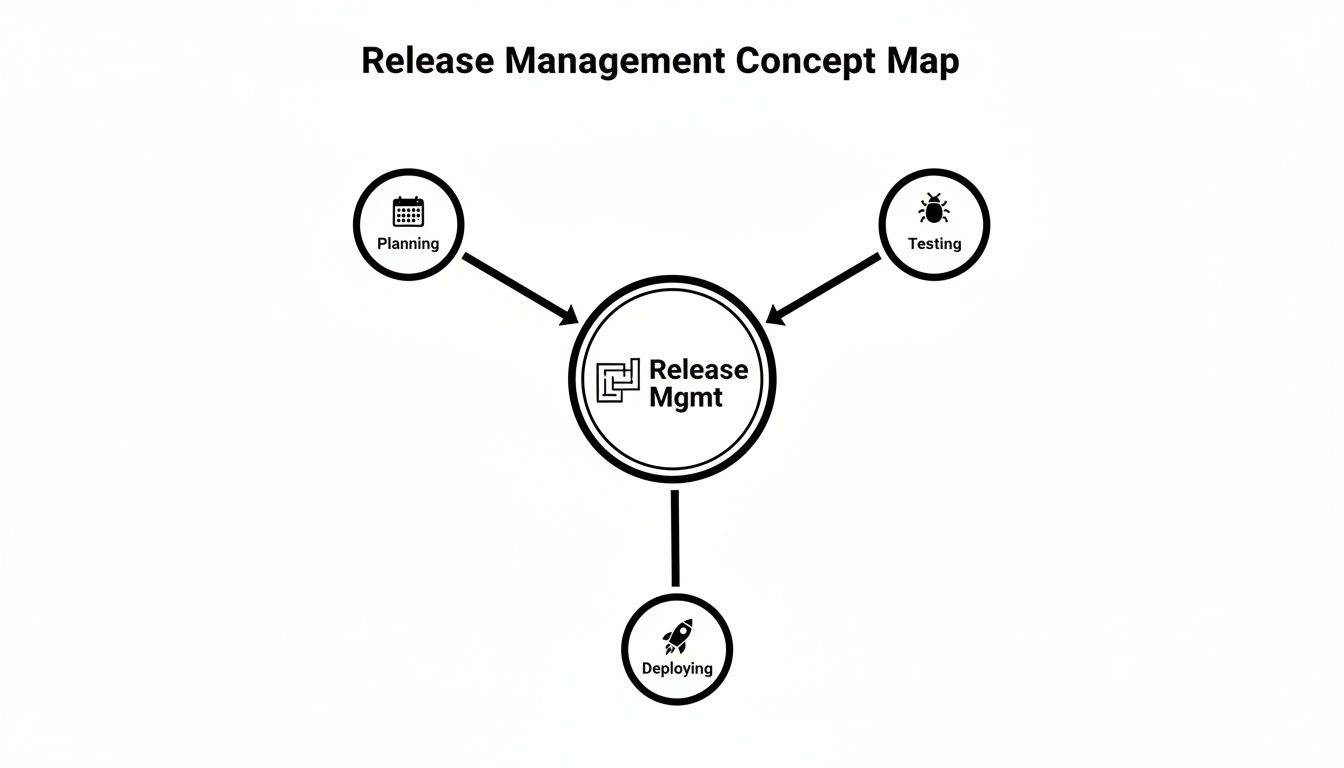
This flow chart breaks down the high-level journey of any software change, moving from planning and testing all the way through to deployment.

A concept map illustrating release management, showing planning, testing, and deploying as key processes.

As you can see, a successful deployment isn't a single event. It’s the result of a deliberate, phased process where each step builds on the last.

The Pillar of Release Governance

First up is release governance. This is your rulebook for any technology change. It answers the most important questions before anyone touches a line of code: Who has the green light to approve a new update? What security checks are non-negotiable? What paperwork needs to be filed?

For a Winter Park medical practice, strong governance is their first line of defense for compliance. Before they even think about updating their patient management software, their governance framework would demand a thorough cybersecurity and privacy review to ensure the update doesn’t violate HIPAA regulations. This isn't just red tape; it's a crucial safeguard against massive data breaches and legal fines.

Governance ensures that every change, no matter how small, follows a consistent, auditable process. This structured approach is a primary defense against cyber threats, as it eliminates the unvetted, chaotic changes that attackers love to exploit.

The Power of Strategic Release Planning

Next, you need strategic release planning. This is all about creating and maintaining a master roadmap of all upcoming changes. It's not just about picking a date on the calendar. It’s about making sure your tech updates are in lockstep with business goals and that you've accounted for all the ripple effects across your systems.

Imagine an Orlando-based architecture firm that wants to upgrade its main CAD software. A strategic plan would make sure this major update doesn't land in the middle of a critical project deadline. It would also coordinate any required patches for connected tools, like their project management or billing systems, to prevent a domino effect of failures.

Effective planning means asking the right questions upfront:

  • What is the business reason for this release?
  • Which other systems or teams will this impact?
  • What resources—people, time, and budget—do we need?
  • Who needs to be notified before, during, and after the release?

Getting these answers early on prevents the last-minute fire drills that cause so much stress and risk.

The Safety Net of Staging Environments

Finally, we have staging environments, which are an absolutely non-negotiable part of any secure release process. A staging environment is an exact clone of your live, public-facing system—a secure sandbox where you can deploy and hammer on updates without any risk to your real business operations.

This is where you find out if a new patch is going to crash your servers before your customers or employees do.

For any business, this is a mission-critical risk reduction tool. A professional services firm in Kissimmee can test a new version of its accounting software in a staging environment to confirm it works perfectly with their time-tracking and invoicing tools. If any bugs or cybersecurity vulnerabilities pop up, they can be fixed without touching real financial data or bringing daily work to a grinding halt. Without this sandbox, every single update becomes a high-stakes gamble with your live systems.

How Automation and AI Are Revolutionizing Modern Releases

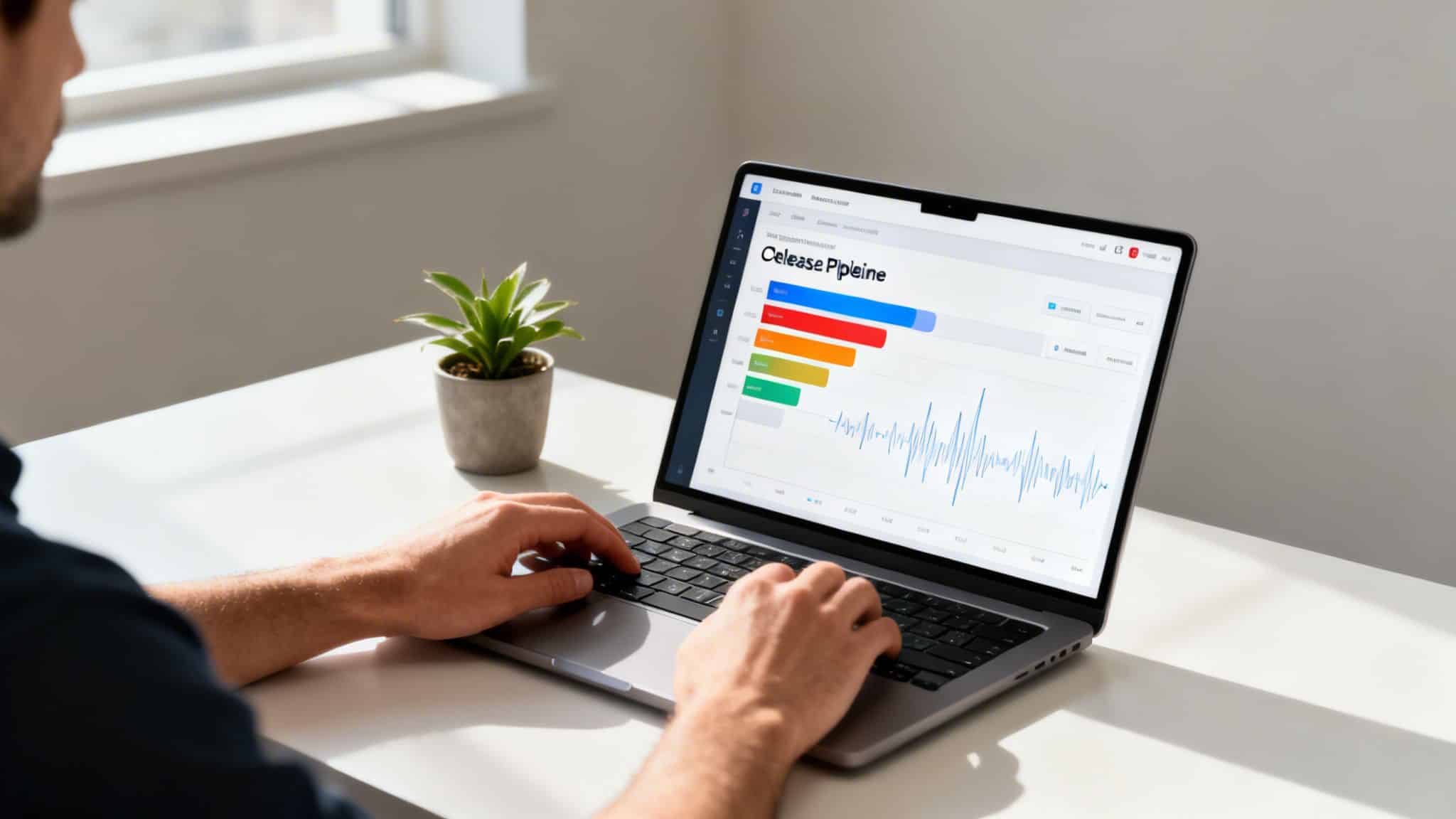
Man working on a laptop displaying a release pipeline dashboard with various charts and data.

The days of holding your breath during a high-stakes, manual software deployment are finally coming to an end. Technology is quickly turning program release management from a tedious, error-prone chore into an intelligent, automated process. This isn't some far-off trend for Silicon Valley giants; it’s a critical strategy for Central Florida businesses looking to secure their operations and get ahead.

At the heart of this change is Application Release Automation (ARA). Think of ARA tools as a tireless, hyper-disciplined project manager for your software. They orchestrate the entire release pipeline—from code compilation and testing to final deployment—making sure every step is executed perfectly, every single time.

Imagine a professional services firm with offices in Orlando and Winter Park. With ARA, a critical software update gets deployed identically across both locations without anyone lifting a finger. This completely removes the risk of one office running a slightly different, potentially buggy or insecure version, guaranteeing uniform performance and security across the company.

The Rise of Intelligent Automation

Automation alone is powerful, but when you add artificial intelligence (AI), it becomes predictive. Modern release systems now use AI to analyze past release data, spot patterns, and predict potential failures before they can disrupt your business. It's a massive leap forward in managing risk.

AI-driven automation dramatically cuts down on human error, which continues to be a leading cause of expensive downtime and serious security breaches. By spotting risks early, AI lets your team fix problems proactively instead of scrambling to contain a full-blown crisis.

This predictive power is a cornerstone of modern cybersecurity. Instead of just hoping a release goes well, AI actively hunts for anomalies that could signal a vulnerability or a system conflict. It transforms your release process from a potential security liability into a fortified, self-monitoring asset. If you're new to integrating AI, developing a clear strategy is the first step. You can explore how to build one with our guide on AI roadmap development.

From Manual Effort to Automated Assurance

The impact of this technology is staggering. The move toward microservices architectures alone has multiplied release frequencies by 10 to 20 times, making manual oversight nearly impossible. This rapid pace is fueling explosive growth in the ARA market, which is projected to more than double from USD 6.42 billion in 2026 to USD 14.97 billion by 2031.

We're already seeing GenAI-powered orchestration slash failure rates. For some major companies, these tools have accelerated deployments by as much as 75%.

Adopting these advanced methods requires a shift in thinking, moving your team toward the principles found in DevOps and platform engineering. The goal is to build a system that is both incredibly fast and resilient. For those looking to adopt the most modern and efficient methods, a practical guide to mastering DevOps and Continuous Delivery can offer invaluable insights into building robust release programs.

The key benefits of an automated, AI-enhanced release process are clear:

  • Increased Speed and Frequency: Deploy updates more often and with higher confidence, allowing you to deliver value to customers and employees faster.
  • Drastically Reduced Errors: Automated checks and predictive analytics catch issues that even the most meticulous human reviewers might miss, leading to more stable and secure deployments.
  • Enhanced Security Posture: Automation enforces security policies with perfect consistency, ensuring that vulnerability scans and compliance checks are never skipped.
  • Improved Team Focus: By automating repetitive deployment tasks, you free up your valuable technical staff to focus on innovation and strategic work instead of manual drudgery.

Ultimately, bringing automation and AI into your program release management isn't just about moving faster. It's about building a smarter, more secure, and more reliable technology foundation for your entire business.

Building a Release Governance Framework That Actually Works

Three professionals discuss documents and governance in a focused business meeting setting.

Let's talk about governance. For many Florida businesses, especially those in healthcare, finance, or law, the word conjures up images of restrictive red tape and slowed-down progress. But that’s an outdated view.

Think of governance as the guardrails on a highway. They aren't there to stop you from driving; they're there to keep you from veering into a ditch. Good governance keeps your technology on the right track, preventing costly detours into downtime and security breaches.

A solid framework for program release management tackles the fundamental tension every business faces: how do you innovate quickly without exposing your operations to unacceptable risk? It shifts the focus from just checking boxes to a more strategic goal—making sure every single technology change is safe, secure, and delivers real business value.

For a Kissimmee-based accounting firm rolling out a new billing system, this means knowing exactly who is accountable if it fails and having a pre-approved plan to fix it. It’s about creating a documented, auditable process that provides clarity, not confusion.

From Vague Policies to Measurable Accountability

Old-school governance often felt like a guessing game built on subjective approvals and endless meetings. A modern framework, on the other hand, is built on cold, hard data. It treats your release process like any other critical business function—one that you can measure, manage, and continuously improve.

This means moving beyond gut feelings like "it feels stable" to tracking concrete metrics that paint a crystal-clear picture of your release health and security posture. These numbers become your dashboard, giving you the real-time visibility needed to operate with confidence.

Key metrics that provide this dashboard view include:

  • Deployment Frequency: How often are you successfully pushing changes to production? A higher frequency often points to a more mature, less risky process.
  • Change Failure Rate: What percentage of your releases blow up in production or require an emergency hotfix? This is a direct measure of your release quality.
  • Mean Time to Recovery (MTTR): When a failure inevitably happens, how fast can you restore service? A low MTTR shows your team can react effectively when things go wrong.

Tracking these numbers gives you the transparent, measurable accountability that builds trust with clients and stakeholders. It’s the proof that your technology is truly under control. A robust release governance framework often incorporates established best practices, like those found in ITIL, to manage changes. You can learn more by checking out this guide on Mastering ITIL Change Management Processes: A Practical Guide.

Enabling Value Realization Through Controlled Releases

Ultimately, the goal of governance isn’t just to prevent bad things from happening. It’s to ensure good things happen efficiently and safely. The most important KPI for any modern governance framework is value realization—confirming that your technology investments actually deliver on their promises.

The hard truth is that many projects fail to connect their activities to clear business value. This is especially true with flashy new tech like AI. Gartner’s recent forecast is a stark warning, revealing that over 40% of agentic AI projects will likely be canceled by the end of 2027 because they fail to demonstrate clear value or establish proper risk controls. To see more on this trend, you can read the full analysis on 2026 program and project management trends.

Effective governance acts as a value filter. It forces critical questions early in the process: What business problem does this release solve? How will we measure its success? What are the cybersecurity risks, and how will we mitigate them?

High-performing teams accomplish this by using smart techniques like canary releases (exposing a new version to a small group of users first) and feature flags (turning features on or off without a full redeployment). This allows them to test new ideas in a controlled way, gathering real-world data on performance and user feedback before a full rollout. It's how they safely deploy changes multiple times a day while continuously watching metrics like deployment frequency and MTTR to ensure every release is safer and faster than the last.

Common Release Pitfalls and Cybersecurity Blind Spots

Even with the best intentions, the road from a planned update to a successful deployment is paved with potential traps. I’ve seen it time and again with businesses right here in Central Florida—a single misstep can spiral into costly downtime, a damaged reputation, and dangerous security breaches. These aren't just abstract risks; they're real-world scenarios that can cripple a business.

Imagine a “minor” software patch that suddenly knocks your Orlando e-commerce site offline during a holiday sale. Or a rushed update to your patient management system that accidentally exposes sensitive client data, creating a compliance nightmare for your Winter Park medical practice. The good news? These disasters are almost always preventable.

They happen when well-known pitfalls are ignored and cybersecurity is treated like an afterthought. By understanding these common mistakes, you can build a release process that sees them coming and neutralizes them before they can do any harm.

A focused man working intensely on a laptop with a shield logo in an office.

The Pitfall of Insufficient Testing

One of the most frequent—and damaging—mistakes is skimping on testing. When business pressures to “just get it done” mount, teams can be tempted to push updates straight into the live environment. This is like performing a surgery without ever practicing the procedure—the odds of something going terribly wrong are sky-high.

Solution: The only way to sidestep this disaster is with a mandatory staging environment. As we've discussed, this is your sandbox—an exact replica of your live system where you can safely test every update. It lets you confirm a patch works as intended and, just as importantly, doesn’t break anything else before it can ever touch your operations or your customers.

The Chaos of Uncontrolled Scope Creep

Scope creep is the silent killer of technology projects. It’s what happens when new features or last-minute changes are continuously tacked onto a release after it has already been planned and approved. Each unplanned addition introduces new variables and new risks, quickly turning a controlled, orderly release into a chaotic free-for-all.

Solution: A formal change control process is your best defense. This process mandates that any proposed change to a planned release must be formally submitted, reviewed for its impact, and approved by the right people. It forces every change to be intentional and its consequences fully understood, stopping the uncontrolled expansion that so often leads to failed deployments.

Cybersecurity Blind Spot: The Disorganized Release

Hackers thrive on chaos. A disorganized release process, full of last-minute scrambles and a lack of oversight, creates the perfect cover for malicious activity. Cybercriminals specifically target these moments of confusion to inject malware, bypass security controls, or gain a foothold in your network.

A change made to your system without going through the proper security review is a backdoor waiting to be discovered. Attackers know that "duct tape" solutions and home-brewed tools often circumvent the secure software development lifecycle (SDLC), creating a massive blind spot.

Even something as seemingly simple as a configuration change can have devastating consequences if not properly vetted. A famous AWS outage was triggered by a simple DNS configuration change that bypassed the normal review process.

You have to treat every single change—whether it's code, a configuration tweak, or a vendor patch—as a potential security event. This means building security checks directly into your release workflow, a practice known as Secure DevOps or DevSecOps. To dig deeper, check out our guide on the best practices for secure DevOps in your CI/CD pipeline.

The Pitfall of Poor Communication

Finally, a release can be technically perfect and still be a total failure if nobody knows what’s happening. When your sales team is caught off guard by a CRM update or your customer service staff doesn't know about a new feature, the result is confusion, lost productivity, and a frustrated team.

Solution: A simple but effective communication plan is essential for every single release. This plan should clearly spell out:

  • Who needs to be informed (e.g., specific departments, all staff, key clients).
  • What they need to know (e.g., the purpose of the change, expected downtime, what's new).
  • When they will be notified (e.g., one week before, one day before, and immediately after deployment).

This proactive communication ensures everyone is prepared, turning a potentially disruptive event into a smooth, predictable transition. By addressing these common pitfalls, you transform your program release management from a source of risk into a powerful engine for stable, secure growth.

Your Action Plan for Better Release Management

Let's be clear: You don't need to operate like a software giant to get your technology updates under control. For most Central Florida businesses, the sweet spot is finding just enough process to make sure your technology is a reliable asset, not a source of constant fire drills.

This isn't about adding layers of bureaucracy. It's a straightforward plan designed to be practical, even if you don't have a dedicated IT department. The goal is simple: move from reacting to problems to proactively preventing them.

It all starts with visibility and communication. Get those two things right, and you've already won half the battle.

Foundational Steps for Immediate Improvement

You can't manage what you can't see. The first step toward taking control is simply knowing what technology actually runs your business. This initial inventory is the most important thing you can do.

  1. Document Your Key Software: Grab a spreadsheet and make a simple list of your business-critical software. For an Orlando law firm, this would be their case management system, accounting software, and secure document portal. Just list the software, the vendor, and the current version you're running.

  2. Define Update Cadence: Next to each piece of software, note how often it gets updated. Is it monthly? Quarterly? Whenever the vendor feels like it? A shared calendar that shows all the upcoming vendor patch cycles can be a game-changer, preventing surprise updates that crash other programs.

Maturing Your Release Process

Once you can see what’s coming, you can start to introduce some basic control. This is all about making sure changes are deliberate and secure—a non-negotiable for any business in industries like healthcare, finance, or legal handling sensitive client data.

The objective here isn't to create red tape. It's to build a common-sense cybersecurity checkpoint. By formalizing approvals, you make sure every change gets a quick review for potential risks before it can hurt your operations or expose data.

This next phase introduces two simple but powerful controls:

  • Establish a Simple Communication Plan: For any planned update, decide who needs to know and when. A quick email to your team a week before—and a day before—an update to your Kissimmee office’s CRM is all it takes to prevent confusion and lost work.
  • Define Go/No-Go Criteria: Before you hit "install," run through a simple checklist. Has the update been tested on a non-critical computer? Have a couple of key users confirmed it works as expected? This quick check prevents you from rolling out an update that’s not ready for prime time.

Taking these small steps puts you firmly in command of your technology. For Orlando and Winter Springs businesses ready to build a truly secure technology roadmap, a trusted IT partner can help fine-tune these processes to your specific goals, locking in long-term stability and security.

Frequently Asked Questions About Program Release Management

When you're trying to grow a business, managing all the moving parts of your technology can feel overwhelming. Let’s tackle some of the most common questions business owners in places like Orlando and Winter Park have about bringing order to their IT changes with program release management.

We’re a Small Business in Orlando. Is This Process Too Complex for Us?

Not at all. The beauty of program release management is that it scales to fit your business, not the other way around. It’s not about adding layers of red tape.

For a smaller business, this could be as simple as keeping a shared calendar of all planned software updates. You might designate one trusted person to approve changes and have them test those updates on a single, non-critical computer before rolling them out to everyone else. The goal is always to add control and visibility, not bureaucracy.

How Does This Actually Improve Our Cybersecurity?

Think of it this way: chaos is a hacker’s best friend. Uncoordinated, untested updates are one of the most common ways they get in. A solid release process is one of your strongest lines of defense.

It ensures every change is checked for security holes before it goes live. It guarantees critical security patches are applied everywhere, not just on some machines. It also makes sure the right access controls are in place during the update.

By closing the security gaps that chaos creates, a structured release process dramatically reduces your company's risk profile. Hackers thrive on disorder; release management brings order.

This systematic approach makes it incredibly difficult for attackers to find—and exploit—those little cracks in your technology.

Can’t Our Software Vendors Manage Their Own Releases?

Yes, they manage updates for their own product. But they have zero visibility into how that update will interact with all the other tools your business relies on.

A vendor’s perfectly good patch could easily break your accounting software, your CRM, or another critical system, bringing your entire operation to a grinding halt. A financial firm in Kissimmee can't afford for a vendor update to crash its entire portfolio management platform.

Program release management is the missing piece that coordinates all changes from all sources. Its job is to act as the air traffic controller, ensuring your entire technology ecosystem stays stable, secure, and functional. It protects your business from the domino effect of a single failed update.

What’s the First Step We Should Take to Get Started?

The simplest, most powerful first step is to take inventory.

Just start by making a list of the critical software you depend on every day—your customer database, your financial software, your scheduling system. Knowing exactly what you have is the foundation for managing it effectively. This one step gives you the visibility you need to start planning updates instead of just reacting to them.


Ready to build a technology roadmap that drives growth and locks down security? Cyber Command, LLC provides expert-led managed IT and cybersecurity services for businesses in Orlando and Winter Springs, delivering the proactive partnership you need to thrive. Learn how we can help you take command of your technology.