Cybersecurity Services in Orlando FL: An SMB’s Guide 2026

On a normal Tuesday in Orlando, the problem rarely looks dramatic at first. A controller gets an email that appears to be from a vendor. The logo is right. The tone is familiar. The request is urgent, but not unusual. Someone hesitates for ten seconds, clicks anyway, and now your day is no longer about customers, staffing, or cash flow.

That's how a lot of cyber incidents start for small and mid-sized businesses. Not with a movie-scene hack. With an ordinary business process that got exploited.

If you run a law firm in Winter Park, a dental practice in Dr. Phillips, an engineering firm near downtown, or a multi-location service business across Central Florida, cybersecurity isn't a side issue anymore. It's part of keeping operations stable, protecting client trust, and making sure one bad click doesn't turn into a week of disruption.

The Growing Need for Cybersecurity in Central Florida

A Central Florida business can lose a normal workday in under an hour. An employee opens a convincing vendor email. A Microsoft 365 login gets captured. Mailbox rules forward messages discreetly. Then accounting, customer communication, and approvals start slipping out of your control.

That pattern shows up here because Orlando businesses run on speed, trust, and connected systems. Professional services firms pass sensitive files back and forth all day. Medical and dental offices depend on scheduling platforms, patient data, and insurance workflows. Construction, property management, and field-service companies rely on mobile devices, email approvals, and third-party apps to keep jobs moving. Each connection helps the business run. Each one also creates another place to secure.

The pressure is not limited to large enterprises. The Cybersecurity and Infrastructure Security Agency has repeatedly warned that phishing, stolen credentials, and known but unpatched weaknesses remain common entry points across U.S. organizations, including small and midsize companies, as described in CISA guidance on reducing cyber risk for businesses. For Orlando owners, that translates into a practical question. If a password gets reused, a laptop misses patches, or a fake payment request reaches the wrong person, how long would operations stay stable?

What this looks like on the ground

In this market, the first sign of trouble is usually ordinary business activity:

  • A vendor message that sends AP to a fake payment portal
  • A cloud account takeover that redirects client emails without anyone noticing
  • A remote employee device that never got basic hardening or monitoring
  • A file-sharing app adopted by one department without any security review

These are process failures as much as technical failures.

That matters in Orlando because many companies sit inside larger supply chains. A law office may handle closing documents for real estate deals. A medical practice may depend on billing vendors, imaging platforms, and patient communication tools. An accounting firm may connect directly into client financial systems. One weak control inside your company can turn into delayed payments, client notifications, contract issues, or downtime that spills into someone else's operation too.

Good cybersecurity services reduce that operational drag. They close the easy gaps first, then add monitoring, response, and testing where the business risk is real. If you want a plain-English view of how a monitored security team works day to day, this overview of a security operations center is a useful starting point. If your business depends heavily on cloud software, this SaaS penetration testing guide is worth reviewing as well.

Practical rule: If your team uses email, cloud apps, shared files, and online payments to serve customers, cybersecurity belongs in daily operations, not a drawer labeled IT.

Decoding Cybersecurity Services What You Actually Get

Most owners hear terms like SOC, MDR, EDR, and SIEM and tune out. Fair enough. The jargon is awful. What matters is what those services do inside your business.

In Orlando, the market has clearly moved beyond old break-fix support. Local provider listings now commonly promote 24/7/365 monitoring, SOC support, advanced detection, and related capabilities, and those same listings show at least 21 cybersecurity companies in the city, which points to a mature local market for specialized services, according to Orlando cybersecurity provider listings.
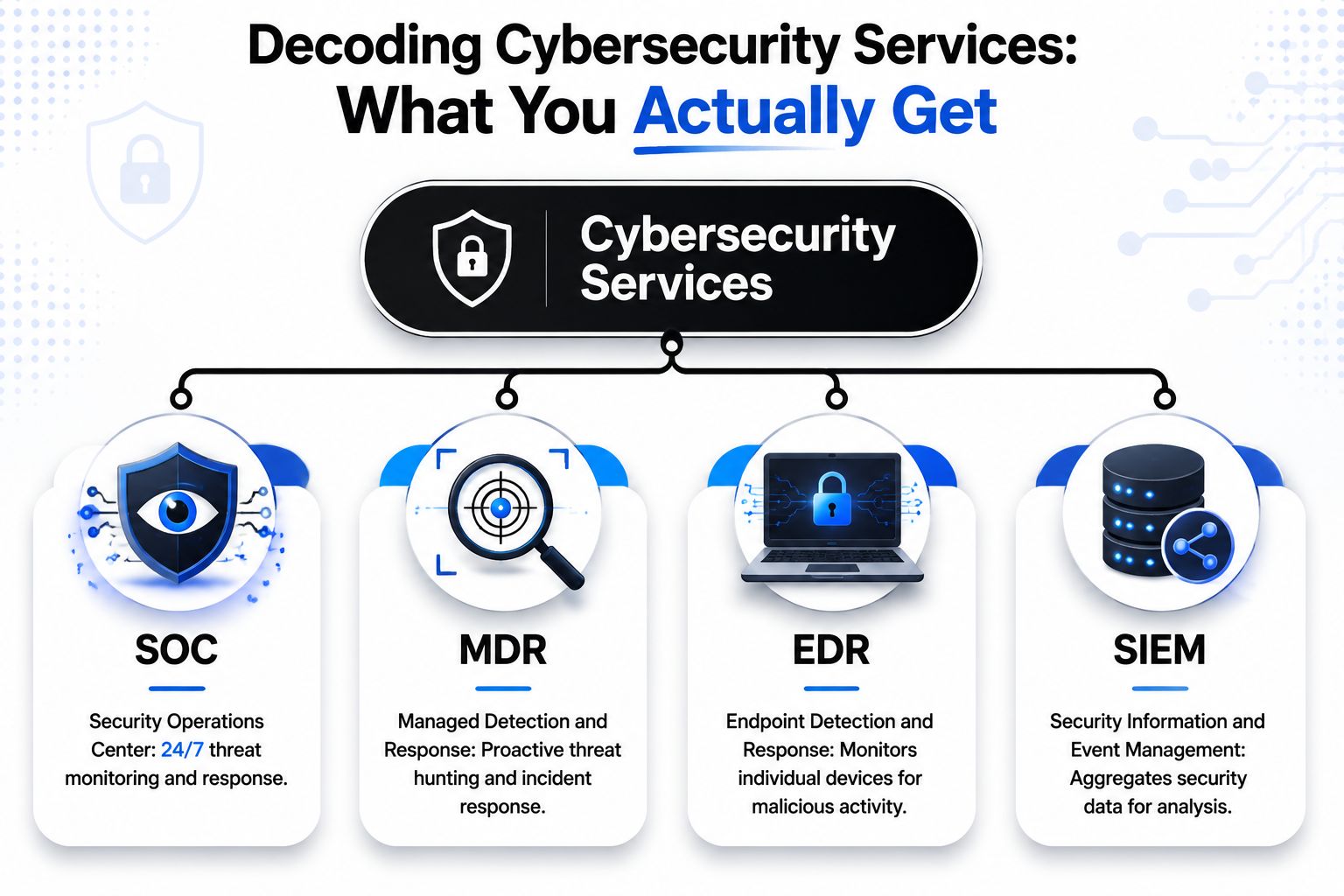
An infographic titled Decoding Cybersecurity Services explaining SOC, MDR, EDR, and SIEM roles in business security protection.

The core layers that matter

Think of cybersecurity services as a building, not a single product.

Patching and hardening are the foundation. If operating systems, browsers, line-of-business apps, firewalls, and cloud settings stay sloppy, every other control has to work harder. This is the unglamorous work that prevents known weaknesses from sitting open for months.

EDR sits on the devices themselves. Laptops, desktops, and servers generate the clues analysts need to spot suspicious behavior. Good endpoint tooling doesn't just say “malware found.” It shows process activity, suspicious scripts, privilege misuse, and signs that an attacker is trying to move laterally.

SIEM acts as the collection and correlation layer. It pulls logs from multiple systems into one place so someone can connect dots that users won't see. A single failed login isn't interesting. The same identity showing odd authentication behavior, mailbox changes, and suspicious endpoint events at once is very interesting.

SOC is the team watching those signals around the clock. If you want a plain-English explanation of that function, this overview of what a security operations center is is useful. The key point is simple: tools generate alerts, but people investigate, triage, escalate, and coordinate response.

Where MDR fits

MDR, or managed detection and response, is what turns monitoring into action. This is the layer that says, “We saw something bad, we investigated it, and here's what happens next.”

That usually includes:

  • Threat hunting to look for suspicious patterns before a full incident is obvious
  • Alert triage so your team isn't buried in noise
  • Containment guidance when a device, identity, or account needs immediate action
  • Incident coordination so legal, compliance, leadership, and operations don't work from different assumptions

The real question isn't whether your business has security software installed. It's whether someone is responsible for watching, interpreting, and acting on what that software reports.

What works and what doesn't

What works is a stack with ownership. Patch discipline. Endpoint visibility. Centralized logging. A real escalation path. Someone answering the phone after hours.

What doesn't work is buying a handful of tools because they looked good in a sales demo, then assuming coverage exists. That's how companies end up with antivirus, a firewall, a cloud app subscription, and no actual response capability.

If your company builds or sells software, application-layer testing belongs in the conversation too. A practical resource is this SaaS penetration testing guide, which helps separate a checkbox test from an assessment that surfaces business risk.

Why Orlando Businesses Are a Prime Target

A lot of Orlando companies assume attackers only care about big brands, hospital systems, or companies with national visibility. In practice, mid-sized firms and growing local businesses are often easier to monetize. They move money, store sensitive records, rely on email, and usually have less internal security depth than an enterprise.

That matters in Central Florida because the local economy is tightly connected. A private medical practice depends on billing vendors and cloud software. A law firm shares documents with clients, courts, and outside consultants. A contractor, property manager, or tourism supplier may touch payment data, scheduling systems, and vendor portals every day. If one company gets compromised, the problem rarely stays contained to that one company.
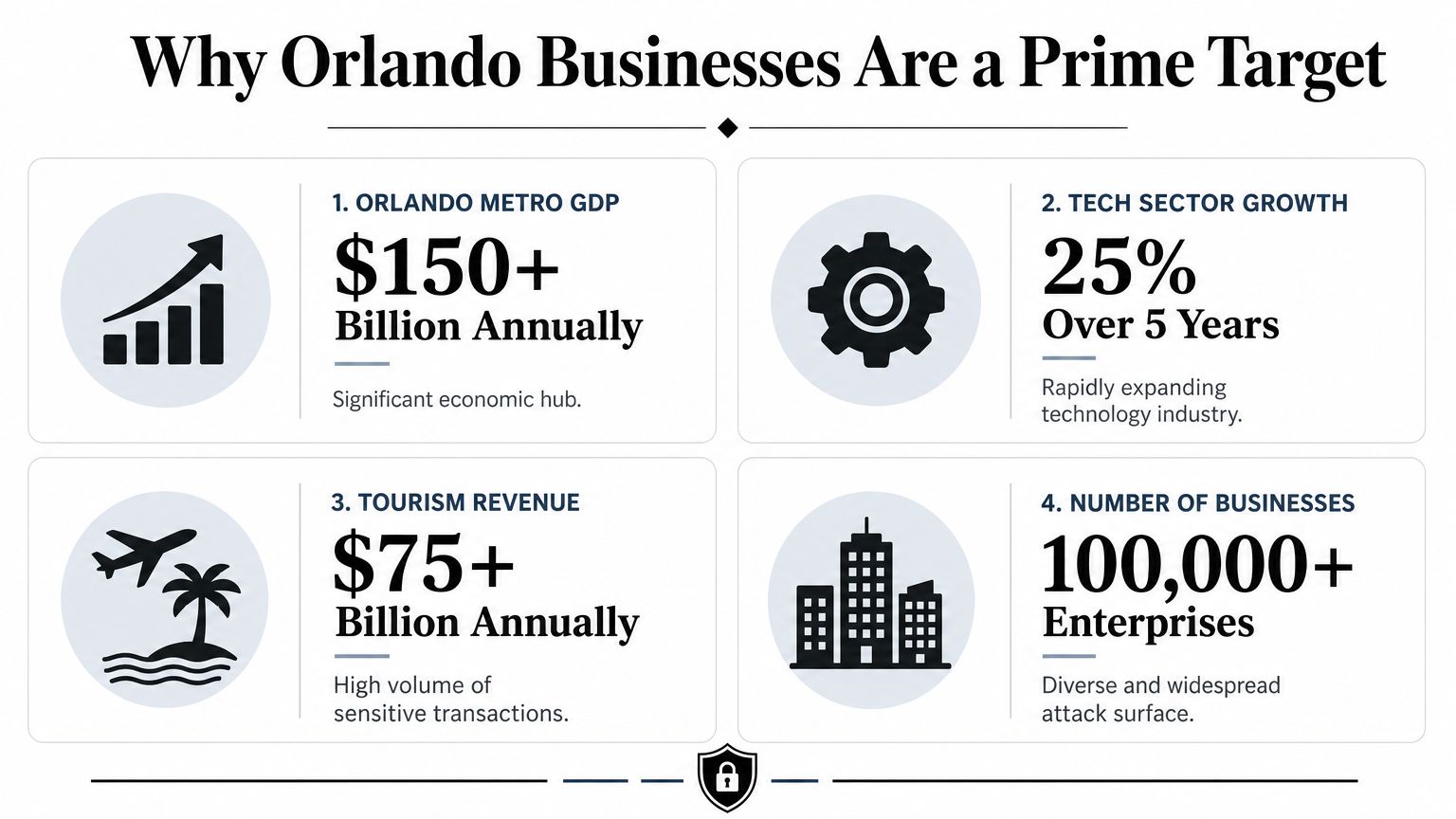
An infographic highlighting four key economic reasons why Orlando businesses are targeted by cyber threats.

Why the local economy raises risk

Orlando has the kind of business mix criminals look for because it creates many points of entry and many ways to get paid.

  • Professional services firms hold contracts, wire instructions, tax records, litigation files, and privileged communications
  • Healthcare practices and support organizations deal with protected information, insurance workflows, and strict downtime tolerance
  • Hospitality, attractions, and tourism vendors handle reservations, payment activity, seasonal staffing, and a high volume of third-party relationships
  • Construction, real estate, and field-service companies rely on mobile access, project-based collaboration, and fast invoice approval cycles
  • Public sector and nonprofit organizations often face budget pressure while still managing sensitive constituent, donor, or operational data

Here is the trade-off I see all the time. The faster a business needs to move, the more trust it extends across email, shared files, vendor requests, and remote access. Speed helps revenue. It also gives attackers more room to blend in with normal work.

Why Orlando businesses get singled out

Many local companies sit in the middle of larger business processes without looking like obvious targets. That makes them attractive.

An accounting firm can be used to redirect funds. A specialty clinic can be pressured because downtime affects patient care. An engineering or architecture firm can expose project documents, credentials, or municipal data. A tourism-related supplier may have enough payment volume and partner access to make a compromise profitable within hours.

Attackers also know that regional businesses often depend on a small number of key people. One controller. One office manager. One outsourced IT contact. One operations lead who approves urgent requests from a phone between meetings. That concentration creates single points of failure, especially around identity, approvals, and account recovery.

In Orlando, the target is often the company that keeps business moving for someone else.

The practical takeaway is simple. Risk here is driven by interconnected operations, third-party trust, and the cost of downtime. A good security program should reflect that reality with stronger identity controls, tighter vendor access, documented approval workflows, and a response plan that matches how the business operates.

Cybersecurity Needs for Key Orlando Industries

A generic “we do cybersecurity” pitch isn't very helpful in this market. A law office, private medical practice, and field-service company don't have the same risk profile, even if they all use Microsoft 365, mobile devices, and cloud storage.

For Orlando's regulated industries, providers increasingly emphasize layered email defense and compliance hardening. Local services commonly include DMARC, DKIM, and SPF alongside vulnerability assessments and related controls, according to Orlando cybersecurity service examples for compliance-focused firms.

Digital cybersecurity overlay featuring tourism, technology, and healthcare symbols over a scenic Orlando city landscape.

Professional services

Law firms, accounting firms, architecture groups, and engineering practices usually care about three things most. Confidentiality, uptime, and clean documentation.

A breach here isn't just a technical failure. It can create client notification issues, reputational damage, billing delays, and ugly questions about due diligence. Email security matters a lot because so much work moves through file shares, approvals, invoice requests, and document review.

For these firms, the most practical controls tend to be:

  • Identity protection around email, cloud apps, and privileged accounts
  • Authenticated email to reduce spoofing and impersonation risk
  • Endpoint visibility on every laptop used by staff and partners
  • Audit-friendly reporting that shows what was found and what got remediated

Healthcare and private practices

Medical spas, dentists, orthodontists, veterinarians, surgical groups, and specialty clinics have a difficult mix. They need convenience for staff, a smooth patient experience, and stronger handling around sensitive information.

A lot of smaller practices don't have deep internal IT maturity. That doesn't reduce risk. It raises the importance of straightforward controls that people can maintain. A good provider in this setting should be able to translate technical findings into operational steps. Which account needs MFA. Which workstation needs replacement. Which backup process needs testing. Which vendor access should be restricted.

A flashy security stack doesn't help if the front desk still shares credentials or if backups can't support real recovery.

In healthcare-adjacent environments, “compliant” and “recoverable” are not the same thing. You need both.

Industrial and field-service organizations

This group gets overlooked. Contractors, logistics firms, specialty manufacturers, and field-service operators often have a blend of office systems, mobile staff, vendor portals, and sometimes older infrastructure that can't be ripped out.

Their risk is usually less about one giant database and more about business interruption. If dispatch fails, job data disappears, or mobile access gets compromised, revenue slows immediately. These firms benefit from standardization more than almost any other segment. Consistent endpoint controls, clear remote-access rules, practical backup strategy, and segmentation where needed.

A field-service company doesn't need enterprise theater. It needs stable systems, fewer exceptions, and a provider who understands that downtime in the office can still stop work in the field.

Understanding Pricing and Engagement Models

Most Orlando business owners don't struggle with the idea that security matters. They struggle with buying it sensibly.

The old break-fix model felt cheap until something failed. Then the invoices piled up, decisions got rushed, and every major problem became an unplanned project. Cybersecurity doesn't fit that model well because a lot of the value comes from continuous prevention, monitoring, and response before visible failure occurs.

Fully managed vs co-managed

Here's the practical comparison:

Engagement model Best fit What you're paying for
Fully managed Businesses without internal IT depth Day-to-day support, security operations, patching, vendor coordination, and a single point of accountability
Co-managed Companies with internal IT staff who need reinforcement Shared responsibility, outside expertise, added monitoring, escalation support, and coverage for gaps

With fully managed IT and security, the appeal is predictability. You're usually trying to convert chaos into a consistent operating expense. That matters for SMBs because budgeting improves when support, monitoring, and routine maintenance aren't billed like emergencies.

With co-managed support, the benefit is amplified effectiveness. Your internal team may know the business well but still need help with after-hours response, advanced security tooling, documentation discipline, or compliance-related work.

What to watch for in proposals

Not all “managed security” offers are structured the same way. Two proposals can look similar and be very different in practice.

Ask whether pricing includes:

  • 24/7 monitoring or only business-hours review
  • Incident response coordination or just alert forwarding
  • Endpoint tooling and licensing or separate line items
  • Vulnerability remediation guidance or only reports
  • Vendor and license management or a handoff back to you
  • Onsite support expectations when something urgent happens locally

If pricing looks low, check what got excluded. Cheap security often means you bought software and a dashboard, not real accountability.

How to Choose the Right Orlando Cybersecurity Partner

Choosing a provider shouldn't feel like shopping for office supplies. This is closer to interviewing a long-term operating partner. The right firm will shape how your business handles incidents, recovers from disruptions, passes audits, and supports growth.

For Orlando SMBs, a strong technical benchmark is a 24/7 SOC paired with EDR and SIEM, because that combination supports continuous monitoring and reduces dwell time during fast-moving attacks, as described in this overview of Orlando SMB cybersecurity benchmarks.
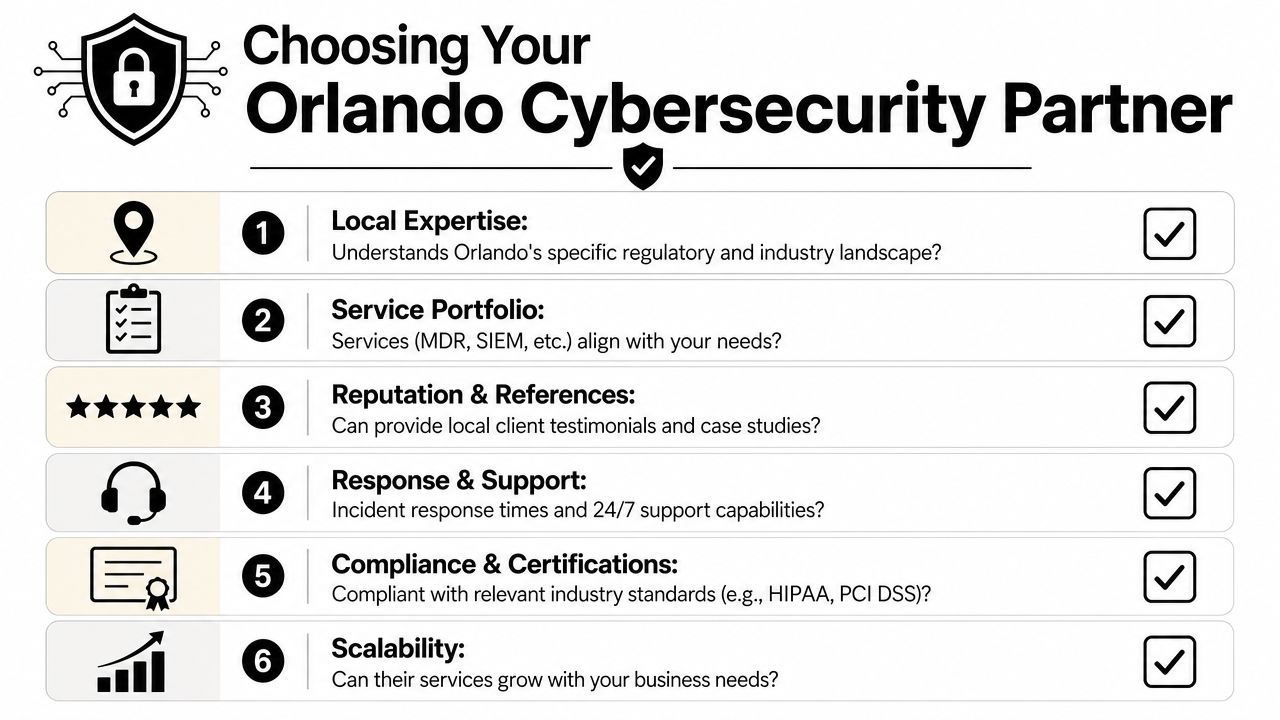
A checklist for choosing an Orlando cybersecurity partner, highlighting six key factors for business security.

Questions worth asking before you sign

A provider should be able to answer these clearly, without hiding behind buzzwords.

  • Who watches alerts after hours
    If something suspicious happens on Friday night, does a real analyst review it, or does your team learn about it Monday morning?

  • What does escalation look like
    Ask who gets contacted, how quickly, and what actions they're authorized to take.

  • How do you handle vulnerability work
    A useful baseline is understanding the difference between scanning and actual analysis. This guide on what a vulnerability assessment is is a helpful reference before those conversations.

  • Can you support forensic readiness
    This is one of the most overlooked areas for smaller firms. If you have a breach, can the provider preserve logs, support evidence collection, and coordinate with legal counsel without making the situation worse?

Signs you're buying the wrong relationship

Some red flags are easy to spot once you know what to look for.

Warning sign Why it matters
They only talk about tools Tools matter, but ownership and response matter more
Reporting is vague If you can't see actions, risks, and trends, you can't manage outcomes
Everything becomes a project Constant change orders usually mean weak planning or narrow coverage
No clear local response model Orlando businesses often need practical support, not just remote ticket handling

One example in the market is Cyber Command, LLC, which states that it provides Orlando-area managed IT and cybersecurity services including a 24/7 SOC, endpoint protection, compliance support, and co-managed or fully managed models. That isn't a recommendation by itself. It's the type of service description you should compare against other providers in the area to see who offers clear accountability, not just a broad list of products.

Ask your future provider one uncomfortable question: “If we have a breach, what do you do in the first hour?” If the answer is fuzzy, keep looking.

From Protection to Partnership A New Approach to IT

The businesses that handle cyber risk well usually stop treating IT as a repair shop. They treat it like an operating function tied to resilience, compliance, and growth.

That changes the relationship. Instead of calling someone when printers break or laptops fail, you build a model where backups are planned, access is reviewed, documentation stays current, and incidents have an actual playbook. If you're revisiting your internal standards, this piece on scalable IT process documentation is a practical resource because mature security depends on repeatable processes, not tribal knowledge.

Partnership also means recovery, not just prevention. If your provider can't speak clearly about restore priorities, communication flow, and business continuity, the relationship is incomplete. A useful starting point is understanding backup and disaster recovery in business terms, not just technical terms.

Good cybersecurity services give you fewer surprises. Better ones give you confidence that the business can absorb problems and keep moving.

Frequently Asked Questions

Business owners usually ask the same small set of questions once the buzzwords are out of the way. Here are direct answers.

With the human element involved in 68% of breaches, cyber insurance carriers are paying close attention to controls like MFA and patch discipline, according to the Orlando cyber insurance and security posture discussion. That's one reason “insurance-ready” security has become a useful framing for SMBs.

Question Answer
Do very small businesses in Orlando really need cybersecurity services? Yes. Smaller firms often have fewer internal controls, fewer staff to catch suspicious activity, and less margin for downtime. Attackers know that.
Is antivirus enough if we already have Microsoft 365 and a firewall? No. Basic tooling helps, but it doesn't replace monitoring, response, identity controls, patch discipline, and recovery planning.
What should we prioritize first? Start with identity security, endpoint protection, patching, backup verification, and a clear response process. Those controls usually provide the most practical reduction in business risk.
Do we need a local Orlando provider? Not always, but local context helps. Businesses with compliance pressure, multiple offices, or onsite support needs usually benefit from a partner who understands the Central Florida market and can respond practically.
Can cybersecurity services help with cyber insurance? They can. Providers that document MFA, access controls, patching, backups, and recovery readiness make underwriting conversations easier and can help you answer carrier questions with evidence.
What's the difference between IT support and cybersecurity support? IT support keeps systems working. Cybersecurity support focuses on reducing risk, detecting suspicious activity, responding to incidents, and proving controls are in place. Strong providers combine both.

The biggest mistake is waiting until something breaks to define expectations. Security works better when the roles, tools, and response steps are decided before the first incident lands in someone's inbox.


If your business needs a clearer plan for Cybersecurity Services in Orlando FL, Cyber Command, LLC is one option to evaluate for fully managed or co-managed IT, 24/7 security operations, and business continuity support in Central Florida. The right next step isn't buying more tools. It's getting a practical view of your risks, your operational dependencies, and what a workable response model should look like for your company.

Orlando IT Services: Top Providers for Your Business

Growth in Orlando often creates IT problems before it creates IT maturity. A firm hires five people, opens a second office, or adds a new software platform, and the weak spots show up fast. Laptops slow down, shared files get messy, remote access fails at the wrong time, and an office manager or operations lead ends up fielding issues that should never have landed on their desk.

That pattern hits Central Florida businesses in different ways. A law office needs dependable document access, secure email, and clear user permissions across partners, associates, and support staff. A medical practice has to add devices, support physicians across locations, protect patient data, and keep systems available after hours. An industrial company may depend on warehouse connectivity, mobile devices, vendor portals, and plant or field operations that cannot afford long outages.

This growth raises the bar for local businesses.

Clients expect faster response times. Employees expect stable systems whether they are in the office, at home, or on the road. Regulators and insurers expect documented controls, not informal workarounds. For Orlando companies in professional services, medical, and industrial environments, the question is not whether outside IT support sounds affordable. The question is whether your current setup can hold up under operational pressure, security threats, and compliance requirements without creating unpredictable costs.

Navigating Growth and IT Headaches in Orlando

Revenue can be up and the business can still feel harder to run.

A growing Orlando firm adds staff, opens another location, or rolls out a new cloud app. Then the weak points show up fast. Password resets pile up. Wi-Fi drops during meetings. A backup fails unnoticed until someone needs a file. The owner, office manager, or operations lead gets pulled into problems that should have been handled upstream.

A professional man holding an award in an office while his laptop shows a loading screen.

That is usually the point where break-fix support starts costing more than it saves. A law office loses billable time because a partner cannot reach matter files before a client call. A medical practice cannot afford after-hours access problems tied to scheduling, imaging, or EHR workflows. An industrial company loses production time because warehouse connectivity or a vendor portal goes down. The invoice for the repair is only part of the cost. Delays, workarounds, and missed deadlines do more damage.

Why this gets harder in Central Florida

Central Florida businesses are operating in a more technical market than they were a few years ago. As noted earlier, the Orlando Economic Partnership reported continued growth in the region's tech workforce in 2023. For business owners, the practical takeaway is clear. The local market now expects better uptime, tighter security, and faster response when systems fail.

That shift is especially important in Orlando's core industries. Professional services firms need controlled access to documents, email, and client data across attorneys, accountants, consultants, and support staff. Medical groups face privacy obligations, device sprawl, and pressure to keep systems available across offices and after hours. Industrial and field-based companies depend on stable networks, mobile access, vendor systems, and recovery plans that hold up during outages and storm season.

Cheap support does not solve those problems.

Practical rule: If IT issues interrupt operations every week, the problem is not random support demand. The problem is the way IT is being managed.

What owners usually need instead

Orlando businesses usually do not need another provider promising a friendly helpdesk and 24/7 coverage. They need a partner that can reduce operational risk, support compliance, and keep spending predictable as the company grows.

That means asking harder questions:

  • Can the provider keep staff working when devices fail, accounts lock, or an office loses connectivity?
  • Can they prevent repeat issues with patching, monitoring, backup testing, and standards for new users and devices?
  • Can they support regulated environments with documented controls, access management, and audit-ready processes?
  • Can they handle multi-site operations without leaving remote staff, physicians, or field teams stranded?
  • Can they give you cost predictability instead of a string of emergency invoices and surprise project charges?

For a lot of Orlando companies, that is the key threshold. IT is no longer a background utility. It is part of service delivery, risk control, and day-to-day operations.

Decoding the Spectrum of Modern IT Services

A provider can answer tickets fast and still leave your business exposed. That gap shows up all over Orlando. A medical practice may get quick password resets but still fail a backup restore test. A law firm may have decent user support but weak access controls around client files. A manufacturer may keep production PCs running while remote site connectivity, vendor access, and patching drift out of control.

That is why "IT services" needs a tighter definition.

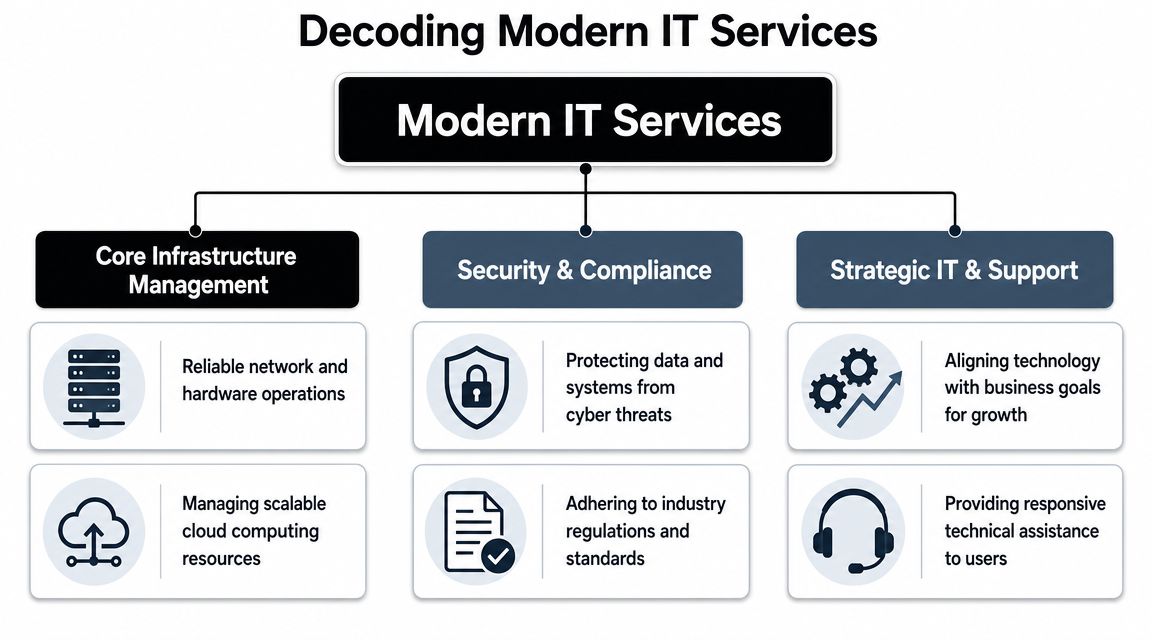
An organizational chart showing the structure of modern IT services, including infrastructure, security, and strategic support.

The service stack is easier to evaluate in three parts. First, the systems that keep staff productive. Second, the controls that reduce security and compliance risk. Third, the planning work that prevents recurring outages, rushed purchases, and undocumented changes.

Core infrastructure management

This is the operating layer behind daily work.

It includes endpoints, networks, wireless, printers, line-of-business applications, identity platforms, backup systems, and cloud tools such as Microsoft 365 or Azure. In a multi-office Orlando business, that also means handling site-to-site consistency, remote access, and vendor coordination without waiting for something to break.

A solid infrastructure scope usually includes:

  • Helpdesk support: A clear process for account lockouts, email issues, application errors, onboarding, offboarding, and access requests
  • Endpoint management: Standardized device setup, patching, encryption, antivirus, and replacement planning
  • Network administration: Ongoing management of firewalls, switches, Wi-Fi, VPNs, internet failover, and location connectivity
  • Cloud operations: Administration of file storage, collaboration tools, identity policies, license changes, and backup settings

The trade-off is straightforward. Providers that focus only on ticket volume often look cheaper at first, but they leave standardization work unfinished. That usually leads to more recurring issues, more user downtime, and more project spend later.

Security and compliance controls

Security should be built into the service model, not bolted on after an incident.

For Central Florida companies, the details matter. Medical groups need access controls, audit trails, device protections, and documented processes that support HIPAA expectations. Professional services firms need tighter identity management, email security, and data handling because a compromised mailbox can expose client communications, contracts, and financial records. Industrial companies need to control remote vendor access, segment networks where needed, and protect older systems that cannot be patched on a normal cycle.

A provider should be able to explain how each control is operated, who reviews alerts, how incidents are escalated, and what evidence is retained for audits or insurance questionnaires. "We include cybersecurity" is not enough.

Look for these controls in plain language:

  • Identity and access management: MFA, conditional access, account reviews, and clean offboarding
  • Endpoint protection: Detection, response, encryption, and policy enforcement on laptops and desktops
  • Email security: Filtering, impersonation protection, user reporting, and response procedures
  • Backup and recovery validation: Restore testing, retention policies, and documented recovery steps
  • Compliance support: Policies, logs, risk reviews, and evidence collection for regulated environments

If a provider offers co-managed IT support options, ask which of these controls stay with your internal team and which ones they will own. That split needs to be explicit.

Strategic support and planning

Planning is where service quality becomes business value.

A provider that only reacts to tickets will not help you control refresh cycles, clean up vendor sprawl, or prepare for office moves, audits, or system changes. Strong providers maintain documentation, review recurring incidents, map out infrastructure decisions, and tie recommendations to budget timing.

Here is what that work should accomplish:

Service area What it should accomplish
IT roadmap Prioritize upgrades, renewals, and projects based on operational risk and business goals
Budgeting Forecast hardware, licensing, and project costs before they become emergencies
Vendor management Coordinate software, internet, telecom, copier, cloud, and line-of-business providers
Documentation Maintain network diagrams, asset records, admin access lists, and operating procedures
Reporting Show recurring issues, unresolved risks, service trends, and accountability

Price and a 24/7 helpdesk promise do not tell you whether a provider can run this full stack well. Orlando IT services should be judged by how they protect uptime, support compliance, and keep technology spending predictable.

Managed vs Co-Managed IT Which Model Fits Your Business

The first decision isn't which provider to hire. It's which operating model fits your company.

Some Orlando businesses need to outsource the entire function. Others already have an internal IT person or small team and need depth, coverage, or specialized security support. That's the difference between fully managed IT and co-managed IT.

When fully managed makes sense

Fully managed IT fits companies that don't want to build an internal department. That's common for smaller law firms, accounting practices, medical groups, manufacturers, and nonprofits where leadership wants one partner to own support, infrastructure, security coordination, vendor management, and planning.

The advantage is clarity. One provider owns the workflow, standards, escalation path, and documentation.

When co-managed is the better move

Co-managed IT works when you already have internal capability but need reinforcement. Maybe you have one systems administrator who handles daily support but can't also cover after-hours issues, compliance work, cloud architecture, major projects, and security monitoring. In that case, a partner can fill the gaps without replacing your internal lead.

If your team is weighing that route, this overview of co-managed IT solutions is a useful reference point for how responsibilities can be split.

Managed vs. Co-Managed IT A Comparison for Orlando Businesses

Factor Fully Managed IT Co-Managed IT
Primary role Outsourced IT department Extension of internal IT
Internal staffing need Minimal or none Existing IT lead or team remains in place
Control over daily decisions Provider handles more operational decisions Shared control between internal team and provider
Access to specialized skills Included through provider bench Added where your internal team lacks depth
After-hours coverage Usually easier to centralize Useful when internal staff can't cover nights or weekends
Scalability Good for growing firms without hiring internally Good for firms outgrowing one-person IT
Best fit Owners who want accountability from one partner Organizations that want support without giving up internal oversight

Decision shortcut: If nobody inside your company owns IT strategy, vendor coordination, and security operations, fully managed is usually the cleaner model. If someone does own those areas but lacks bandwidth, co-managed often fits better.

The wrong choice creates friction. Fully managed can frustrate a strong internal IT leader if the provider tries to replace them. Co-managed can fail if responsibilities are vague and both sides assume the other is handling critical work.

The Cybersecurity Imperative for Central Florida Businesses

A Maitland medical practice can lose access to scheduling and patient records from one compromised Microsoft 365 account. A manufacturer west of Orlando can halt shipping because a ransomware event hits a file server tied to production paperwork. A law firm downtown can create a reportable client-data issue because one former employee still has cloud access. In Central Florida, cybersecurity failures turn into operating problems fast.

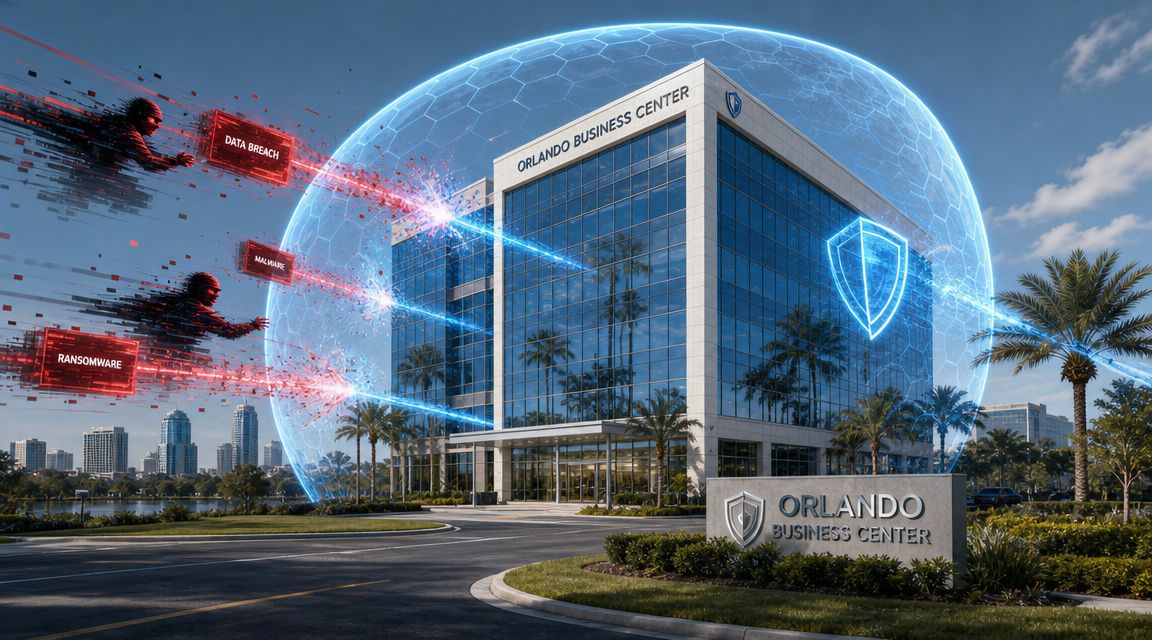
A digital shield protecting an Orlando business building from cyber threats like malware and ransomware attacks.

The common mistake is treating security like a product purchase instead of an operating discipline. A business installs antivirus, adds a firewall, and assumes coverage is in place. Then patching slips, login alerts go unread, a cloud app is shared too broadly, or no one knows who is supposed to isolate an infected device. The failure happens between controls, ownership, and follow-through.

Why layered defense matters

Effective protection comes from coordinated controls that cover different points of failure. Firewalls limit unwanted access. Endpoint protection helps catch malware on user devices. Intrusion monitoring improves visibility when an attacker starts moving through the environment. Encryption reduces exposure if a laptop, phone, or backup set is lost.

Those tools matter, but operations decide whether they work. Someone has to own patch timing, identity policy, privileged access reviews, alert triage, containment, backup testing, and recovery. If your provider cannot show how those tasks are performed each month, you are buying software, not a security program.

Central Florida risk looks different by industry

Local businesses do not share the same threat profile, even when they have similar headcounts.

Professional services firms in Orlando and Winter Park often face email compromise, weak offboarding, and overexposed document repositories. The financial hit usually comes from lost billable time, client notification, and reputation damage. Medical practices carry a different burden. They need tighter access controls, audit trails, device management, and support for HIPAA-related processes because patient data moves through front-desk systems, clinical applications, mobile devices, and third-party vendors. Industrial and field-service companies have another set of trade-offs. They often run older systems, shared workstations, remote access for technicians, and office-to-plant connections that widen the attack surface and complicate patching windows.

Cloud use adds another layer of exposure. File sharing, SaaS applications, and remote collaboration improve speed, but they also create more places for identity abuse and misconfigured access. For cloud-heavy teams, understanding cloud security for startups is a useful primer on how storage, identity, and application risk change once work happens outside the office.

What to ask a provider

Skip broad promises and ask how security works in practice. Ask who reviews alerts after hours, how fast suspicious sign-ins are investigated, how endpoints are isolated, how backups are tested, and what documentation you receive after an incident. Ask how they handle MFA enforcement, user access reviews, vendor risk, and compliance support for your industry.

A useful baseline is this guide to cybersecurity best practices for small businesses. It outlines the controls business owners should expect to see turned into routine operational work, not left as one-time setup tasks.

One more point matters in Orlando. Summer storms, regional outages, and dispersed offices put pressure on business continuity. Security planning should cover recovery priorities, remote access fallback, and clear communication during an outage, not just threat prevention.

If a provider can list tools but cannot explain alert ownership, containment steps, recovery order, and compliance responsibilities, the risk has not been reduced. It has been reassigned, usually back to you.

Understanding Pricing Models and Service Level Agreements

IT proposals often look comparable until you read the exclusions. That's where many bad decisions start.

A business owner sees one provider with a lower monthly fee and assumes the value is obvious. Then they discover patching is limited, endpoint protection costs extra, documentation isn't included, after-hours response triggers extra billing, and project work starts a second invoice stream. The plan was cheaper on paper, not in operation.

What common pricing models actually mean

Most Orlando IT services are packaged in one of three ways:

  • Per user pricing works well when staff rely on multiple devices and standardized applications. It can simplify budgeting for office-heavy teams.
  • Per device pricing can fit environments with shared workstations, fixed assets, or nontraditional user counts, but it can also create blind spots if some tools and services aren't tied cleanly to device counts.
  • Flat-rate managed service sounds attractive because it offers predictability, but the details matter more than the label.

A useful industry caution is that “cheaper” flat-rate IT can end up costing more if it excludes patching, endpoint protection, or after-hours response, as discussed in this analysis of cost control and operational inclusion in IT services. That's the right lens. Don't compare fee alone. Compare what's operationally included.

The SLA terms that deserve attention

A Service Level Agreement, or SLA, is where the provider shows what “support” means in measurable terms. Many buyers focus on response time only. That's not enough.

Review these items carefully:

  1. Response commitment
    How quickly does the provider acknowledge a critical issue, a standard issue, and a low-priority request?

  2. Resolution ownership
    Does the provider only respond, or do they stay engaged until the issue is resolved across vendors and systems?

  3. After-hours scope
    Are nights, weekends, and holidays covered for all users, only emergencies, or billed separately?

  4. Included security operations
    Does the agreement include patching, endpoint protection, monitoring, and remediation workflow?

For a plain-English primer on how SLAs are structured in connectivity services, this guide to SLAs for internet and VoIP is useful context.

A better way to compare proposals

Use a scope-first comparison. Put each provider's offer into the same grid and map what's included, excluded, capped, or billed separately. This breakdown of IT managed services pricing models can help frame that review.

A low headline price often hides labor shifting back onto your staff. The better question is whether the agreement reduces interruption, risk, and surprise spending.

Real-World IT Scenarios for Orlando Industries

The best way to judge Orlando IT services is to test them against actual operating conditions. Different industries break in different places.

One of the biggest gaps in local provider marketing is that broad promises don't explain how support works for regulated, multi-site, or field-based organizations. Buyers should push providers to answer questions about compliance support, standardized remote monitoring, and incident response across offices and field teams, as emphasized in Vann Data's IT planning and budgeting perspective.

Professional services in downtown Orlando

A law firm or accounting office usually depends on document access, email continuity, identity security, and clean onboarding and offboarding. The helpdesk matters, but the deeper issue is process. Who controls permissions for former employees? Who verifies backup integrity? Who standardizes laptops so every new hire doesn't become a custom setup project?

A solid provider should bring documented user lifecycle processes, secure remote access, and reporting that leadership can readily review.

Industrial and field-service operations

An industrial firm near the 417 corridor has a very different environment. Some users sit in an office. Others are in warehouses, vehicles, plants, or customer locations. Devices go offline. Printers support inventory workflows. VPN and authentication failures can stop field work before the day starts.

In this setting, “support” must include standardized remote monitoring across sites, repeatable device deployment, and escalation paths that don't depend on one person knowing the environment from memory.

Multi-site businesses don't fail because they lack a ticketing system. They fail because nobody standardizes the environment behind the tickets.

Private medical practices and specialty clinics

A medical spa, dental group, veterinary practice, or specialty clinic has little room for sloppy access control. The challenge isn't only HIPAA awareness. It's handling everyday realities such as front-desk turnover, shared devices, line-of-business systems, imaging workflows, patient communication platforms, and secure mobile access.

Providers should be able to explain how they support compliance-sensitive workflows without slowing the office down. That includes documentation, endpoint standards, encryption, and incident response discipline.

Nonprofits and community organizations

Nonprofits usually need predictable support and less chaos, not an enterprise science project. They often work with lean administrative teams, donated technology, and mixed user skill levels. The right provider simplifies the environment, trims unnecessary vendor overlap, and sets a realistic standard the organization can maintain.

If you operate across several programs or facilities, classifying locations and operating needs consistently can even become a data problem. Teams working on broader systems planning sometimes use tools like a NAICS classification API when organizing business-unit or partner data across platforms.

Your Checklist for Choosing an Orlando IT Partner

A provider meeting often goes the same way. You ask about response time, cybersecurity, and support coverage. They answer yes to everything. Two months later, your medical office still has shared logins at the front desk, your law firm still has no clear escalation path after hours, or your shop floor PCs are falling behind on patches because nobody defined ownership.

That is why vendor selection needs to get past the sales script.

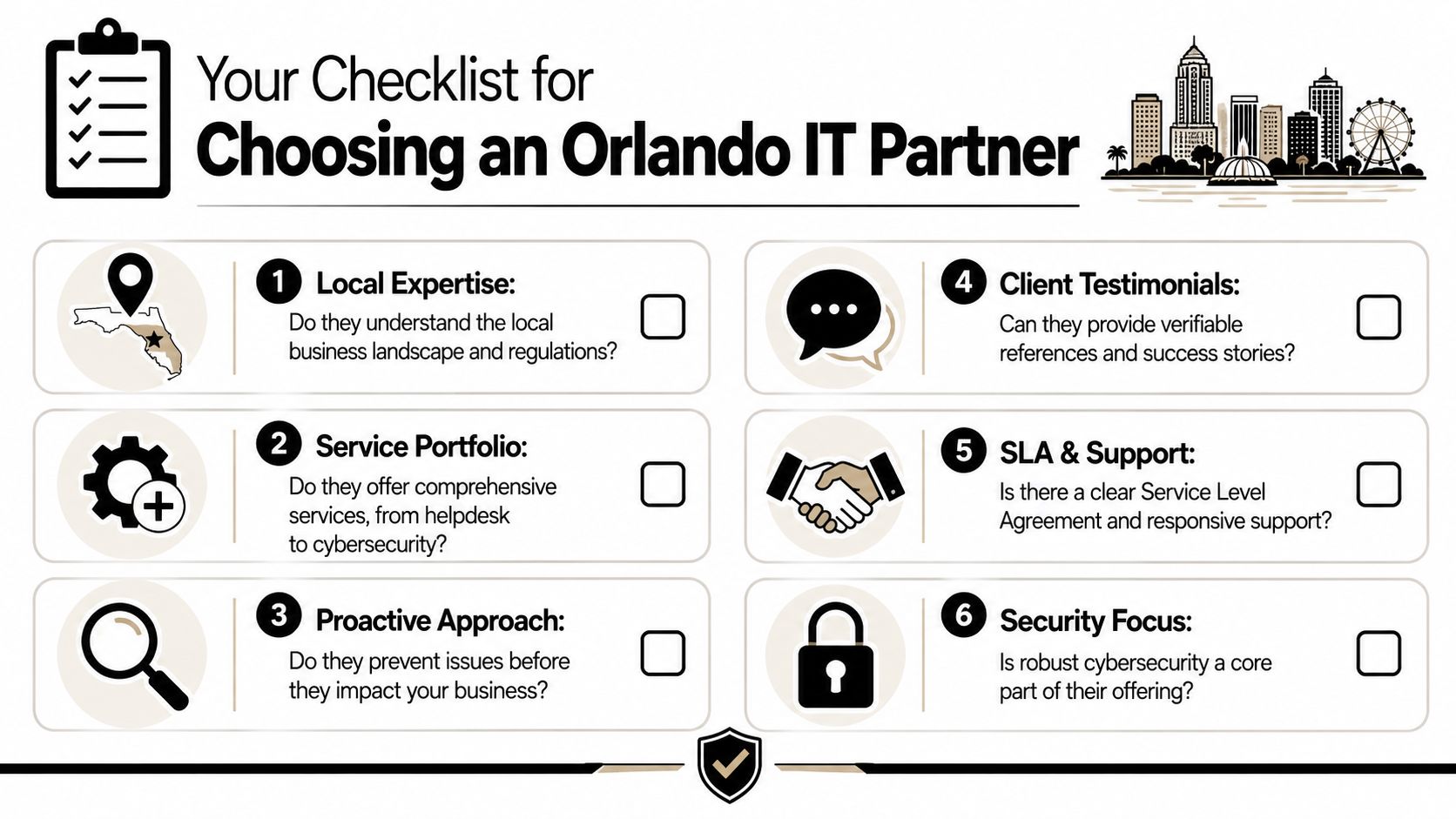
A checklist graphic helping businesses choose an IT partner in Orlando, Florida, featuring six key criteria.

For Orlando businesses, a key test is operational clarity. A capable provider should explain how it handles after-hours incidents, patch approvals, vendor coordination, user onboarding, and security events in a way that fits your industry. A specialty clinic has different risk points than a CPA firm. A manufacturer with multiple shifts has different uptime demands than a nonprofit with a lean admin team. Price matters, but gaps in process usually cost more than a higher monthly fee.

Questions worth asking in every sales call

Use this list to pressure-test any Orlando IT services proposal:

  • Who answers after hours? Ask whether support is staffed continuously, what qualifies as an emergency, and who owns escalation.
  • What is included in the standard stack? Get specifics on patching, endpoint protection, encryption, monitoring, documentation, vendor coordination, and backup oversight.
  • How do you support compliance-sensitive environments? A good answer should address access control, device standards, audit support, and incident handling without slowing daily work.
  • How do you handle multi-site and remote staff? Ask how they standardize systems across offices, field users, and shared devices.
  • What reporting do we receive? You should see recurring incidents, open risks, asset visibility, and planning recommendations.
  • What happens during onboarding? A disciplined provider should document systems, credentials, vendors, endpoints, and policies before taking over.
  • What is excluded? This usually exposes project fees, third-party vendor work, hardware support limits, or security tasks that are assumed but not covered.

What a strong answer sounds like

Good providers speak in operating details. They explain who reviews failed backups, how suspicious login alerts are triaged, when management gets notified, how Microsoft 365 changes are approved, and what happens if an internet circuit fails at 4:30 p.m. on a Friday. If they stay at the level of "we are proactive" or "we customize everything," keep pushing.

In Central Florida, I would also test for industry fit. Professional services firms need tight identity control, email security, and documented procedures that hold up under client scrutiny. Medical groups need consistent workstation standards, account removal discipline, and support that understands patient-facing downtime. Industrial companies need providers that respect production schedules, older equipment constraints, and the cost of an outage during receiving, shipping, or a late shift.

Cyber Command, LLC is one provider in the local market that offers managed IT, co-managed IT, cloud services, and cybersecurity support. That is not a recommendation by default. It is a reminder to compare breadth, accountability, and operating maturity, not just whether a company promises a 24/7 helpdesk.

Buyer test: If you cannot identify who owns security, support, planning, and escalation after the first meeting, the proposal is still too vague.

The right partner should reduce business risk, stabilize day-to-day operations, and make IT costs easier to forecast. That is the standard.

Disaster Recovery Plan Template for Central Florida SMBs

A lot of Central Florida businesses are one bad day away from a long, expensive scramble.

It doesn’t have to be a headline event. Sometimes it’s a ransomware lockout on a Tuesday morning in Orlando. Sometimes it’s storm-related power loss that takes out connectivity, phones, and access to cloud systems right when payroll is due. Sometimes a small law firm in Winter Springs learns the hard way that “we back up everything” is not the same as “we can restore everything fast, in the right order, with clear owners.”

That’s where a disaster recovery plan template earns its keep. Not as a binder on a shelf. As a working document your team can follow under pressure, with enough structure to avoid chaos and enough flexibility to fit your environment, your compliance requirements, and your real-world risks.

For SMBs, the template matters even more. Many SMB teams lack a deep bench of internal IT specialists, and they cannot afford confusion during an outage. The plan has to tell people what to do, who approves what, what gets restored first, and how security response connects to recovery.

Why You Need a Disaster Recovery Plan Template

Hurricane season changes how Central Florida companies should think about recovery. A regional outage doesn’t just hit one server. It can disrupt office access, internet circuits, phones, vendor support, and staff availability at the same time.

Without a template, teams waste the first part of an incident making decisions they should’ve settled months earlier. Who leads the call? Which systems are Tier 1? Are backups clean? Who contacts clients if email is down? Which vendor owns the failover step? That delay is where damage grows.

A templated plan solves a simple but costly problem. It removes guesswork.

Organizations without a documented plan face average recovery costs exceeding $1 million for major incidents, while SMBs can reduce losses by 50 to 70 percent with standardized templates that define RTO and RPO. The same source also notes that 75 percent of untested businesses fail within two years of a major disruption (Secureframe on disaster recovery plans).

What a template changes during a real outage

A good template forces decisions before stress takes over. It standardizes:

  • Recovery order: Which systems return first, and which can wait.
  • Team ownership: Who leads infrastructure, security, communications, and vendor coordination.
  • Escalation paths: When a technical outage becomes a legal, compliance, or client-notification event.
  • Fallback operations: How staff keeps working when primary systems are unavailable.

Practical rule: If your team has to debate priorities during an outage, the plan isn’t finished.

For Orlando-area SMBs, this is rarely just an IT issue. Professional services firms depend on email, document access, and line-of-business apps to bill and serve clients. Medical practices have patient workflows and privacy obligations. Manufacturers and field-service companies need scheduling, inventory, and dispatch continuity.

A reusable template also helps multi-location companies stay consistent. The Plano office and the Winter Springs office may face different local conditions, but the structure for response, documentation, approvals, and testing should still be uniform.

If you’re still relying on tribal knowledge, spreadsheets, and “we’ll call our IT guy,” start with a documented framework and build from there. Cyber Command breaks down that business case in its guide on why it’s important to have a disaster recovery plan.

Preparing Your DRP Template

The strongest plans start before anyone fills in RTOs or backup schedules. They start with scope, ownership, and document control. If those pieces are weak, the rest of the plan turns into a paperwork exercise.

A professional man in a suit reviews a disaster recovery plan template on a tablet in an office.

Effective DRP creation begins with a recovery team, a risk assessment, defined RTOs and RPOs, verified backups, and ongoing testing and refinement. Quarterly tests boost recovery times by 40 to 50 percent according to Seagate’s guidance on disaster recovery planning (Seagate DRP challenges and pitfalls).

Start with a scope that’s narrow enough to use

Most SMBs make one of two mistakes. They either write a plan so broad that nobody can execute it, or so technical that leadership can’t use it for decisions.

A practical scope statement should answer:

  • Which locations are covered
  • Which systems are in scope
  • Which departments depend on them
  • Which incidents activate this plan
  • Which separate playbooks already exist

For example, a dentist with one office may keep one integrated document. A law firm with multiple offices may need a master plan plus separate appendices for each site, ISP, and key application.

Name real people, not job titles only

A template should list primary and backup owners for each recovery function. “IT Manager” isn’t enough if that person is unavailable.

Use a roster that includes:

Function Primary owner Backup owner What they decide
Incident lead Named person Named backup Activates DRP and sets priorities
Infrastructure lead Named person Named backup Servers, cloud, network, endpoints
Security lead Named person Named backup Containment, evidence, access review
Communications lead Named person Named backup Staff, clients, vendors, counsel
Business approver Named executive Named backup Downtime trade-offs and spending approvals

That last role matters. During recovery, somebody on the business side has to decide what’s acceptable. IT can restore systems. Leadership decides whether the business can operate on degraded service for a period, or whether a more aggressive failover is worth the cost and disruption.

Decide where the plan lives

A disaster recovery plan template is useless if it’s trapped behind the systems you’re trying to recover.

Keep copies in more than one place. Use a secure cloud document repository that key staff can access from outside the office. Keep an offline copy for critical contacts, vendor numbers, and basic recovery sequences. If your team collaborates in shared documents, follow solid document version control best practices so you don’t end up with three “final” plans and no confidence in which one is current.

Store the current plan where your team can reach it during an internet outage, an identity outage, and a facility outage. If one failure blocks access, it isn’t enough.

Build a simple project checklist

Before you customize the template, finish these setup tasks:

  1. Approve the owner who maintains the document.
  2. Collect current contacts for staff, vendors, internet providers, and cloud platforms.
  3. Pull system inventory for servers, SaaS apps, endpoints, and backup platforms.
  4. List business-critical processes such as intake, scheduling, billing, payroll, and client communications.
  5. Set a review calendar so the plan doesn’t go stale after the first draft.

That prep work isn’t glamorous. It’s what makes the template usable when the pressure is on.

Customizing Core Sections of Your Template

Generic templates usually cover infrastructure recovery well enough. Where they fall short is the handoff between restoration and security response. That gap matters for SMBs because ransomware doesn’t end when you restore a file server. You still need containment, validation, access review, and post-recovery monitoring.

That weakness shows up in current template content. Most DRP templates omit integration with 24/7 SOC threat hunting and incident response, even though ransomware attacks on SMBs rose 37 percent in 2025 and backups are targeted 96 percent of the time according to the verified source summary tied to Smartsheet’s template coverage (Smartsheet disaster recovery templates).

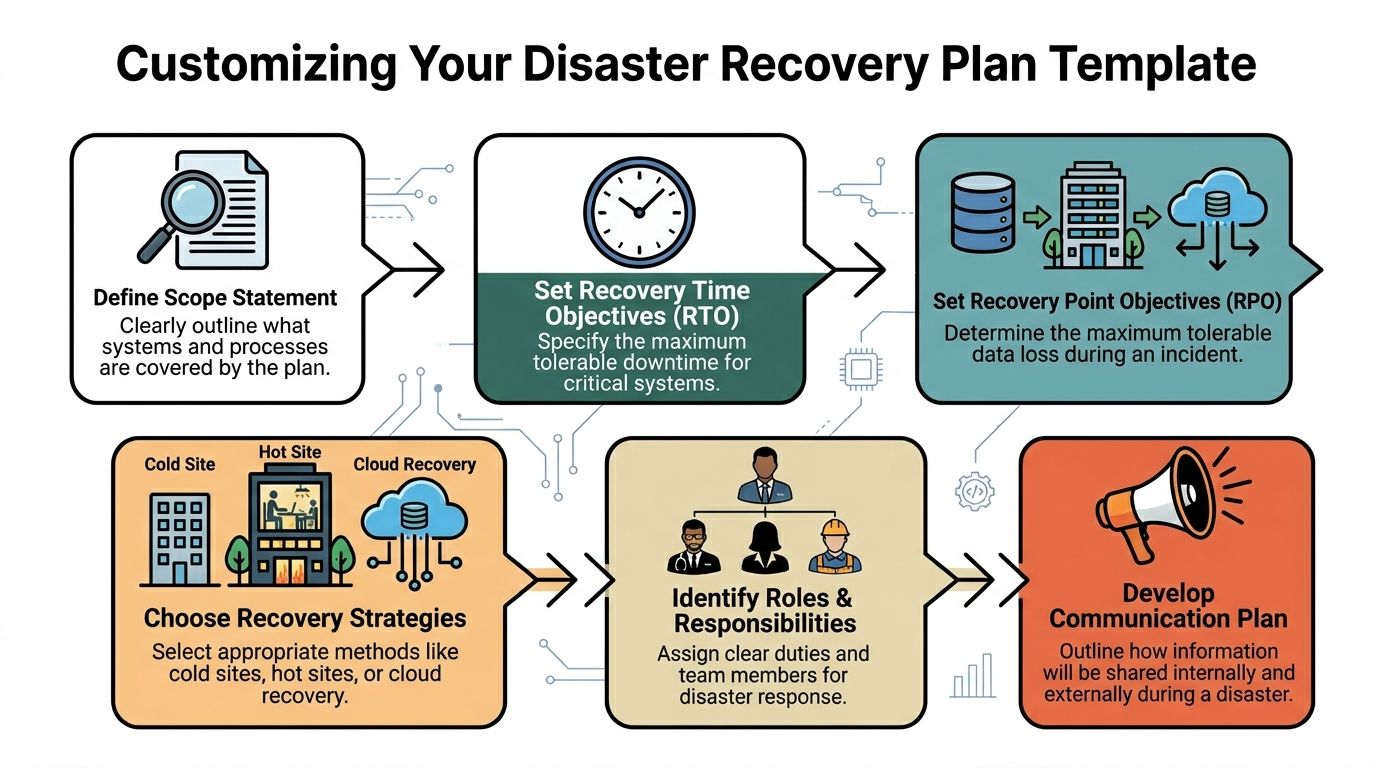
A diagram illustrating the six essential steps for customizing a disaster recovery plan template for businesses.

Write a scope statement people can actually follow

The first section should define what the plan covers in plain language.

A strong scope statement includes:

  • Business units covered
  • Locations covered
  • Critical applications and data sets
  • Dependencies outside your control
  • Incidents that trigger the plan
  • Incidents handled by a separate incident response playbook

A weak version says, “This plan covers company systems.”

A usable version says the plan covers production Microsoft 365 services, line-of-business applications, file storage, cloud backups, VPN access, endpoint management, and communications for the Orlando office and remote staff, with a separate cyber incident playbook referenced for active malware containment.

That distinction matters. During a storm outage, you may focus on connectivity and continuity. During ransomware, you need a recovery path that doesn’t restore infected systems back into production.

Set RTO and RPO by business process, not by server

Many SMBs still assign one recovery target to every system. That’s tidy on paper and wrong in practice.

RTO is the maximum acceptable downtime. RPO is the maximum acceptable data loss window. Those targets should come from the business impact of each process.

Use a table like this inside your disaster recovery plan template:

Process or system Business impact if unavailable RTO RPO Notes
Email and calendaring Client communication stops Short Short Needed for internal coordination too
Practice management or case management Scheduling and records access disrupted Short Short Often tied to compliance workflows
File shares and document storage Active work slows or stops Moderate Short to moderate Depends on document volume
Accounting system Billing delays, payroll risk Moderate Moderate Timing matters around close and payroll
Archived data Limited immediate impact Longer Longer Recover after Tier 1 systems

The point isn’t to force every SMB into aggressive targets. The point is to connect recovery objectives to actual business pain.

Choose recovery methods based on reality

Not every workload needs continuous replication. Not every budget supports hot standby. Some systems can come back from image-based backups. Others need near-current replication to keep the business moving.

Common recovery options

  • Image-based backups
    Good for restoring servers and endpoints after hardware failure or corruption. Slower than replication, but often more affordable.

  • Continuous or near-continuous replication
    Better for systems where recent changes matter and downtime tolerance is low.

  • SaaS-native recovery plus third-party backup
    Useful when your core stack lives in Microsoft 365 or other cloud platforms. Native retention alone may not match your recovery needs.

  • Cold, warm, or hot recovery environments
    The right choice depends on application criticality, cost tolerance, and how often configuration changes.

A lot of businesses overspend on low-priority workloads and underspend on the systems that drive revenue. The template should force that conversation early.

Add runbooks that remove ambiguity

A disaster recovery plan template should contain short, system-specific runbooks. Don’t bury the execution details in a long narrative.

A runbook entry should include:

  1. Trigger condition
    What happened that starts this procedure.

  2. Owner and backup owner
    Who runs the task and who takes over if needed.

  3. Prerequisites
    Credentials, approvals, known dependencies, and tools.

  4. Recovery steps in order
    Keep them short and sequential.

  5. Validation checks
    How the owner confirms recovery succeeded.

  6. Security sign-off
    What must be reviewed before the system is reopened to users.

The fastest restore isn’t always the right restore. If the security review is missing, you may bring the same threat back online with the system.

Include a SOC handoff section

Many templates fall short at this juncture.

You need a defined handoff between infrastructure recovery and security operations. That handoff should answer:

  • Has the root cause been contained?
  • Have privileged accounts been reviewed?
  • Are restored systems being monitored for persistence or reinfection?
  • Which logs must be retained?
  • Who approves reconnecting restored systems to production?

For businesses that use an MSP or co-managed model, this is also the place to document responsibilities. Cyber Command, LLC is one example of a provider that combines managed recovery support with a 24/7 SOC, helpdesk, and compliance operations for SMB environments. In a co-managed setup, the template should spell out exactly where internal staff stops and provider-led response begins.

Build communication scripts before you need them

Most outages get harder because communications lag. Staff doesn’t know whether to work from home, clients hear rumors before receiving a status update, and vendors aren’t called until too late.

Create prewritten message categories:

  • Internal staff notification
  • Leadership update
  • Client service advisory
  • Vendor escalation request
  • Compliance or counsel notification

Keep them short. Name the approver for each one. Add offline alternatives if email and collaboration tools are unavailable.

There’s a useful lesson in physical disaster response too. A practical checklist such as Restore Heroes’ 10 critical steps for house fire recovery works because it sequences urgent actions clearly, separates safety from salvage, and reduces decision fatigue. A good IT recovery communications plan should do the same.

Don’t forget the vendor directory

During a real event, nobody should have to search old emails for account numbers, support portals, or after-hours escalation contacts.

Your template should include:

  • Internet and telecom providers
  • Cloud and SaaS vendors
  • Backup and recovery platforms
  • Managed security and SOC contacts
  • Building management and utility contacts
  • Legal, insurance, and compliance contacts

For Orlando-area SMBs, also note whether a vendor has regional dependencies. Some providers look redundant on paper but route support, connectivity, or logistics through the same impacted area.

Conducting Risk Assessment and Business Impact Analysis

The best disaster recovery plan template isn’t the prettiest one. It’s the one built from an honest risk assessment and a business impact analysis that leadership agrees with.

Modern templates trace back to NIST SP 800-34 from 2001, and current frameworks commonly target restoring critical services within 4 hours and full recovery within 8 to 24 hours. The same verified source notes that 60 percent of SMBs suffer irrecoverable data loss without templates, and that quarterly simulations can raise success rates from 50 percent to 95 percent (Micro Focus disaster recovery planning template).

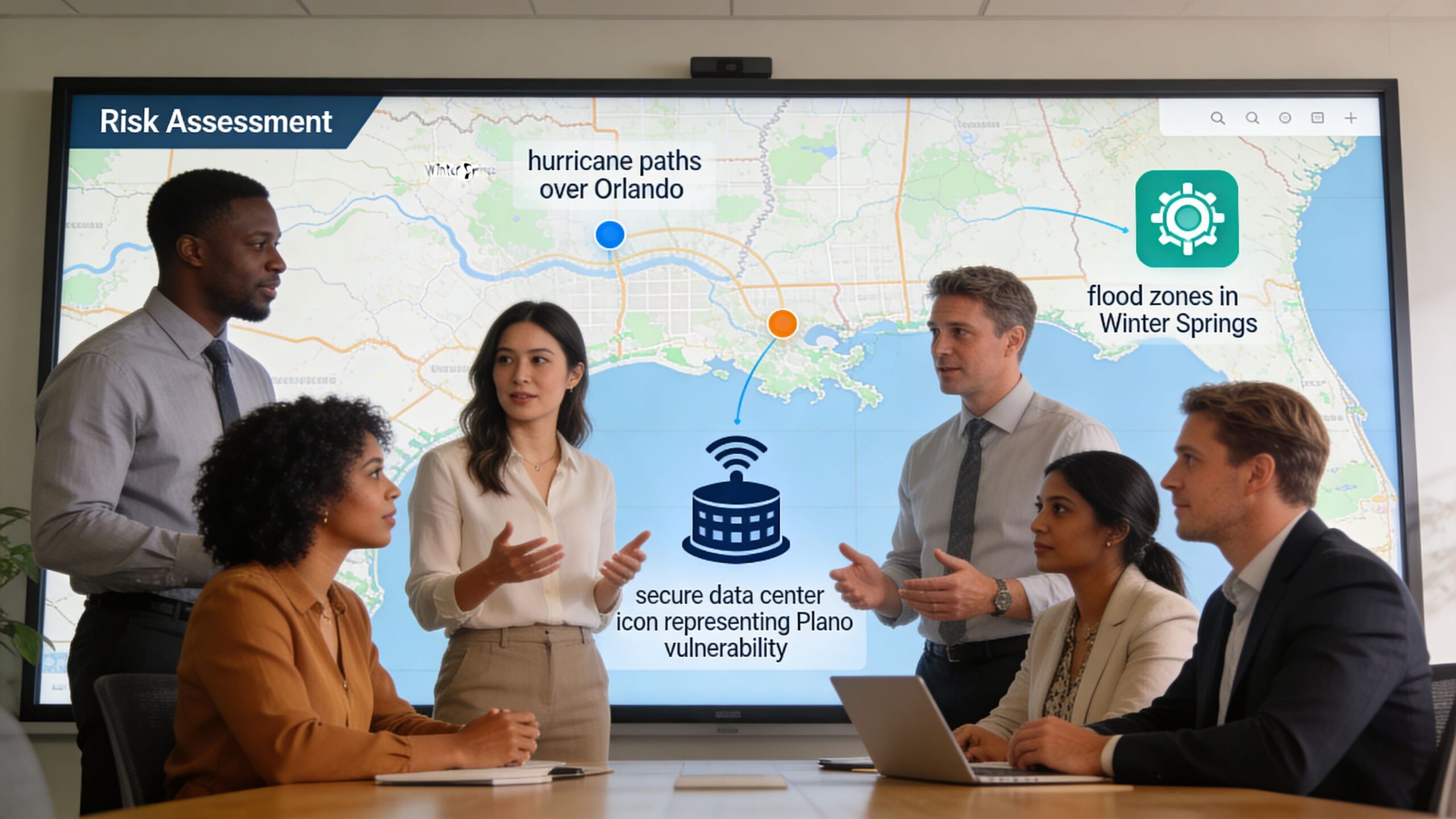
A professional team discussing a disaster recovery plan during a meeting in a modern office boardroom.

Rate hazards the way your business actually operates

For Central Florida, the risk workshop should include both regional hazards and operational ones. Hurricanes and severe weather belong on the same worksheet as ransomware, internet failure, cloud platform issues, vendor outages, and human error.

Use a simple matrix with two dimensions:

Hazard Likelihood Business impact Notes
Hurricane-related office disruption High in season High if staff and connectivity are local Check remote work readiness
Flooding or building access issue Location dependent Moderate to high More severe for single-site firms
Ransomware High concern for SMBs High Recovery must include security validation
ISP outage Moderate High for cloud-heavy firms Identify secondary connection options
Core SaaS outage Moderate Moderate to high Need workaround procedures
Accidental deletion Common operational risk Varies by data type Recovery depends on retention and backups

This process goes wrong when teams rank hazards by fear instead of business effect. Leadership may worry most about storms, while the business is more exposed to identity compromise, backup failure, or a key SaaS dependency.

Translate risk into business tiers

A business impact analysis asks a harder question than “what could fail?” It asks, “what hurts first, and how badly?”

Start with business functions, not infrastructure:

  • Client intake or patient scheduling
  • Billing and payment processing
  • Document access and collaboration
  • Line-of-business application workflows
  • Voice communications and customer support
  • Field coordination or dispatch

Then map each function to the systems, vendors, and people it depends on. Hidden dependencies emerge through this process. A practice may think its EHR is the most critical system, only to discover staff can’t access it without identity services, MFA, stable internet, and functioning endpoint devices.

A BIA should expose operational choke points. If it only lists servers, it isn’t finished.

Ask the finance question early

Even when you don’t assign a precise number to every hour of downtime, leadership still needs to classify impact in business terms:

  • Lost billable work
  • Delayed patient or client service
  • Payroll interruption
  • Contract or SLA exposure
  • Reputational damage
  • Compliance review or breach response

That conversation helps settle RTO and RPO debates faster than technical arguments do.

For firms that want a structured process, Cyber Command’s guide on how to conduct a cyber security risk assessment is a useful companion to the DRP worksheet because it forces teams to document assets, threats, controls, and gaps in one place.

Use the BIA to guide prevention, not just recovery

This is the part many teams skip. If the BIA shows that one internet circuit, one building, one privileged account group, or one untested backup chain can stop the business, fix that before the next event.

That may mean better endpoint management, stronger backup verification, more resilient communications, clearer vendor escalation, or continuous monitoring from a SOC team that stays engaged through both containment and recovery.

A strong template doesn’t just tell you how to recover. It reveals where you’re too fragile.

Testing and Exercising Your DRP

A plan that hasn’t been tested is mostly a theory.

That sounds blunt, but the numbers support it. Untested DRPs fail in 80 percent of incidents, while regular testing pushes success rates over 90 percent. The same verified benchmark summary says 60 percent of SMB backups are unverified, and inadequate communication can delay recovery by more than 24 hours in 40 percent of cases (ClearFuze on IT disaster recovery plans).

A professional team collaborating on a disaster recovery plan in a high-tech monitoring control room.

Use three levels of exercises

Not every test needs to be a disruptive failover. Good programs use a mix.

Tabletop exercises

These are discussion-driven. Leadership, IT, operations, and communications walk through a realistic incident and explain what they’d do.

Tabletops are useful for:

  • Role clarity
  • Escalation timing
  • Vendor coordination
  • Communications approvals
  • Finding missing dependencies

They’re low-risk and easy to schedule. They also expose whether the plan is readable by nontechnical leaders.

Technical simulations

These simulations validate actual restoration steps. Recover a system into a test environment. Confirm access, dependencies, and data integrity. Review timing against your defined objectives.

These tests catch issues that paper reviews miss, such as:

  • Wrong credentials in the runbook
  • Incomplete backup jobs
  • Expired certificates or licenses
  • Application dependencies restored in the wrong order
  • Security tools blocking recovery steps unexpectedly

Full or partial failover drills

These are the closest thing to reality. A planned cutover, limited failover, or segmented recovery exercise proves whether the business can operate on the recovery path you documented.

These drills require more planning, stronger change control, and executive support. They're worth it for critical systems.

Put a cadence on the calendar

A disaster recovery plan template should contain the testing schedule, not just generic language about “regular review.”

A practical SMB cadence often looks like this:

Timeframe Exercise type Main goal
Quarterly Tabletop Review scenarios, roles, and communications
Quarterly or semiannual Technical restore validation Prove backups and runbooks work
Annual Larger simulation or failover Validate business operations on recovery path
After major change Targeted retest Confirm new systems or vendors fit the plan

This schedule matters because environments change constantly. New SaaS tools get added. Office moves happen. Staff turnover breaks call trees. Security controls evolve. A plan that matched the environment last year may be misleading now.

Test scenarios that fit Orlando-area SMB reality

Don’t run generic drills only. Test the combinations that occur.

Good scenarios include:

  • Regional weather event plus ISP outage
  • Ransomware on endpoints with suspected backup targeting
  • Identity outage that blocks cloud admin access
  • Primary office unavailable while remote staff must continue operations
  • Critical vendor support delayed during a broader regional event

Those mixed scenarios are where weak plans collapse. A business may survive a server failure. It may survive a building issue. It may not survive both at once if the runbook assumes normal staffing, normal connectivity, and normal vendor response.

Test the environment you have, not the one you wish you had.

Measure more than “did it come back”

A useful test report captures operational detail, not just pass or fail.

Track:

  1. Time to declare the event
  2. Time to assemble the team
  3. Time to start restoration
  4. Time to user access
  5. Actual data gap at recovery
  6. Communications timing and approval delays
  7. Security review completion before reopening systems

For leadership, summarize test results in business language. Did the firm preserve client service? Did billing continue? Were staff able to work from alternate locations? Did the communication plan hold up?

Run an After Action Review every time

The test isn’t done when systems recover. The most valuable part is the review afterward.

An After Action Review should capture:

  • What worked as written
  • What failed or slowed the response
  • Which contacts were outdated
  • Which systems had hidden dependencies
  • Which decisions required executive input
  • Which steps belong in a separate cyber incident playbook
  • What needs to be updated in the template

Assign owners and due dates to the fixes. If the AAR becomes a discussion with no tracked action items, the same weaknesses will show up during the next event.

If you need a structured process to validate your plan, Cyber Command’s walkthrough on how to test a disaster recovery plan is a practical reference for building tabletop exercises and recovery validation into a repeatable routine.

Watch for the common failure points

In SMB environments, the same issues appear again and again:

  • Unverified backups
    Teams assume backup success equals restore success.

  • Single-person dependency
    One admin knows the process, and nobody else can execute under pressure.

  • Outdated contact lists
    Old cell numbers and stale vendor contacts slow everything down.

  • Recovery without containment
    Systems get restored before the threat is fully understood.

  • Overly complex documentation
    The plan is technically complete but too dense to use during a live event.

The fix usually isn’t a bigger document. It’s a clearer one.

Meeting Compliance and Security Requirements

Compliance doesn’t sit beside recovery planning. It runs through it.

For medical practices, law firms, financial services businesses, and community organizations, the disaster recovery plan template should map recovery actions to the controls you already have to prove. Auditors and regulators usually want to see the same basics: documented responsibilities, controlled access, backup and restoration procedures, test evidence, change history, and incident documentation.

Match requirements to plan artifacts

Instead of keeping compliance in a separate binder, tie each requirement to a document or record inside the plan set.

A simple mapping looks like this:

Requirement area DRP evidence to keep
Access control Role matrix, privileged account review, emergency access procedures
Data protection Backup policy, restore logs, retention notes, validation records
Incident response Escalation workflow, containment handoff, communications log
Business continuity BIA, recovery priorities, alternate work procedures
Governance Version history, approvals, review dates, test reports

That structure helps a lot during audits. Instead of answering with general statements, you can point to the exact document, owner, and last review date.

Build compliance into the workflow

For HIPAA, PCI, FINRA, or contract-driven security obligations, the practical questions are usually operational:

  • Who approves emergency access?
  • How are backup restores logged?
  • Where is evidence of testing retained?
  • Who reviews security alerts during recovery?
  • When does legal or compliance get pulled in?
  • How are changes to the plan documented?

Those tasks belong in the template itself, not in somebody’s memory.

Include the security layer during recovery

A compliance-ready plan should also show that recovery doesn’t bypass security controls. That means documenting:

  • Access review before reopening systems
  • Endpoint and server validation after restoration
  • Log retention for incident review
  • SOC monitoring during the recovery window
  • Executive sign-off where regulated data is involved

For regulated SMBs, that last point matters. The business may be desperate to restore operations, but reopening too quickly can create a second incident, especially if the original issue involved ransomware, unauthorized access, or sensitive records.

Auditors rarely care that recovery felt stressful. They care whether your team followed a documented process and kept evidence.

Keep a review rhythm

A compliant plan is a living one. Update it when you add offices, replace line-of-business systems, change backup platforms, shift vendors, or change who owns critical functions.

Quarterly business reviews are a good place to do that qualitatively. Leadership already has the right people in the room. Use that time to confirm contacts, system changes, test results, and open action items from prior exercises.

Conclusion and Next Steps

A solid disaster recovery plan template does two jobs at once. It gives your team a clean execution path during an outage, and it forces the business to make recovery decisions before stress, confusion, and downtime start stacking up.

For Central Florida SMBs, that plan has to reflect reality. Storm exposure is real. So is ransomware. So are phone failures, vendor delays, identity problems, and the everyday operational mistakes that can cripple a small business just as fast as a major event.

The practical version isn’t complicated. Define scope. Name owners. Set realistic RTO and RPO targets. Document recovery methods. Add communication scripts. Build SOC handoffs into the runbooks. Test the plan often enough that people trust it. Then update it whenever your environment changes.

If you’re starting from scratch, begin with a lean draft. Don’t wait for the perfect document. A usable plan with current contacts, business priorities, and recovery order is far better than a polished template nobody can execute.

A short starter checklist is enough to get moving today:

  • List your critical systems and business processes
  • Name primary and backup recovery owners
  • Document where backups live and how restores are verified
  • Write a first-pass communications list
  • Schedule your first tabletop exercise
  • Review hurricane-specific dependencies before the next storm event
  • Add security validation steps before restored systems go live

The businesses that recover well usually aren’t the ones with the biggest IT teams. They’re the ones that decided in advance how recovery works.


If your organization needs help building or testing a disaster recovery plan template for Orlando, Winter Springs, or North Texas operations, Cyber Command, LLC can support the process with managed IT, co-managed IT, backup and recovery planning, and 24/7 SOC-driven incident response aligned to SMB environments.

A Guide to Managed IT Services Orlando FL for 2026

For businesses here in Central Florida, the term “managed IT services” gets thrown around a lot. But what does it actually mean? Think of it as putting a dedicated team of tech and security experts on your staff, handling everything from cybersecurity to helpdesk support, all for one predictable monthly fee. The goal is to keep your systems running smoothly and securely, always.

Why Orlando Businesses Need Managed IT Services

In Orlando’s fast-paced, competitive market, your technology is the engine that drives your business forward. But keeping that engine tuned up can be a massive drain on your time and money, especially if you’re a small or mid-sized company.

Let's be honest, the old way of doing things—waiting for a server to crash or a laptop to die and then frantically calling for help—just doesn't cut it anymore. That "break-fix" model is a recipe for disaster. A single server outage or security breach can bring your entire operation to a standstill, costing you money and damaging the trust you’ve built with your clients.

This is why the sharpest businesses across Central Florida are making the switch to a proactive model. It’s like hiring a property manager for your digital assets. Instead of just calling a plumber after a pipe bursts and floods the office, your manager is constantly checking the pipes, looking for weak spots, and fixing them before they can cause a catastrophe. That’s the kind of forward-thinking approach every business needs in 2026.

Supporting Central Florida's Core Industries

Every industry has its own unique pressures and tech headaches. A law firm in Downtown Orlando has entirely different compliance worries than a medical practice in Lake Nona or an engineering group in Winter Springs. A real IT partner understands these local nuances and has the specialized knowledge to address them.

  • Healthcare and Medical Practices: If you run a dental office, med spa, or clinic anywhere from Winter Park to Kissimmee, you know that HIPAA compliance isn't a suggestion—it's the law. A data breach can lead to severe fines and loss of patient trust. Managed IT services provide the hardened security, encrypted communications, and 24/7 monitoring you absolutely must have to protect sensitive patient information (ePHI).

  • Professional Services: Law firms, accounting groups, and engineering companies in cities like Maitland and Altamonte Springs live and die by the confidentiality of their client data. A managed services provider rolls out advanced cybersecurity—including endpoint detection and response (EDR) and email encryption—to guard against data breaches and keep that client trust intact.

  • Technology and Service Companies: As your tech-focused business grows, your IT needs get exponentially more complex. A managed partner brings the expertise needed to support that growth, ensuring your infrastructure—whether in the cloud or on-premise—can handle the new demand without stuttering on performance or security.

When you partner with a provider that truly understands the local Central Florida landscape, you get more than just tech support; you get a strategic ally. It’s about giving you the peace of mind to stop worrying about your technology and get back to what you do best—running your business.

What's Actually Included in a Managed IT Plan?

When you sign on for managed IT services in Orlando, what are you really getting? It’s more than just an IT guy on speed dial. You're bringing a full team of experts into your business to keep everything running smoothly, securely, and efficiently.

A good managed IT plan isn't about just fixing what breaks; it's about making sure things don't break in the first place. It’s a fundamental shift in strategy.

This image really drives home the difference. Instead of waiting for a fire and then scrambling to put it out (reactive), you have a team building a fireproof shield around your business (proactive).

Concept map illustrating the difference between Reactive IT responding to failures and Proactive IT preventing business issues.

That proactive shield is the core value we deliver, and it’s built on a few key services that all work together to keep you online and focused on your business.

Let’s take a look at the two main approaches to IT support and how they stack up.

Traditional IT Support vs Managed IT Services

Feature Traditional IT Support Managed IT Services
Approach Reactive (Break-Fix) Proactive and Strategic
Goal Fix problems as they occur Prevent problems from happening
Cost Unpredictable hourly rates Predictable monthly fee
Incentive More problems mean more billing Aligned with your uptime and success
Security Basic, often an afterthought Advanced, continuous monitoring
Downtime Frequent and costly Minimized through prevention
Expertise Limited to available technician Access to a full team of specialists
Budgeting Difficult and inconsistent Simple and predictable

The table makes it clear: the old break-fix model just doesn't cut it anymore. A proactive, managed approach is the only way to truly protect your business and turn technology into an asset.

On-Demand Expert Support and Monitoring

Think of these as the foundation of your IT strategy. This is the first line of defense for your team and the constant oversight that keeps your digital operations humming along.

  • 24/7/365 U.S.-Based Helpdesk: It’s 7 PM on a Friday and a key employee can’t access a critical file. Instead of waiting until Monday morning, they can pick up the phone and talk to a live, U.S.-based technician who knows your system and can fix the issue on the spot. Productivity doesn't stop, no matter the day or time.
  • Proactive Network Monitoring: We act as a digital watchtower for your network. Our systems are constantly looking for early signs of trouble—a server getting too hot, a strange spike in traffic, a failing hard drive—and we step in to fix it before it can cause a crash or a breach.

This constant vigilance is what separates managed services from traditional IT support. It’s having a team that’s always looking out for you, making sure small hiccups don’t turn into expensive disasters.

Advanced Security and Strategic IT

Beyond day-to-day support, a true managed services partner delivers advanced security and strategic advice to protect your business and fuel its growth. This is where you see the biggest long-term return, especially if you’re in a regulated industry like a law firm in Downtown Orlando or a dental practice in Lake Nona.

A dedicated Security Operations Center (SOC) is your organization's team of digital guards. This specialized unit actively hunts for cyber threats around the clock, using advanced tools to detect and neutralize attacks before they can inflict damage.

For most small and mid-sized businesses, building an in-house SOC is simply out of reach financially. This is where a partnership shines. In the world of managed IT services in Orlando FL, local providers are known for their rapid response and deep security expertise.

Top local firms often maintain perfect client satisfaction scores by resolving critical issues in under 15 minutes—a level of agility that larger, national providers can't match. You can see how local focus impacts service by checking out Orlando-area IT provider rankings on Clutch.co.

This security blanket is often paired with strategic services designed for growth.

  • Cloud Services and Platform Engineering: Need to move your old servers to a secure cloud environment? Or maybe you need custom software integrations to make your workflow more efficient. Your IT partner handles the entire process, giving you the power to scale your business up or down without huge capital investments in hardware.
  • Co-Managed IT: Already have an in-house IT person or a small team? Co-managed IT offers the best of both worlds. Your internal staff can focus on high-value, business-specific projects while we handle the time-consuming 24/7 monitoring, security, and helpdesk tickets. It’s the perfect way to prevent burnout and fill in any knowledge gaps.

Understanding Managed Services Pricing and Value

For many Orlando business owners, IT expenses feel like a constant, unpleasant surprise. One minute things are fine, and the next you're staring at a massive, unexpected invoice for an emergency server repair. It’s a reactive, chaotic cycle.

Managed services completely changes that dynamic by introducing one simple, powerful concept to your IT budget: predictability. The whole financial model is built around a flat-rate, all-inclusive monthly fee.

This approach finally lets you budget for technology with confidence. Instead of lurching from one expensive crisis to the next, you pay a single, consistent fee. That fee covers everything from daily helpdesk calls to sophisticated cybersecurity monitoring, turning IT from a volatile cost center into a stable, strategic investment in your company's uptime and growth.

Think about it: with the old break-fix model, an IT company makes more money when your technology breaks. A managed IT partner, on the other hand, is financially motivated to keep those problems from ever happening. Our success is directly tied to your stability.

The All-Inclusive Value Proposition

A quality managed services plan isn't just about fixing things—it's about bundling all the critical IT functions that would be incredibly expensive to piece together on your own. This is especially true for small and mid-sized businesses trying to compete in busy Central Florida markets like Winter Park, Kissimmee, and the greater Orlando area.

A truly all-inclusive plan rolls all the essentials into one fee:

  • Unlimited Remote Support: Your team gets the help they need, right when they need it, without you ever having to worry about an hourly bill.
  • Proactive Maintenance and Patching: We keep every server, computer, and network device updated and secured, which dramatically cuts down your risk of a breach or frustrating downtime.
  • Vendor Management: Tired of spending hours on the phone with your internet or software provider? We take that off your plate and handle it for you.
  • Endpoint Security and Licensing: All the essential security software and the licenses that go with it are included, which simplifies your overhead and reduces hidden costs.

This consolidated model gives you a much clearer picture of your technology's real cost. For a deeper dive into how these plans are structured, check out our guide on managed IT services pricing. It gives you a framework for comparing proposals and making sure you're getting real value.

Comparing Costs: In-House vs. Outsourced

When you're looking at managed it services orlando fl, it’s not enough to compare the monthly fee to your old break-fix bills. You have to compare it to the true cost of hiring an in-house IT team.

Hiring just one qualified IT professional in Orlando can easily cost over $80,000 a year once you factor in salary, benefits, training, and tools. And that one person simply can't be an expert in everything from cybersecurity to cloud infrastructure.

A partnership with a managed services provider gives you access to an entire team of specialists—helpdesk technicians, cybersecurity analysts, cloud engineers, and strategic advisors—often for a fraction of what you'd pay a single full-time hire.

The return on investment becomes even clearer when you look at proactive prevention. Shifting from reactive firefighting to a model driven by a 24/7 Security Operations Center (SOC) and diligent patching prevents disasters before they happen. In 2023, the average cost of a single data breach for a U.S. business was a staggering $4.45 million.

A flat-fee structure gives SMBs access to enterprise-grade security and support without the massive overhead, often leading to 25-40% in cost savings compared to building an internal team. The results are measurable; we often see clients reduce their IT support tickets by as much as 60% because issues are prevented, freeing up everyone to focus on growing the business.

Fortifying Your Business with Advanced Cybersecurity

For any business in Central Florida, strong cybersecurity isn’t just an IT line item—it’s a basic requirement for staying in business. As cyber threats get more aggressive, having a multi-layered defense system is no longer a nice-to-have. This is especially true for companies in Orlando and the surrounding cities like Winter Park, Kissimmee, and Lake Mary, which are becoming prime targets for cybercriminals.

A man at a desk works on three computer monitors displaying cybersecurity locks and network graphs.

A real cybersecurity partner does more than just install antivirus software. It’s about building a robust, proactive shield around your entire digital operation. This means deploying advanced tools and strategies designed to hunt for, find, and shut down threats before they can damage your finances or reputation. This is where partnering for managed it services orlando fl becomes a game-changing business decision.

Cybersecurity for Regulated Industries

Certain industries live under a microscope when it comes to protecting sensitive data. For these businesses, a data breach isn't just an inconvenience; it can lead to crippling fines, lawsuits, and a complete collapse of client trust. A specialized managed services provider gets these unique pressures.

For healthcare providers in Orlando, from dental offices to specialized clinics, HIPAA compliance is a constant concern. Protecting patient data (ePHI) takes more than just secure servers. It requires non-stop monitoring and a ready-to-go response plan, which is exactly what a 24/7 Security Operations Center (SOC) provides. This team is your dedicated digital guard, always watching for any hint of unauthorized access or suspicious activity that could compromise patient privacy.

Likewise, law and accounting firms in places like Kissimmee and Winter Park handle incredibly sensitive client files. A breach could expose legal strategies, financial records, or personal data, causing irreparable harm. Advanced security isn't optional; it's essential to:

  • Secure Client Communications: Encrypting emails and file transfers to stop them from being intercepted.
  • Prevent Data Breaches: Putting strong firewalls and access controls in place to keep the wrong people out.
  • Ensure Business Continuity: Creating solid backup and disaster recovery plans to get you back up and running fast after an incident.

Unpacking Advanced Security Concepts

Understanding the tools that keep you safe is the first step to appreciating a real cybersecurity partnership. While the technology is complex, the ideas behind it are pretty straightforward.

A modern defense strategy is built on active threat hunting, not passive waiting. This means proactively searching for indicators of compromise within your network rather than just waiting for an alarm to go off.

This proactive approach is powered by several critical technologies working together:

  • Endpoint Detection and Response (EDR): Think of this as a high-tech security guard for every single computer and server you own. It doesn't just block known viruses; it watches for suspicious behavior. If an employee's computer suddenly starts trying to encrypt files it shouldn't touch, EDR spots this strange activity and can automatically isolate that device to stop an attack dead in its tracks.
  • Security Information and Event Management (SIEM): Your network generates millions of activity logs every day—a needle-in-a-haystack problem. A SIEM system acts like a master detective, collecting and analyzing all this data from your firewalls, servers, and computers in one place. It spots patterns and connects dots a human might miss, helping the SOC see a coordinated attack as it happens.
  • Incident Response: When an attack does get through, you need a clear, practiced plan. Incident response is the playbook that guides your cybersecurity team to contain the threat, kick the attacker out of your system, and get your operations back to normal with minimal disruption.

These services form a complete security shield that is vital for operating safely in 2026 and beyond. To further protect your business from digital threats, check out these valuable Cybersecurity Tips For Small Businesses. You can also learn more about the specific technologies that power a strong defense in our article on the top cybersecurity tools for managed services.

How To Choose Your Orlando IT Partner

Picking the right managed IT partner is one of the most important decisions you'll make for your business. It directly impacts your security, your team's efficiency, and your bottom line. So, with every provider in town claiming to be the best, how do you cut through the marketing hype and find a genuine partner for your Orlando-area company?

The secret is to look past the slick sales pitch. Focus on transparency, proven expertise, and a real commitment to helping your business succeed.

Two smiling professionals in an office reviewing a digital checklist on a tablet, with a map behind them.

The stakes have never been higher. Orlando's economy is booming—it grew by a remarkable 5.9% in 2022 alone. This growth is driven by industries like healthcare, tourism, tech, and manufacturing that all depend on a solid IT backbone.

For the small and mid-sized businesses that make up our community—law offices, accounting practices, engineering firms, and other professional services—the pressure is even greater. You need enterprise-grade IT, but often without the luxury of a large in-house IT department. You can learn more about the importance of managed IT for Orlando's top industries to see just how critical this is.

Your Vendor Selection Checklist

A methodical approach is your best defense against locking into a bad partnership. As you evaluate providers offering managed IT services in Orlando FL, you need to ask tough, specific questions.

We've put together this checklist to help you vet any potential IT partner. Use it to ensure you cover all the critical areas before signing a contract.

Vendor Selection Checklist

Category Key Question Why It Matters
Response & Availability What are your guaranteed response times for critical, high, and normal priority issues, and do you have a local Orlando presence for on-site support? When your business is down, every second counts. You need a partner who responds instantly and has a local Central Florida team that can get to your office fast for emergencies or hardware failures.
Industry Expertise Can you provide case studies or references from businesses in my specific industry (e.g., law, healthcare, engineering)? A provider who gets the unique compliance and workflow needs of your industry—like HIPAA for a Kissimmee medical practice or data security for a Winter Park law firm—will deliver far better and more relevant solutions.
Security & Compliance How do you protect our business from ransomware and other cyber threats? Describe your Security Operations Center (SOC) and incident response process. Their answer should be detailed and confident. Vague responses about "firewalls and antivirus" are a huge red flag. They must be able to prove how they'll protect your data—your most valuable asset.
Proactive Strategy What is your process for creating a technology roadmap, and how often will we meet to review strategy and performance? A true partner is always looking ahead. They should be meeting with you regularly (think Quarterly Business Reviews) to align technology with your business goals, not just fixing things as they break.
Pricing & Contracts Is your pricing all-inclusive, or are there extra charges for projects, on-site visits, or specific support requests? What are the terms for ending the contract? Hidden fees can absolutely wreck your budget. Demand a clear, transparent, flat-rate pricing model. You need to know exactly what you’re paying for and have a clear exit path if the partnership isn't working out.

This checklist is your starting point for a serious conversation and will help you quickly filter out the providers who don't measure up.

Digging Deeper for a True Partnership

Going through a checklist is essential, but the process doesn't stop there. The best IT partners will welcome your toughest questions and give you straightforward, transparent answers. As you evaluate your options, it helps to have some background knowledge on how the industry works. For a solid overview, this guide on understanding Managed Service Providers (MSPs) and their business models is a great resource.

Look for a provider who listens more than they talk during your initial meetings. Are they asking smart questions about your business goals, your pain points, and your growth plans? Or are they just pushing a pre-packaged solution?

A partner invests the time to understand your unique situation before proposing a solution. They should feel like an extension of your own leadership team—a strategic advisor whose goal is to use technology to help you win in the competitive Central Florida market.

That right there is the defining difference between a simple vendor and a valued partner.

Common Questions About Managed IT Services

If you're an Orlando business owner exploring managed IT, you've probably got a few key questions on your mind. Getting straight answers is the first step toward finding the right technology partner, so let's tackle some of the most common questions we hear from local businesses.

Are Managed IT Services Affordable for My Small Business?

This is probably the number one question we get, and the answer surprises a lot of people: yes, it's not only affordable, but it's often more cost-effective than you'd think. There’s a persistent myth that outsourced IT is a luxury reserved for big corporations, but the reality is quite the opposite.

Think of it this way: instead of paying the high, fixed salary of an in-house IT person (plus benefits, training, and vacation time), you get an entire team of specialists for a single, predictable monthly fee. This model typically saves small businesses 25-40% compared to hiring internally. An all-inclusive plan gives Orlando SMBs access to enterprise-level tools and expertise without the enterprise price tag.

We Already Have an IT Person. How Does Co-Managed IT Work?

Co-managed IT isn't about replacing your internal expert; it's about empowering them. It’s a strategic partnership that’s become incredibly popular with Central Florida businesses that have a great IT person on staff but need to scale up their capabilities.

Your internal expert gets to focus on the high-impact projects that drive your business forward, while we handle the time-consuming (but critical) day-to-day tasks that can lead to burnout. This includes things like:

  • 24/7/365 helpdesk support for your entire team.
  • Constant network and security monitoring.
  • Systematic patching and software updates.
  • Advanced cybersecurity defense.

This team-based approach lets your key employee shine, fills any expertise gaps (especially around complex cybersecurity), and guarantees your business has deep support around the clock.

What Local Industries Do You Specialize In?

Our team has deep roots in the industries that form the backbone of Orlando's economy. We've built our managed IT services in Orlando FL to specifically address the unique operational and regulatory challenges that businesses here face every day.

We have extensive experience partnering with professional services like law, accounting, and engineering firms; financial services companies with strict compliance requirements; and privately owned medical and dental practices that need robust HIPAA security. We understand the unique pressures of your sector.

How Quickly Can I Expect Help if I Have an IT Problem?

When something breaks, you need it fixed—fast. We get that. Downtime costs money and damages your reputation, which is why a rapid response isn't just a goal; it's a core part of our promise. Our 24/7/365, U.S.-based live helpdesk is always on standby to minimize any disruption.

And because we’re local to Orlando, we can provide fast on-site support when a problem needs a hands-on solution. The best providers in this market are known for resolving critical issues in under 15 minutes—a standard we are committed to meeting and exceeding for our partners.


Ready to stop worrying about IT issues and focus on growing your business? The team at Cyber Command, LLC provides the proactive support and strategic guidance your Orlando business needs to thrive. Learn more about our partnership approach.