Best IT Support Orlando: Top Providers for 2026

If your Monday starts with a ticket queue that's already stacked, a receptionist who can't get through to anyone, and an owner asking whether the backup even ran last night, you're not shopping for “IT support.” You're shopping for control. In Orlando, the difference between a decent helpdesk and a real managed partner shows up fast, especially when cybersecurity, uptime, and onsite response all matter at the same time.

This guide cuts through the marketing. It gives you a practical way to judge the best IT support Orlando businesses can rely on, a grounded view of local market conditions, a pricing baseline, a sector-by-sector fit guide, and a checklist you can use before you sign anything.

Provider Core Services 24/7 Support Pricing Model Best-Fit Industries Standout Strength
Cyber Command, LLC Managed IT, co-managed IT, cloud support, vendor management, cybersecurity, QBRs Yes, 24/7/365 live helpdesk and SOC Predictable, all-inclusive style Professional services, medical, industrial, public and community organizations Strong fit for businesses that want proactive control and documented accountability
Orlando-area boutique MSPs Helpdesk, network monitoring, backup oversight, patching Varies by provider Usually per-user or flat-rate Smaller offices, multi-location SMBs Direct access to senior technicians
Central Florida regional firms Managed IT, security operations, consulting Varies by provider Mixed contract structures Growing SMBs, regulated firms Broader service depth and more formal reporting

Table of Contents

Why Orlando SMBs Are Rethinking IT Support in 2026

A lot of Orlando owners have already lived the same bad morning. A login issue turns into a helpdesk dead end, a backup job fails, or a security scare exposes how little anyone knows about the systems that keep the business moving. Once that happens, hourly break-fix support stops looking cheap and starts looking risky.

That is why more businesses are shifting to managed, cybersecurity-first support. They need continuity, not just a number to call. They need proactive monitoring, patching, backup oversight, and clear answers on what is covered before the next outage hits.

Practical rule: If a provider cannot tell you exactly how they respond after hours, assume the answer is “when the office opens.”

A live support image matters here because it reflects the standard buyers should expect from a local provider: someone reachable, accountable, and ready to act when the system goes down. Live support reference

For a useful mental model on resilience, the logic behind stable NBN connectivity with 4G backup translates well to IT support. You want that same layered continuity in Orlando, not a single point of failure. That matters more in a city where provider density is high enough that reputation alone does not separate one firm from another.

The local market is crowded enough to create choice, but not so standardized that contracts look the same. Buying on brand recognition alone is a mistake. The smarter move is to compare response capacity, security coverage, and what is bundled into the monthly fee.

If you are scanning a provider from your phone between meetings, the fastest signal is simple. Ask whether they prevent problems, handle incidents after hours, and document what they are doing in a way your business can audit later. If the answer is fuzzy, keep moving.
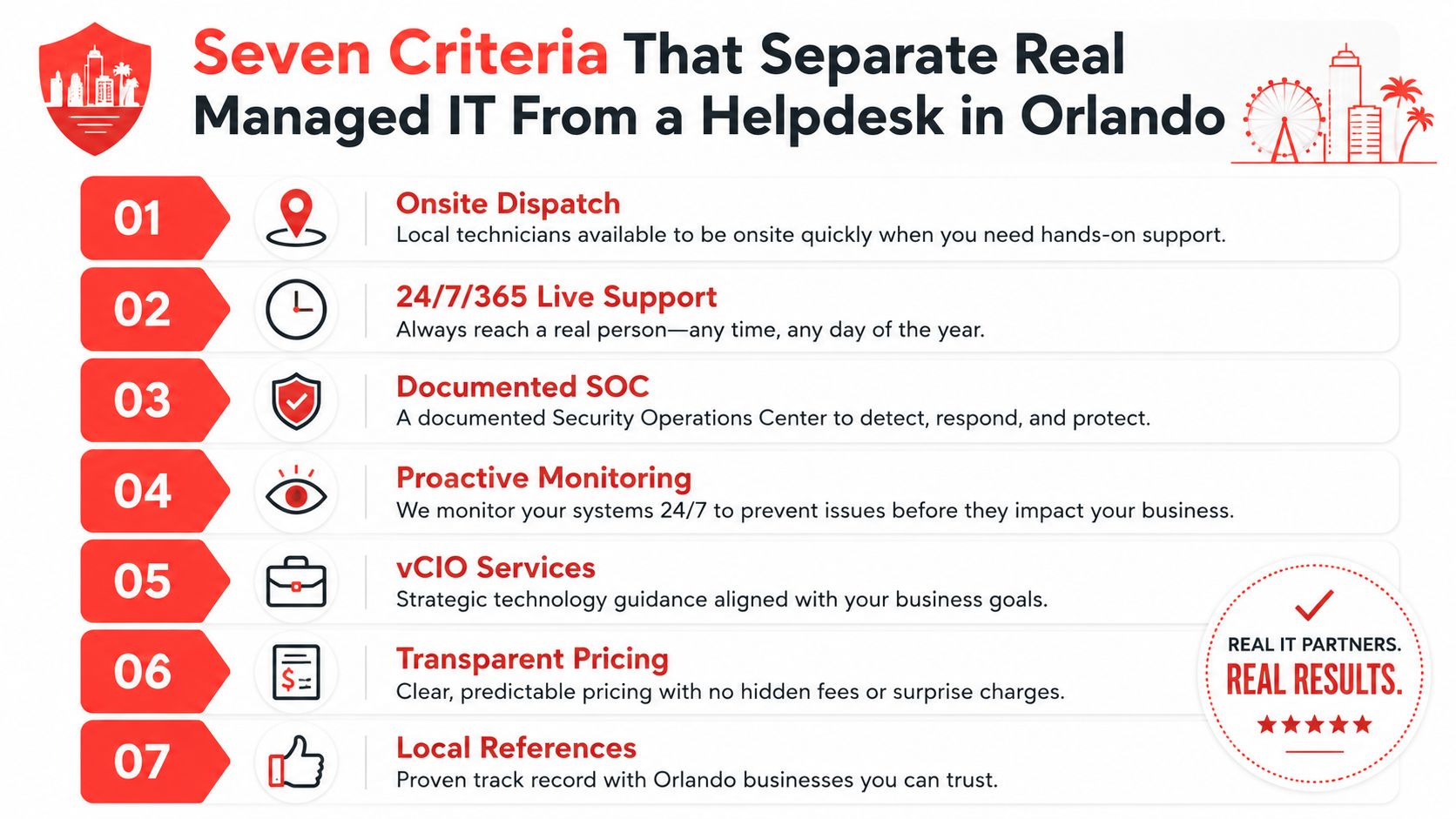
A list of seven key criteria for selecting managed IT service providers in the Orlando area.

The Orlando IT Support Market at a Glance

Orlando's managed IT market is busy, but it's still fragmented enough that buyers have to do the homework. In Florida's April 2026 help desk rankings, listed providers range from 6 to 9 employees up to 50 to 75 employees, while Orlando-specific listings in 2026 show multiple firms in the 2 to 5 employee range. That mix points to a market built around small teams rather than a few giant vendors, which usually means more direct access to senior technicians, but also a wider spread in process maturity and after-hours coverage. Clutch Florida help desk rankings

A separate Orlando business database lists 84 verified computer support and services firms in the city, which makes the local field dense enough that buying decisions should focus on measurable differences, not generic availability. Orlando computer support and services database In practical terms, that means you should care about onsite dispatch, escalation speed, and whether the monthly fee covers monitoring and reporting or only ticket handling.

What fragmentation means for buyers

More small firms can be a good thing if you value direct communication. It also means the sales pitch may sound polished while the operating model stays thin. One provider may advertise local service but rely on voicemail after hours, while another may run a real 24/7 team with documented response paths.

The local directories also tell buyers to verify things that matter in procurement, not just marketing. Clutch's Orlando directory urges businesses to ask about uptime metrics, ticket response times, client retention, and whether the provider has truck-roll capacity in Orange or Seminole County. Clutch Orlando MSP directory That's the right mindset for this market, because “local” only matters if someone can get onsite when a switch dies or a firewall drops.

Orlando buyers should think like operators, not shoppers. The best choice is rarely the loudest vendor, it's the one that can prove response capacity and tell you what happens when business hours are over.
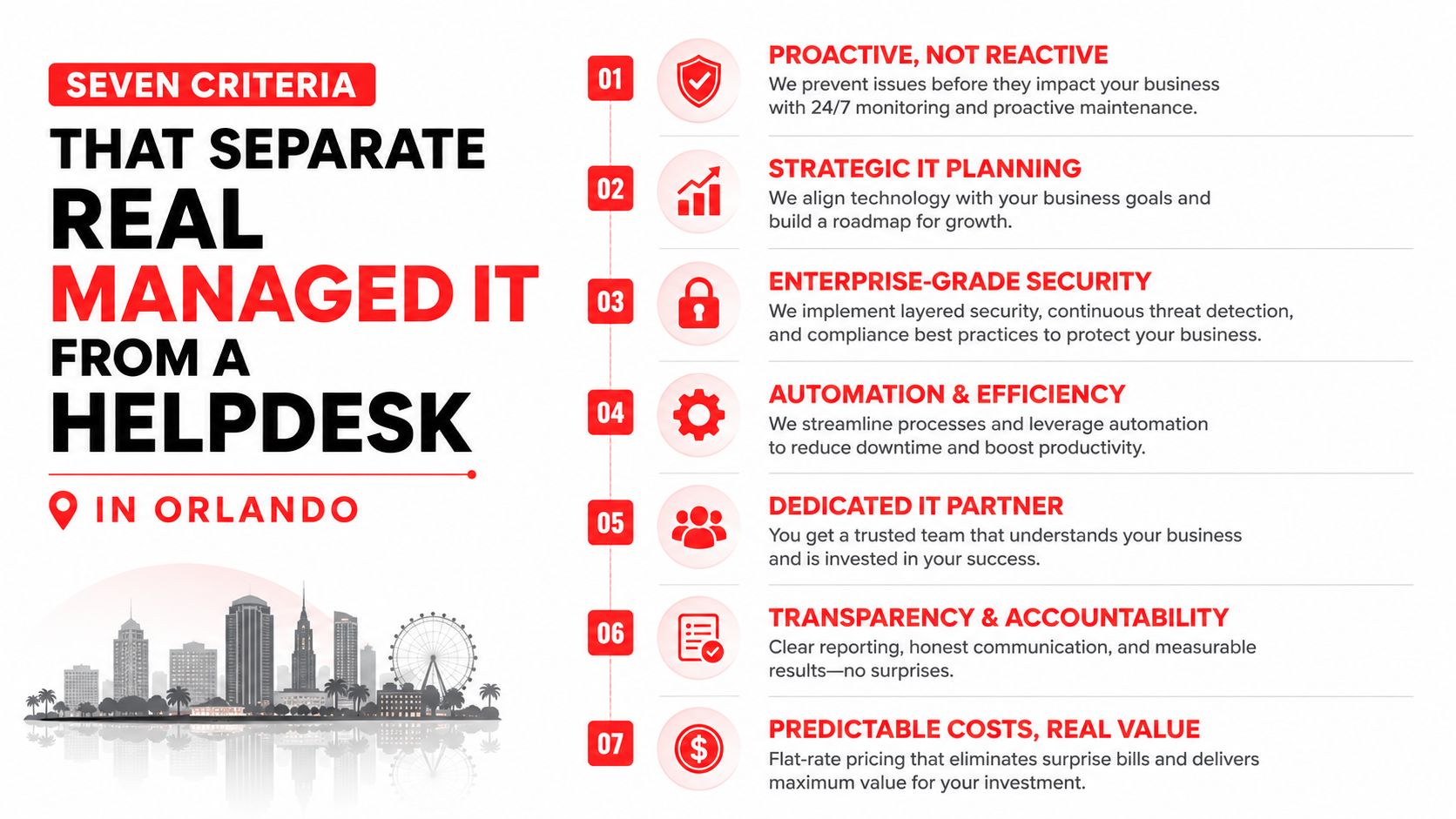
An infographic detailing seven criteria that differentiate professional managed IT services from standard helpdesk support in Orlando.

Seven Criteria That Separate Real Managed IT From a Helpdesk in Orlando

The easiest way to compare providers is to score what they do, not what they promise. Start with local response capacity. A real Orlando partner can explain who dispatches onsite, how far they'll travel, and what happens if a network issue starts after the workday ends.

1. Local dispatch and onsite coverage

A provider should be able to tell you whether they have a truck-roll team in Orange or Seminole County, not just a mailing address. If they can't show that capability, you're probably buying remote helpdesk access, not true local support.

2. True 24/7/365 live support

Voicemail, callbacks, and “next business day” are not the same thing as live support. A provider that advertises 24/7 support should staff it, especially if your office runs late, has client-facing systems, or can't afford after-hours downtime.

3. Documented security operations

Good managed IT includes active security coverage, not a vague promise that someone “watches things.” Ask whether they have security monitoring, incident response, and recovery practices that are written into the service model.

4. Transparent pricing and scope

You want to know what's included before the first invoice lands. Monitoring, patching, backup oversight, and helpdesk support should be clearly defined, and any add-ons should be obvious.

5. Vendor and license management

Many businesses lose time to password resets, SaaS renewals, and vendor coordination. A stronger provider will manage those tasks instead of pushing them back on your office manager.

6. Proactive controls

Endpoint protection, patching cadence, and backup monitoring should be part of the daily operating rhythm. If the provider only reacts to tickets, you're still living in break-fix mode.

7. SLAs and reporting

Look for measurable response commitments and regular review meetings. If there's no reporting cadence, it's hard to know whether the service is improving or just staying busy.
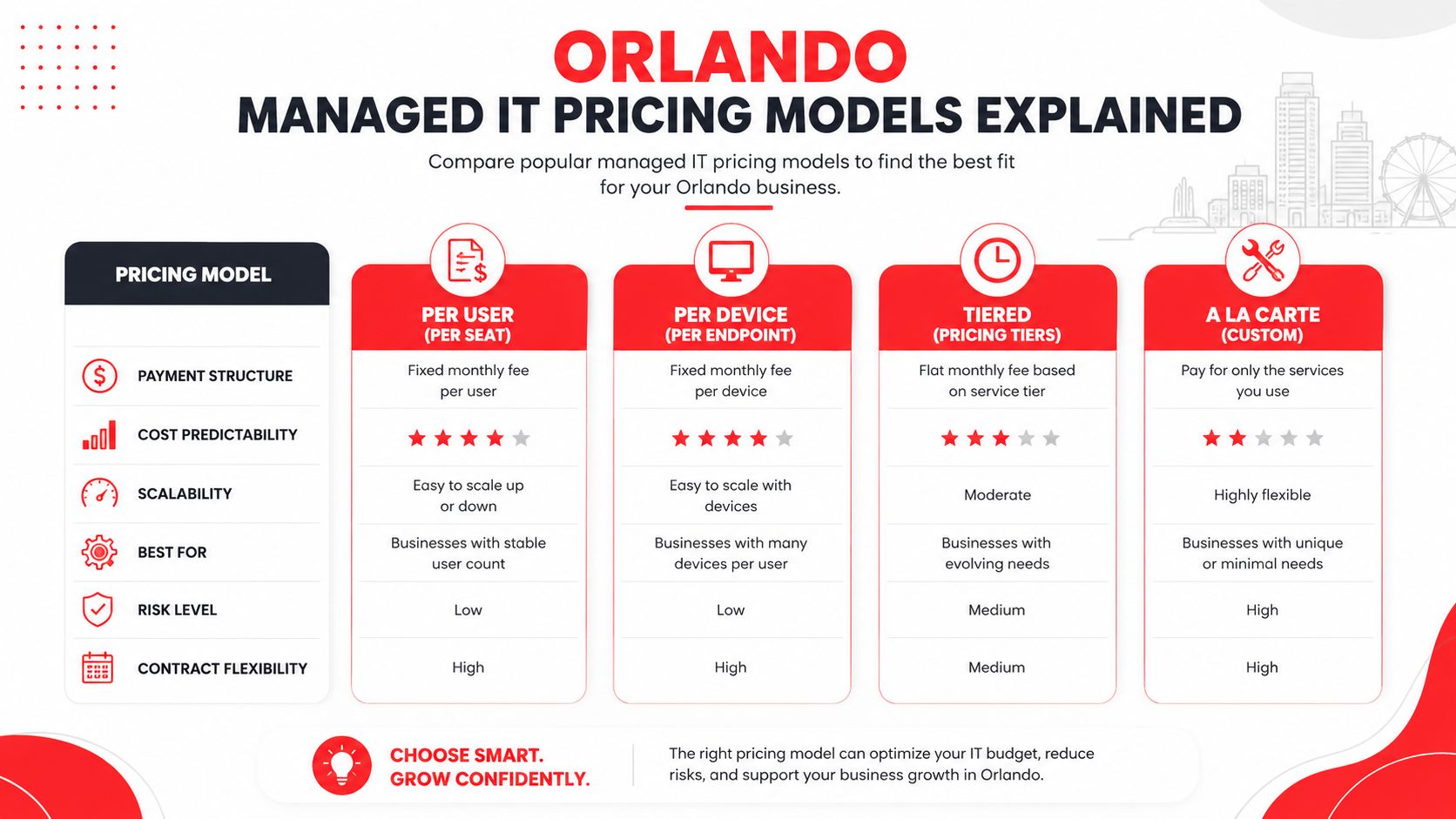
A comparison chart explaining four common managed IT service pricing models for businesses in Orlando.

Comparing the Top Orlando IT Support Providers

A bad fit shows up fast in Orlando. The office sounds supported on paper, but the team still waits on callbacks, after-hours coverage is thin, and no one can say what the monthly fee covers.

The right shortlist depends on the operational pain you need to fix. Some firms are built for direct access and fast local response, others are a better match for regulated work, and some only make sense if you need basic helpdesk coverage.

Orlando IT Support Provider Snapshot Core Services 24/7 Support Pricing Model Best-Fit Industries Standout Strength
Cyber Command, LLC Managed IT, co-managed IT, cloud services, DevOps, AI consulting, vendor management, endpoint protection, patching, QBRs Yes, live U.S.-based helpdesk and SOC Predictable, all-inclusive approach Professional services, medical, industrial, public and community organizations Strong fit for businesses that want proactive support and documented accountability
Established Florida MSP profile Managed IT, monitoring, consulting, security operations Varies by provider Often per-user or mixed contract Multi-location SMBs, compliance-sensitive firms Broader service mix with formal reporting
Boutique Orlando provider profile Helpdesk, onsite support, backup oversight, patching Sometimes limited to business hours with emergency coverage Usually lean monthly plans Smaller offices, local professional firms Direct senior access and faster informal escalation

A good example of the first category is Cyber Command, LLC, which offers managed IT, 24/7/365 U.S.-based helpdesk support, cloud support, and vendor management from its Orlando presence. It is the kind of setup that suits firms that want fewer surprises and clearer ownership of the environment. See the Cyber Command cloud partner badge and the Cyber Command Orlando provider snapshot for the sort of public-facing proof buyers should ask every provider to show.

Read a provider snapshot for the gap between marketing and operating reality. A smaller Orlando firm can still be the right answer if it shows dispatch capacity, live support, and a clear scope. A larger regional name can still disappoint if the contract is full of exclusions and slow escalation paths.

Friendly service language is easy to sell and hard to rely on. The stack behind the helpdesk matters more, including security ops, vendor management, and whether someone owns the problem from first ticket to resolution. If a provider cannot explain those pieces cleanly, it is not a managed relationship, it is just reactive support.

Orlando Managed IT Pricing Models Explained

The most useful pricing benchmark for Orlando buyers is $100 to $300 per user per month for managed IT services, according to an Orlando-focused guide. Orlando managed IT pricing benchmark For a 25-user firm, that translates to roughly $2,500 to $7,500 per month before custom projects or add-ons, depending on scope and security requirements.

That band makes sense if the provider is covering monitoring, helpdesk, patching, backup oversight, cybersecurity, cloud services, and consulting. It gets less attractive when the monthly fee leaves out after-hours work, vendor management, or anything beyond simple ticket triage.

What different pricing models usually look like

A per-user model is common when each employee has a standard device stack and consistent support needs. A per-device model can work when headcount is uneven or field equipment matters more than seats. A flat-rate model is the cleanest option when the provider includes broad coverage and doesn't pile on charges later.

Low advertised fees usually leave out the security stack Orlando businesses actually need. The monthly number looks small until you add backup oversight, incident response, and patch management one line item at a time.

That's where predictable pricing matters. If the contract is built well, you'll know what's covered, what triggers an extra project fee, and how emergencies are handled. If it's built loosely, the invoice becomes the actual service agreement.

The most common upcharges are easy to spot once you know where to look. After-hours onsite work, custom projects, advanced security modules, and compliance audits are often excluded from entry-level plans. That doesn't make them bad, but it does mean the actual cost is higher than the brochure suggests.

Matching Orlando Providers to Local Industries

Different industries in Orlando need different IT instincts. A law office cares about confidentiality, a medical practice cares about uptime and patient data, and an industrial firm cares about resilience across sites and devices. If the provider doesn't understand the risk profile, the support model will feel generic from day one.

Legal, accounting, and architecture firms

These firms usually need tight document control, secure remote access, and reliable email protection. They also need someone who can explain risk in plain language, because partners and office managers don't have time for jargon.

A strong fit is a provider that offers vendor management, endpoint protection, and reporting that shows what's being monitored. A small Orlando law firm that gets a client data-breach inquiry will care less about flashy tools and more about whether the team can show logs, access controls, and a documented response path.

Privately owned medical practices

Plastic surgeons, medical spas, dentists, orthodontists, and veterinarians tend to need fast issue resolution, backup oversight, and a clear security posture. If the office runs on appointment schedules and billing, downtime becomes visible immediately.

This group should prioritize providers with 24/7 support, security operations, and a contract that spells out incident handling. A dental practice opening a second location, for example, needs the provider to manage connectivity, shared systems, and consistent support across both offices.

Industrial and field-service firms

These businesses need stable infrastructure across locations, mobile users, and often more complicated vendor dependencies. They benefit from proactive monitoring, patching, and a provider that can coordinate with outside software and hardware vendors without slowing down operations.

The right profile here is a managed services partner that can standardize systems instead of just reacting to breakage. If a field-service manager can't get an answer during a jobsite issue, productivity takes the hit immediately.

Public and community organizations

These groups usually want reliable local support, better documentation, and predictable service ownership. They're often under pressure to show accountability without building a large internal IT team.

A provider with clear reporting, good escalation habits, and a local presence fits best. The moment they are juggling donor systems, community services, or multi-site staff support, the value of consistent management becomes obvious.

Why a Local, Compliance-Focused Partner Beats Break-Fix in Orlando

A broken network is bad enough. A broken network during patient check-ins, client billing, or a busy office morning turns into missed work, angry calls, and hours of cleanup. Break-fix support may look cheap on paper, but the actual cost shows up the moment your team needs immediate help and nobody is already watching the environment.

A managed partner gives you predictability. You get one monthly service structure, fewer surprise invoices, and a better handle on what is covered before something fails. Break-fix does the opposite, it pushes costs into the moment of failure and leaves small issues to sit until they become larger recovery jobs.

Response time is the other issue. A provider with a live helpdesk and a security operations function can act during an incident, not after the damage is done. That matters for professional services and medical practices, where confidentiality, uptime, and audit trails are part of normal operations.

Cyber Command, LLC is built around that model with 24/7/365 U.S.-based helpdesk, a 24/7 SOC, predictable pricing, compliance alignment, QBRs, and vendor management. Their cloud partner badge is one sign of that posture. You do not need every provider to mirror that exact setup, but you do need a partner that can explain how it prevents problems instead of only closing tickets.

A local, compliance-focused relationship also tightens accountability. When contracts include documentation, reporting, and escalation paths, your team knows who owns what and how issues get handled. That is the difference between buying labor and buying operational continuity.

Buyer's Checklist and FAQs for Choosing Orlando IT Support

Use these ten questions before you sign anything.

  1. Do you provide true 24/7 live support, or only after-hours callbacks?
  2. Who handles onsite dispatch in Orange or Seminole County?
  3. What security monitoring is included in the monthly fee?
  4. Is patching covered, and how often is it performed?
  5. Do you manage backup oversight and recovery testing?
  6. Which vendor tasks are included, and which are billable?
  7. What's excluded from the contract, especially after-hours work and projects?
  8. Can you show your SLA response commitments in writing?
  9. How do you support compliance, documentation, and audit requests?
  10. What does onboarding look like for the first 30 days?
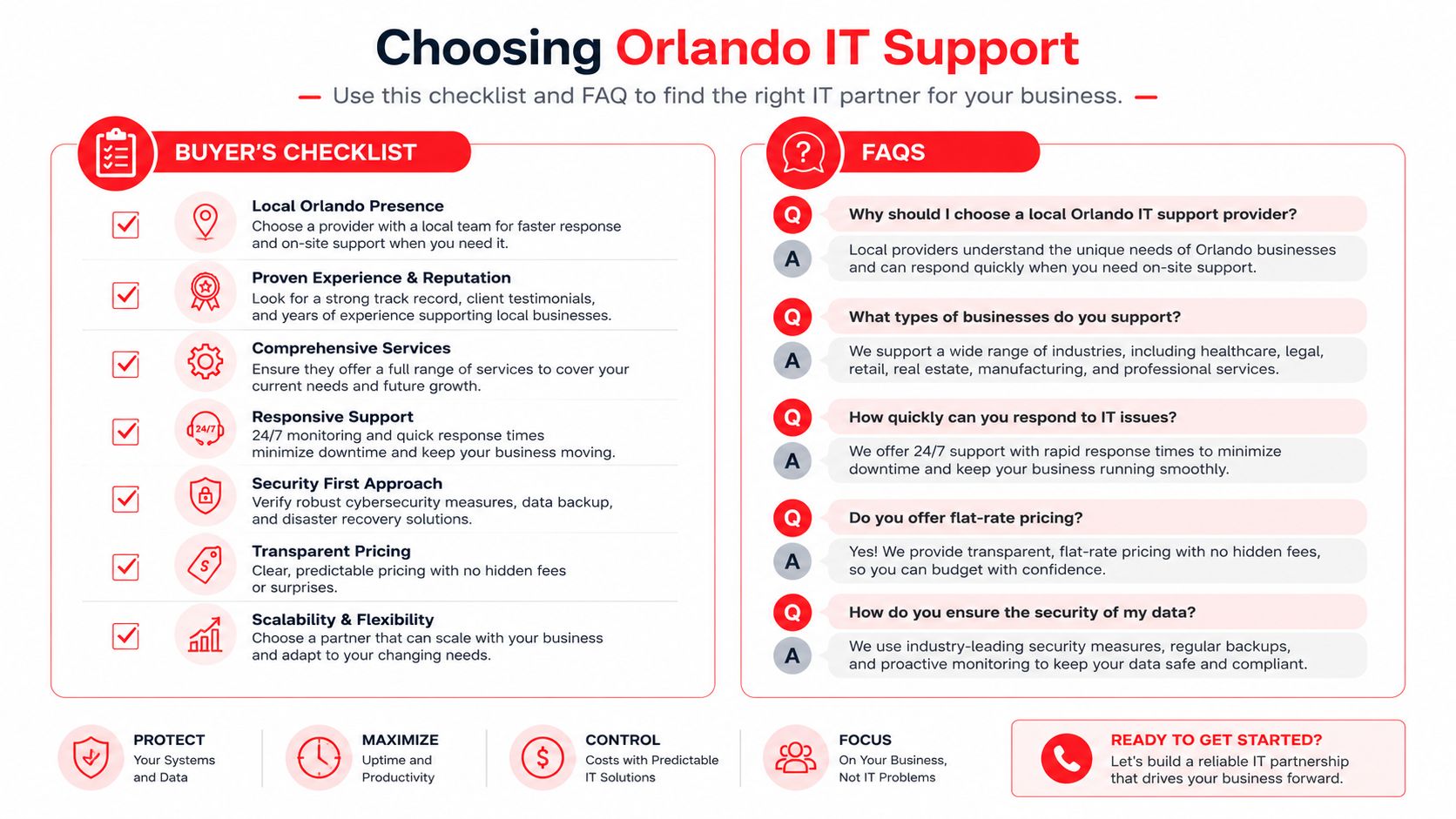
An infographic checklist and FAQ guide for choosing a reliable IT support provider in Orlando, Florida.

FAQs

How long does onboarding usually take?
It depends on how much documentation, device standardization, and account cleanup the provider has to do. A clean onboarding process should start with discovery, access review, and a defined support handoff so your team isn't left guessing.

What should an Orlando-specific SLA include?
It should spell out response timing, escalation handling, onsite availability, and what happens during after-hours incidents. If the SLA only talks about business hours, it's not enough for a company that depends on continuity.

How do you phase out a break-fix provider without disruption?
Start by inventorying accounts, devices, passwords, backups, and vendor contacts before the handoff date. Then overlap support briefly so the new provider can verify monitoring, patching, and recovery coverage before the old relationship ends.

If you want a local partner that handles managed IT, co-managed support, cloud services, vendor management, and 24/7 helpdesk coverage with a cybersecurity-first approach, talk to Cyber Command, LLC. Visit Cyber Command, LLC to set up a discovery call and compare your current support model against a more accountable option for your Orlando business.
IT Helpdesk Orlando: Your 2026 Guide to Services

Monday starts with a full schedule. Your team logs in, the practice management system stalls, email access breaks for two users, and one employee reports a strange sign-in prompt they've never seen before. At that point, you don't have an IT inconvenience. You have billing delays, client frustration, staff downtime, and a real security question that can't wait until the next available ticket window.

That's the context most Orlando business owners are operating in now. Technology supports intake, scheduling, accounting, document handling, communication, and compliance. When it goes down, the business slows down with it. When a security event slips through, the issue stops being technical and becomes financial and legal.

The pressure is rising locally. Central Florida, particularly the Orlando metropolitan area, experienced a 34% increase in cybersecurity incidents targeting small and mid-sized businesses between 2023 and 2024, with financial services and professional firms like law and accounting offices reporting the highest volume of breaches according to Cyber Command's local market update. That matters if you're evaluating IT helpdesk Orlando options, because the old model of “call when something breaks” no longer matches the risk.

Table of Contents

Is Your IT a Business Asset or a Liability

A business owner usually notices the problem in operations first, not in infrastructure. Phones still ring, staff are still present, and appointments or deadlines are still on the calendar. But the work can't move because one system failure causes three more. Users create workarounds, data gets handled outside the normal process, and stress pushes people into risky decisions.

An office worker looking stressed while staring at a computer screen displaying a critical system error message.

That's when the difference between a liability and an asset becomes obvious. If your IT setup only reacts after users complain, your business absorbs the delay. If your support partner monitors systems, controls access, and catches warning signs early, technology starts behaving like an operational advantage.

A lot of owners still think of helpdesk support as a cost line item. In practice, it affects revenue protection, staff productivity, and client trust. A legal office can't afford file access issues before a filing deadline. A dental office can't have scheduling and imaging interruptions during a packed day. An accounting firm can't lose momentum in a reporting cycle because user permissions weren't maintained correctly.

A reliable helpdesk doesn't just solve tickets. It protects the day's work.

The local risk profile makes this more urgent. The increase in attacks against Orlando-area small and mid-sized businesses isn't an abstract cyber headline. It means firms that hold client records, financial data, or patient information are seeing more attempts to exploit weak passwords, delayed patching, unmanaged devices, and after-hours gaps in coverage.

Here's the practical test. If your current support model waits for failure, chases recurring issues, and treats security as a separate project, IT is acting like a liability. If it reduces interruptions, supports your staff quickly, and closes risk before it turns into downtime, it's functioning like a business asset.

What an IT Helpdesk Really Means for Your Orlando Business

Many owners hear “helpdesk” and think of a phone number for broken laptops, password resets, and printer complaints. That's part of it, but that definition is too small for how businesses operate now.

A modern IT helpdesk Orlando company should work more like preventive maintenance than roadside assistance. Waiting until a user can't work is the expensive path. Monitoring devices, handling patching, managing access, and spotting patterns before they turn into outages is the better path.

Orlando-area businesses often need that broader model because internal staffing is limited. In Orlando and Winter Springs, 68% of small businesses operate with fewer than three dedicated IT staff members, creating a dependency on external managed IT partners for endpoint protection, patch management, and network diagram maintenance to meet industry compliance standards according to this local market overview. That means your outsourced helpdesk often isn't a side function. It's part of your core operating structure.

The helpdesk role has changed

The older break-fix model focused on closing tickets. The stronger model focuses on keeping users productive and reducing the number of preventable tickets in the first place.

A real business helpdesk should cover more than immediate support:

  • User support: Staff need fast help with logins, application access, hardware issues, and day-to-day technical problems.
  • Device and endpoint oversight: Workstations and laptops need updates, policy enforcement, and security controls maintained consistently.
  • Access management: New hires, role changes, and departures require controlled account setup and removal.
  • Escalation discipline: Issues that touch security, compliance, or server performance shouldn't sit in a generic queue.

What good support looks like day to day

You can usually tell within a month whether a provider is helping your business or just processing tickets.

A strong helpdesk tends to show these behaviors:

Area Reactive support Proactive support
Issue handling Waits for the complaint Watches for early indicators
User onboarding Set up after requests pile up Standardized process with access control
Patching Done inconsistently Managed on a schedule with oversight
Security events Treated as separate from support Routed with urgency and context
Reporting Ticket counts only Operational visibility and accountability

Practical rule: If your provider only talks about response time, ask how they reduce the need for emergency responses in the first place.

For many firms in Central Florida, especially law offices, accounting practices, architects, dentists, veterinary clinics, and medical spas, the helpdesk has to do more than answer the phone. It has to support the business model. That means reliable user support, clean systems, documented processes, and enough operational discipline that routine IT doesn't keep interrupting actual work.

Core Helpdesk Services That Drive Business Uptime

The most useful way to judge helpdesk value is to look at what it does for uptime. Not activity. Not ticket volume. Uptime.

In practical terms, the service stack should move from immediate support to continuous prevention. That's where an average support arrangement and a real managed service model start to separate.

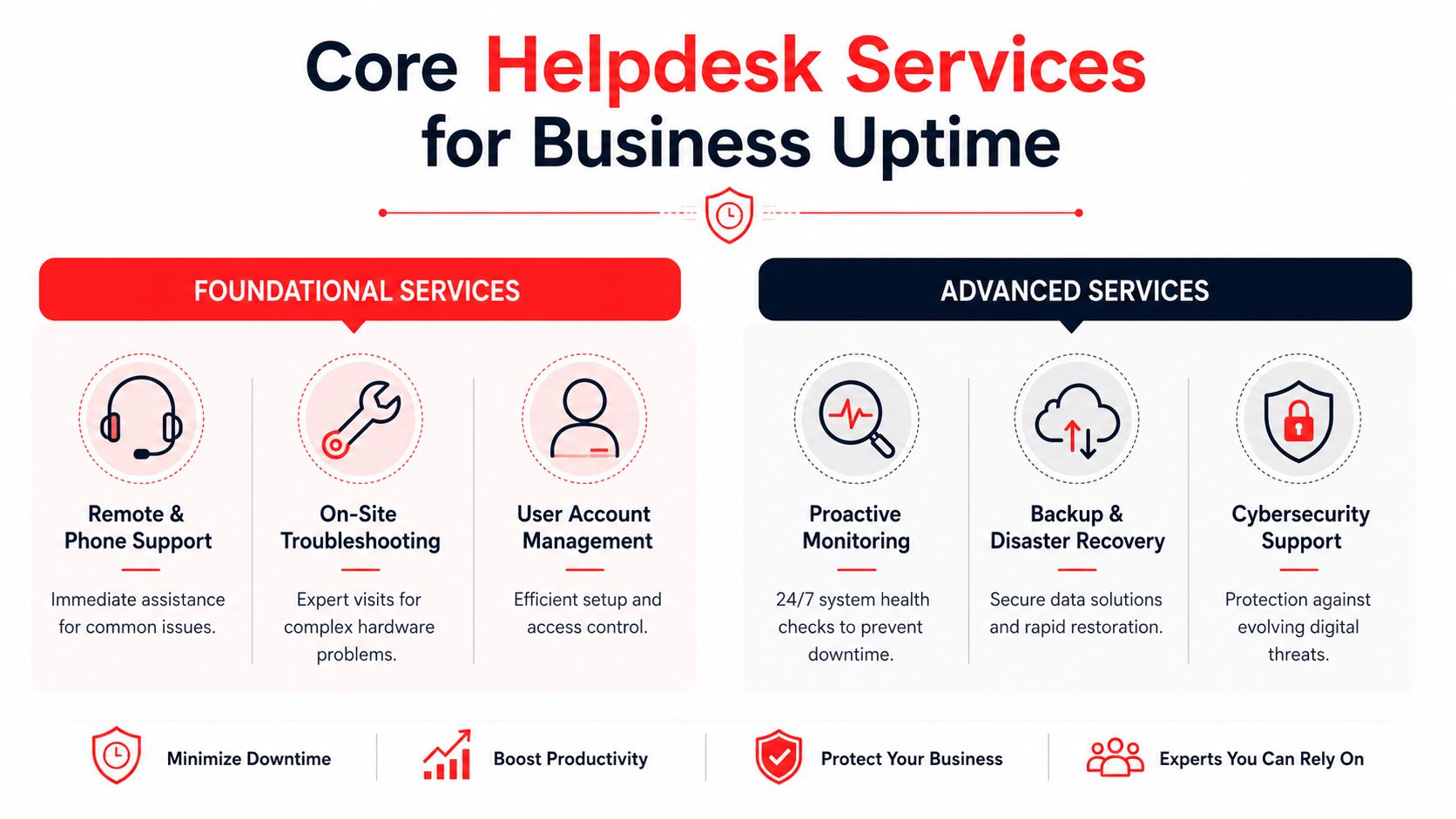
A structured infographic detailing foundational and advanced IT helpdesk services for business uptime and technical support.

In the Orlando managed IT market, combining 24/7/365 live helpdesk support with real-time system monitoring preempts 85% of potential downtime events, directly resulting in a 30% increase in operational uptime for mid-sized businesses based on managed IT performance data published here. That's the business case for treating helpdesk support as an operational function instead of a repair service.

The baseline every business should expect

Foundational services are still important. They're just not enough by themselves.

You should expect:

  • Remote and phone support: Staff need quick answers for common issues without waiting for an on-site visit.
  • On-site troubleshooting: Some hardware failures, connectivity issues, and office changes need hands-on work.
  • Account administration: New user setup, permission changes, and offboarding need to happen cleanly and quickly.

Those services keep people moving. But they don't prevent much on their own.

The advanced layer is where uptime is protected:

  • Continuous monitoring: Systems are watched for health warnings, failed services, storage issues, and suspicious behavior.
  • Backup and recovery readiness: Data protection isn't useful unless restoration is planned and tested as part of operations.
  • Cybersecurity support: Endpoint protection, patching, access controls, and escalation procedures need to sit inside support workflows.

For accounting firms and professional offices, backup discipline deserves special attention. If you want a practical business-side explanation of why backup planning matters to financial operations, these valuable insights for business data strategy are worth reading.

Fully managed vs co-managed support

Many companies choose the wrong fit.

Fully managed IT makes sense when you don't want to run day-to-day IT internally. The provider handles helpdesk operations, system monitoring, endpoint care, vendor coordination, and ongoing maintenance. This usually fits smaller firms or growing companies that need predictable coverage without building a larger internal team.

Co-managed IT fits organizations that already have in-house IT capability but need reinforcement. That support may cover after-hours helpdesk work, escalation backup, cybersecurity operations, project assistance, documentation, or specialist oversight the internal team doesn't have capacity for.

Here's a simple comparison:

Model Best fit Main benefit
Fully managed Small and mid-sized firms with limited internal IT One accountable partner for daily operations
Co-managed Businesses with existing IT staff Extra capacity, depth, and after-hours coverage

A practical example helps. A three-location medical practice may want fully managed support because it needs one team to handle staff issues, device standards, access changes, and security operations consistently. A larger engineering firm with an internal administrator may prefer co-managed support to cover escalation, monitoring, and specialized security response.

The important point is this: the right service model reduces interruption. The wrong one creates confusion about who owns what when something goes wrong.

Why a Standard Helpdesk Is Not Enough The SOC Integration Imperative

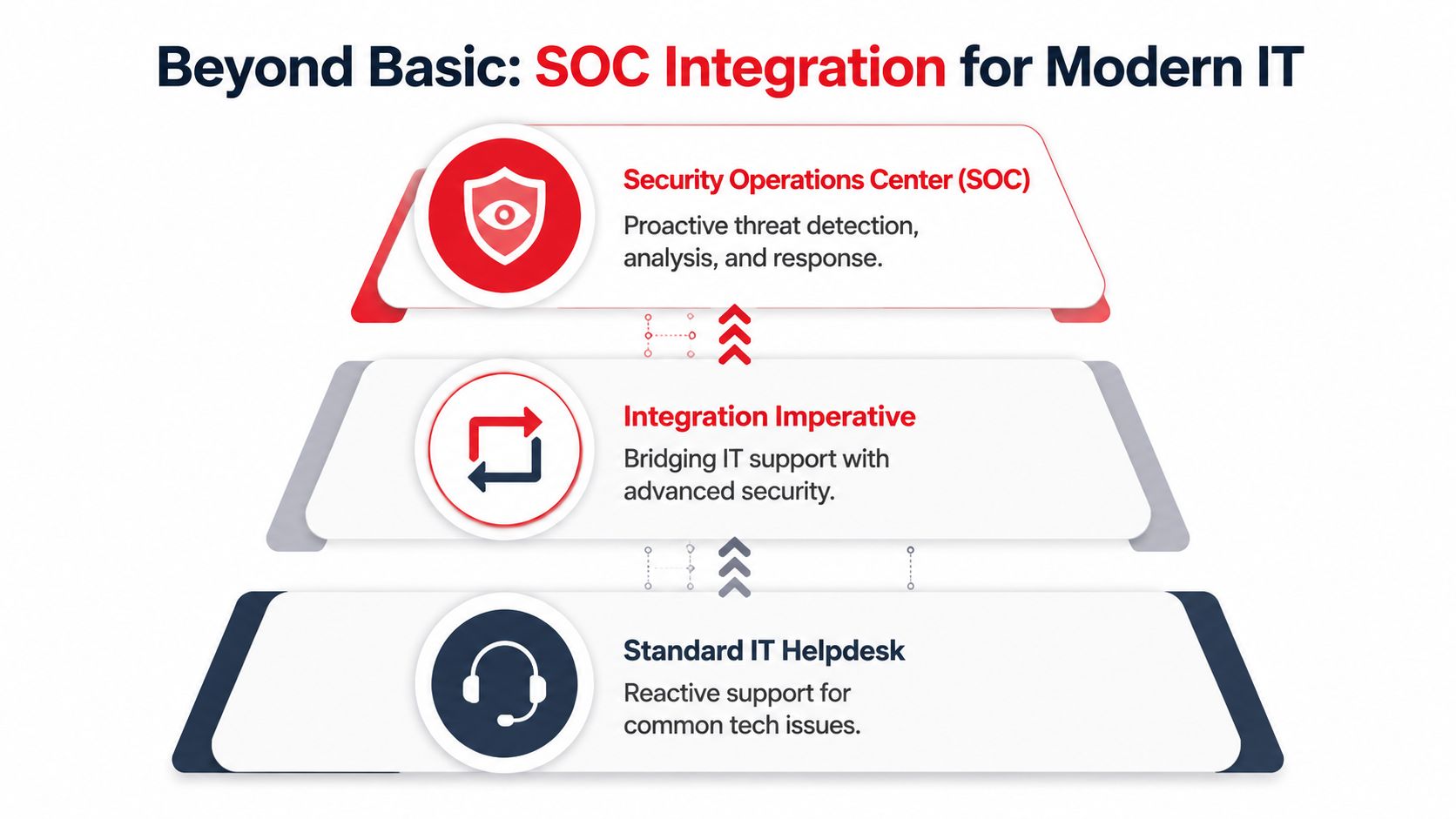
A standard helpdesk fixes user problems. A Security Operations Center, or SOC, looks for threats, investigates suspicious activity, and responds before a problem spreads. Those are different functions. Businesses that handle sensitive data need both working together.

That's why the old separation between “IT support” and “cybersecurity” no longer works well for compliance-sensitive firms. If a user reports a locked account, unusual login, missing email, or suspicious file activity, that may not be a normal ticket. It may be the first visible sign of a breach attempt. A standard helpdesk can restore access. A SOC-backed helpdesk asks why the event happened, what else was touched, and whether the issue is still active.

A hierarchical diagram illustrating the integration of Standard IT Helpdesk with SOC security operations for modern IT.

Orlando small businesses that integrate a 24/7 Security Operations Center into their IT strategy experience a 60–75% reduction in successful cyber incidents, driven by proactive threat hunting and automated patching mechanisms according to this Orlando IT support analysis. That's why a SOC-backed helpdesk isn't an add-on for many firms now. It's the safer operating model.

How a breach ticket should be handled differently

When a normal support desk gets a security-related ticket, the process often stops at symptom resolution. Password reset. Device reboot. Mailbox access restored. Case closed.

That isn't enough when the ticket may involve compromised credentials, lateral movement, malicious forwarding rules, unauthorized access, or persistence on an endpoint.

A better process looks more like this:

  1. Triage the user issue immediately. The employee still needs support.
  2. Assess whether the event is security-related. Login anomalies, unexpected MFA prompts, or data access changes should trigger deeper review.
  3. Contain if needed. Disable access, isolate a device, or suspend risky sessions.
  4. Investigate behind the ticket. Review logs, identity events, endpoint signals, and related activity.
  5. Recover and document. Restore business operations while preserving a record of what happened and what changed.

That integrated workflow is the core distinction. If you're curious what that security layer looks like visually, this SOC support model illustration captures the difference between ordinary support and active security operations.

Security incidents often enter through the helpdesk. They should not end there.

Why this matters for legal medical and financial firms

These industries don't just need working systems. They need defensible handling of sensitive information. A law office may see an account takeover attempt disguised as a simple login complaint. A medical practice may have a staff member report missing access when the underlying issue is a permissions change tied to suspicious activity. A financial office may notice inbox rules changing before anyone sees direct evidence of fraud.

In those environments, a standard helpdesk is incomplete because it treats the user symptom without addressing the threat. A SOC-backed helpdesk changes the ticket lifecycle. The support desk doesn't hand security off into a separate silo and hope for a callback later. It routes the incident with urgency, context, and response discipline.

One factual example of this model in the market is Cyber Command, LLC, which provides a 24/7/365 live helpdesk alongside a dedicated SOC for organizations in Orlando and Winter Springs. That kind of combined structure is what compliance-focused businesses should be looking for when evaluating providers.

Choosing Your Orlando IT Partner Key Decision Criteria

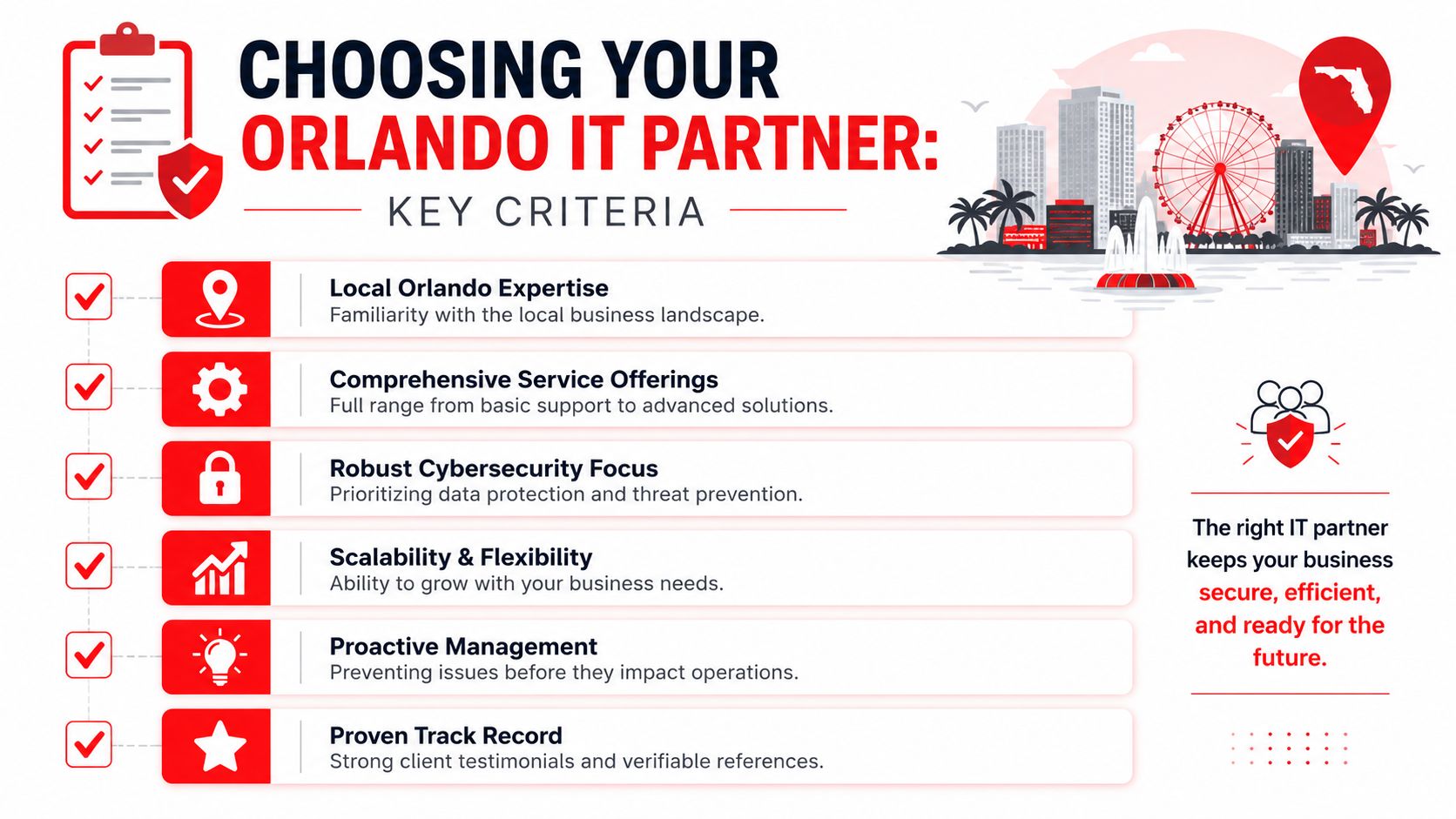
A lot of provider evaluations go wrong because the buyer asks broad questions and gets polished broad answers. “Do you offer support?” always gets a yes. “Do you handle cybersecurity?” also gets a yes. Those answers don't tell you how the relationship will work when your office is under pressure.

The better approach is to test for operating discipline, pricing clarity, local fit, and escalation maturity.

An infographic titled Choosing Your Orlando IT Partner listing six key criteria for selecting IT services.

One issue deserves immediate attention. Data indicates that Orlando businesses in professional services and medical practices often suffer from ticket-driven vendor support where costs spike unexpectedly, contrasting with the budget stability of predictable, all-inclusive pricing models that prevent such volatility, as described in this Orlando small business IT support analysis. If your firm operates across multiple offices or has periodic onboarding surges, that pricing structure matters.

Questions worth asking before you sign

Ask direct questions that expose how the provider works.

  • How do you handle after-hours issues: You want a clear answer on live coverage, escalation paths, and what happens when a security concern appears outside normal business hours.
  • What happens when a ticket involves a possible breach: If they separate support and security too sharply, incidents can stall between teams.
  • How do you support our industry workflows: Law, medical, accounting, engineering, and field-service operations all have different dependencies and urgency patterns.
  • What documentation do you maintain: Good providers keep environment records current so issues don't depend on one technician's memory.

A provider should also be willing to show you what accountability looks like. This might include reporting, recurring reviews, asset visibility, and a documented service scope. Recognition can matter too, but only if it reflects real operating quality. For example, this managed service provider recognition graphic can be a conversation starter, not a substitute for due diligence.

Where pricing models change the relationship

Ticketed billing often changes behavior in the wrong direction. Staff hesitate to report recurring issues. Managers delay improvements because every request looks like another charge. The provider gets paid to react, not necessarily to reduce the reasons you need to call.

Flat-rate models shift the conversation. Instead of debating whether a request will trigger another invoice, you can focus on standards, maintenance, cleanup, and user experience. That's especially valuable for firms with multiple locations in Central Florida, where moves, onboarding, and uneven office infrastructure can create surprise work.

If pricing punishes you for asking for help, your provider has the wrong incentive structure.

Look for a partner that can explain scope clearly, identify what's covered, define escalation routes, and say no to ambiguity. Clear boundaries are a sign of maturity, not inflexibility.

Navigating Compliance in Central Florida Industries

For a lot of businesses in Orlando, compliance pressure shows up long before an audit. It appears in client questionnaires, insurance applications, vendor requirements, and internal concern about who has access to sensitive information.

Law firms, accounting offices, dental practices, medical spas, and veterinary clinics all handle data that carries consequences when mishandled. That makes IT support a compliance function as much as an operational one.

What FIPA means in practice

Florida businesses handling consumer data need to understand the baseline legal risk. The Florida Department of State mandates that all businesses handling consumer data must comply with the Florida Information Protection Act, which requires notification of data breaches within 30 days and imposes penalties up to $50,000 per violation, as outlined in this Florida compliance summary.

That changes how you should think about support. A delayed investigation isn't just inconvenient. Poor visibility into account misuse, device compromise, or unauthorized access can affect your response timeline and increase legal exposure.

The IT controls that support compliance

Compliance doesn't start with forms. It starts with operational control.

The most useful controls are usually straightforward:

  • Access control: Users should have the access they need, and no more.
  • Endpoint protection and patching: Unmanaged devices and delayed updates create avoidable risk.
  • Logging and review: You need enough visibility to understand what happened when something looks wrong.
  • Incident response coordination: Helpdesk and security actions should support documentation and containment, not compete with each other.

Medical and healthcare-adjacent practices also need to think beyond basic privacy habits. For a practical outside perspective on emerging concerns, this guide on protecting patient records from AI risks is a useful companion read. Identity and access management is another major pillar, and this identity and access management overview graphic helps frame why account control is central to compliance.

The takeaway is simple. Compliance becomes far more manageable when your IT support model already enforces disciplined access, monitored systems, and documented response procedures.

Frequently Asked Questions About Orlando IT Helpdesk Services

Will onboarding disrupt our day-to-day operations

A competent provider should stage onboarding in a way that limits interruption. That usually means gathering documentation first, reviewing users and devices, validating access, and scheduling changes in a controlled order. If onboarding feels chaotic, that's often a warning sign about how daily support will feel later too.

Can an IT helpdesk support the specialized software our firm uses

Usually yes, if the provider is comfortable documenting workflows, vendor contacts, login dependencies, and escalation paths. The important question isn't whether they built the software. It's whether they can support the environment around it, including devices, permissions, updates, integrations, and user access issues.

What happens during a major IT emergency

You want a provider with a defined emergency process. That should include immediate triage, communication to the right decision-makers, technical containment if security is involved, and a path to restore operations in a documented order of priority. Firms that work in legal, medical, and financial settings should expect both operational response and security judgment.

Is local presence still important if most support is remote

Yes. Remote support handles many issues faster, but local presence still matters for hardware failures, office changes, network work, and situations where someone needs to be on-site to coordinate recovery. For multi-location firms in Central Florida, local familiarity also helps with consistency.

How do we know if our current provider is no longer the right fit

Look for patterns. Repeated issues, unclear billing, poor communication, weak documentation, and vague answers about security handling are all signs that the relationship may be reactive instead of protective. If your staff has learned to “just work around IT,” the support model is already costing you more than the invoice shows.


If your business needs an IT helpdesk in Orlando that supports uptime, security, and predictable operations, Cyber Command, LLC is one local option to evaluate. Ask for a conversation focused on your actual environment, including after-hours support, SOC integration, compliance needs, and whether fully managed or co-managed coverage fits your team.