Best IT Support Orlando: Top Providers for 2026

If your Monday starts with a ticket queue that's already stacked, a receptionist who can't get through to anyone, and an owner asking whether the backup even ran last night, you're not shopping for “IT support.” You're shopping for control. In Orlando, the difference between a decent helpdesk and a real managed partner shows up fast, especially when cybersecurity, uptime, and onsite response all matter at the same time.
This guide cuts through the marketing. It gives you a practical way to judge the best IT support Orlando businesses can rely on, a grounded view of local market conditions, a pricing baseline, a sector-by-sector fit guide, and a checklist you can use before you sign anything.
| Provider | Core Services | 24/7 Support | Pricing Model | Best-Fit Industries | Standout Strength |
|---|---|---|---|---|---|
| Cyber Command, LLC | Managed IT, co-managed IT, cloud support, vendor management, cybersecurity, QBRs | Yes, 24/7/365 live helpdesk and SOC | Predictable, all-inclusive style | Professional services, medical, industrial, public and community organizations | Strong fit for businesses that want proactive control and documented accountability |
| Orlando-area boutique MSPs | Helpdesk, network monitoring, backup oversight, patching | Varies by provider | Usually per-user or flat-rate | Smaller offices, multi-location SMBs | Direct access to senior technicians |
| Central Florida regional firms | Managed IT, security operations, consulting | Varies by provider | Mixed contract structures | Growing SMBs, regulated firms | Broader service depth and more formal reporting |
Table of Contents
- Why Orlando SMBs Are Rethinking IT Support in 2026
- The Orlando IT Support Market at a Glance
- Seven Criteria That Separate Real Managed IT From a Helpdesk in Orlando
- Comparing the Top Orlando IT Support Providers
- Orlando Managed IT Pricing Models Explained
- Matching Orlando Providers to Local Industries
- Why a Local, Compliance-Focused Partner Beats Break-Fix in Orlando
- Buyer's Checklist and FAQs for Choosing Orlando IT Support
Why Orlando SMBs Are Rethinking IT Support in 2026
A lot of Orlando owners have already lived the same bad morning. A login issue turns into a helpdesk dead end, a backup job fails, or a security scare exposes how little anyone knows about the systems that keep the business moving. Once that happens, hourly break-fix support stops looking cheap and starts looking risky.
That is why more businesses are shifting to managed, cybersecurity-first support. They need continuity, not just a number to call. They need proactive monitoring, patching, backup oversight, and clear answers on what is covered before the next outage hits.
Practical rule: If a provider cannot tell you exactly how they respond after hours, assume the answer is “when the office opens.”
A live support image matters here because it reflects the standard buyers should expect from a local provider: someone reachable, accountable, and ready to act when the system goes down. Live support reference
For a useful mental model on resilience, the logic behind stable NBN connectivity with 4G backup translates well to IT support. You want that same layered continuity in Orlando, not a single point of failure. That matters more in a city where provider density is high enough that reputation alone does not separate one firm from another.
The local market is crowded enough to create choice, but not so standardized that contracts look the same. Buying on brand recognition alone is a mistake. The smarter move is to compare response capacity, security coverage, and what is bundled into the monthly fee.
If you are scanning a provider from your phone between meetings, the fastest signal is simple. Ask whether they prevent problems, handle incidents after hours, and document what they are doing in a way your business can audit later. If the answer is fuzzy, keep moving.
The Orlando IT Support Market at a Glance
Orlando's managed IT market is busy, but it's still fragmented enough that buyers have to do the homework. In Florida's April 2026 help desk rankings, listed providers range from 6 to 9 employees up to 50 to 75 employees, while Orlando-specific listings in 2026 show multiple firms in the 2 to 5 employee range. That mix points to a market built around small teams rather than a few giant vendors, which usually means more direct access to senior technicians, but also a wider spread in process maturity and after-hours coverage. Clutch Florida help desk rankings
A separate Orlando business database lists 84 verified computer support and services firms in the city, which makes the local field dense enough that buying decisions should focus on measurable differences, not generic availability. Orlando computer support and services database In practical terms, that means you should care about onsite dispatch, escalation speed, and whether the monthly fee covers monitoring and reporting or only ticket handling.
What fragmentation means for buyers
More small firms can be a good thing if you value direct communication. It also means the sales pitch may sound polished while the operating model stays thin. One provider may advertise local service but rely on voicemail after hours, while another may run a real 24/7 team with documented response paths.
The local directories also tell buyers to verify things that matter in procurement, not just marketing. Clutch's Orlando directory urges businesses to ask about uptime metrics, ticket response times, client retention, and whether the provider has truck-roll capacity in Orange or Seminole County. Clutch Orlando MSP directory That's the right mindset for this market, because “local” only matters if someone can get onsite when a switch dies or a firewall drops.
Orlando buyers should think like operators, not shoppers. The best choice is rarely the loudest vendor, it's the one that can prove response capacity and tell you what happens when business hours are over.
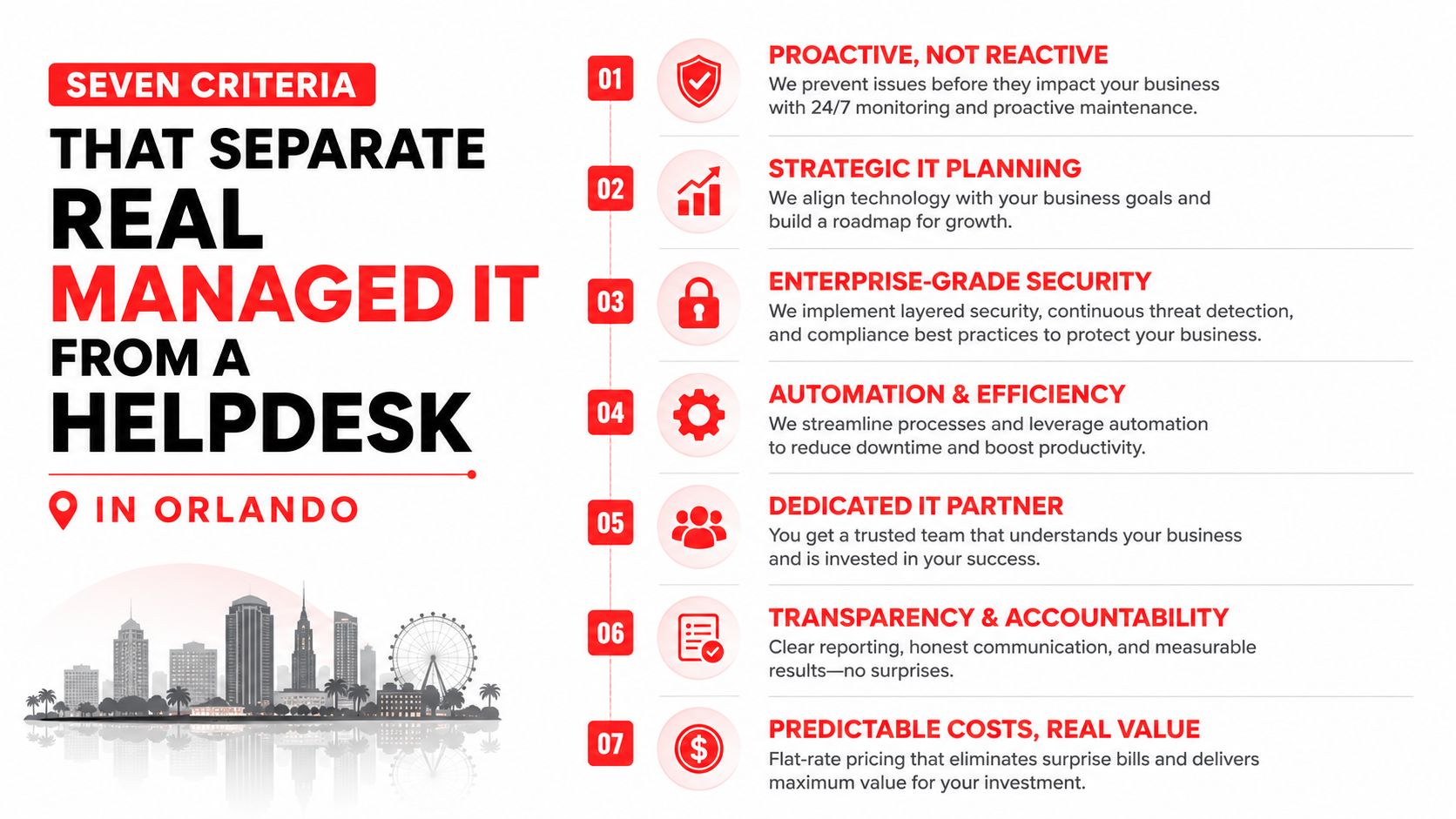
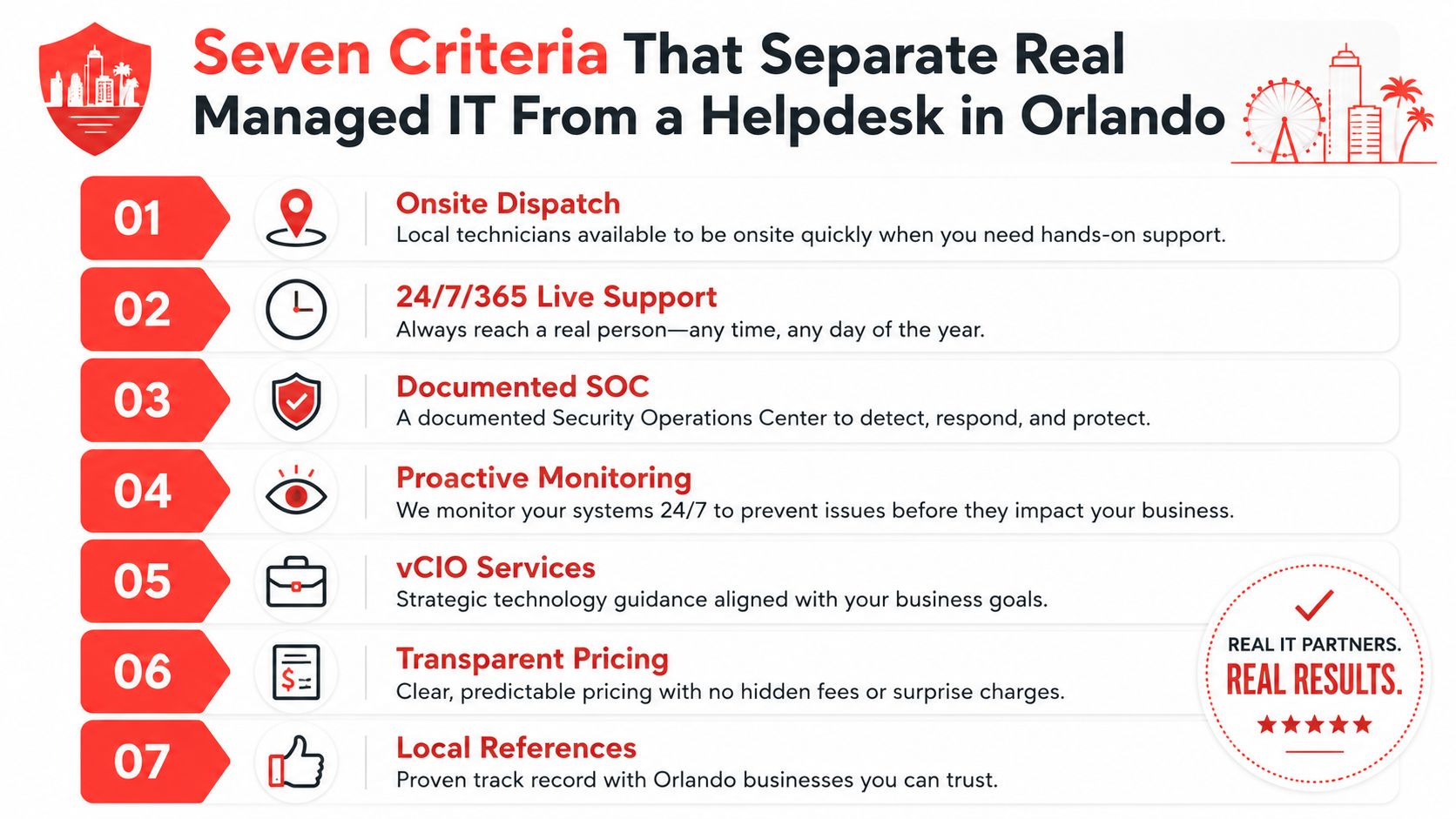
Seven Criteria That Separate Real Managed IT From a Helpdesk in Orlando
The easiest way to compare providers is to score what they do, not what they promise. Start with local response capacity. A real Orlando partner can explain who dispatches onsite, how far they'll travel, and what happens if a network issue starts after the workday ends.
1. Local dispatch and onsite coverage
A provider should be able to tell you whether they have a truck-roll team in Orange or Seminole County, not just a mailing address. If they can't show that capability, you're probably buying remote helpdesk access, not true local support.
2. True 24/7/365 live support
Voicemail, callbacks, and “next business day” are not the same thing as live support. A provider that advertises 24/7 support should staff it, especially if your office runs late, has client-facing systems, or can't afford after-hours downtime.
3. Documented security operations
Good managed IT includes active security coverage, not a vague promise that someone “watches things.” Ask whether they have security monitoring, incident response, and recovery practices that are written into the service model.
4. Transparent pricing and scope
You want to know what's included before the first invoice lands. Monitoring, patching, backup oversight, and helpdesk support should be clearly defined, and any add-ons should be obvious.
5. Vendor and license management
Many businesses lose time to password resets, SaaS renewals, and vendor coordination. A stronger provider will manage those tasks instead of pushing them back on your office manager.
6. Proactive controls
Endpoint protection, patching cadence, and backup monitoring should be part of the daily operating rhythm. If the provider only reacts to tickets, you're still living in break-fix mode.
7. SLAs and reporting
Look for measurable response commitments and regular review meetings. If there's no reporting cadence, it's hard to know whether the service is improving or just staying busy.
Comparing the Top Orlando IT Support Providers
A bad fit shows up fast in Orlando. The office sounds supported on paper, but the team still waits on callbacks, after-hours coverage is thin, and no one can say what the monthly fee covers.
The right shortlist depends on the operational pain you need to fix. Some firms are built for direct access and fast local response, others are a better match for regulated work, and some only make sense if you need basic helpdesk coverage.
| Orlando IT Support Provider Snapshot | Core Services | 24/7 Support | Pricing Model | Best-Fit Industries | Standout Strength |
|---|---|---|---|---|---|
| Cyber Command, LLC | Managed IT, co-managed IT, cloud services, DevOps, AI consulting, vendor management, endpoint protection, patching, QBRs | Yes, live U.S.-based helpdesk and SOC | Predictable, all-inclusive approach | Professional services, medical, industrial, public and community organizations | Strong fit for businesses that want proactive support and documented accountability |
| Established Florida MSP profile | Managed IT, monitoring, consulting, security operations | Varies by provider | Often per-user or mixed contract | Multi-location SMBs, compliance-sensitive firms | Broader service mix with formal reporting |
| Boutique Orlando provider profile | Helpdesk, onsite support, backup oversight, patching | Sometimes limited to business hours with emergency coverage | Usually lean monthly plans | Smaller offices, local professional firms | Direct senior access and faster informal escalation |
A good example of the first category is Cyber Command, LLC, which offers managed IT, 24/7/365 U.S.-based helpdesk support, cloud support, and vendor management from its Orlando presence. It is the kind of setup that suits firms that want fewer surprises and clearer ownership of the environment. See the Cyber Command cloud partner badge and the Cyber Command Orlando provider snapshot for the sort of public-facing proof buyers should ask every provider to show.
Read a provider snapshot for the gap between marketing and operating reality. A smaller Orlando firm can still be the right answer if it shows dispatch capacity, live support, and a clear scope. A larger regional name can still disappoint if the contract is full of exclusions and slow escalation paths.
Friendly service language is easy to sell and hard to rely on. The stack behind the helpdesk matters more, including security ops, vendor management, and whether someone owns the problem from first ticket to resolution. If a provider cannot explain those pieces cleanly, it is not a managed relationship, it is just reactive support.
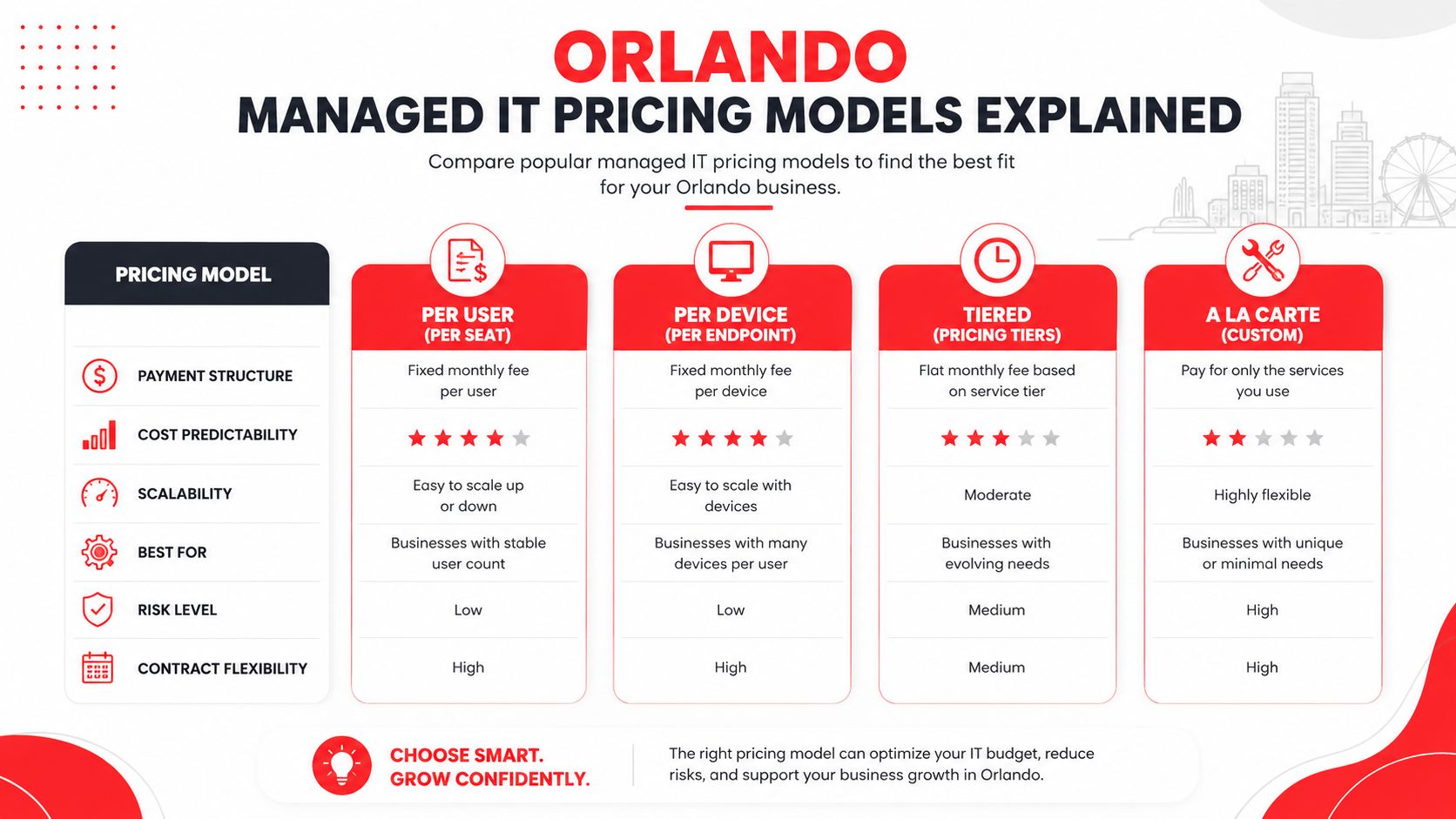
Orlando Managed IT Pricing Models Explained
The most useful pricing benchmark for Orlando buyers is $100 to $300 per user per month for managed IT services, according to an Orlando-focused guide. Orlando managed IT pricing benchmark For a 25-user firm, that translates to roughly $2,500 to $7,500 per month before custom projects or add-ons, depending on scope and security requirements.
That band makes sense if the provider is covering monitoring, helpdesk, patching, backup oversight, cybersecurity, cloud services, and consulting. It gets less attractive when the monthly fee leaves out after-hours work, vendor management, or anything beyond simple ticket triage.
What different pricing models usually look like
A per-user model is common when each employee has a standard device stack and consistent support needs. A per-device model can work when headcount is uneven or field equipment matters more than seats. A flat-rate model is the cleanest option when the provider includes broad coverage and doesn't pile on charges later.
Low advertised fees usually leave out the security stack Orlando businesses actually need. The monthly number looks small until you add backup oversight, incident response, and patch management one line item at a time.
That's where predictable pricing matters. If the contract is built well, you'll know what's covered, what triggers an extra project fee, and how emergencies are handled. If it's built loosely, the invoice becomes the actual service agreement.
The most common upcharges are easy to spot once you know where to look. After-hours onsite work, custom projects, advanced security modules, and compliance audits are often excluded from entry-level plans. That doesn't make them bad, but it does mean the actual cost is higher than the brochure suggests.
Matching Orlando Providers to Local Industries
Different industries in Orlando need different IT instincts. A law office cares about confidentiality, a medical practice cares about uptime and patient data, and an industrial firm cares about resilience across sites and devices. If the provider doesn't understand the risk profile, the support model will feel generic from day one.
Legal, accounting, and architecture firms
These firms usually need tight document control, secure remote access, and reliable email protection. They also need someone who can explain risk in plain language, because partners and office managers don't have time for jargon.
A strong fit is a provider that offers vendor management, endpoint protection, and reporting that shows what's being monitored. A small Orlando law firm that gets a client data-breach inquiry will care less about flashy tools and more about whether the team can show logs, access controls, and a documented response path.
Privately owned medical practices
Plastic surgeons, medical spas, dentists, orthodontists, and veterinarians tend to need fast issue resolution, backup oversight, and a clear security posture. If the office runs on appointment schedules and billing, downtime becomes visible immediately.
This group should prioritize providers with 24/7 support, security operations, and a contract that spells out incident handling. A dental practice opening a second location, for example, needs the provider to manage connectivity, shared systems, and consistent support across both offices.
Industrial and field-service firms
These businesses need stable infrastructure across locations, mobile users, and often more complicated vendor dependencies. They benefit from proactive monitoring, patching, and a provider that can coordinate with outside software and hardware vendors without slowing down operations.
The right profile here is a managed services partner that can standardize systems instead of just reacting to breakage. If a field-service manager can't get an answer during a jobsite issue, productivity takes the hit immediately.
Public and community organizations
These groups usually want reliable local support, better documentation, and predictable service ownership. They're often under pressure to show accountability without building a large internal IT team.
A provider with clear reporting, good escalation habits, and a local presence fits best. The moment they are juggling donor systems, community services, or multi-site staff support, the value of consistent management becomes obvious.
Why a Local, Compliance-Focused Partner Beats Break-Fix in Orlando
A broken network is bad enough. A broken network during patient check-ins, client billing, or a busy office morning turns into missed work, angry calls, and hours of cleanup. Break-fix support may look cheap on paper, but the actual cost shows up the moment your team needs immediate help and nobody is already watching the environment.
A managed partner gives you predictability. You get one monthly service structure, fewer surprise invoices, and a better handle on what is covered before something fails. Break-fix does the opposite, it pushes costs into the moment of failure and leaves small issues to sit until they become larger recovery jobs.
Response time is the other issue. A provider with a live helpdesk and a security operations function can act during an incident, not after the damage is done. That matters for professional services and medical practices, where confidentiality, uptime, and audit trails are part of normal operations.
Cyber Command, LLC is built around that model with 24/7/365 U.S.-based helpdesk, a 24/7 SOC, predictable pricing, compliance alignment, QBRs, and vendor management. Their cloud partner badge is one sign of that posture. You do not need every provider to mirror that exact setup, but you do need a partner that can explain how it prevents problems instead of only closing tickets.
A local, compliance-focused relationship also tightens accountability. When contracts include documentation, reporting, and escalation paths, your team knows who owns what and how issues get handled. That is the difference between buying labor and buying operational continuity.
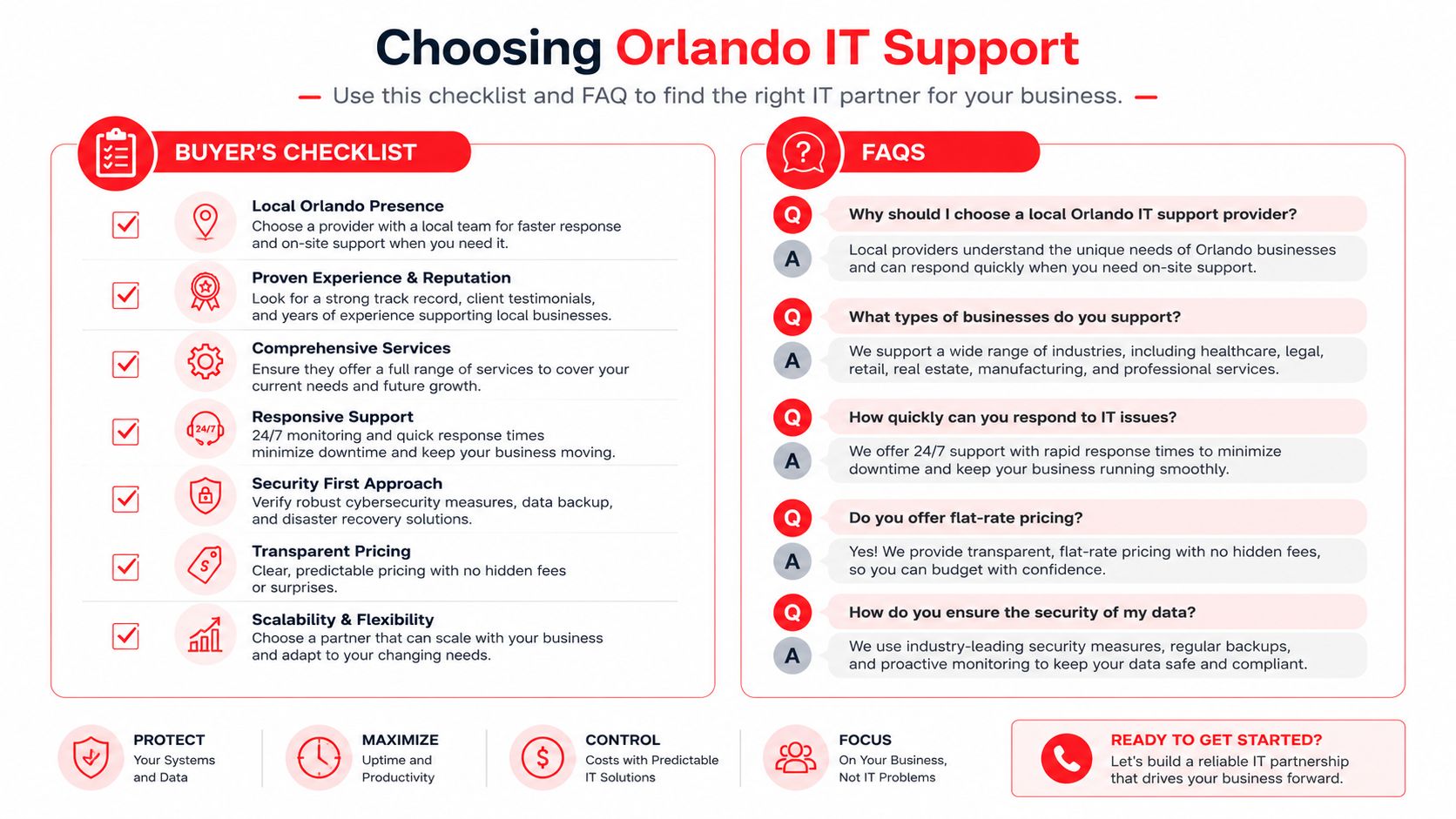
Buyer's Checklist and FAQs for Choosing Orlando IT Support
Use these ten questions before you sign anything.
- Do you provide true 24/7 live support, or only after-hours callbacks?
- Who handles onsite dispatch in Orange or Seminole County?
- What security monitoring is included in the monthly fee?
- Is patching covered, and how often is it performed?
- Do you manage backup oversight and recovery testing?
- Which vendor tasks are included, and which are billable?
- What's excluded from the contract, especially after-hours work and projects?
- Can you show your SLA response commitments in writing?
- How do you support compliance, documentation, and audit requests?
- What does onboarding look like for the first 30 days?
FAQs
How long does onboarding usually take?
It depends on how much documentation, device standardization, and account cleanup the provider has to do. A clean onboarding process should start with discovery, access review, and a defined support handoff so your team isn't left guessing.
What should an Orlando-specific SLA include?
It should spell out response timing, escalation handling, onsite availability, and what happens during after-hours incidents. If the SLA only talks about business hours, it's not enough for a company that depends on continuity.
How do you phase out a break-fix provider without disruption?
Start by inventorying accounts, devices, passwords, backups, and vendor contacts before the handoff date. Then overlap support briefly so the new provider can verify monitoring, patching, and recovery coverage before the old relationship ends.
If you want a local partner that handles managed IT, co-managed support, cloud services, vendor management, and 24/7 helpdesk coverage with a cybersecurity-first approach, talk to Cyber Command, LLC. Visit Cyber Command, LLC to set up a discovery call and compare your current support model against a more accountable option for your Orlando business.