
July 30, 2026
Compliant IT Services Orlando: A Guide for SMBs in 2026
Discover compliant IT services Orlando that meet HIPAA, PCI, and SOC 2 requirements. Practical guide for SMBs in 2026.
You don’t need a lecture on compliance. You need to know whether the IT partner you’re paying every month can keep your business moving when a client asks for proof, an auditor wants records, or a breach forces a hard conversation. In Orlando, that question has gotten more serious because managed services have already replaced old break-fix habits for most small and mid-sized businesses, and regulated firms are still being asked to prove more with less in-house staff.
That’s the core conversation behind compliant IT services Orlando. It’s not about buying a stack of tools and hoping they make you safe. It’s about whether your provider can enforce controls, preserve evidence, and produce documentation that holds up when a client, insurer, or regulator starts asking pointed questions.
Table of Contents
- What Compliant IT Services Actually Mean for Orlando Businesses
- The Compliance Frameworks Orlando SMBs Run Into
- Technical and Operational Services Behind Compliant IT
- How AI and Cloud Tools Are Reshaping Compliance Risk
- How to Evaluate a Compliant IT Services Provider in Orlando
- Real-World Scenarios From Central Florida
- How Cyber Command Approaches Compliant IT in Orlando
- Frequently Asked Questions About Compliant IT Services in Orlando
Stuck on something like this right now?
Talk it through with a real US-based engineer, 24/7, no phone trees: (407) 587-0089.
Book a Free Strategy SessionWhat Compliant IT Services Actually Mean for Orlando Businesses
A lot of Orlando owners get stuck because they think compliance is a software category. It isn’t. When a dental practice, law office, or engineering firm gets a client security questionnaire and a regulator notice in the same week, the issue is whether the business can prove its controls were active, reviewed, and documented. That’s the job of compliant IT, a mix of policy enforcement, system oversight, and evidence production that keeps the business from improvising under pressure.
Compliant IT services mean your provider doesn’t just keep devices online. It also sets access rules, maintains logs, backs up data, documents exceptions, and gives you records on demand. That matters because auditors and regulators care about what existed at a point in time, not what a dashboard looked like after the fact.
Practical rule: If a provider can’t show you the evidence trail, it’s not really a compliance service. It’s just IT with better branding.
For Orlando firms, this approach fits the way regulated work happens. A healthcare office needs HIPAA-oriented support. A finance-adjacent business needs stronger identity control and documentation. A contractor handling sensitive client data needs a provider that can keep systems aligned to policy, not just patched and powered on.
A useful way to frame it is this. Compliance is the outcome, controls are the mechanism, and evidence is the proof. If one of those three pieces is missing, the business is exposed.
If you want a broader planning lens for compliance programs, the Alignmint compliance overview is a helpful starting point because it shows how compliance topics are often grouped before they get translated into operational work.
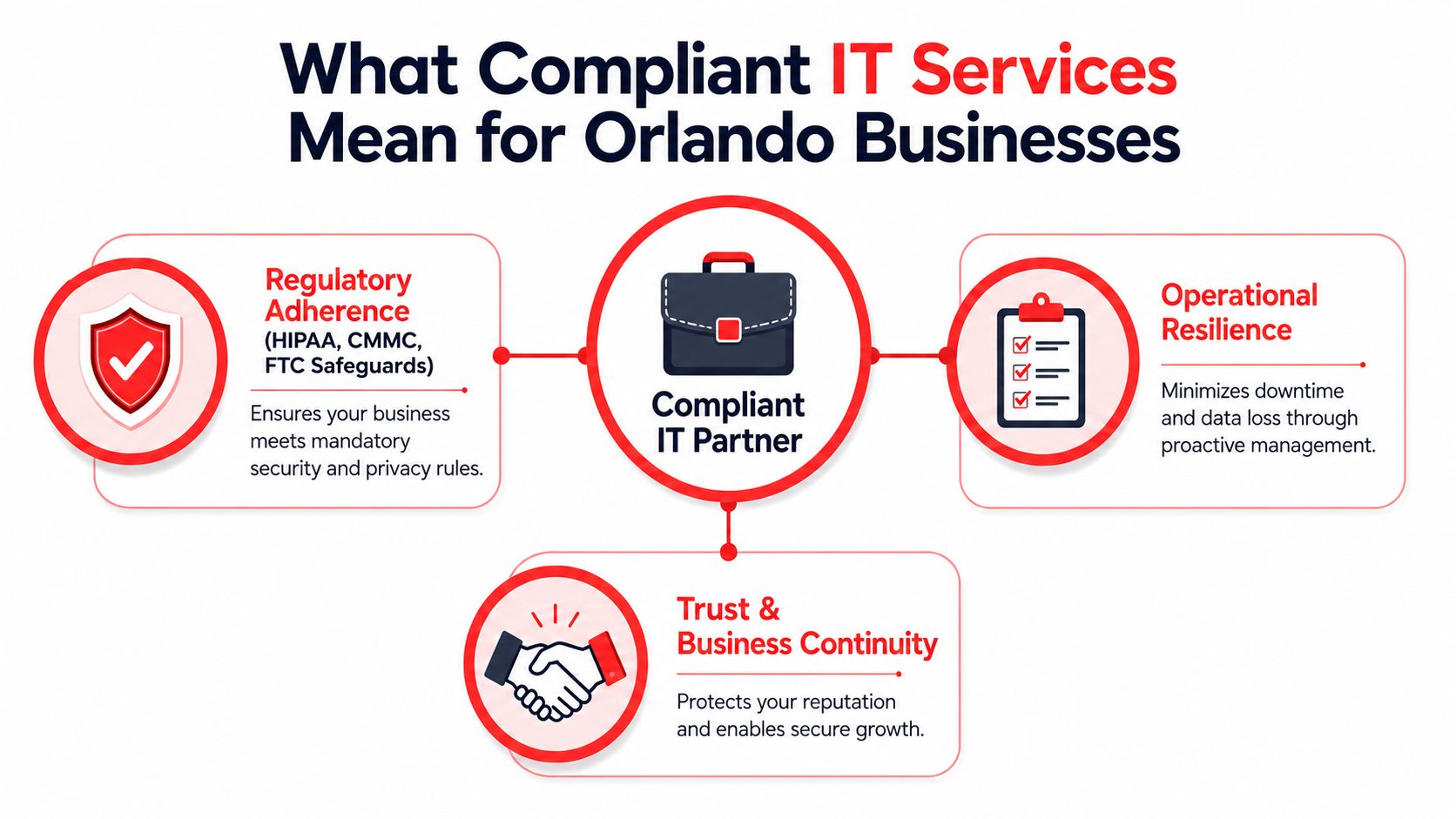
A good working definition for Orlando SMBs is simple. Compliant IT services are managed technology services that continuously enforce required controls, preserve proof, and help the business respond to audits, customer requests, and incidents without scrambling. That’s the standard worth paying for.
Master cybersecurity compliance for IT managed services
The Compliance Frameworks Orlando SMBs Run Into
Orlando businesses don’t live under one framework. They live under a mix of rules that depend on the industry, the data, and the clients they serve. A medical practice has different obligations than a payment processor. A defense-adjacent contractor carries different exposure than a design firm. The mistake is trying to buy a generic MSP and hoping the framework problem goes away.
Which rules hit which businesses
HIPAA is the obvious one for medical offices, dental groups, orthodontists, and veterinary clinics handling protected health information. The FTC Safeguards Rule also matters for firms handling customer financial data, because it calls for MFA, encryption of customer financial data in transit and at rest, annual risk assessments, and a designated Qualified Individual overseeing the program Techrage IT compliance guide. That is not a checkbox exercise. It demands ongoing proof that controls are active.
PCI-DSS applies when a business stores, processes, or transmits cardholder data. SOC 2 comes up in professional services and SaaS environments where clients want evidence of control maturity. NIST SP 800-171 matters for defense-adjacent contractors, especially when controlled unclassified information is involved. Florida breach-notification rules apply broadly any time personal data is in the mix, which means almost every organization has some exposure.
A clean way to read the field is to ask one question. What does the business hold, and who expects proof about it?
Framework
Typical Orlando Industry
Core Operational Requirement
HIPAA
Medical, dental, veterinary
Protect patient data, document access, and maintain risk-based controls
FTC Safeguards Rule
Financial services and finance-adjacent firms
MFA, encryption, annual risk assessments, designated oversight
PCI-DSS
Retail, service firms, payment environments
Secure card data and restrict access to payment systems
SOC 2
Professional services, SaaS
Prove controls, monitoring, and documented governance
NIST SP 800-171
Defense-adjacent contractors
Control sensitive data and maintain evidence across systems
Florida breach rules
Most businesses holding personal data
Trigger timely response and notification workflows
Why documents matter as much as systems
If you need a solid reference for document handling under healthcare rules, master HIPAA compliant doc management is worth reading because it focuses on the operational side of records, access, and retention.
The provider that knows the framework name but can’t produce the policy, log, or assessment behind it is not ready for a real audit.
Technical and Operational Services Behind Compliant IT
Compliance falls apart fast when the day-to-day stack is weak. The provider can talk about frameworks all morning, but if nobody is watching the environment, patching the devices, or testing recovery, the business is still exposed. Orlando owners should judge a compliant IT provider by the operational work it performs every day, not by the labels on a sales sheet.
What the provider has to do continuously
A 24/7 SOC exists to catch active threats, triage suspicious behavior, and keep incidents from turning into outages. That matters because compliance is not just about policy on paper. It’s about whether someone is watching the network when something starts moving the wrong way.
Endpoint protection and patching close known vulnerabilities. Backups and tested recovery procedures matter because data loss is a compliance issue as soon as the business can’t prove it can restore records. Centralized logging with retention rules gives auditors evidence and gives your team a timeline when something breaks. Vendor and license management keeps software inventory, access rights, and evidence current instead of stale.
Practical rule: If the provider can’t tell you where logs live, how long they’re kept, and who reviews them, you don’t have a compliance-ready environment.
Why multi-framework environments need structure
In a mixed environment, ad hoc security gets messy fast. A business that handles regulated health data, payment information, and client records needs segmented access controls, standardized policy mapping, and consistent remediation tracking across systems. If one part of the business is documented and another part is managed casually, the audit trail becomes unreliable.
That’s also where data handling discipline matters. Citizenship-aware handling for restricted defense data, role-based access for sensitive records, and vendor oversight for third-party software all belong in the same operational model. The goal is simple. Evidence should look the same no matter which framework is asking the question.
How AI and Cloud Tools Are Reshaping Compliance Risk
The biggest compliance mistake in Orlando right now is assuming a clean firewall and MFA mean the job is done. They don’t. Staff are using cloud apps, generative AI, and connected tools faster than most firms are governing them, which means the compliance boundary has moved well beyond the office network.
That matters because current breach data points to two ugly realities. The 2025 Verizon Data Breach Investigations Report found that 16% of breaches involved vulnerabilities in third-party software and 30% involved the human element. The same year, Cisco’s AI Readiness Index found that only 13% of organizations were prepared to turn AI into business value. Those numbers say the same thing in different ways. Businesses are adopting tools faster than they’re building controls around them.
What does that mean in practice? A staff member pastes client data into an AI prompt. A department signs up for a SaaS app outside the approved stack. A cloud identity sits open longer than it should. None of those failures looks dramatic on day one. All of them can become compliance problems later because the data moved outside the documented environment.
The answer is not to ban AI or cloud software. That’s a lazy reaction, and it doesn’t work. The answer is to govern them like part of the regulated stack. That means controlling identities, reviewing vendor access, defining where data can and cannot go, and keeping exception handling documented.
Straight answer: If your provider says “we do compliance” but doesn’t govern cloud apps and AI use, they’re behind the curve.
Continuous compliance now includes shadow IT, third-party software, and AI workflows. If those pieces aren’t in scope, the business is only compliant in the narrowest possible sense, and that won’t survive a serious review.
How to Evaluate a Compliant IT Services Provider in Orlando
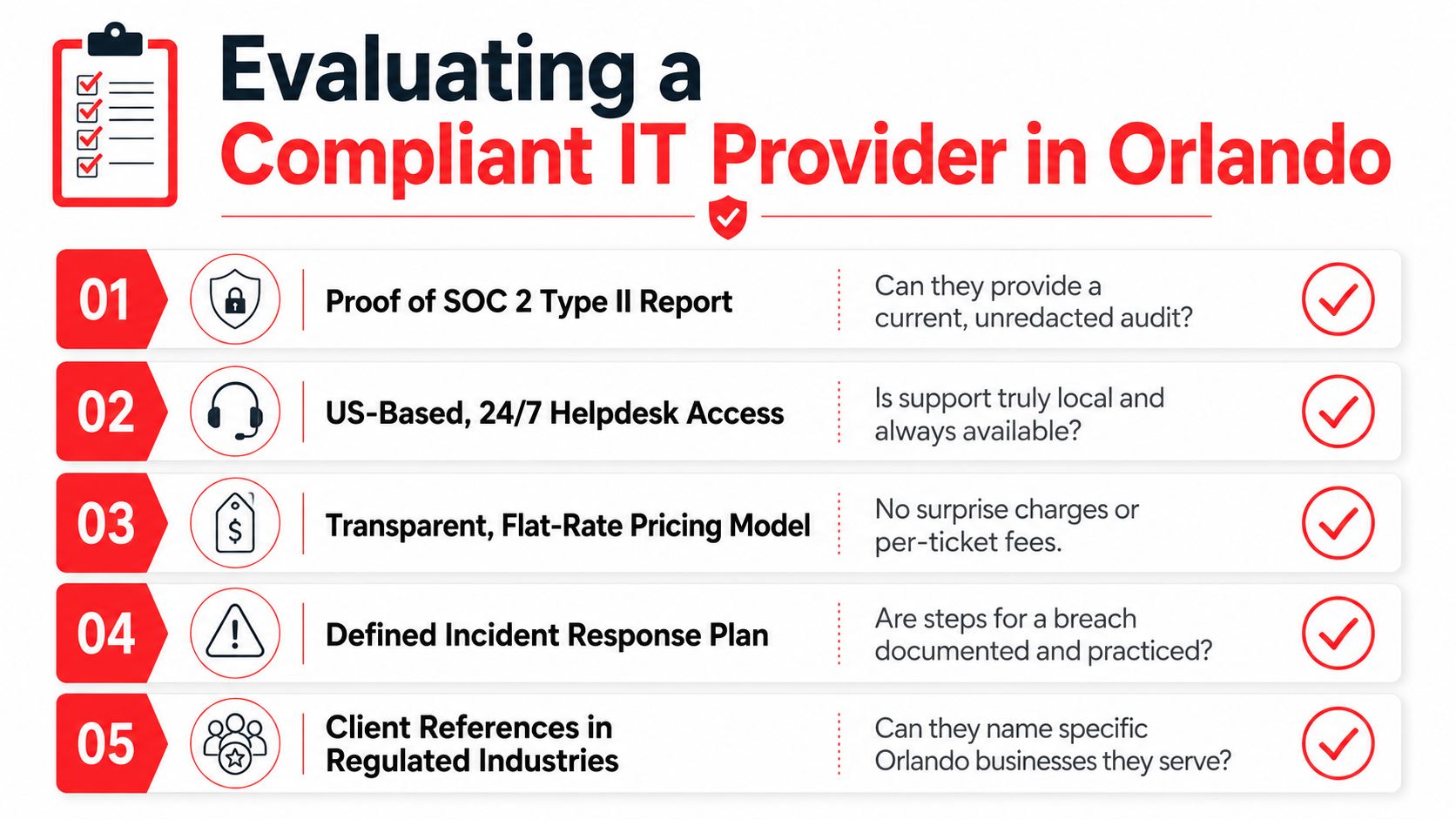
Most sales meetings sound fine until you ask for evidence. Then the gap shows up. A real provider should be able to prove what they do, not just describe it. If you’re comparing compliant IT services Orlando options, focus on evidence, response behavior, and documentation, because that’s what protects you when the pressure rises.
What to ask for before you sign
Start with the basics. Ask whether they can provide proof of a current audit or equivalent review, sample incident response runbooks, evidence-handling workflows, and written targets for recovery. Ask who owns compliance inside their operation, not just who answers the phone. If the answer is vague, keep moving.
Then ask how support works in your world. Can they respond on-site in Orlando, Winter Park, Lake Mary, Maitland, and Kissimmee when something can’t be solved remotely? Where do backups live, and how do they handle data residency concerns for Florida-based clients? Is the SOC staffed around the clock by U.S.-based analysts, or does coverage change overnight?
A provider that’s serious about regulated work should also be able to talk about documentation samples. Not just uptime reports. Actual evidence. That includes logs, policy acknowledgements, backup reports, and remediation records.
Red flags that should make you walk
- No audit evidence: If they can’t show a compliance artifact, they’re probably not maintaining one.
- No named owner: If nobody owns the compliance process, nobody really owns the risk.
- No recovery detail: If they can’t explain RTO and RPO in plain language, they’re guessing on resilience.
- No local response plan: If on-site support takes too long, the business loses momentum during incidents.
- No clear exclusions: If flat-rate pricing sounds too broad, ask what major work and third-party audit fees are excluded.
A flat monthly fee only matters if you know what’s inside it. If the provider won’t define the line between included operational support and out-of-scope project work, the contract is too fuzzy for regulated business.
Real-World Scenarios From Central Florida
A Winter Park dental practice gets hit with a phishing email, and an employee opens the attachment before anyone spots the warning signs. The 24/7 SOC isolates the account, reviews the log trail, and confirms whether protected records were exposed. The provider then assembles the incident record, because the owner doesn’t need another tool, they need a clean account of what happened and what was done.
A Lake Mary law firm gets a client security questionnaire after signing a new matter with sensitive data requirements. The firm doesn’t need a generic IT answer. It needs proof of access control, backup handling, and policy enforcement in a format the client will accept. That’s where compliance-ready managed services matter, because the provider has to turn operational work into defensible evidence.
In both cases, flat-rate pricing changes behavior. The owner is more likely to call early instead of waiting until a small issue becomes a reportable one. That alone can change the outcome.
The best compliance support is the kind that reduces hesitation, because hesitation is where incidents get worse.
A Winter Springs architecture and engineering firm faces a different test. It has to answer client questionnaires and demonstrate that the right systems, controls, and records are in place for sensitive project data. The provider’s job is to make sure the firm can answer without assembling a one-off mess every time a customer asks for proof.
How Cyber Command Approaches Compliant IT in Orlando
Cyber Command’s model lines up with what regulated Orlando firms need. The firm offers flat-rate per-user managed IT, a 24/7 U.S.-based helpdesk, a dedicated 24/7 SOC, and a co-managed IT option for teams that already have internal staff but need stronger coverage. That structure matters because compliance work gets easier when endpoint protection, patching, backups, logging, vendor management, and quarterly business reviews all live inside the same operating model.
The pricing guidance is straightforward. Cyber Command’s own cost guide puts managed IT at $150 to $250 per user per month for most SMBs, while more compliance-heavy packages can reach $250 to $400 or more. That range makes sense for businesses that need more than break-fix support, because the cost is not just the ticket queue. It’s the evidence work, response discipline, and ongoing oversight.
What’s included matters as much as the rate. A provider like this should be covering ongoing support, monitoring, and the operational backbone of compliance. Major project work and third-party audit fees usually sit outside a flat monthly fee, and that’s normal. What’s not acceptable is ambiguity. If the contract doesn’t spell out where the baseline ends, you’re buying uncertainty.
Cyber Command, LLC fits that model because it treats compliance as part of managed operations, not a separate buzzword service. For Orlando owners who want one team to own the day-to-day and the audit trail, that’s the right shape of offer.
Frequently Asked Questions About Compliant IT Services in Orlando
How fast should on-site support be?
Fast enough that a broken office system doesn’t stall the business for a full day. For Orlando-area firms, ask for a clear local response plan for Orlando, Winter Park, Lake Mary, Maitland, and Kissimmee, then get the expectation in writing.
What does data residency mean for Florida-based clients?
It means asking where backups, logs, and sensitive data are stored, and who can access them. If your business handles regulated or sensitive information, you should know whether those records stay in a setup your leadership is comfortable defending.
Does a flat monthly fee cover audit participation?
Sometimes it covers operational support and documentation, but not always full audit work. Make the provider say exactly what’s included, what’s excluded, and whether audit prep or third-party review support is billed separately.
Can a co-managed model still be compliant?
Yes, if responsibilities are written down and the handoff between internal IT and the provider is clean. The danger is overlap without ownership, because that’s how logging, patching, and evidence tasks get missed.
What should a business owner listen for in the first sales call?
Listen for concrete answers about controls, logs, backups, incident response, and proof. If the conversation stays at the level of general cybersecurity language, you’re probably not talking to a provider that can carry compliance pressure.
If you want a straight answer about whether your current IT setup can stand up to an audit, a client questionnaire, or a breach review, talk to Cyber Command, LLC. They offer managed and co-managed IT, 24/7 U.S.-based support, and compliance-focused operations for Orlando businesses that need the evidence as much as the uptime.
This article is for general informational purposes only and is not legal, compliance, insurance, or other professional advice. Threats, technologies, and regulations change quickly; confirm current requirements with your own advisors before acting. See our full disclaimer.