
August 2, 2026
Cyber Command IT Support: Complete Guide for Florida
Elevate your business with Cyber Command IT support. Explore managed services, cybersecurity, and expert solutions for Florida companies.
You’re probably not looking for another IT vendor. You’re trying to stop the late-night outages, the “urgent” email scares, and the constant sense that your systems only get attention after something breaks. If you run a business in Orlando, Winter Springs, or anywhere across Central Florida, that pressure is real, and it’s exactly why cyber command it support deserves a harder look than the usual break-fix pitch.
The difference is simple. Reactive IT waits for the fire, then sends a bill. Proactive IT reduces the fire load, protects access, and gives leadership a way to measure whether the business is safer, faster, and more resilient. Cyber Command, LLC has built its service model around that second approach, with 24/7/365 live U.S.-based helpdesk support, managed and co-managed IT, a dedicated Security Operations Center, and reporting that ties technology work to business outcomes.
Table of Contents
- Why Florida Businesses Are Rethinking IT Support
- What Cyber Command IT Support Actually Includes
- Managed IT Versus Break-Fix and Internal IT Teams
- Industry-Specific Benefits for Central Florida Organizations
- How the Engagement Process Works
- Measuring ROI and Uptime Outcomes
- Frequently Asked Questions About Cyber Command IT Support
Stuck on something like this right now?
Talk it through with a real US-based engineer, 24/7, no phone trees: (407) 587-0089.
Book a Free Strategy SessionWhy Florida Businesses Are Rethinking IT Support
A server goes down at 2 a.m., the front desk can’t print, the phones won’t route, and the owner spends the next morning calling whoever answers first. By the time the issue gets attention, the damage is already done. That’s the situation for too many Central Florida firms that still rely on someone who fixes problems after the fact instead of preventing them.
The smarter move is to stop buying “repairs” and start buying readiness: treating uptime and security as an always-on operation rather than a series of emergencies, because networks don’t fail on a neat schedule.
Cyber Command, LLC fits that model better than a break-fix relationship does. Since 2015, it has focused on proactive support, predictable pricing, and live coverage instead of emergency-only response. For owners in Orlando and Winter Springs, that matters because the loss isn’t the ticket fee, it’s the missed work, the stalled transactions, and the time your team spends waiting for systems to come back.
Practical rule: if your current provider makes money mainly when something breaks, your incentives are backwards.
What the current setup is really costing you
If your business only hears from IT when users are angry, you’re probably paying for chaos in hidden ways. Staff lose hours resetting passwords, vendors wait on approvals, and simple issues linger until they become operational problems. That’s not resilience, that’s delay with invoices attached.
Cyber Command’s model is built to reduce that pattern. Its value isn’t just faster fixes, it’s fewer preventable interruptions, cleaner security hygiene, and a support relationship that treats uptime like a business asset. For Florida owners, that is the difference between technology as a drag and technology as a stabilizer.
What Cyber Command IT Support Actually Includes
The service stack isn’t a pile of random offerings. It works best when each layer supports the next, from user help to security oversight to recovery planning. That’s the point of cyber command it support, it connects day-to-day service with the controls that keep a business running.
Managed and co-managed coverage
Fully managed IT makes sense when you want one accountable partner to run the environment, handle user support, and maintain the baseline. Co-managed IT makes sense when you already have an internal technician or small IT team and need to extend their reach, fill skill gaps, or add after-hours coverage. The important distinction is ownership. Managed IT owns more of the environment, while co-managed IT augments your staff without replacing them.
Cyber Command also supports multi-location organizations that need consistent standards across offices. That matters because a business with several sites can’t afford a patchwork of different support habits. One location should not be more vulnerable than another just because the local setup drifted over time.
Security, recovery, and operations
A strong support model includes a 24/7 U.S.-based helpdesk, not a maze of transfers and generic scripts. It also includes a SOC that watches for threats, routes alerts through playbooks, and works through containment and remediation quickly. Cyber Command describes layered controls such as EDR, MFA, conditional access, segmentation, DNS filtering, and 3-2-1 backups with immutable copies and restore tests in its own support guidance Cyber Command FAQ. Those controls matter because recovery only counts if backups restore when pressure is on.
You also need the unglamorous work done right. Vendor and license management cut administrative drag. Network diagrams make the environment visible. Quarterly Business Reviews force the roadmap to match business goals instead of drifting into technical busywork. If you want a local starting point, the Orlando managed services page gives a clear example of how that support is packaged Orlando managed IT services.
The best IT support isn’t the loudest. It’s the one that reduces surprises and can show you what changed, what improved, and what still needs attention.
A simple way to see the structure
- Helpdesk and monitoring: users get live support, and the environment gets continuous attention.
- Security operations: threats get investigated, contained, and documented instead of ignored.
- Recovery and continuity: backups, restore tests, and baseline controls support business continuity.
- Operational alignment: QBRs, documentation, and vendor management keep the stack under control.
Managed IT Versus Break-Fix and Internal IT Teams
A server goes down at 4:30 p.m., staff are waiting on access to files, and the owner is deciding whether to call someone on an hourly basis or hope the issue clears itself. That kind of delay is what separates a controlled support model from an expensive interruption. Central Florida businesses face that choice all the time, even if they do not frame it that way.
Dimension
Break-Fix
Internal IT
Cyber Command Managed IT
Cost predictability
Unstable, tied to incidents
Salary is predictable, but overtime and gaps aren’t
Predictable, all-inclusive pricing
Response time
Depends on who is available
Good on-site, limited after hours
24/7 live support and monitoring
Security depth
Usually basic
Depends on one person’s bandwidth
SOC-backed monitoring and incident response
Compliance support
Minimal
Varies widely
Ongoing support and documentation discipline
Scalability
Weak for growth and multi-site work
Limited by headcount
Built for growth and distributed environments
Break-fix feels cheaper until downtime shows up on the P&L. The hourly bill is rarely the cost. The cost is the gap between incidents, when nobody is checking patch status, identity controls, backup verification, or suspicious activity. That is where recovery times stretch and routine problems turn into business disruption.
Internal IT has real value. An in-house person knows the environment, knows the users, and can solve local issues fast. The problem is coverage. One technician cannot stay on top of helpdesk tickets, security monitoring, project work, vendor coordination, and after-hours escalation forever. Co-managed IT helps by adding outside support to the internal team, and firms with an existing staff can use co-managed IT services in Orlando to fill those coverage gaps without replacing what already works.
The situation for too many Central Florida firms is simple. They rely on someone who fixes problems after the fact instead of preventing them. That model keeps the lights on until the first serious outage, and then it becomes clear how much time, access, and money was tied to reactive support.
Bottom line: if your provider only reacts, your business is paying for the next outage.
Industry-Specific Benefits for Central Florida Organizations
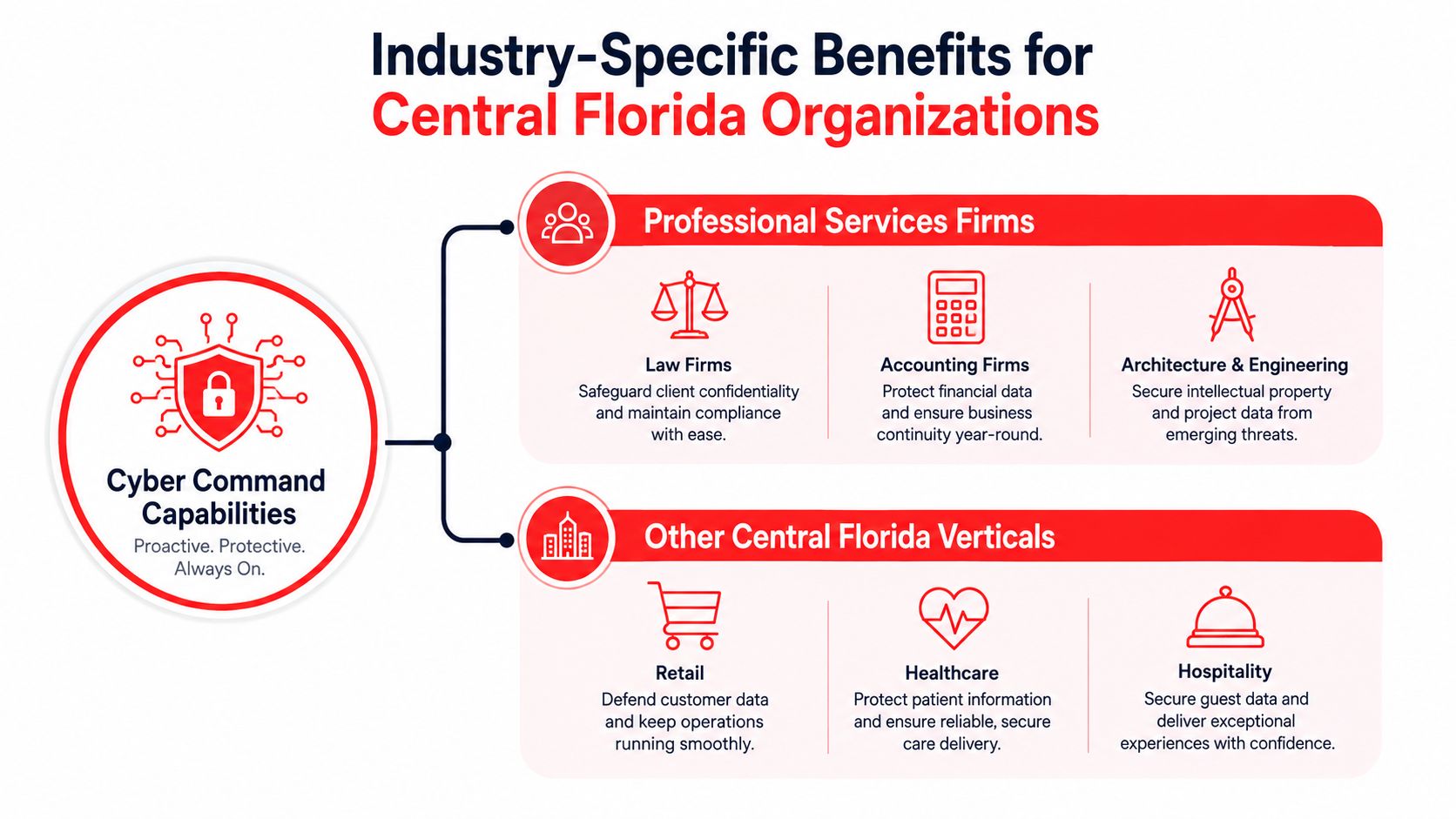
Central Florida’s business mix is exactly where a disciplined support model pays off. Professional services, healthcare, industrial firms, and community organizations all have different risks, but they share one problem, interruption is expensive and trust is fragile. Cyber Command’s model matters because it treats technology as part of operations, not as a side function.
Professional services firms
Law firms, accounting practices, architecture groups, and engineering firms live on document access, client confidentiality, and deadlines. They usually don’t need a huge internal IT department, but they do need secure file access, controlled permissions, and a clean recovery plan when staff can’t reach case files or project documents. A managed partner helps reduce the administrative burden so the firm can focus on billable work instead of password resets and access issues.
Florida’s breach environment is not forgiving. The Florida Information Protection Act requires notification to affected individuals within 30 days after discovery of a breach involving personal information, unless a law-enforcement delay applies Florida Information Protection Act summary. That makes documentation, response discipline, and access control part of the business model, not optional extras.
Medical and healthcare practices
Plastic surgeons, medical spas, dentists, orthodontists, and veterinarians all deal with sensitive records and availability issues. HIPAA’s Security Rule requires administrative, physical, and technical safeguards for electronic protected health information, and the HHS breach notification rule generally requires notice without unreasonable delay and no later than 60 days after discovery for breaches involving 500 or more people (HHS breach notification rule). That means security and recovery planning are not IT niceties, they’re compliance obligations.
For practices in Orlando and nearby cities, the operational win is straightforward. Staff need reliable access, patients need confidence, and owners need fewer surprises when an audit, incident, or outage lands on the calendar. A support partner that understands those pressures makes the practice easier to run.
Industrial, field-service, and public-facing organizations
Industrial firms and field-service businesses need standardized infrastructure across offices, warehouses, and job sites. They can’t afford a different security posture in each location, and they can’t wait for a technician to show up every time a remote user loses access. The same goes for public and community service organizations in Orlando that need steady local support and transparent budgeting.
The operating principle is simple. Standardization lowers risk. Monitoring shortens reaction time. Documentation reduces guesswork. That combination is more valuable than a vague promise to “handle whatever comes up.”
How the Engagement Process Works
The switch to a better IT partner shouldn’t feel like a leap of faith. It should feel like a controlled transition with clear ownership at every step. Cyber Command’s process is designed that way, and that structure matters more than glossy sales language ever will.
The first conversation should be plain. You explain your locations, your pain points, your compliance concerns, and where the business keeps getting stuck. From there, the discovery phase maps the environment, identifies weak spots, and shows what’s in place rather than what someone thinks is in place.
Then comes the proposal. Predictable pricing is the point, because surprise hourly billing makes planning harder and creates friction every time a user needs help. A proper onboarding phase should cover network documentation, endpoint deployment, baseline security settings, and helpdesk integration so the transition doesn’t disrupt day-to-day work.
What a clean onboarding looks like
- Discovery and assessment. The provider inventories the environment and identifies obvious risks.
- Proposal and alignment. You review the scope, response model, and pricing.
- Onboarding and stabilization. Documentation, baseline controls, and support routing get set.
- Ongoing reviews. QBRs keep priorities tied to the business, not just the ticket queue.
Cyber Command also includes remote projects for covered systems and reduced-rate office moves, which tells you the relationship is meant to last beyond the first month. That matters for growing firms, because change is constant and IT should stay ahead of it, not chase it.
Good onboarding does one thing well, it removes ambiguity before the first real incident hits.
Measuring ROI and Uptime Outcomes
Owners should demand proof, not reassurance. If a provider can’t explain what improved after rollout, the relationship is built on faith instead of management. Cyber Command’s approach is useful because it pushes the conversation toward reporting, recovery, and operational outcomes instead of vague “IT peace of mind.”
The right metrics are practical. You want to know whether threats are detected and contained faster, whether patching is keeping up, whether backups restore cleanly, and whether outages are getting shorter or less frequent. That aligns with the broader public cybersecurity guidance that speed by itself is not enough, prevention and recovery performance are what matter for real resilience CISA workforce-development guidance.
QBRs turn those numbers into leadership language. They show whether identity hygiene is improving, whether the backup process is tested, and whether the support model is helping the business avoid downtime. If the reports can’t be tied to uptime, risk reduction, and user productivity, they’re just noise.
The financial case is just as direct. A managed model may look more expensive than a reactive one until you price a prolonged outage, a breach response, or the management time spent cleaning up preventable messes. For business owners who want a specific performance lens, the mean-time-to-resolution page is a useful place to think about response quality and support accountability mean time to resolution.
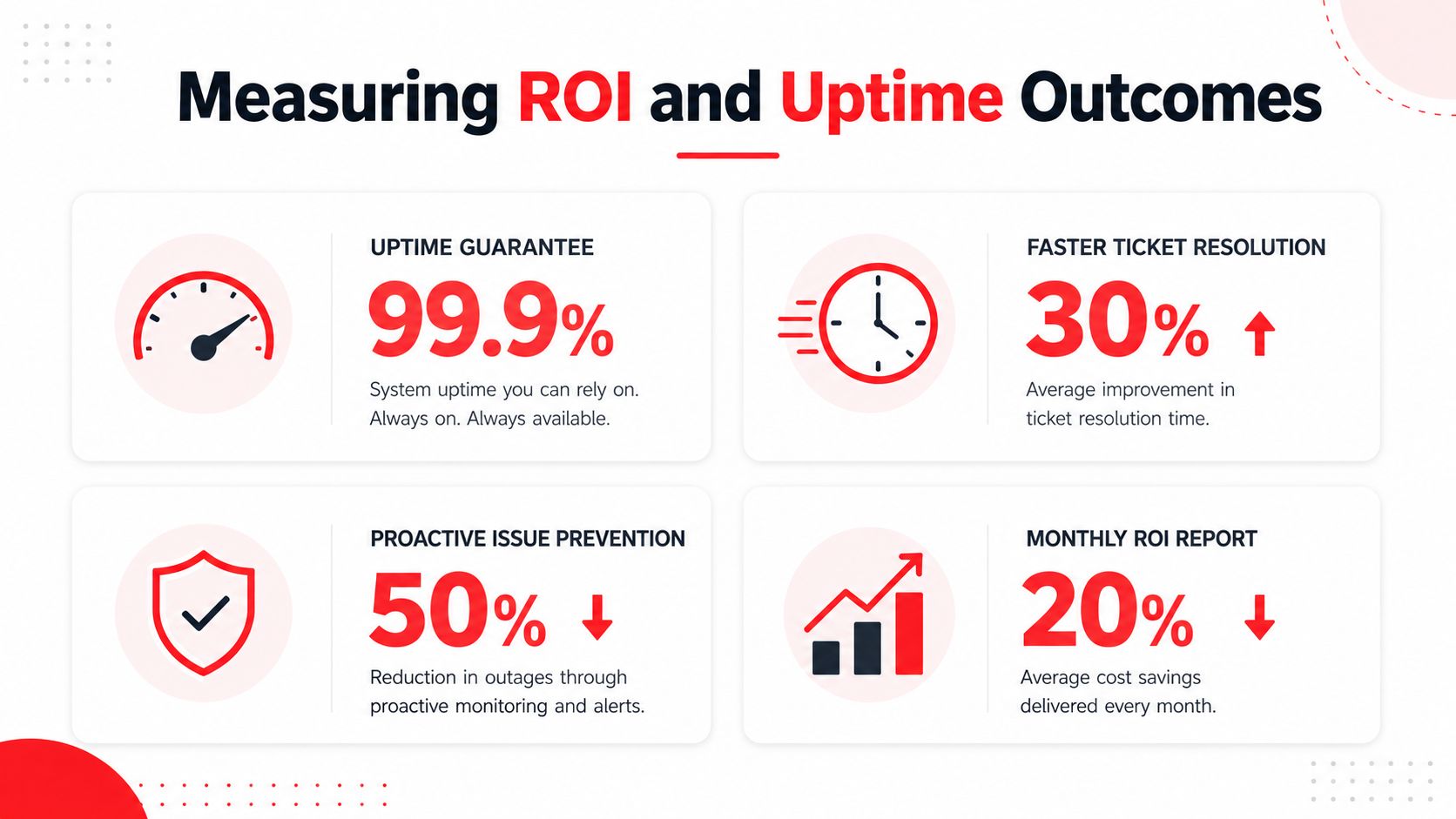
If a provider can’t give you a monthly view of what changed, what improved, and what still needs work, keep looking.
Frequently Asked Questions About Cyber Command IT Support
Can Cyber Command work with our internal IT person? Yes. Co-managed support is built for that exact setup. Your internal person keeps local context and day-to-day ownership, while the external team adds monitoring, escalations, security coverage, and project support.
What happens after hours? You should expect live help, not a voicemail loop. For urgent issues, after-hours coverage is where a 24/7 model earns its keep, because the goal is to contain impact before it spreads to the next business day.
How does pricing work for multi-location businesses? The model should be predictable and scoped to the environment, not driven by surprise hourly charges. Multi-site companies need consistent coverage and one support standard across all locations, otherwise costs and risk both creep upward.
How do you handle regulated industries in Florida? The support plan should include access control, recovery planning, documentation, and compliance-minded reporting. For healthcare and finance-adjacent firms, that’s not a bonus feature, it’s part of staying operational and audit-ready.
What should I have ready before the first call? Bring a list of locations, the systems that matter most, the biggest recurring issues, and any compliance concerns. The first conversation should focus on risk, uptime, and support gaps, not a sales script.
Cyber Command, LLC provides managed and co-managed IT, 24/7 U.S.-based helpdesk support, and cybersecurity services built around uptime, recovery, and accountability. If you want a support model that gives your Central Florida business fewer disruptions and clearer reporting, visit Cyber Command, LLC and start with a conversation about your current environment.
Get updates like this in your inbox
Plain-English alerts when something like this breaks, and the occasional guide. No sales sequences; unsubscribe with one click.
This article is for general informational purposes only and is not legal, compliance, insurance, or other professional advice. Threats, technologies, and regulations change quickly; confirm current requirements with your own advisors before acting. See our full disclaimer.