
July 24, 2026
Platform Engineering Florida: A Guide for Local SMBs
Discover platform engineering Florida strategies tailored for SMBs. Streamline operations, reduce costs, and scale efficiently with expert insights.
In Florida, a platform engineer averages $99,409 a year in 2026, or about $47.79 an hour. That’s the budget question behind most searches for platform engineering Florida, because once you see that number, you have to decide whether to hire, share, or outsource the function entirely.
You’re probably staring at a messy version of that decision right now. Maybe it’s an Orlando firm with a few AWS environments, a compliance headache, and one senior engineer who’s already carrying too much. Maybe it’s a medical practice, a law office, or an industrial business in Central Florida that knows its deployments are too manual, but can’t justify building a full platform team.
Table of Contents
- Why Central Florida SMBs Are Asking About Platform Engineering
- What Platform Engineering Means for a Small Team
- How Florida Salaries Compare to the National Platform Engineering Market
- In-House, Co-Managed, or Fully Managed Platform Engineering
- The Four Capabilities a Florida Platform Must Cover First
- Cybersecurity and Compliance as Part of the Platform
- A Central Florida Vendor Selection Checklist
- Your Next 30, 60, and 90 Days With a Local Platform Partner
Stuck on something like this right now?
Talk it through with a real US-based engineer, 24/7, no phone trees: (407) 587-0089.
Book a Free Strategy SessionWhy Central Florida SMBs Are Asking About Platform Engineering
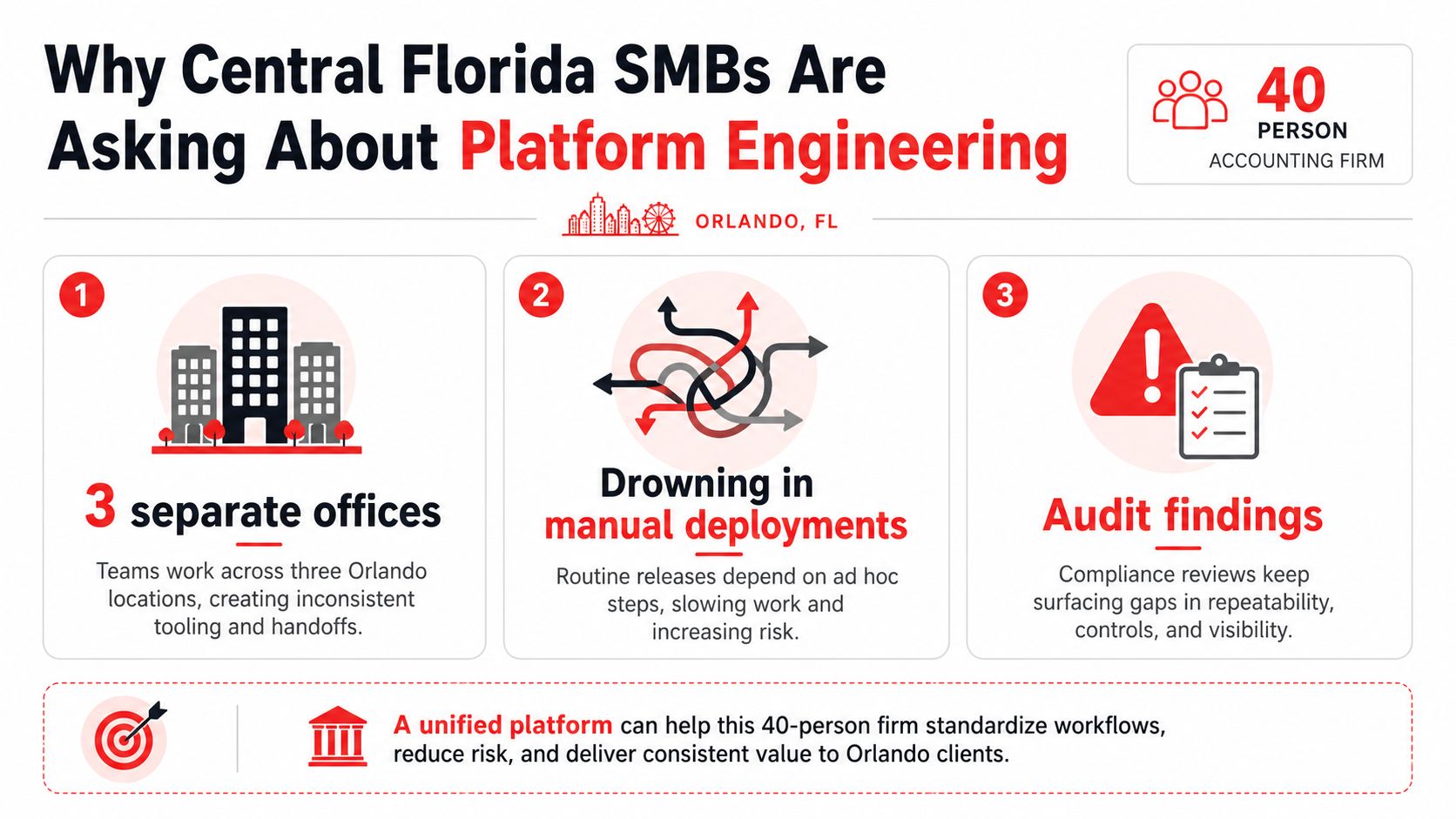
A 40-person Orlando accounting firm with three offices doesn’t need a buzzword. It needs fewer broken deployments, fewer audit findings, and a cleaner way to move code without waking up the whole team. That’s the core reason people start searching for platform engineering Florida, even if they don’t phrase it that way.
The salary anchor matters because it forces the budget conversation into the open. $99,409 in Florida, from ZipRecruiter, is not an abstract market number, it’s the cost of a person who can own this work if you decide to staff it internally ZipRecruiter Florida platform engineer salary data. For most SMBs, that immediately raises the question of whether one hire is enough, or whether the smarter move is a shared or managed model.
Practical rule: If the platform work is intermittent, a full-time hire usually becomes an expensive side project. If the work is constant and tied to product delivery, the hire starts to make sense.
Platform engineering is the practice of building an internal developer platform so teams can deploy, observe, and govern software through self-service instead of ticket queues Microsoft’s platform engineering overview. That definition matters in Central Florida because regulated firms rarely need another layer of operational noise. They need guardrails, repeatability, and proof.
The better Orlando and Winter Springs question isn’t, “Should we do platform engineering?” It’s, “Which operating model gives us the outcome without dragging us into a staffing trap?” For professional services, medical practices, and industrial firms, that’s the whole game. The rest of this guide is built to answer exactly that.
What Platform Engineering Means for a Small Team
A small Florida team does not need a flashy platform program. It needs a paved road that keeps deployments, environments, and control steps from turning into a custom project every time something changes. That matters in Orlando, Winter Springs, and the rest of Central Florida because SMBs have to keep releases moving while still meeting compliance demands and holding the line on staffing.
DevOps, SRE, and platform engineering are not the same thing
DevOps is the operating culture. SRE is the reliability discipline. Platform engineering is the function that builds the shared system everyone uses. DevOps pushes collaboration, SRE keeps systems reliable, and platform engineering gives the team a repeatable path that supports both.
That difference matters more in a small firm than in a big one. You do not get value from labels. You get value from deployment pipelines, logging standards, policy checks, templates, and support boundaries that make work repeatable. A platform team owns those guardrails. It does more than support infrastructure.
If you want to see how the role is usually framed, browse platform engineering careers. The role is centered on internal tooling, infrastructure delivery, and developer enablement. That is useful because it shows platform engineering is broader than scripting and narrower than general IT support.
The platform-as-a-product mindset is the core change
Microsoft’s framing fits SMBs in Central Florida. The platform should improve security, compliance, costs, and time to business value through self-service inside a governed framework Microsoft’s platform engineering overview. That means the platform is not a tool you buy, and it is not managed cloud hosting with a new label. It is a product with users, adoption goals, and outcomes.
Build the smallest platform that removes the most friction. If it does not reduce cognitive load, it is probably just another admin layer.
For a Florida practice manager or operations leader, that is the point. You do not need everyone on staff to become a Terraform specialist. You need non-engineering staff to work through approved paths without breaking controls, and you need the business to see whether the platform is paying off.
For regulated professional firms, medical practices, and public-sector shops in Central Florida, the smarter move is usually not a full internal platform squad. It is a small, disciplined platform function tied to actual delivery needs, with clear ownership for access, guardrails, and repeatable deployment.
How Florida Salaries Compare to the National Platform Engineering Market
Florida’s $99,409 average sits well below the $160,000 North America average for platform engineers in 2026 ZipRecruiter Florida platform engineer salary data, Platform Engineering 2026 industry assessment. That gap is the labor-market signal every Orlando employer should read carefully. It means Florida SMBs are not shopping in a vacuum, they’re competing against a mature market that’s already treating platform engineering as a mainstream career track.
What the gap means for hiring in Central Florida
The North American data says the field had democratized by 2025, with more engineers in the 3 to 7 years’ experience range entering platform roles and junior engineers participating too Platform Engineering 2026 industry assessment. That tells you platform engineering is no longer a niche reserved for a handful of ultra-senior specialists. Still, Florida’s lower average strongly suggests local employers are dealing with a talent pool that’s newer, less standardized, and often pulled toward broader infrastructure roles.
That’s why a Central Florida SMB has three realistic choices. Hire locally and accept the constraints. Pay national remote rates and fight retention and coordination issues. Or use a managed model with a Florida delivery footprint and keep the hard operational work out of your hiring plan.
Metric
Florida (ZipRecruiter)
North America (2026)
Average annual pay
$99,409
$160,000
Hourly equivalent
$47.79
Not provided
Monthly equivalent
$8,284
Not provided
What the gap means for budgeting discipline
The smart read is not that Florida talent is “cheaper.” It’s that the market is still differentiated by experience, specialization, and employer type, while the national market has already matured around platform outcomes. Florida SMBs should use that to their advantage. Don’t hire a platform engineer just to own tickets. Hire only if the work volume, release cadence, and compliance load are real enough to justify a dedicated function.
If your business is still trying to decide whether platform engineering is a side duty or a core capability, the salary gap is your warning label. It’s cheaper to start with a co-managed or fully managed structure than to drag a senior engineer into a permanently overloaded internal role.
In-House, Co-Managed, or Fully Managed Platform Engineering
The right model depends on how much software change you push and how much internal depth you already have. A 25-person Orlando law firm should not buy the same model as a multi-location medical practice. A Winter Springs industrial company with field technicians shouldn’t either.
In-house works only when platform work is constant
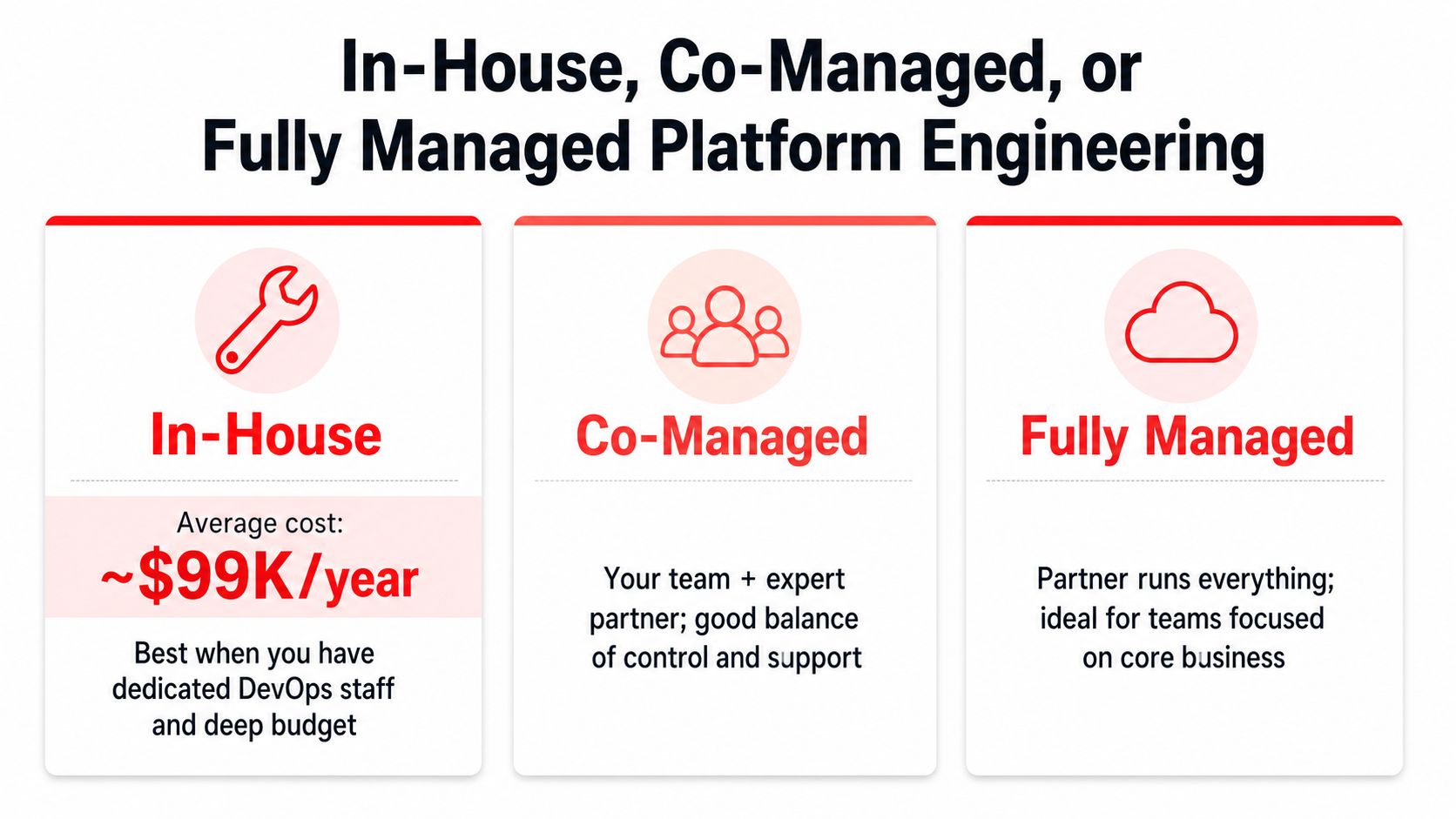
In-house makes sense when you already have recurring deployment pressure, clear product ownership, and a retention plan for technical staff. It also requires budget room for a real platform function, not just a “helpful engineer” who gets reassigned every quarter. Florida’s average salary figure is a starting point, but senior people will cost more in practice, and that extra spend only makes sense if the platform is central to revenue or regulated operations.
Co-managed is usually the smartest middle path
Co-managed is the model I’d recommend most often for Central Florida SMBs. Your internal team owns business priorities, release timing, and application context. A local partner handles platform operations, observability, and on-call coverage, so your staff doesn’t become the weekend escalation layer.
If you’re deciding between staffing and supplementation, a plain-language comparison like managed services vs staff augmentation is useful because it separates “extra hands” from “owned outcome.” That distinction matters here. Platform engineering is not just labor. It’s an operating model.
Fully managed fits firms that want outcomes, not a new internal department
Fully managed is the right call when leadership wants deployment frequency, change-failure reduction, and better recovery behavior without building the function in-house. That’s especially sensible for medical groups, public-facing organizations, and smaller professional firms that don’t have enough engineering depth to keep a platform team healthy.
For the three profiles I see most in Orlando and Winter Springs, here’s the short answer:
- 25-person Orlando law firm: Fully managed, unless software delivery is already a core differentiator.
- Multi-location medical practice: Co-managed, because internal workflow knowledge still matters.
- Winter Springs industrial firm with field technicians: Co-managed or fully managed, depending on how much production software and device support you own.
If you can’t name the person who owns 24/7 platform response, don’t pretend you have an in-house platform team.
Cyber Command, LLC is one Florida provider that offers managed and co-managed IT, cloud services, and DevOps support, which makes it relevant for firms looking to keep platform engineering tied to local operations instead of a detached technical experiment. That’s not a recommendation to buy blindly. It’s a reminder that the service model should match the business problem.
The Four Capabilities a Florida Platform Must Cover First
A small team should build the platform in the order that removes the most pain first. Start anywhere else and you end up with a polished interface over an unstable base. That is a bad trade for a Florida SMB, because it burns time before it gives leadership any real control.
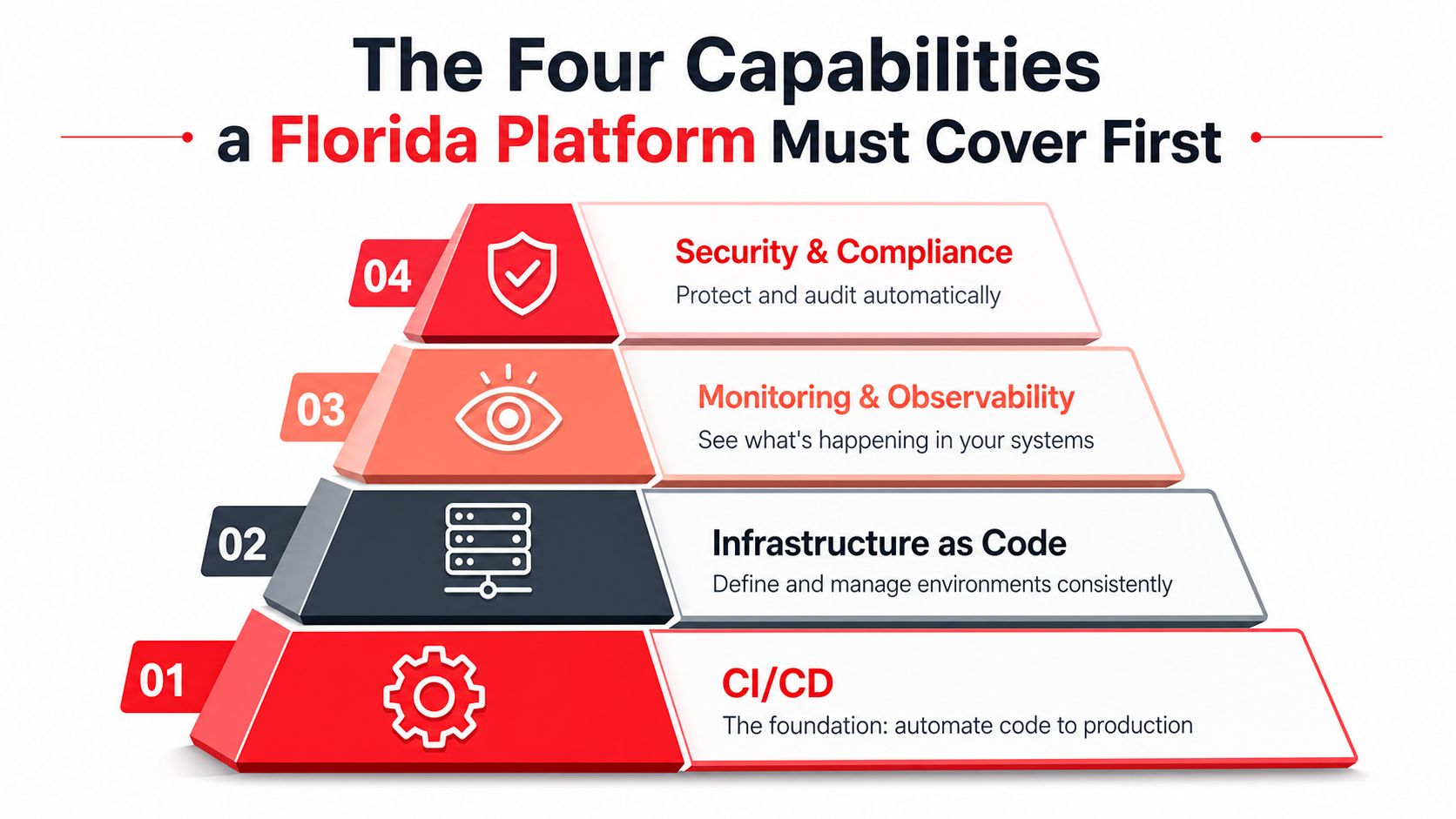
A four-layer pyramid diagram showing the essential capabilities required for a Florida platform engineering strategy fits the way most Orlando and Central Florida firms should think about this work.
Build CI/CD first
Continuous integration and continuous deployment come first because every other layer depends on clean release flow. If code cannot move through a repeatable pipeline, the rest of the platform is window dressing. For a plastic surgery practice running a HIPAA-aligned environment, that means controlled promotion paths, not manual uploads and hope.
Put infrastructure as code second
Infrastructure as code stops environment drift. That matters when one Orlando office, one clinic, or one plant has a slightly different stack than the others. In practice, you want environments defined the same way every time so new builds do not turn into archaeology projects.
Make observability a standard, not a luxury
Logs, metrics, and traces belong in the platform early because you cannot operate what you cannot see. If a multi-location veterinary group rolls out a new endpoint policy, the platform should show the team what changed, where it changed, and whether anything broke. That is operational truth, not guesswork.
Save the internal developer portal for last
The portal should come after the pipelines and guardrails are stable. Otherwise you are building an expensive front end over a fragile backend. The portal is where users request environments, deployment paths, and approved workflows, but it only helps if the underlying mechanics already work.
A simple scorecard for vendors should focus on whether they can demonstrate the order of operations, not just the interface. If they start with a dashboard and end with governance, keep looking. The smarter path is foundation first, self-service second.
Cybersecurity and Compliance as Part of the Platform
Security can’t sit beside the platform. It has to live inside it. For regulated Florida firms, that’s the only model that makes sense, because annual audit scrambles and bolt-on controls are too brittle for real operations.
Guardrails belong in the pipelines
The platform should enforce code scanning, environment baselines, secrets handling, audit logging, and evidence collection in the same automated path that ships features. That way, security isn’t a separate approval theater after the fact. It becomes part of the release process itself.
That design fits the actual compliance pressures Florida SMBs face. Medical practices need HIPAA-aware workflows. Professional and financial services firms have FTC Safeguards Rule obligations to think about. Public and community organizations in Orlando also have records and access considerations that need structured controls. None of that is solved by a “security review” once a quarter.
Continuous compliance beats audit fire drills
The right goal is a continuous compliance posture. That means the platform produces usable evidence as work happens, rather than making the team reconstruct history later. It also means the control plane should be opinionated enough to prevent risky shortcuts, especially when multiple offices or departments share the same infrastructure.
Security is strongest when developers can’t accidentally skip it.
For a platform to be a real control, it has to standardize access, logging, and traceability across the environments it manages. The idea isn’t perfection. It’s predictability. A good platform gives you a repeatable pattern for proving that the right thing happened.
The internal link below is worth keeping close because it’s a reminder that platform engineering and security communication need to be visually clear, not vague:
cybersecurity reference asset

A Central Florida Vendor Selection Checklist
Don’t choose a platform partner because the sales deck sounds modern. Choose one because it can operate in Central Florida, support regulated workloads, and tell you what stays with your team. That’s the difference between a real operating partner and a remote ticket desk with a nicer logo.
Use the same checklist on every finalist
- Local presence: Confirm the provider can support Orlando and surrounding Central Florida sites with real engineers, not just a distant sales presence.
- 24/7 security operations: Ask who is watching alerts after hours, who responds, and how incidents are escalated.
- Pricing clarity: Favor all-inclusive pricing over a menu of ticket-based surprises.
- Vendor and license management: Make sure someone owns the paperwork, renewals, and coordination burden.
- Regulated workload onboarding: Ask for a documented process for medical, professional, or public-sector systems.
- Peer references: Ask for references from Florida firms that look like yours, not generic national stories.
- Ownership boundaries: Get a plain answer on what your internal team keeps and what the provider runs.
A good checklist should force each vendor to answer the same operational questions. If they can’t explain onboarding, response boundaries, and evidence handling in plain language, they’re not ready for a regulated Florida environment. That’s a dealbreaker, not a minor gap.
The internal asset below is useful as a reminder to ask for proof, not promises:
Orlando managed service provider reference asset
The mistake I see most often is picking a national remote-only provider and assuming it can handle a Central Florida incident or office move with the right urgency. That usually works fine until it doesn’t, and then the delay lands on your business, not theirs.
Your Next 30, 60, and 90 Days With a Local Platform Partner
Start with a current-state review of environments, deployment paths, and incidents. In the first 30 days, you should also write a one-page business case that names the metrics the platform must move, because a platform without business goals becomes an expensive technical hobby. Keep the scope tight and tied to one Orlando business unit or one regulated workflow.
During days 31 to 60, build the minimum viable platform. Standardize one or two pipelines, put production infrastructure under code, and establish an observability baseline that your team can use. Don’t chase the portal yet. Get the control points stable first.
By days 61 to 90, roll out one pilot team with self-service enabled and security guardrails on by default. Then schedule a quarterly business review cadence so leadership can see adoption, incidents, and operational friction in one place. That keeps the platform tied to outcomes instead of activity.
If you want a local conversation about the right model for your firm, keep it simple and practical. Ask a Central Florida provider to walk through your current environment, the staffing model you can sustain, and the controls you need for the next phase.
A CTA for Cyber Command, LLC.
This article is for general informational purposes only and is not legal, compliance, insurance, or other professional advice. Threats, technologies, and regulations change quickly; confirm current requirements with your own advisors before acting. See our full disclaimer.