


An MSP Industry First
Cybersecurity Preparedness Program

Because cybersecurity is a responsibility, not just a product.
Cybercrime doesn't just hit large corporations. It hits local businesses, schools, cities, and families, often without warning and without mercy. After more than a decade in cybersecurity, we've seen a hard truth: most organizations don't discover their gaps until something breaks. By then the damage is done, recovery costs are high, and trust is shattered.
Get Your Cybersecurity Preparedness GuideSee What Attackers Can Already See

Get a FREE Dark Web Scan of your Business
Before a cyberattack ever happens, attackers do their homework. They look for exposed credentials, leaked data, and publicly available signals that indicate weakness. Understanding your digital footprint is the first step toward protection.
Our free DARK WEB Scan checks whether your business data is already visible through known breach sources and exposure databases, giving you clarity and valuable insights.
How Validation Works
Calm, controlled validation for your existing IT and security. No scare tactics. No replacement pitch. Just clarity, a score, and an executive-ready report.
- Public Exposure Scan: understand what’s visible from the outside. Attackers start with public signals, not magic. We scan by domain or business email and flag known exposure indicators and common leak signals. No systems accessed. No changes made.
- Fire Drill Validation: a permission-based, controlled test built to answer one question: would your current setup hold up under real-world conditions? Identity and access sanity check (MFA, privileged exposure), detection visibility (would you know fast?), and backup and recovery readiness. Proof over assumptions.
- Preparedness Report: an executive-ready summary you can share with leadership and your current IT provider. A clear, explainable Preparedness Score, what’s working, what would break first, and vendor-neutral next steps ranked by impact. The goal is clarity, not fear.
WHAT CHANGES WHEN YOU VALIDATE
See the difference between assumptions and confirmed reality.
| Dimension | Before | After | Proof you get |
|---|---|---|---|
| Visibility | Assumptions + blind spots | Confirmed external view | External exposure indicators, leak signals tied to your domain/email, and a clear, shareable risk summary |
| Time-to-Notice | Hours or days later | Minutes, with proof | Alert path + owner, what triggers an alert, and a response timeline sanity check |
| Recovery Readiness | “We think we’re covered” | Validated recovery path | Backup existence check, restore viability (sanity check), and critical dependencies identified |
| Decision Clarity | Noise + vague risk | Clear score + ranked actions | Preparedness Score, top 3 priorities, and vendor-neutral next steps |
- Visibility: stop guessing what’s exposed. Validation turns “we think” into “we know.” No internal access, no changes made, just clear, explainable results.
- Time-to-Notice: speed is containment. A “good” stack that alerts late behaves like a bad stack. Validation checks who gets notified and how fast they act.
- Recovery Readiness: backups exist, recovery is proven. Many teams have backups; far fewer have tested the recovery path. Validation checks whether the business can restore and resume operations.
- Decision Clarity: an answer you can act on. An example summary might read Score: 82 · Strengths: 3 · Priority risks: 2 · Next steps: 5. Built for leadership, shareable and explainable.
Designed to be low-risk and high-clarity: no invasive access, no changes made, no obligation. Just a real answer you can share with leadership.
In the Event of a Cyber Emergency…
$4.45M is the average cost of a data breach in 2025, with small businesses often facing proportionally higher impacts.
- 83% of attacks start via email: the most common cyberattacks begin with a phishing email, making email security a critical defense layer.
- 60% of SMBs close after an attack: small-to-medium businesses that suffer a major cyberattack often close within six months due to the financial impact.
- 277 days to identify a breach: the average time organizations take to spot a data breach, during which attackers have free access to systems.
Remain Calm and Call Cyber Command
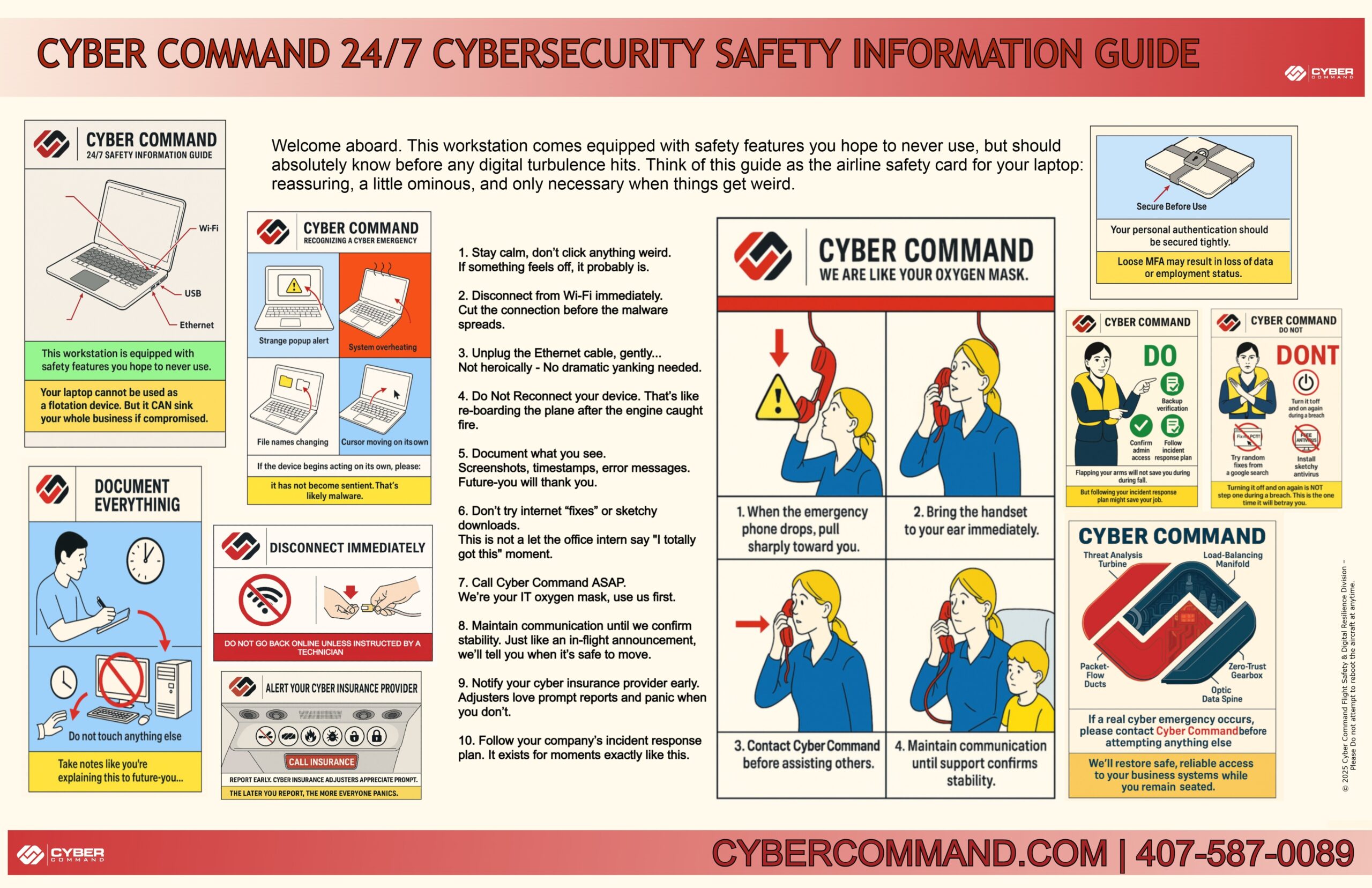
Think of this poster as the airline safety card for your business. You hope you never need it, but if something goes sideways, you'll be very glad it's there.
Cyber incidents don't usually announce themselves with alarms and flashing lights. They start quietly, get weird fast, and reward the attackers when no one knows exactly what to do next. This Cybersecurity Survival Poster gives you calm, clear direction in those moments. No panic, no guesswork. It's not about fear. It's about being ready.
Download it, share it with your team, and keep it handy just in case turbulence hits.
Get a Cybersecurity Survival PosterCYBER COMMAND // Cybersecurity Preparedness
While you’re busy running the business… this keeps running too.
Attack activity: around the world, automated scans, phishing attempts, and credential stuffing never stop.
Estimated impact: downtime, fraud, recovery, legal exposure, reputation damage. The meter moves either way. (These reflect ongoing global activity patterns, not your specific environment.)
Get ahead of it while things are calm.
Get Your Cybersecurity Preparedness Guide Schedule a Strategy Session
