
Choosing an Orlando Network Security Company: A 2026 Guide

You're probably looking at two proposals right now.
One promises “complete protection” with a flat monthly fee. The other lists a lower starting price, then buries key services in optional add-ons, project fees, and vague language about “advanced response” if something serious happens. Both claim they can protect your business. Neither makes it easy to compare the precise offering.
That's where most Orlando business owners get stuck. For a law firm, medical practice, accounting office, architecture firm, or engineering company, network security isn't a side purchase. It's a business continuity decision tied to client trust, compliance pressure, downtime risk, and how much management attention gets dragged into emergencies. If your office is growing, moving locations, adding remote staff, or opening another site, security choices get even more expensive to fix later. That's one reason relocation planning should include infrastructure decisions early, not after the furniture is in place. A practical guide to IT infrastructure for office relocations makes that point well.
A good Orlando network security company should help you buy clarity, not just software. The right provider gives you a procurement process you can defend internally: what's covered, what isn't, how incidents are handled, who responds, and what costs can still surprise you.
Table of Contents
- Why Your Choice of Orlando Network Security Company Matters
- Core Security Needs for Orlando Professional Services Firms
- The Evaluation Checklist Technical and Business Criteria
- Key Questions to Ask Every Potential Security Provider
- Red Flags to Watch For When Choosing a Security Firm
- The Cyber Command Approach Predictable Security for Orlando
Why Your Choice of Orlando Network Security Company Matters
Monday starts with a locked screen at the front desk. Your staff cannot open client files. Phones are still ringing, appointments are still booked, and payroll, billing, and deadlines have not paused just because your systems did. In that moment, the quality of your security provider stops being an IT decision and becomes a business continuity decision.
That is why procurement matters here.
Many Orlando business owners buy security the way they buy internet service. They collect a few quotes, compare monthly fees, and assume the listed tools tell the story. They do not. For a law firm, medical practice, or accounting office, the bigger cost usually shows up after the contract is signed. It appears in emergency project fees, slow incident response, unclear ownership, staff downtime, and leadership time pulled into avoidable problems.
You are purchasing operational stability. You are also purchasing a provider's judgment under pressure.
A capable Orlando network security company should help you reduce surprises, not just install controls. That starts with clear scoping. A vulnerability assessment that shows where your network is actually exposed is more useful during procurement than a long list of product names, because it ties the service to business risk, recovery effort, and likely cost.
The buying question is simple. What will this provider prevent, what will they respond to, and what will still become your problem?
| Decision lens | Weak buying approach | Strong buying approach |
|---|---|---|
| Budget | Lowest advertised monthly fee | Predictable total cost, including response and remediation |
| Coverage | Broad service labels with little detail | Specific protections, exclusions, and ownership spelled out |
| Response | General promise to assist | Defined monitoring hours, escalation path, and response steps |
| Leadership reporting | Technical reports no one uses | Plain-language updates tied to risk, downtime, and priorities |
The wrong provider can look affordable in a proposal and become expensive in practice.
Professional services firms feel that gap quickly. A medical office loses patient flow and trust when systems are unavailable. A law firm risks missed deadlines and confidentiality problems. An accounting firm in filing season cannot afford vague support boundaries or a provider that treats every urgent issue as a separate billable event.
Orlando buyers should treat security selection like a managed procurement process, not a rushed technical purchase. Ask for pricing that holds up during incidents, office changes, and growth. That matters even in routine operational events such as expansions or moves, where weak planning can create new exposure. The same discipline that applies to IT infrastructure for office relocations applies here. Hidden work during change is still cost, even if it was missing from the original quote.
Cyber Command, LLC approaches this work as an operations issue first. The practical question is not whether a provider says they offer cybersecurity. The practical question is whether their service model is clear enough that you can budget for it, rely on it, and explain it to partners, managers, or compliance stakeholders without translating jargon.
If a proposal cannot tell you who is watching, what is covered, when response begins, and which tasks trigger extra fees, keep shopping.
Core Security Needs for Orlando Professional Services Firms
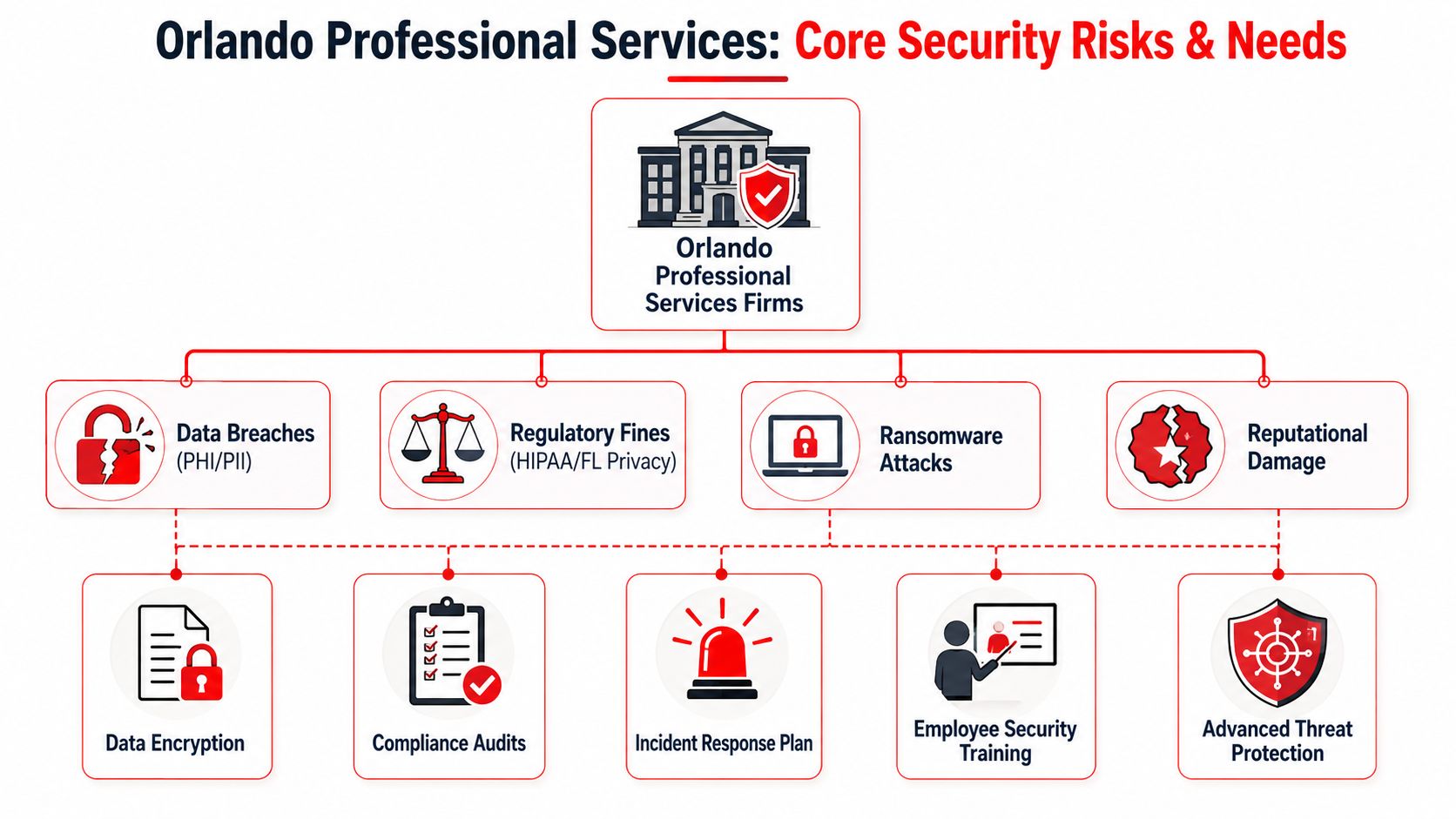
Professional services firms don't all face the same threats, but they do share one problem: they hold information that clients assume is protected. Medical records, financial documents, legal files, design plans, internal communications, signed agreements, and payment data all carry consequences when access is lost or confidentiality breaks down.
Sensitive data changes the stakes
A dentist and a CPA may buy different software, but their security priorities overlap. Both need to protect client records, control access, train staff, and keep systems available when the business day starts. The biggest mistake is treating network security like a hardware purchase instead of a risk management process.
An Orlando-focused guide puts the small-business risk in plain terms: 43% of cyberattacks target small businesses, only 14% are prepared to defend themselves, and 95% of breaches involve human error, which is why training and continuous monitoring matter so much for smaller organizations (Orlando cybersecurity guidance for small businesses).
For legal practices, human error often shows up in email, document sharing, and account access. For medical practices, it can appear in front-desk workflows, mobile devices, and third-party access. For accounting firms, it often centers on credential security, seasonal workload spikes, and sensitive file transfer. If you're evaluating policy and practical controls for law offices, this overview of securing sensitive client information is a useful outside reference.
Start with maturity before tools
Most firms ask for solutions too early. The better starting point is a Technology Maturity Assessment. That means identifying where data lives, how employees access it, which systems are critical, what compliance obligations apply, and where the highest-vulnerability assets sit. From there, layered controls make sense: next-generation firewalls, intrusion prevention, endpoint protection, segmentation, reporting, and response playbooks.
A one-tool mentality fails because risk doesn't enter through one door. Staff click links. Vendors connect remotely. Old devices miss patches. Shared accounts linger. Cloud apps get used outside policy. Buying one product and calling it “network security” leaves gaps between systems, users, and processes.
A practical assessment usually follows this sequence:
- Inventory assets so you know what must be protected.
- Classify data so high-risk information gets stronger controls.
- Baseline current controls to see what already exists and what's missing.
- Close critical gaps first instead of trying to modernize everything at once.
- Monitor and revise because staff, offices, and workflows change constantly.
Practical rule: If a provider recommends tools before mapping your data, access paths, and compliance duties, they're probably selling inventory, not building a security program.
If you want a plain-English primer on the assessment process itself, Cyber Command's guide to what a vulnerability assessment is is a good starting point.
The Evaluation Checklist Technical and Business Criteria
Choosing a security provider is a procurement decision, not just a technical one. For an Orlando law firm, medical practice, or accounting office, the wrong choice usually shows up later as overtime invoices, confusing scope disputes, slow response during an incident, or compliance work your staff thought was included but was not. A proposal needs to hold up with both the person responsible for operations and the person watching the budget.
Technical criteria that should be required
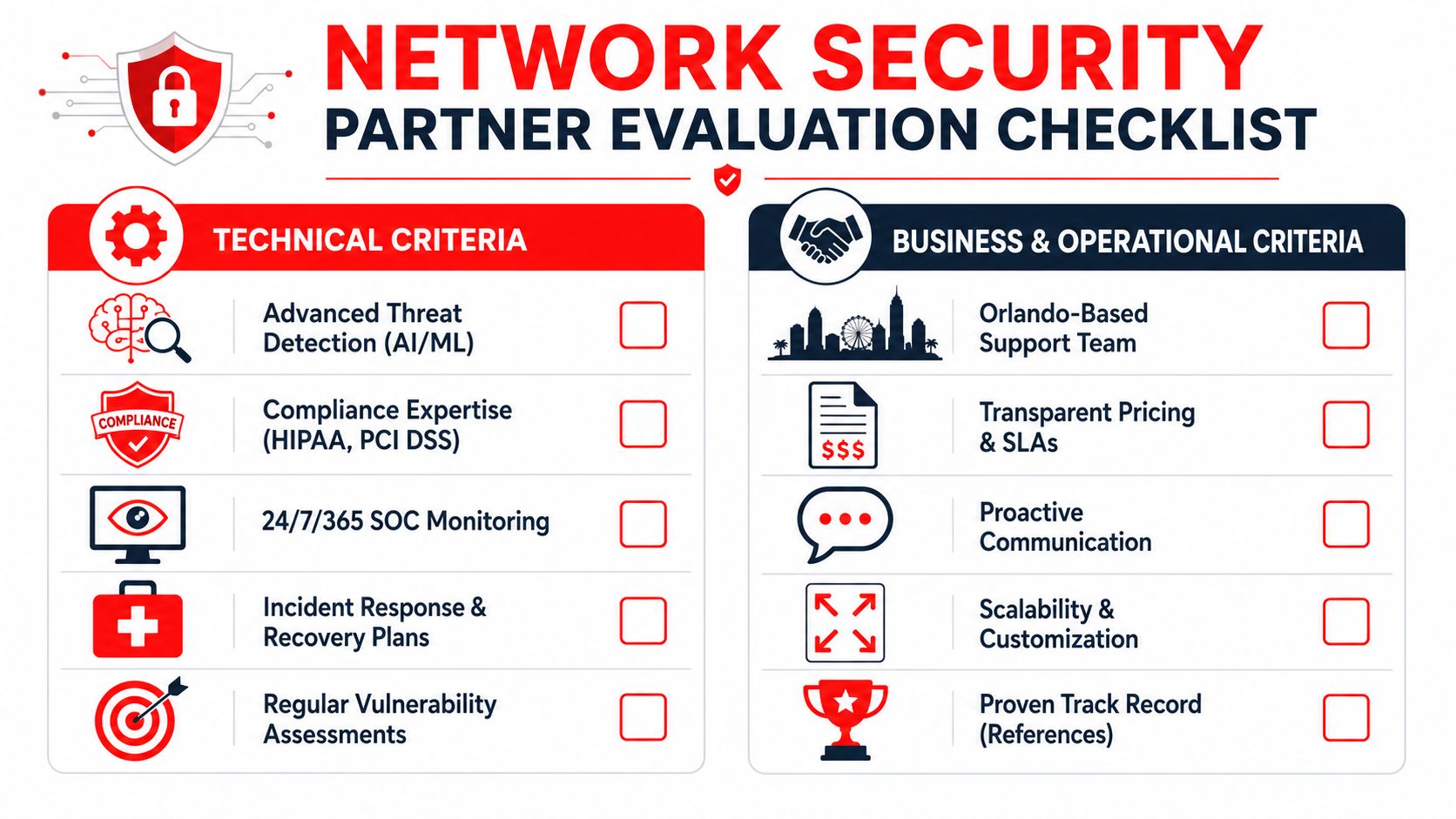
Start by checking how the provider runs security day to day. Product lists are easy to pad. Operating discipline is harder to fake.
A provider should be able to explain who watches alerts after hours, how incidents get triaged, what gets escalated, and how your firm is notified. If they cannot explain their monitoring workflow in plain English, expect confusion during a real event. For background, this overview of what a Security Operations Center is helps clarify what should sit behind any serious monitoring service.
Use this technical checklist during evaluation:
- Continuous monitoring: Alerts should be reviewed and acted on outside business hours, not left waiting until the next morning.
- Endpoint detection and response: Laptops, desktops, and servers should have active visibility so suspicious behavior can be investigated and contained quickly.
- Network security controls: Firewalls, segmentation, intrusion prevention, remote access restrictions, and account controls should support each other.
- Patch and vulnerability management: The provider should show a repeatable process for identifying weaknesses, prioritizing fixes, and tracking exceptions.
- Incident response process: Detection alone is not enough. You need documented containment steps, recovery responsibilities, communication rules, and decision ownership.
- Support for regulated workflows: Professional services firms need controls that fit how client files, case data, tax records, and protected health information move through the business.
One practical test helps here. Ask the provider to walk through a realistic event, such as a compromised employee mailbox or malware on a bookkeeper's laptop. Strong firms answer with sequence, ownership, and timing. Weak firms answer with tool names.
Business criteria that determine the real experience
Many Orlando buyers often make an expensive mistake. They compare monthly fees without comparing what the fee buys.
A lower quote can become the higher-cost option if onboarding, after-hours response, remediation labor, compliance reporting, user changes, or project work sit outside the base agreement. Predictable pricing matters because professional services firms run on utilization, scheduling, and client trust. Surprise invoices hit all three.
Review the business side with the same discipline you use for the technical side:
| Business criterion | What to ask for | Why it matters |
|---|---|---|
| Scope clarity | A written list of included services, exclusions, and billable extras | Prevents disputes and unexpected project charges |
| SLA detail | Response times, escalation rules, and after-hours coverage terms | Sets expectations before an urgent event happens |
| Reporting | Executive summaries, technical detail, and compliance-facing documentation | Gives leadership usable information without forcing them to decode jargon |
| Local support model | Who handles onsite needs in Central Florida and when they are available | Matters for office moves, hardware issues, and coordination with your staff |
| Change management | Pricing and process for adds, moves, departures, and permission changes | Keeps routine business changes from turning into ticket delays and extra fees |
| Contract flexibility | Term length, termination language, renewal terms, and onboarding costs | Reduces lock-in risk if service quality slips |
Good providers make the environment easier to understand over time. Bills become more predictable. Reports become more useful. Roles become clearer.
The strongest proposal usually is not the one with the longest feature list. It is the one that ties each control and each line item to a business outcome your firm cares about: fewer interruptions, faster recovery, cleaner compliance support, and pricing that stays stable instead of expanding every time something goes wrong.
Key Questions to Ask Every Potential Security Provider
A security sales call should answer one procurement question: what will this cost us over the life of the agreement, and how will this provider perform when something breaks? Orlando law firms, medical practices, and accounting firms do not need more glossy language. They need clear operating answers they can compare across bids.

Questions that clarify pricing
Security pricing gets messy fast because many providers quote a low monthly fee, then bill separately for the work that matters during a real incident. For professional services firms, that usually means surprise charges tied to compliance requests, user changes, vendor coordination, and cleanup work after an attack. Ask questions that turn a vague quote into a usable budget.
Start here:
- What is included in the monthly fee, line by line? Ask them to break out monitoring, endpoint protection, patching, reporting, alert response, after-hours coverage, and remediation.
- What work is billed outside the agreement? Ask for plain examples such as incident recovery, employee onboarding and offboarding, office moves, policy updates, audit support, and third-party vendor coordination.
- Which services are one-time projects and which are recurring protections? This helps separate a true managed service from a proposal padded with future project work.
- How is pricing handled for regulated firms? Legal, medical, and accounting offices often need more documentation, access review, retention controls, and policy support.
- Can you show a sample invoice from a client with similar complexity? A sample invoice often reveals more than a polished proposal.
This is procurement, not just vendor selection. A provider that explains pricing clearly is usually easier to manage after the contract starts. A provider that stays abstract during the sales process often stays abstract when invoices arrive. For a practical reference point, review this breakdown of managed security service provider pricing models.
Questions that test operational maturity
A low price does not help if your staff cannot work on Monday morning.
Ask the provider to walk through actual operating scenarios, especially the ones that hurt revenue and client trust. For an Orlando medical office, that may be an EHR outage or a compromised Microsoft 365 account. For a law firm, it may be a partner's mailbox sending phishing emails to clients. For an accounting firm, it may be ransomware during tax season. Good providers can describe their process without hiding behind jargon.
Use questions like these:
- Walk me through the first hour of a ransomware event at a firm like ours.
- Who contacts us first, and who has authority to contain the issue?
- What decisions would you expect our internal team to make during an incident?
- How do you explain security performance to an owner or practice administrator who is not technical?
- What proactive work do you perform each month to reduce risk, not just report on it?
- How do you handle repeated user mistakes, access problems, and training gaps?
Listen for specifics. Strong answers include sequence, ownership, communication steps, and realistic limits. Weak answers drift into product names, dashboard screenshots, and promises that sound good until you ask who performs the work.
One more test helps separate polished sales teams from mature operators. Ask, "Tell me about a client situation where your original recommendation had to change because of budget, workflow, or compliance constraints." Experienced firms have real examples. They understand trade-offs. They know that a ten-person accounting office and a fifty-user medical practice should not be sold the same package just because both need security.
You are buying operating discipline. That includes how the provider thinks, how it communicates under pressure, and how reliably its pricing matches the work your firm will actually need.
Red Flags to Watch For When Choosing a Security Firm
A weak provider usually tells on itself early. Not always through a dramatic mistake. More often through ambiguity, inconsistency, and small evasions that seem harmless during the courtship phase.
Proposal red flags
Watch for proposals that sound broad but define very little. “Fully protected” means nothing if the document never states which systems are covered, what response work is included, or how after-hours events are handled. The more regulated your business is, the more dangerous that vagueness becomes.
Other warning signs show up in pricing language:
- Unclear bundles: The proposal groups many services together but never identifies service boundaries.
- Low base fee, high exception model: The headline number looks reasonable, but essential work sits outside scope.
- Assessment-light selling: They want to quote quickly without understanding data flows, user access, or site layout.
- Project dependency: Routine security upkeep appears to require recurring “special” projects.
A good security agreement shouldn't feel like buying a low-cost airline ticket where every useful function costs extra.
Behavior red flags
The sales process is a preview of the service process. Slow follow-up, unclear answers, and constant personnel changes during quoting usually don't improve after the contract is signed.
Pay close attention to behavior like this:
| Red flag | What it usually means |
|---|---|
| They avoid direct answers | Scope problems later |
| They over-focus on products | Weak service operations |
| They can't explain reporting | Poor executive communication |
| They speak only to technical staff | Leadership gets left out during incidents |
| They promise everything immediately | Process is probably thin |
The proposal phase is the easiest your relationship with a provider will ever be. If it already feels confusing, don't expect clarity after onboarding.
Another red flag is defensiveness when you ask about exclusions, escalation, or local response. Serious buyers should ask those questions. A good firm expects them. A weak one treats scrutiny like distrust because scrutiny exposes weak process.
The Cyber Command Approach Predictable Security for Orlando
A law firm partner approves a security contract because the monthly fee looks manageable. Three months later, an after-hours alert, an email compromise review, and a firewall change all show up as extra charges. The budget problem is not the attack. It is the gap between the proposal and the actual operating cost.
What predictable security looks like in practice
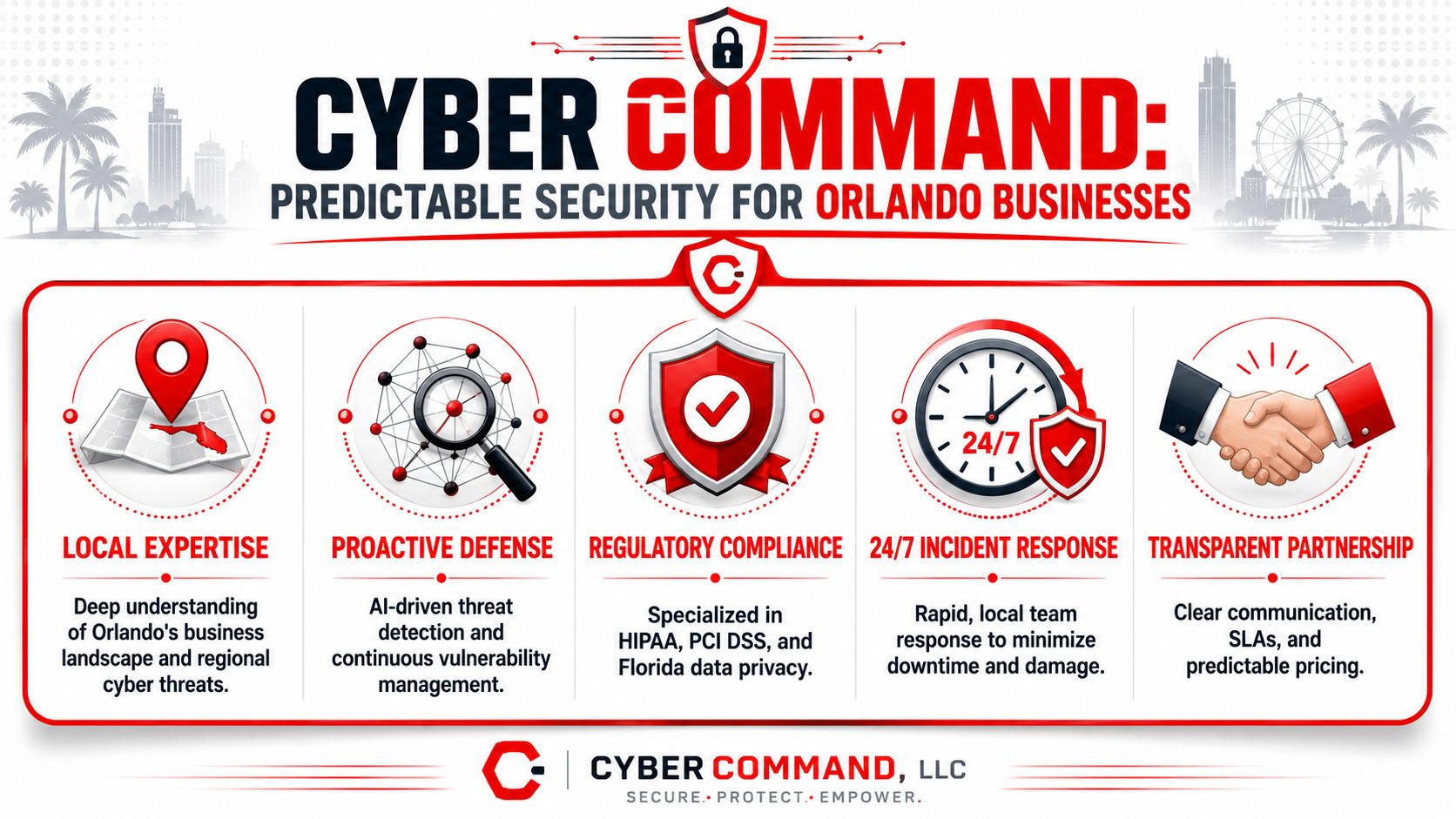
For Orlando professional services firms, predictable security means the contract matches the daily reality of the environment. Monitoring runs after hours. Response paths are defined before an incident. Reporting makes sense to a managing partner, practice administrator, or office manager, not just to technical staff.
Cyber Command, LLC is positioned as a managed security provider, not a reactive repair shop. That difference matters during procurement. A managed model is built around recurring coverage, defined processes, and ongoing visibility into endpoints, network activity, and suspicious behavior. A reactive model often looks cheaper at signing and more expensive once the exceptions start.
In practical terms, buyers should look for four things:
- Continuous monitoring: Issues are reviewed outside normal office hours, which matters because many account misuse events start at night or on weekends.
- Coordinated controls: Endpoint protection, network defenses, alerting, and response procedures work together instead of sitting in separate silos.
- Support that fits real offices: Professional services firms still deal with office moves, copier vendors, line-of-business software, remote staff, and third-party access.
- Clear recurring scope: Leadership can budget for the service without guessing which routine security tasks will become surprise projects.
Why this model fits professional services firms
Legal, medical, and accounting firms do not buy security for its own sake. They buy it to keep client work moving, protect regulated information, and avoid billing disruption. If a provider cannot explain what is covered, who responds, and what will trigger added cost, the procurement process has not done its job.
That is where predictable pricing becomes a business control, not just a finance preference. A flat monthly agreement with clear inclusions gives owners a cleaner way to compare vendors and a better way to forecast support costs over a year. Hidden exclusions do the opposite. They turn routine security work into unplanned spend and force leadership to approve technical decisions in the middle of an incident.
For smaller firms with lean internal IT support, that trade-off is especially important. The right provider reduces decision fatigue. The wrong one creates a steady stream of approvals, change orders, and vague recommendations that someone on your team still has to sort out.
Cyber Command, LLC fits this procurement lens because the value is not just tools. The value is a service structure a business owner can price, review, and hold accountable over time. If you want help evaluating what your firm needs from an Orlando network security company, Cyber Command, LLC can help you review your current environment, identify coverage gaps, and understand what should be included in a predictable managed security agreement before you sign anything.